You've got a deadline, a spreadsheet of employees in different countries, and a gift that needs to arrive before the moment it represents has passed. Then an address is outdated, a hoodie size is missing, and one package gets held at customs while everyone else receives theirs. The purchase was simple. The delivery system wasn't.
That distinction matters because corporate gift delivery now sits across People Ops, marketing, finance, procurement, and customer success. A late or incorrect gift doesn't feel like a neutral logistics error to the recipient. It can signal that the company didn't plan carefully, especially when the gift carries a new-hire welcome, recognition moment, client milestone, or event message.
Table of Contents
- Why Corporate Gift Delivery Matters More Than Ever
- Planning Your Program Goals Recipients and Budget
- Choosing Vendors and Protecting Your Brand
- How Corporate Gift Delivery Works End to End
- Mastering International Logistics Tracking and ROI
- Your Next Corporate Gift Delivery Made Simple
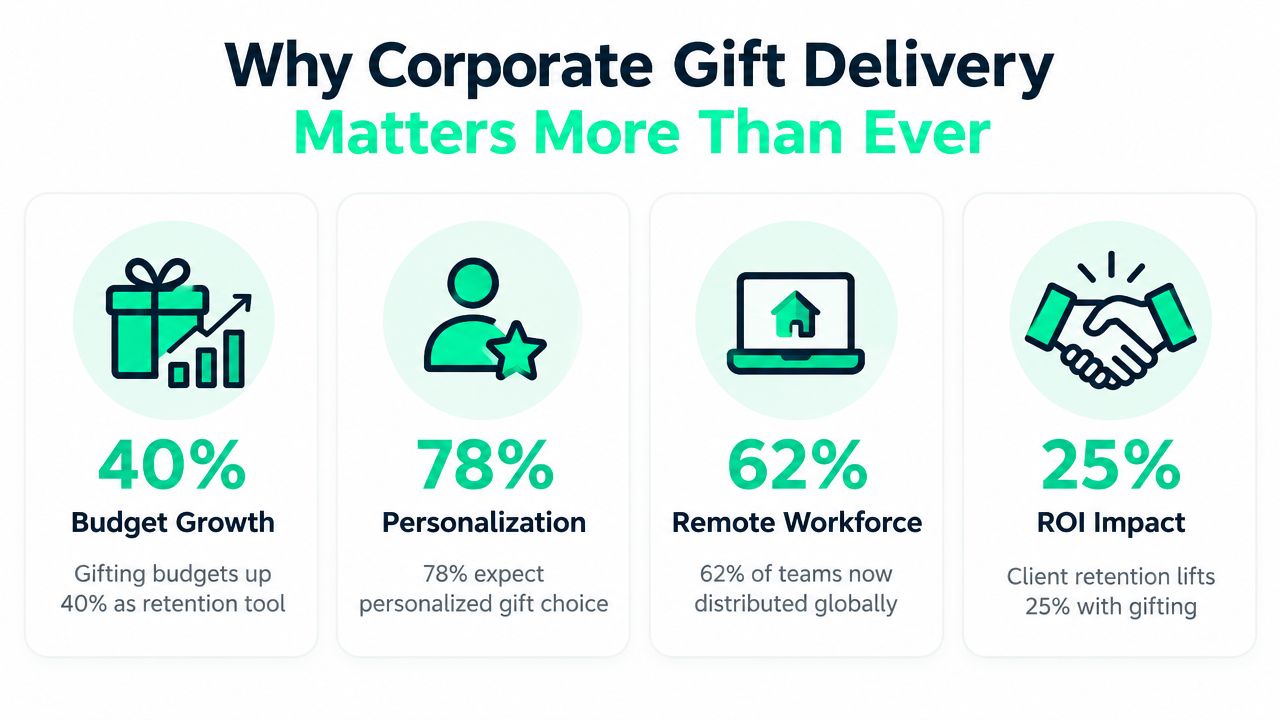
Why Corporate Gift Delivery Matters More Than Ever
Corporate gifting has moved beyond holiday baskets and occasional client presents. Industry summaries estimate that the category grew from $125 billion before the pandemic to $217 billion in 2019 and $242 billion in 2020, with continued expansion frequently projected at roughly 5.8% CAGR through 2027. More than one-third of companies spend over $50 per employee on gifts each year, while the average corporate gift is around $125, according to corporate gifting industry data.
Those figures describe a budget line, but they don't explain the operational stakes. A People team may be sending onboarding kits to new hires, a marketing team may be preparing event gifts, and an account team may be recognizing strategic clients. Each program has a different purpose, audience, timeline, and tolerance for failure. Treating them as one bulk shipment usually creates unnecessary compromise.
The recipient experience starts before the parcel arrives. Choice, presentation, delivery communication, and the ability to resolve an issue all shape whether the gift feels thoughtful or burdensome. For client-facing programs, a well-chosen regional item, such as a bottle or food product sourced with local context, may carry more meaning than a generic box. Teams researching premium options for Australian events can use this guide to McLaren Vale Cellars wineries as an example of how local relevance can improve curation.
The delivery failure is the brand experience
A company can approve a beautiful design and still lose the moment through poor execution. The parcel may arrive after the event, require an unexpected payment, go to an old address, or include apparel that doesn't fit. The recipient won't separate the creative concept from the fulfillment error. They experience one company.
A mature program treats delivery as an operating system with:
- A defined purpose: Each send supports onboarding, recognition, retention, an event, or a client relationship.
- Recipient control: People can choose an appropriate item, size, color, or digital alternative.
- Validated data: The program captures and checks shipping information before production.
- Regional execution: Inventory and fulfillment decisions reflect destination, customs, and delivery windows.
- Visible ownership: Someone monitors exceptions and handles replacements without forcing recipients to chase the parcel.
The rest of the playbook applies that system to planning, vendor selection, fulfillment, international measurement, and the decision between physical and digital delivery.
Planning Your Program Goals Recipients and Budget
Start with the moment, not the product catalog. “Send branded gifts” is an activity. “Welcome new hires in a distributed workforce” or “recognize employees after a demanding launch” is a program objective that can guide choices.
Define the job the gift must do
Write one primary outcome for the send. Onboarding gifts should make a new employee feel equipped and included. Recognition gifts should communicate specific appreciation. Client gifts should reinforce a relationship without creating awkwardness around personal preferences, procurement rules, or import restrictions.
Then identify the operational constraints:
- Audience: Employees, clients, prospects, partners, or event attendees.
- Timing: A fixed event date, a recurring milestone, or an open redemption window.
- Location: One country, several regions, or a global audience.
- Preference: Fixed item, curated choice, gift card, or a physical and digital combination.
- Ownership: People Ops, marketing, finance, procurement, or an external fulfillment partner.
Employee preference deserves a prominent place in the brief. A 2022 holiday gifting study found that 75% of employees said an employer's holiday gift increased their job satisfaction, and 46% said that effect lasted for one year or more. The same employee gifting study reported that 65% preferred money, cash equivalents, or gift cards, while 66% considered the $50 to $100 range appropriate. These findings support choice, but they don't mean every program should become purely monetary. They mean the default item shouldn't be selected without considering usefulness and autonomy.
Segment recipients before selecting products
Create groups based on moment, geography, and preference, not just department. A new hire in London may need a different fulfillment route from a new hire in Singapore. An event attendee may need a compact item that travels well, while a long-term employee may value a durable product with a more personal note.
Keep the catalog controlled. A short, well-curated choice set is easier to quality-check, forecast, and explain than an enormous marketplace. For apparel, capture size information directly from the recipient and make the measurement guidance clear. Never infer a size from a personnel record.
Build a landed-cost budget
Your budget needs more than the item price. Include packaging, personalization, pick and pack, domestic or international shipping, duties and taxes, payment processing, returns, replacements, and customer support. Hold a defined buffer for address corrections and failed delivery rather than treating those costs as surprises.
Set tiers only when they reflect a real distinction. A milestone may justify a different item from routine recognition, but arbitrary tiers can create internal friction. Before approving the program, ask whether each tier is easy to explain, equitable across regions, and practical to fulfill.
Practical rule: Approve the recipient experience and the exception budget at the same time as the gift.
Finish the brief with success measures. Track participation, redemption, delivery completion, recipient feedback, replacement volume, and cost per successful delivery. Marketing teams may add event engagement or client response. People teams may compare participation and qualitative feedback across recognition moments. The point is to measure the complete experience, not only the purchase order.
Choosing Vendors and Protecting Your Brand
Vendor selection is a risk decision disguised as a sourcing decision. The cheapest unit price can become expensive when your team spends hours correcting artwork, replacing incorrect items, answering delivery questions, and repairing a recipient's impression of the brand.
A recent survey of enterprise swag programs found that organizers spend nearly 10 hours per week on ordering tasks, with 60% doing that work outside their official role. The same report identified the main operational risks as products looking cheap in person at 30%, design errors at 28%, late arrival at 22%, and wrong sizes at 20%. Those results are summarized in Custom Ink's enterprise swag survey.
Compare the operating models
| Vendor Model | Best For | Delivery Risk | Brand Control |
|---|---|---|---|
| Marketplace | Small, simple orders with limited customization | Recipient data, stock, and shipping may sit across disconnected systems | Product quality and decoration standards vary |
| Managed service | Global programs, recurring sends, and employee choice | Lower when the provider owns validation, routing, and exception handling | Stronger governance through approved catalogs, proofs, and QA |
| DIY sourcing | Experienced teams with local supplier relationships | High if procurement, production, warehousing, and shipping are split | High in theory, but dependent on internal capacity |
A marketplace can work for a one-off local send. It becomes harder to manage when you need consistent decoration, different sizes, regional inventory, or individual addresses. DIY sourcing gives you control, but only if someone owns every handoff. A managed service costs more than ordering a product directly in some cases, yet it can reduce the hidden labor and coordination burden.
Ask questions that expose weak partners
Request a physical sample, not only a digital mockup. Check garment weight, print placement, embroidery density, color accuracy, packaging, and the quality of the insert card. A design that looks balanced on screen can appear oversized or poorly placed on the finished product.
Ask the vendor:
- Proofing: Do you provide garment-accurate proofs and require written approval before production?
- Quality assurance: What checks catch spelling, logo, color, and size errors before dispatch?
- Inventory: Which products are stocked by region, and what happens when an item becomes unavailable?
- Delivery: Can recipients enter or update their own shipping details, and how are failed deliveries escalated?
- Customs: Who prepares declarations, duties, and recipient communication for international shipments?
- Data handling: How are recipient records imported, stored, restricted, and deleted?
- Sustainability: Can you substantiate material, packaging, and regional fulfillment claims?
Brand protection also includes product traceability and documentation. Teams assessing supply-chain records and product-level transparency may find Digital Product Passport compliance tools useful when sustainability or provenance claims need evidence rather than marketing language.
For a broader view of how branding choices affect corporate gifting, review corporate gifts and branding. The best partner won't ask for a logo and a quantity. They'll show how the brand survives production, packing, delivery, and replacement.
How Corporate Gift Delivery Works End to End
The most reliable workflow gives recipients control at the point where the company has the least reliable information, their current address and preference. It also places validation before production, not after a parcel has already left the warehouse.
Start with a choice-based redemption link
Upload only the recipient data needed to invite the person. A name, work email, country, eligibility rule, and any program-specific identifier may be enough to start. Send a branded redemption link that lets the recipient choose from approved gifts, provide the delivery address, select a size, and opt for a digital alternative where appropriate.
This approach avoids collecting hundreds of home addresses in advance. It also reduces stale records and gives the recipient a clear way to correct a typo. Mobile-first forms matter because many people will complete the process from a phone rather than a desktop.
A choice workflow doesn't remove governance. Set a redemption deadline, define what happens to unclaimed gifts, and limit the catalog by region or eligibility. Keep sensitive data out of open spreadsheets, and give internal stakeholders access to status rather than unrestricted recipient records.
Validate before production
Address validation should check formatting, postal code, locality, country, and deliverability signals. It should also identify missing apartment or unit details and normalize variations that can confuse carriers. Ask the recipient to confirm the final address before the order becomes irreversible.
For apparel, validate size and fit information separately. A correct address won't prevent a return caused by a poor size selection. If a country has restrictions on particular products, remove those products from that recipient's available choices rather than relying on a warehouse worker to catch the issue later.
Route by destination and inventory
Allocate orders to the warehouse or production partner that can meet the delivery promise with the fewest handoffs. Regional fulfillment can reduce cross-border exposure, but it requires consistent specifications, packaging, and quality standards across locations. If the same hoodie, card, or box looks different by region, the program needs a documented tolerance and approval process.
Physical gifts make sense when the moment benefits from an object people can keep, use, or share. Digital rewards work better when timing is tight, addresses are difficult to collect, or local delivery creates more friction than value. Verified reporting says eGift cards and virtual rewards are growing 2.5 times faster than physical gifts, while 54% of employees prefer choosing their own reward, as described in recent corporate gifting coverage.
Pack, inspect, and communicate
Before dispatch, inspect the item, decoration, recipient name, size, card, and packaging. Photograph or scan the packed order when the program is high value or brand sensitive. Then send tracking information that explains what the recipient should expect and how to get help.
FLYP can accept recipient data from Salesforce, HubSpot, or CSV files, produce branded gifts on demand, and ship directly to each recipient with a personalized card. For teams comparing operating models, global fulfillment services provide useful context on the handoffs that need clear ownership.
After delivery, confirm the outcome. Record delivered, delayed, returned, replaced, and unclaimed orders. A recipient support queue should have clear escalation rules, because the difference between a recoverable exception and a damaged moment is often how quickly someone responds.
Mastering International Logistics Tracking and ROI
International gifting fails when teams measure the wrong finish line. “Shipped” is not success. The useful endpoint is a recipient receiving the correct gift, on an acceptable date, without an unexpected charge or avoidable support burden.
Build a claims-to-door dashboard
Track the full pipeline:
- Redemption rate: How many eligible recipients claim a gift or reward?
- Claim velocity: How quickly do people complete the claim after the invitation?
- Address-validation pass rate: How many addresses clear checks without manual intervention?
- Delivery success: How many orders reach the intended recipient without replacement?
- Customs delay rate: Which countries or products create import friction?
- Time to door by country: Where do delivery promises consistently miss?
- Landed-cost variance: How often does the final cost differ from the approved estimate?
- Replacement and resend rate: Which failure types consume budget and support time?
One industry source reported that 39% of multinational gift programs faced customs or duty delays in 2023, affecting over 120,000 shipments. It also reported average return rates of 6.8% globally and 9.5% for apparel, making size capture, localization, and routing particularly important for apparel-heavy kits. The benchmark is detailed in this corporate gift market logistics report.
Diagnose the failure, not just the country
A country-level view can hide the cause. Separate address errors from recipient absence, carrier damage, customs documentation, product restrictions, wrong size, and inventory substitution. Each cause needs a different fix.
Customs issues may require a different product, a clearer declaration, or a regional warehouse. Apparel returns may require improved size guidance or a different product mix. Repeated failed delivery attempts may indicate that recipients need a delivery-location option or clearer pre-arrival messaging.
Use international shipping and customs guidance when reviewing duties, documentation, restricted products, and country-specific delivery requirements. The aim isn't to eliminate every exception. It's to identify which exceptions the program can prevent and which it must handle quickly.
Connect delivery to business value
ROI should combine financial and experience measures. Calculate cost per successful delivery, not only cost per item. Add participation, recipient feedback, event engagement, client response, or retention-related indicators that match the original program objective.
Avoid claiming that a gift caused a business outcome when the program didn't establish a comparison or baseline. Instead, report the operational chain clearly: eligible recipients, redemptions, successful deliveries, replacements, total landed cost, and feedback. That gives finance, HR, and marketing a credible view of what happened and where the next program can improve.
Your Next Corporate Gift Delivery Made Simple
Your next send doesn't need a larger catalog. It needs fewer uncontrolled handoffs.
Begin with one written objective and a defined recipient group. Decide which people need a physical experience and which people should receive a choice-based digital or physical reward. Set the budget around landed cost, support, replacements, and regional constraints, then get stakeholder approval before ordering.
Use this launch checklist:
- Confirm eligibility: Remove duplicate, inactive, and incomplete recipient records.
- Design the choice: Offer approved options by country, moment, and recipient type.
- Capture details directly: Let recipients enter their own address and apparel size.
- Validate before production: Block incomplete or suspicious records until corrected.
- Assign fulfillment routes: Use regional inventory where it reduces customs and delivery exposure.
- Approve physical samples: Check decoration, garment quality, packaging, and inserts.
- Monitor exceptions: Assign a named owner for tracking, customs, returns, and replacements.
- Report the outcome: Measure redemption, delivery success, landed cost, and recipient response.
Physical delivery still earns its place for onboarding, milestone recognition, executive relationships, and events where a tangible object reinforces the moment. It isn't automatically the responsible choice, though. A digital reward or recipient-choice flow may create less waste and less administrative friction when addresses, tax treatment, timing, or local availability make physical shipping unsuitable.
Sustainability should influence the operating model, not only the product material. Nearly 56% of corporate buyers prefer eco-friendly and sustainable gifts, and 63% of corporate gifting purchase volume is projected to be online in 2026, as businesses move toward locally sourced products and regional fulfillment networks, according to market reporting on sustainable corporate gifting. That shift favors smaller catalogs, on-demand production, regional routing, and fewer unwanted shipments.
The practical standard is simple: deliver something appropriate, to the right person, through a route the team can monitor and support. When corporate gift delivery works that way, the gift feels personal because the system behind it is disciplined.
FLYP LTD helps enterprise teams run branded onboarding kits, recognition moments, event drops, and employee-choice stores with curation, QA, budgeting, fulfillment, international shipping, customer service, and returns managed end to end. Visit FLYP LTD to discuss a corporate gift delivery program built around recipient choice, validated data, and reliable global fulfillment.