Employee recognition is no longer a small HR perk. Companies worldwide spend about $46 billion on employee reward and recognition programs, and organizations with recognition report 14% better employee engagement, productivity, and customer service than organizations without it, according to Reward Gateway's summary of recognition data. The more important question isn't whether your company should recognize people. It's whether your program runs often enough, fairly enough, and consistently enough to change behavior.
Custom employee recognition awards can help, but the trophy isn't the program. A crystal award, engraved metal piece, branded apparel item, or carefully packed gift is only one delivery channel inside a broader operating system. The system needs clear triggers, reliable fulfillment, manager participation, employee feedback, and a dashboard that tells you whether recognition reaches the people who need it.
Table of Contents
- Why Custom Employee Recognition Awards Matter Now
- Designing Your Recognition Program Framework
- Choosing the Right Award Types and Materials
- Procurement, Vendor Selection, and Quality Assurance
- Logistics, Distribution, and Sustainable Operations
- Measuring Impact With the Right KPIs
- A 30-Day Launch Checklist and Common Pitfalls
Why Custom Employee Recognition Awards Matter Now
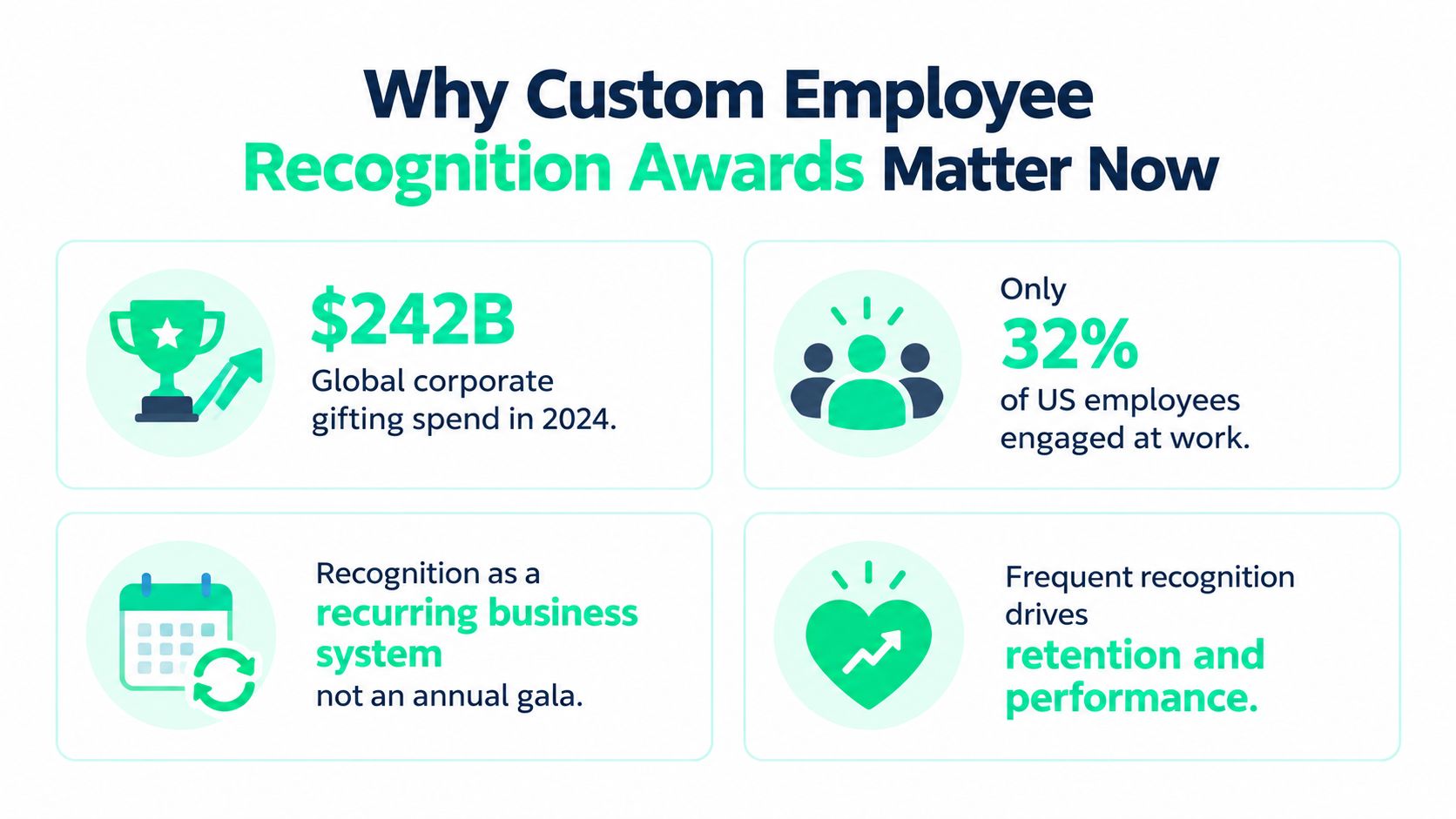
Recognition works only when employees experience it regularly, fairly, and close to the behavior being reinforced. Annual ceremonies create visibility, but they leave long gaps between contribution and response. A sustainable program treats frequency, access, measurement, and fulfillment as operating decisions, with a physical award serving as one delivery channel.
Reward Gateway's employee recognition statistics summarizes guidance that Gallup recommends recognizing employees every seven days to reinforce performance and retention habits. That cadence changes the design brief. The goal is not to order more trophies. It is to create dependable touchpoints that reach frontline, hybrid, and distributed employees without making managers carry an administrative burden.
The award is a touchpoint, not the strategy
Digital shout-outs provide speed. Gift cards provide choice. A custom award adds a durable signal by connecting the company, the achievement, and the recipient in one object. It may sit on a desk, appear in a home office, or become part of a team ritual, but its value depends on the message and timing around it.
That physical presence helps distributed teams, whose employees do not share the same daily visual cues. A branded, personalized object can reinforce belonging when it arrives with a specific explanation of the contribution being recognized.
Practical rule: Tie the award to a performance moment, not to the calendar alone.
Avoid the most common budget trap: treating premium design as proof of program quality. A polished executive trophy cannot repair weak nomination access, delayed fulfillment, or managers who rarely recognize their teams. Ask a vendor such as FLYP to handle production, personalization, and delivery standards so internal teams can focus on eligibility, manager adoption, and communication.
Measure participation, reach, frequency, feedback, and retention. Those signals show whether recognition reaches overlooked groups and supports the behaviors the business needs, rather than funding an expensive annual ritual.
For broader retention planning, retention tips from Approved Experiences Traveler places recognition alongside manager quality, growth, and workplace experience. Recognition strengthens those practices. It does not replace them.
Designing Your Recognition Program Framework
Start with rules, not products. Before choosing a plaque or gift box, decide what behavior deserves recognition, who can nominate, how quickly someone must act, and how the company will prevent the same visible employees from receiving every award.
A workable framework usually combines several award types:
- Spot recognition: A fast response to exceptional service, problem-solving, or collaboration.
- Milestone recognition: A planned moment for promotions, major project completion, or meaningful career progress.
- Peer-to-peer recognition: A channel for colleagues to acknowledge help that managers may not see.
- Tenure recognition: A structured way to mark service milestones without making loyalty the only celebrated contribution.
- Safety and innovation recognition: Awards tied to behaviors the business needs to reinforce.
Build the operating rules
Define eligibility in plain language. State whether contractors, part-time employees, international staff, and people on leave can participate. Keep nomination forms short. For a 500-person company, a peer nomination form capped at 150 words gives colleagues enough room to describe the result without turning recognition into an essay.
Use a manager review service-level agreement of five business days in the sample program below. A quarterly awards council can ratify selections, resolve ambiguous cases, review distribution across teams, and identify categories that are being ignored. The council shouldn't rewrite every nomination. It should protect consistency and equity.
For budgeting, a starting band of roughly 1% to 2% of payroll is a defensible planning assumption described in the program brief. Finance should validate the treatment for each award type, especially where awards have cash-equivalent value or create tax obligations.
Sample Award Tier Framework for a 500-Person Company
| Tier | Trigger | Budget Range | Approver | Cadence |
|---|---|---|---|---|
| Spot | Immediate contribution or customer save | Lower monetary-equivalent tier | Direct manager | Weekly |
| Milestone | Project completion, promotion, or major delivery | Mid monetary-equivalent tier | Department leader | Monthly |
| Signature | Cross-functional impact or exceptional business result | Higher monetary-equivalent tier | Awards council | Quarterly |
| Tenure | Defined service milestone | Mid monetary-equivalent tier | People Ops | Scheduled milestone |
Assign ownership before launch. People Ops owns policy, eligibility, and reporting. Finance owns budget controls and tax review. Internal Communications owns launch language, storytelling, and manager prompts. Legal or privacy counsel reviews personal data, trademark use, and cross-border requirements.
Document the program in three artifacts: a program charter, a recognition rubric, and an award criteria matrix. The charter defines purpose and ownership. The rubric explains what strong nominations contain. The matrix maps each behavior to an award tier, approver, item, and delivery method.
Choosing the Right Award Types and Materials
The right award depends on the moment. A permanent object suits a major contribution or tenure milestone. A digital note may be better for immediate peer recognition. Problems begin when companies force every act of appreciation into the same expensive format.
| Material | Cost Band | Lead Time | Best For | Sustainability Note |
|---|---|---|---|---|
| Crystal or glass | Premium | Longer customization cycle | Signature achievements and formal ceremonies | Recycled glass can reduce material impact compared with newly produced premium glass |
| Machined metal | Premium | Moderate to longer | Durable performance, safety, and innovation awards | Long service life can justify the material when the award is kept and reused in stories |
| Wood and acrylic | Moderate | Moderate | Team awards, modern office displays, and branded designs | FSC-certified wood and recyclable acrylic should be evaluated separately |
| Leather and textile | Moderate | Moderate | Wearable recognition, travel gifts, and practical milestone items | Select durable materials and avoid unnecessary packaging |
| Digital or experiential | Flexible | Immediate to moderate | Remote teams, peer moments, and sustainability-first programs | Avoids physical shipping and can support employee choice |
Match the format to the recognition moment
Crystal and glass communicate ceremony. Use them for a signature award where the recipient will display the object. Machined metal works when durability matters, particularly for safety, engineering, or operational excellence. Wood and acrylic offer more freedom for logos, layered shapes, and modern visual systems.
Personalization determines whether a stock form feels custom. Laser engraving creates a restrained, durable finish on suitable surfaces. UV printing supports color and detailed graphics. Sublimation works for compatible textiles and coated products. Embroidery turns apparel or bags into a wearable recognition item, but it needs a clear design that survives at small scale.
Leather and textile products can be more useful than a trophy for distributed employees. A branded travel case, jacket, notebook, or work bag may become part of daily life. For more unconventional directions, award ideas from ROCKS Whiskey Chilling Stones offers examples of how practical products can carry a recognition story without looking like standard corporate merchandise.
Use this four-part decision rubric:
- Audience: Is the recipient remote, office-based, customer-facing, or part of a group?
- Occasion: Is the award spontaneous, recurring, ceremonial, or tied to tenure?
- Permanence: Should the item last for years, or should the moment be immediate?
- Budget and footprint: Can the program support storage, packaging, and shipping responsibly?
Digital recognition beats physical awards when speed, employee choice, or low-waste distribution matters most. A digital certificate, personalized video message, or employee-choice catalog can create a better experience than shipping an unwanted object across borders. For a wider set of physical and nonphysical concepts, see employee recognition award ideas, then narrow the list using your rubric rather than choosing products by novelty.
Procurement, Vendor Selection, and Quality Assurance
Procurement fails when the buying team asks vendors for “custom awards” without defining the production variables. Write a specification sheet first. Include quantities, award tiers, dimensions, materials, logo files, personalization fields, packaging requirements, delivery regions, and acceptable substitutions.
Use a controlled buying workflow
- Create the specification sheet. Separate fixed design elements from variable data such as names, dates, teams, and award citations.
- Shortlist three to five vendors. Compare minimum order quantities, tiered pricing, production lead times, proof processes, and international fulfillment capability.
- Run a blinded sample round. Have reviewers assess color accuracy, engraving depth, alignment, weight, finish, and packaging integrity without vendor names influencing the decision.
- Negotiate protections. Put pricing tiers, payment terms, defect replacement, damaged-shipment handling, and rework obligations in writing.
- Set recurring quality checks. Require pre-production proofs, mid-run inspections, and a documented returns process.
Don't approve artwork from a screen alone. Physical materials reflect light differently, engraving can lose detail, and a logo that looks balanced in a PDF may look crowded on a small award. Review the finished sample beside the approved brand guidelines.
Brand safety deserves its own approval gate. Confirm logo usage rights, trademark clearance, approved color values, employee consent for personalization data, retention periods for production files, and secure handling of address information. A vendor that can make attractive products but can't explain data handling creates unnecessary exposure.
| Vendor | MOQ and Tiered Pricing | Lead Time (days) | Proof and QA Process | Logo and Brand Safety | Total Score |
|---|---|---|---|---|---|
| Vendor A | |||||
| Vendor B | |||||
| Vendor C | |||||
| Vendor D |
Decide what to delegate
A managed service such as FLYP can consolidate sourcing, artwork coordination, quality assurance, warehousing, and fulfillment instead of making People Ops coordinate several direct suppliers. That model is useful when the program includes different product types, multiple regions, employee-choice data, or recurring HRIS-triggered shipments.
For supplier governance, use vendor quality management guidance to formalize scorecards, inspection records, corrective actions, and escalation paths. Your budget template should separate unit cost, decoration, packaging, shipping, and contingency. Keeping those lines distinct exposes the actual cost of a physical award and prevents a low unit price from disguising expensive fulfillment.
Logistics, Distribution, and Sustainable Operations
A recognition program becomes credible when the award arrives while the achievement is still meaningful. Store finished awards or approved components in a controlled inventory, then fulfill them on demand. Kitting should combine the award, presentation box, recipient card, certificate, and any manager instructions so the experience feels deliberate rather than assembled at the last minute.
Design for distributed delivery
Connect shipment triggers to HRIS milestones such as work anniversaries, promotions, role changes, and approved recognition events. Let employees confirm their address through a secure branded portal where appropriate. Address validation matters even more for remote staff, who may not receive deliveries at a corporate location.
Cross-border fulfillment requires accurate customs descriptions, commercial documentation, VAT treatment, and import-duty planning. Don't assume the recipient can resolve a customs bill or provide missing paperwork. Executive awards may also need discreet packaging, while team distributions may benefit from consolidated delivery to an office or event venue.
Sustainability is a design decision, not a final packaging check. Guidance from Award Force on sustainable recognition emphasizes digital-first options, recyclable or FSC-certified materials, carbon-aware shipping, digitized selection, and sustainable catalogs.
| Choice | Practical Advantage | Trade-Off |
|---|---|---|
| Recycled glass | Keeps a premium visual language with a lower-waste material direction | May limit certain shapes or finishes |
| Crystal | Strong ceremonial presence and visual clarity | Heavier and more demanding to ship |
| FSC-certified wood | Warm, distinctive, and suitable for engraved designs | Requires careful finishing and material verification |
| Resin | Flexible for sculptural forms and color | Can create a less circular material profile |
| Biodegradable mailers | Reduces unnecessary packaging materials | Needs validation for durability and local disposal systems |
| Carbon-aware shipping | Helps align delivery with environmental goals | May affect speed, routing, or available carrier options |
Audit inventory on a regular schedule, set reorder triggers before stock reaches a critical level, and reconcile physical counts with recipient data. Align larger deliveries with quarterly all-hands meetings or team rituals when that adds meaning. Keep spot recognition available between those moments, but don't let ad-hoc shipping become the default operating model.
Measuring Impact With the Right KPIs
A recognition dashboard should answer three questions. Are people using the program? Does recognition reach the workforce fairly and frequently? Does the experience correlate with stronger employee outcomes over time?
Benchmarking guidance for mature programs recommends tracking participation rate, recognition reach, recognition frequency, eNPS shift, and voluntary turnover delta, with the first three treated as leading indicators and the latter two reviewed at 90 days and 12 months, according to Vantage Circle's recognition program benchmarks. The same guidance points to healthy monthly participation of 60% to 100% for peer-to-peer recognition and 80% or higher for manager recognition, while mature peer programs should aim for 80% to 100% of employees receiving recognition monthly.
Separate program health from business impact
Engagement KPIs show whether the mechanics work. Track participation rate, nomination volume, recognition reach, manager-to-individual-contributor distribution, and time-to-recognition. Recognition frequency is especially useful because a program can have many users while still leaving most employees unrecognized.
Retention KPIs need cohort discipline. Compare voluntary or regrettable turnover among recognized and unrecognized cohorts, then examine tenure among repeat award recipients. Don't claim causation from a simple comparison. Use the result to identify patterns worth investigating with managers and pulse surveys.
Business-outcome measures can include eNPS shift, internal mobility, review sentiment, and productivity proxies where the underlying work produces reliable data. Connect recognition data from the HRIS, Slack or Teams integrations, and quarterly pulse surveys. Keep access controls tight when nominations contain personal or performance information.
| KPI | Tier | Target Benchmark | Data Source | Reporting Cadence |
|---|---|---|---|---|
| Participation rate | Leading | Compare against the program benchmark for its channel | Recognition platform and HRIS | Monthly |
| Recognition reach | Leading | Mature peer programs should reach 80% to 100% monthly | Recognition platform | Monthly |
| Recognition frequency | Leading | Review monthly patterns by team and role | Recognition platform | Monthly |
| Manager recognition | Leading | 80% or higher monthly participation is a mature-program benchmark | Recognition platform and HRIS | Monthly |
| eNPS shift | Outcome | Review direction and segment differences | Pulse survey | Quarterly and at 90 days |
| Voluntary turnover delta | Outcome | Compare recognized and unrecognized cohorts | HRIS | Quarterly and at 12 months |
Use KPI dashboards for operational reporting as a reference for making the dashboard readable to leaders. A practical layout has a top row for participation, reach, and frequency; a middle row for team and demographic coverage; and a lower row for eNPS, turnover, comments, and open actions.
Review program health monthly. Hold a quarterly business review with People Ops, Finance, and business leaders. Run an annual audit that removes weak award tiers, updates criteria, checks equity, and confirms that the physical catalog still matches employee preferences and sustainability requirements.
A 30-Day Launch Checklist and Common Pitfalls
You don't need a perfect global program to start. You need a controlled pilot with clear rules, approved samples, and a date for reviewing what employees use.
Four weeks to a usable pilot
Week 1, define the system. Confirm award tiers, criteria, eligibility, nomination limits, approval responsibilities, budget, tax review, and reporting fields. Write the program charter before anyone places an order.
Week 2, control the design. Shortlist vendors, compare proof protocols, lock artwork, confirm personalization data requirements, and choose the initial physical and digital formats. If the first awards will be presented at a company gathering, use a practical resource such as plan corporate event seating to make the presentation flow work for the audience.
Week 3, test the experience. Place a pilot order, approve physical samples, inspect engraving and color, test presentation boxes, verify recipient data, and document the returns process. Don't skip this week because the design looked correct on screen.
Week 4, launch narrowly. Soft-launch with one team, collect employee and manager feedback, fix fulfillment issues, and schedule the first full distribution. Keep the pilot small enough that People Ops can answer questions quickly.
Pitfalls that quietly damage trust
- Over-designed tier names: Use language employees understand. A clever label isn't a substitute for clear criteria.
- Unreviewed tax treatment: Cash-equivalent awards may require tax and gross-up review. Finance and local advisers should confirm the rules for each region.
- Unvalidated recipient data: Don't buy personalized inventory before names, addresses, team assignments, and milestone dates are checked.
- Skipped samples: A production proof is not optional for color, engraving, packaging, and sizing.
- One-off recognition: Annual ceremonies create peaks, not habits. Schedule recurring manager and peer moments.
- Unprepared managers: Give managers a short script, the reason for the award, and guidance on presenting it personally.
The handoff is operational. Add recognition to the monthly People Ops calendar, review the dashboard, replenish only what earns use, and ask employees which formats feel meaningful. A launch quarter creates attention. A recurring cadence creates credibility.
FLYP LTD can help People Ops teams manage custom employee recognition awards through curated products, employee-choice experiences, brand-safe production, quality assurance, warehousing, and international fulfillment. If you want to move from scattered supplier coordination to a repeatable recognition operation, visit FLYP LTD and discuss the program you need to run.