A People Ops lead gets an urgent request: prepare welcome kits for new hires joining from several countries, make sure every package carries the right brand assets, and deliver everything before the next onboarding cycle. The team has handled smaller shipments from a storage room before, so the first instinct is familiar. Order the products, stack the boxes, print the labels, and ask a domestic logistics partner to send them out.
That approach works until the program becomes global, the catalog becomes personalized, or the deadline becomes firm. Then customs questions, address formats, missing sizes, split shipments, returns, and unclear shipping charges appear at the same time. A fulfillment store addresses this problem by treating merch as an operating system for demand, production, routing, and delivery, not as a branded catalog.
Table of Contents
- The Onboarding Kit That Exposed the Problem
- What a Fulfillment Store Actually Is
- How a Fulfillment Store Operates Day to Day
- Fulfillment Store vs Traditional 3PL and Warehousing
- The Choice-Based Versus Pre-Selected Fork
- Integrating a Fulfillment Store Into Enterprise Merch
- Global Routing and Distributed Inventory
- Deciding If a Fulfillment Store Fits Your Program
The Onboarding Kit That Exposed the Problem
The People Ops lead starts with a spreadsheet. It contains employee names, addresses, shirt sizes, manager details, start dates, and the kit contents approved by Brand. The fulfillment plan looks manageable until the team checks the destinations. Some recipients are in countries with different address conventions, some need local customs documentation, and others have joined too close to the shipping deadline for a slow international route.
The first failure is a customs hold. A package leaves the domestic warehouse with the right products but incomplete or unsuitable import information. Another shipment reaches a carrier depot because the address was entered in a format the local delivery network couldn't process. The hoodie selected for the kit runs out just as the largest onboarding wave begins, so the team has to choose between substitutions, delayed kits, or a second production run.
Finance then asks a reasonable question: why does shipping consume such a large share of the kit budget? The answer isn't necessarily carrier waste. A single hub may send products across borders, charge for international handling, and create separate shipments when one item isn't available. The team thought it was buying merchandise. Operationally, it was buying merchandise, storage, coordination, exception handling, and a series of international shipping decisions.
Practical rule: A global merch program should be designed around the recipient's destination and deadline before the team finalizes the catalog.
The problem isn't that the People Ops lead chose the wrong vendor. The problem is that a back-room inventory model was being asked to behave like a distributed fulfillment network. A traditional warehouse mainly protects and releases stock. A modern fulfillment operation also receives goods, stores them, picks and packs orders, ships them, and processes returns. This overview of retail warehouse and fulfillment operations describes that evolution and notes that U.S. value-added warehousing and distribution generated $69.6 billion in gross revenue in 2024, representing 61.3% of commercial warehousing revenue.
For teams planning an onboarding kit, the practical lesson is simple: the box is the visible output, not the operation. The underlying model must decide where an item comes from, how it crosses a border, what happens when the recipient isn't available, and whether a returned garment can be used again. A useful starting point is this employee onboarding kit guide, but the logistics design needs to go beyond choosing items and writing an insert card.
What a Fulfillment Store Actually Is
A fulfillment store is a digital storefront connected to a production and delivery network. The recipient sees a catalog or selection page, but the operator doesn't necessarily hold every listed item in a dedicated warehouse. After an order is placed, the system can trigger production or select stock from a qualified node, then arrange packing and delivery.
A hotel front desk is a useful analogy. The front desk doesn't own a separate hotel room for every possible guest. It checks availability, applies the booking rules, assigns the right room, and gives the guest a reliable arrival experience. A self-storage unit works differently. It holds a specific set of belongings until the owner arrives with a key. Traditional merch warehousing resembles the storage unit. A fulfillment store behaves more like the front desk.
The storefront is not the stockroom
A branded storefront is primarily a presentation and ordering layer. It can show products, collect sizes, apply permissions, and display brand-approved designs. That alone doesn't tell you how orders are produced or shipped.
The fulfillment model begins after the recipient clicks. A routing engine can consider the destination, product availability, production time, carrier options, and service requirements. It may select a regional production partner for one order and a stocked node for another. The recipient still experiences one store, while the operator manages several possible paths behind it.
This separation changes the catalog decision. Shelf space no longer limits every SKU in the same way, and teams can offer country-specific products, employee choice, or occasional recognition items without purchasing large quantities in advance. The trade-off is that the operator exchanges some inventory control for dependence on production availability, routing quality, and supplier consistency.
The cost model moves with the order
A warehouse-centered program pays to acquire and hold inventory before demand is certain. An inventory-less or made-to-order program shifts more cost into each order. Receiving, production, picking, packing, and shipping become visible transaction costs rather than expenses hidden inside a bulk purchase.
That doesn't make a fulfillment store automatically cheaper. It makes the cost profile easier to align with uncertain demand. For low-velocity employee gifts or geographically varied onboarding kits, avoiding dead stock can matter more than achieving the lowest possible unit price. For predictable, high-volume merchandise, committed inventory may still offer stronger economics.
The distinction matters because many teams compare the storefront interface while ignoring the fulfillment architecture. A polished catalog can still produce late orders if the platform can't route, produce, and support them reliably.
How a Fulfillment Store Operates Day to Day
A fulfillment store works when four operational layers agree on the same order. The recipient sees a product page and a confirmation email. Behind that simple interaction, the system must decide whether to make the item, where to make it, how to ship it, and what to do if the delivery fails.
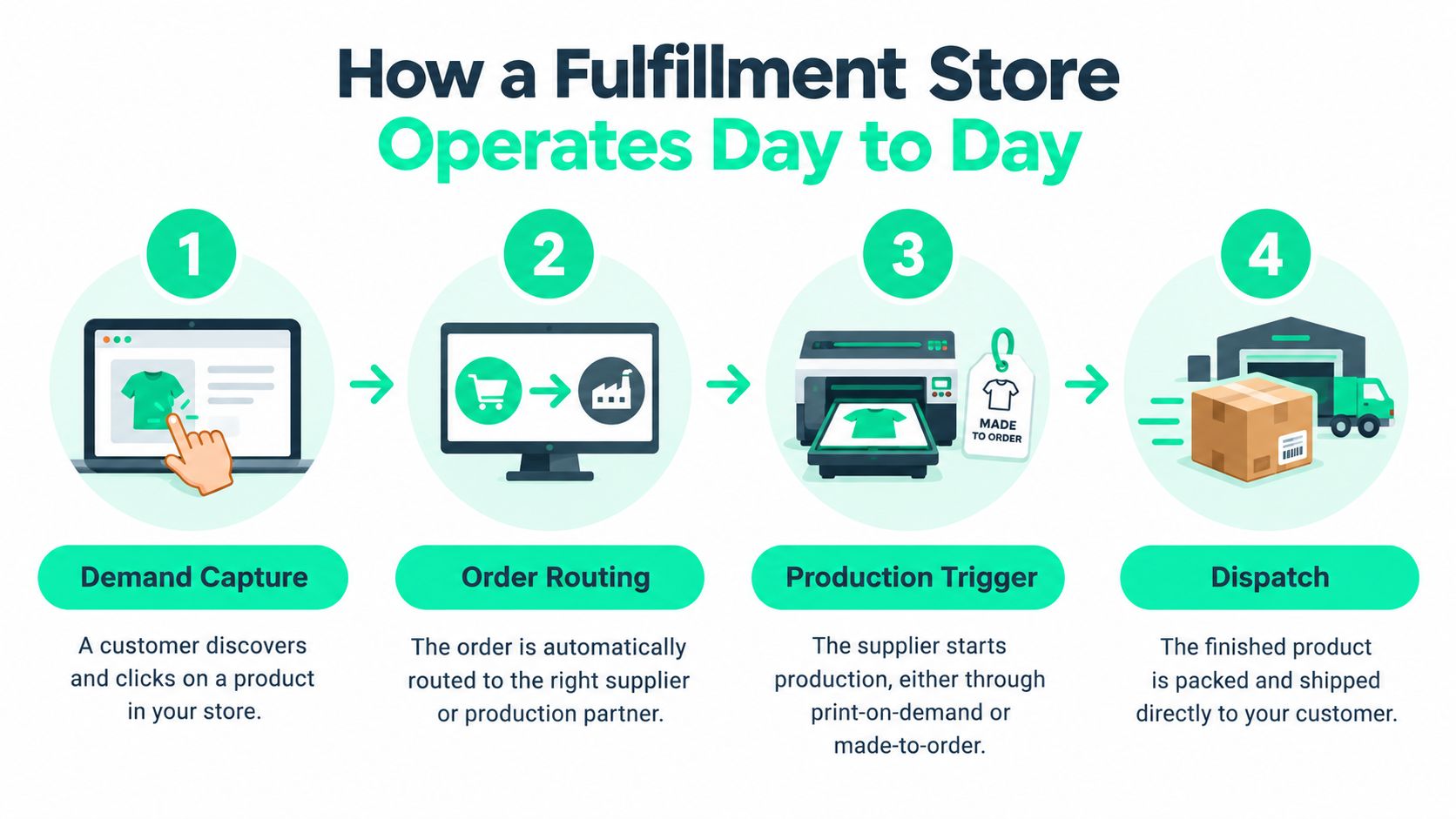
Demand capture and inventory-less production
The first layer captures the order and checks the rules attached to it. An employee might receive a credit and choose a size and color. A new hire might receive a fixed kit. An event manager might create a restricted store that closes after the event.
Inventory-less fulfillment can use print-on-demand, made-to-order production, or an aggregated supplier pool. In each case, the buyer doesn't need to reserve a complete range of sizes and colors in a dedicated warehouse. The advantage is flexibility. The risk is that a production delay appears after the order has already been promised.
Routing is an operational decision
The system then evaluates possible origins. It can compare destination, available blanks or finished goods, production lead time, carrier service, and shipping cost. The lowest-cost node isn't always the right node. A slightly more expensive local route may protect a firm delivery commitment, while a distant hub may be suitable for a flexible recognition gift.
Routing also affects split shipments. If a kit contains items with different production times, the platform must decide whether to wait, ship separately, or substitute. Those rules should be agreed before launch, because the customer support team shouldn't invent them order by order.
International shipping needs ownership
Cross-border fulfillment includes more than printing a label. The operator needs a process for landed cost, duties, customs documentation, carrier selection, and delivery exceptions. The commercial decision between duties-paid and duties-unpaid delivery also affects the recipient experience. A People team may prefer a predictable delivered cost, while Finance may prioritize a lower upfront shipping charge.
Automation adoption reflects the wider shift toward scan-controlled and technology-driven fulfillment. Industry data reports that 78% of fulfillment centers use robots or automated guided vehicles for picking and packing. The point for a merch team isn't that every program needs robotics. It's that reliable fulfillment depends on system control, accurate status updates, and repeatable handoffs rather than informal warehouse knowledge. Teams reviewing the broader discipline can use this resource on how to master your ecommerce operations in 2026.
Returns complete the loop
A return needs its own route. The item might be restocked locally, sent back to the production origin, consolidated for later processing, or replaced without asking the recipient to return it. The right policy depends on product value, cross-border cost, condition, and whether the program uses made-to-order goods.
Returns are no longer an edge case in ecommerce operations. The National Retail Federation estimated that 19.3% of online sales and 15.8% of total retail sales would be returned in 2025, with returned merchandise valued at about $849.9 billion (National Retail Federation return figures). A fulfillment store that designs only for outbound delivery has left out a major part of the customer experience.
Fulfillment Store vs Traditional 3PL and Warehousing
The main comparison isn't digital store versus physical warehouse. It's committed inventory versus order-triggered fulfillment.
A traditional third-party logistics provider, or 3PL, receives inventory that the enterprise has already purchased, stores it, and releases it when an order arrives. An in-house warehouse follows a similar logic, with the company managing the building, staff, equipment, and systems itself. A fulfillment store can avoid dedicated stock for some or all products, but it introduces production and routing dependencies.
| Dimension | Fulfillment Store | Traditional 3PL | In-House Warehouse |
|---|---|---|---|
| Inventory model | Made-to-order, print-on-demand, or shared supplier availability | Enterprise-owned inventory stored by a logistics partner | Enterprise-owned inventory managed internally |
| Cost structure | Per-order production, handling, and shipping charges | Storage, receiving, pick-and-pack, and shipping fees | Labor, facility, equipment, software, inventory, and shipping costs |
| SKU flexibility | Broad catalog without dedicating shelf space to every item | Constrained by purchased stock and storage plans | Constrained by capital, space, and warehouse capacity |
| Product control | Depends on approved production partners and available materials | Strong control over purchased styles, colors, and sizes | Direct control over stock and warehouse processes |
| Best fit | Variable demand, employee choice, global gifting, and low-velocity SKUs | Predictable demand with meaningful order volume | Stable programs where internal logistics capability is strategic |
| Main trade-off | Lower deadstock exposure, with less direct control over production availability | More control, with inventory and storage commitments | Maximum control, with maximum operational responsibility |
The fee structure explains why order design matters. Fulfillment cost guidance from Fit Small Business describes receiving charges based on labor time or pallet volume, pick-and-pack often around $2 to $5 for the first item, and outbound shipping as a major variable driven by dimensional weight, zone distance, and service level. Smaller cartons and consolidated orders can reduce handling and dimensional shipping exposure, while fragmented single-item orders can become expensive as each additional line creates work.
Traditional warehousing still has a place. If a program sells the same high-volume products continuously, buying inventory in advance can produce a lower per-unit cost and give the team tighter control over exact materials. An inventory-less model is more useful when demand changes, recipients are distributed, or the cost of unsold stock is harder to justify.
For People Ops, the choice often sits between a fixed 3PL contract and a managed fulfillment layer. This explanation of what a fulfillment company does can help teams separate storage, order handling, shipping, and returns when evaluating providers.
The Choice-Based Versus Pre-Selected Fork
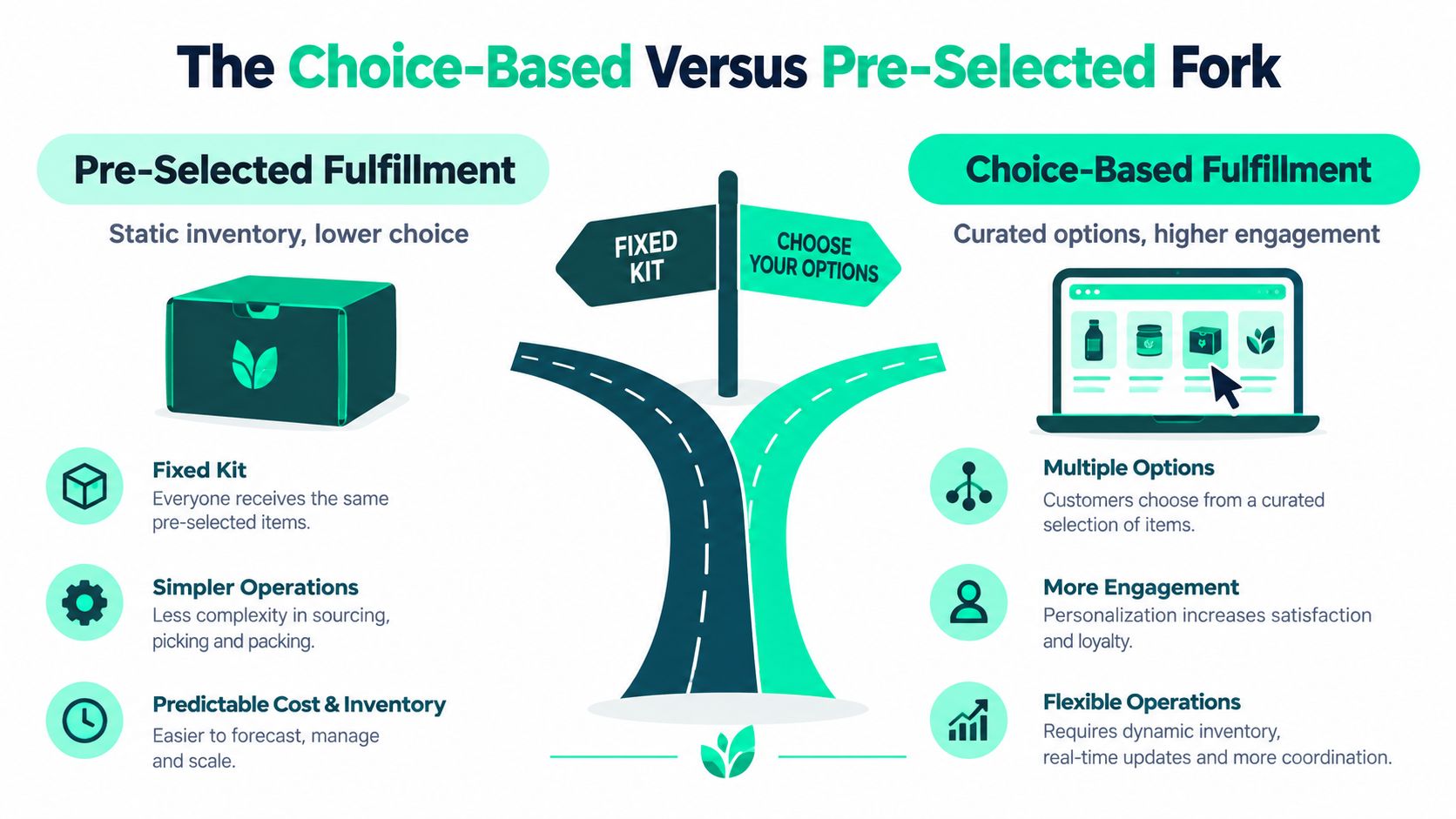
Many teams spend their planning time on catalog design. They debate hoodie colors, embroidery placement, packaging inserts, and the number of approved products. Those decisions matter, but the more consequential question is whether the recipient chooses the item or receives a predetermined package.
A pre-selected model sends a defined combination of products. Every recipient may receive the same garment, insert, and packaging, subject to practical substitutions. This works well when a company wants a consistent onboarding moment, an event needs a coordinated look, or a recognition program has a simple gift rule.
A choice-based model gives the recipient access to a store or selection link, often with a credit or eligibility rule. The recipient selects the size, color, and product that fit their preferences. That approach can reduce avoidable size problems and make the gift more relevant, but it spreads demand across more SKUs and creates more individual order paths.
Preference fit is an operations metric
Independent survey data shows why People teams should treat choice as a measurable program decision. Only 30.5% of North American employees said the last branded item they received matched what they would have chosen, while 52.5% said they rarely used, donated, or discarded it (branded merchandise preference study). The same study found that 37.9% still used the item regularly.
Those findings don't prove that every employee-choice store will succeed. They do show that delivery alone isn't the outcome. The program should measure redemption, selected categories, size-related support requests, returns, and whether recipients continue using the item.
The catalog is only useful when the recipient can find a product they actually want.
Pre-selected fulfillment has operational strengths. Production can be consolidated, pack configurations stay predictable, and the team can forecast the contents of each shipment. Choice-based fulfillment creates a richer experience, but the platform must handle varied orders without turning every selection into a manual exception.
The right decision depends on the purpose. Use pre-selected kits when consistency and timing dominate. Use choice when preference fit and ongoing participation matter more. A hybrid can work too, with a fixed welcome insert and a recipient-selected garment. The decision belongs in the operating design, not as a last-minute feature choice.
Integrating a Fulfillment Store Into Enterprise Merch
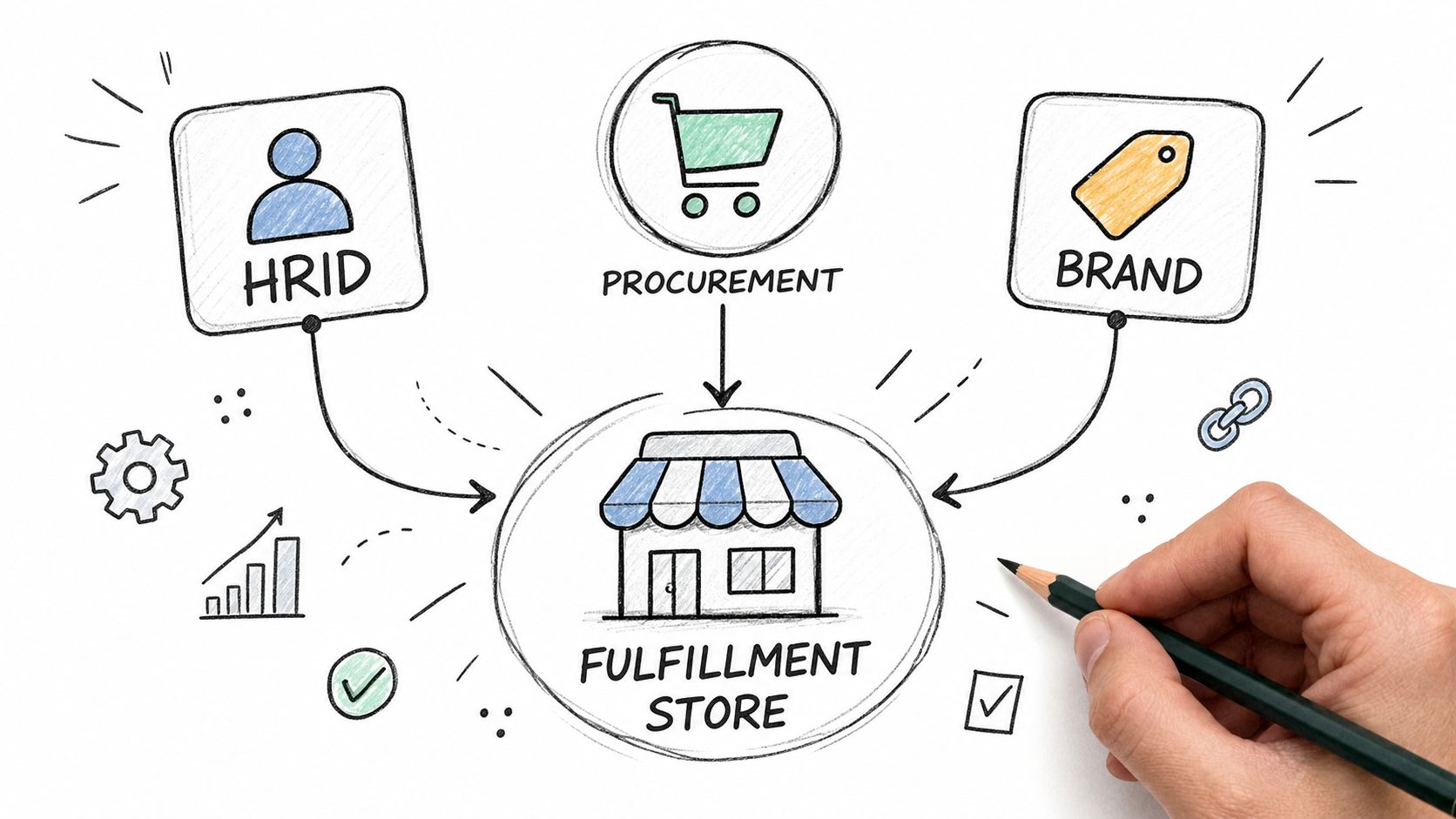
Enterprise adoption starts with triggers, permissions, and data quality. The storefront is only one interface in a chain that can include an HR information system, procurement, Brand, Finance, customer support, and the logistics platform.
Start by listing every event that can create an order:
- New hire activation: An approved employee record creates an invitation or shipment request.
- Event registration: A confirmed attendee receives a selection link or eligibility credit.
- Recognition approval: A manager or People partner authorizes a gift within a defined budget.
- Milestone completion: A contract or customer milestone triggers a controlled merchandise offer.
For each trigger, document the fields that move into the fulfillment system. Recipient name, delivery address, country, size, eligibility, cost center, and shipping preference may all be relevant. The integration should also define what happens when an address is incomplete, a person changes countries, or an employee becomes ineligible before dispatch.
Put governance before convenience
Enterprise teams should review single sign-on, role-based permissions, data retention, audit logs, and security documentation before opening the store broadly. A marketer may need to approve artwork, while a People Ops administrator manages eligibility and Finance reviews spend. Those roles shouldn't share one unrestricted account.
Brand governance also needs a workflow. Approved logos, colors, placement rules, garment restrictions, and regional exceptions should live in a controlled approval process. A store that lets employees order products is still a brand surface, so the team needs a clear owner for catalog changes and product retirement.
Decide who owns the exception
Normal orders are easy to demonstrate in a vendor presentation. Exceptions reveal whether the operating model is ready. Assign ownership for customs holds, damaged items, failed deliveries, size exchanges, duplicate orders, and delayed production before the pilot begins.
A platform such as FLYP LTD can combine branded storefronts, made-to-order merchandise, fulfillment, international shipping, customer service, returns, and reporting in one managed workflow. That type of consolidation can reduce handoffs between design approval, production, logistics, and support, but the enterprise still needs to define its policies and approval rights.
Pilot the process with a controlled employee group in more than one region. Test the full path, including invitation, selection, address validation, production, tracking, support, and return handling. A successful pilot isn't just a batch of delivered boxes. It produces an exception log and confirms which system owns each decision.
Global Routing and Distributed Inventory
A single hub is easier to govern. One team can approve stock, one warehouse can pack kits, and Finance can reconcile one primary logistics account. That structure can work when the catalog is small, demand is concentrated, and recipients can tolerate longer transit times.
Distributed fulfillment becomes more valuable when the program serves several regions with different delivery expectations. A routing system can direct an order toward a qualified production or stocking node closer to the recipient. The benefits may include shorter transit, fewer cross-border handoffs, and simpler regional returns. The costs include more supplier coordination, more inventory visibility work, and a greater need for consistent quality control.
Recent industry planning data indicates that 44% of brands plan to ship to new countries in 2026, 44% plan to increase the number of fulfillment centers they use, and 30% plan to start fulfilling orders in new countries. The same source says 75% plan to add at least one new sales channel in 2026 (fulfillment trends and distributed network data). These are projections reported for 2026, not a guarantee that every merch program needs multiple nodes.
| Factor | Single Hub | Distributed Nodes |
|---|---|---|
| Lead time | Longer for distant recipients | Potentially shorter within served regions |
| Customs exposure | More cross-border shipments | More local or regional delivery paths |
| Inventory control | Easier to reconcile | Requires node-level balancing |
| Program complexity | Lower | Higher, especially for substitutions and returns |
| Best fit | Concentrated demand and limited SKUs | Global demand with firm local delivery expectations |
| Main risk | Transit delays and import friction | Stock imbalance and inconsistent execution |
Customs policy should be explicit. With duties-paid delivery, the sender generally takes more responsibility for the delivered import experience. With duties-unpaid delivery, the recipient may face charges or collection steps. The appropriate choice depends on the audience, the commercial arrangement, and the organization's tolerance for delivery surprises.
Distributed nodes only create value when the program can keep them supplied and synchronized. A regional node that lacks popular sizes is not a useful node. Teams reviewing placement, replenishment, and supplier coordination can use this supply chain optimization guide as a planning reference. For a broader view of international service design, see global fulfillment services.
Deciding If a Fulfillment Store Fits Your Program
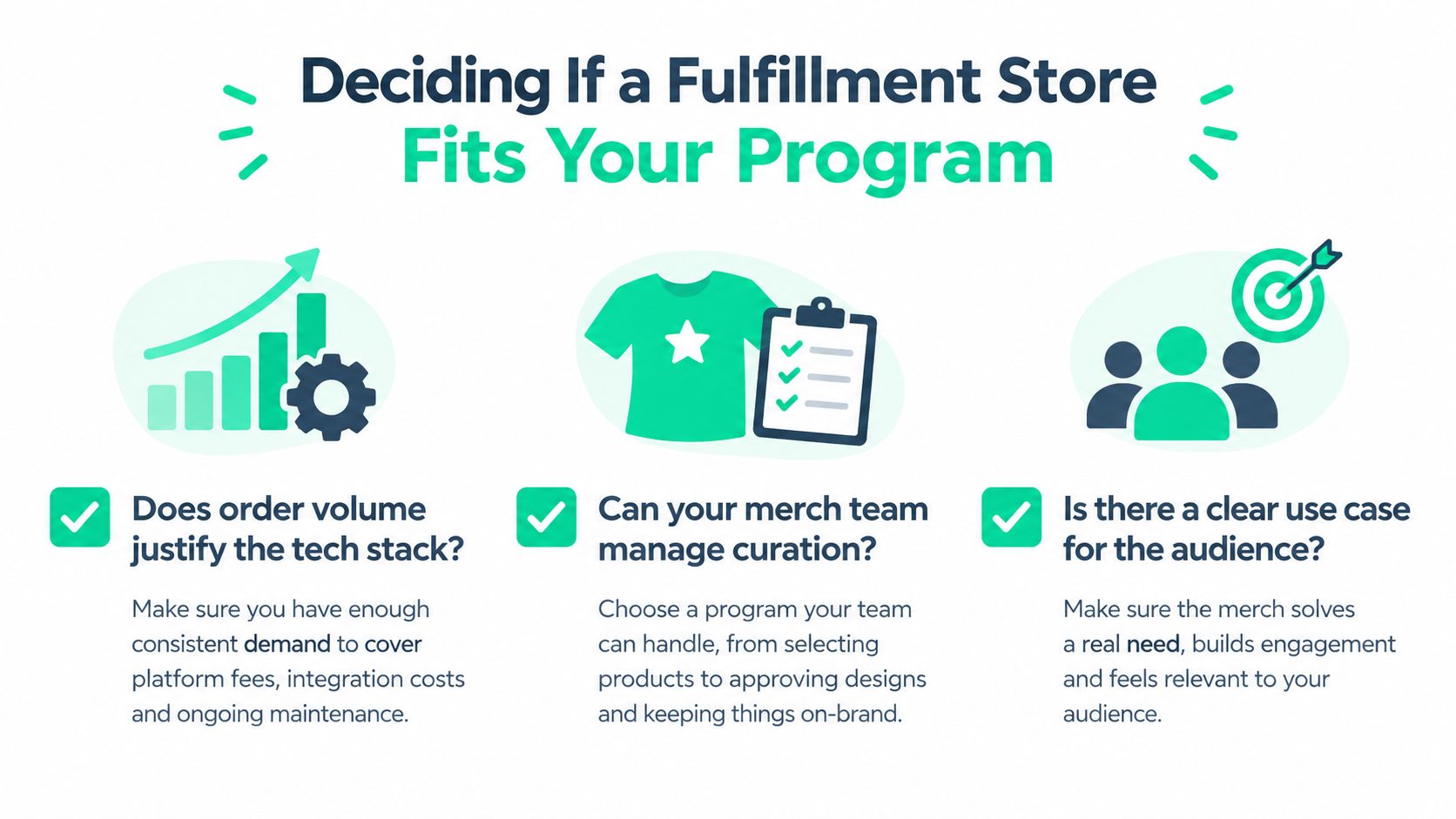
A fulfillment store fits when the operational problem is more complex than storing boxes. Use these questions to decide whether it deserves a pilot.
- Does demand fluctuate? If orders arrive in waves around hiring, events, or recognition moments, inventory-less fulfillment can reduce the risk of buying too much. Stable, continuous demand may favor a stocked model.
- Are recipients spread across regions? A global audience increases the value of routing and local production. A concentrated audience may be served efficiently from one hub.
- Do recipients need choice? Size, color, and product preferences support a choice-based store, but they also require stronger catalog governance and dynamic order handling.
- Do you need kitting or branded packaging? Ask whether the provider can assemble the required package, manage inserts, and maintain quality across production nodes.
- What happens to returns? Require a documented policy for exchanges, damaged items, wrong sizes, failed deliveries, and region-specific disposal or restocking.
- Is your 3PL contract changing? A renewal or service review is a natural point to compare traditional storage, a fulfillment store, and a hybrid arrangement.
The model tends to suit global, choice-driven programs where consistent execution and recipient relevance matter more than minimizing the unit cost of a predictable bulk order. A hybrid approach can preserve stocked inventory for core products while using made-to-order production for long-tail items.
Run a pilot when you can define the audience, trigger, catalog, delivery promise, budget owner, and return policy. Track order accuracy, on-time shipment, support volume, preference fit, and post-delivery usage. Operational benchmarks commonly target order accuracy above 99.5%, on-time shipment above 98%, and simple small-parcel cost performance in the range of $2.50 to $4.75 per order (fulfillment KPI benchmarks). Barcode confirmation can support accuracy above 99.5%, while manual picking without scan verification is typically closer to 97% to 99%, and a mis-pick can cost about $10 to $30 after replacement shipping, support time, and returns, according to the same benchmark source.
FLYP LTD helps enterprise teams run branded employee stores, onboarding kits, recognition programs, and event drops with managed curation, production, fulfillment, international shipping, customer service, returns, and reporting. Visit FLYP LTD to discuss a fulfillment store pilot built around your recipients, regions, delivery commitments, and operating policies.