Your team is probably closer to variant chaos than it looks on the dashboard.
Marketing approves a clean new-hire kit. People Ops wants size choice by region. Procurement asks for supplier codes. Ecommerce needs the right SKUs in the store. Fulfillment needs labels that won't confuse a navy hoodie in medium with a black hoodie in medium. Then someone duplicates a product record instead of creating a child variant, and now three teams are looking at three slightly different versions of the same item.
That's what product variant management is in enterprise work. It isn't just deciding whether a shirt comes in blue and black. It's the operating discipline that keeps every sellable option connected to the right data, assets, inventory rules, and downstream workflows.
The pain shows up fast when that discipline is missing. Launches slip because teams argue over which SKU is live. Global onboarding kits arrive with the wrong regional item mix. Brand teams approve one product image, while fulfillment picks from another record with different attributes. What looks like a catalog problem turns into an operations problem.
There's also a commercial side that teams often miss. Many companies still judge assortment complexity by total SKU count alone. That's too blunt. A large variant set isn't always bad, and a small one isn't always efficient. The more useful question is whether each variant earns its place through demand, availability, and operational clarity.
Table of Contents
- Introduction to Product Variant Management at Scale
- How Product Variants Work and Why Structure Matters
- Essential Data and Taxonomy for Every Sellable Variant
- Controlling SKU Proliferation Without Limiting Choice
- Inventory Fulfillment and QA Implications for Enterprise Merch
- Automation Rules and the Future of Variant Intelligence
- Putting Product Variant Management Into Practice
Introduction to Product Variant Management at Scale
A new hire in London opens the company store and picks a hoodie from the approved onboarding kit. Marketing sees one branded item. People Ops sees a policy-compliant choice. Fulfillment sees a very specific unit that must exist in the right warehouse, with the right size, decoration method, barcode, and shipping rules. If those views are not tied together, one “simple” hoodie turns into returns, stockouts, and manual cleanup.
That is why variant management at scale is really a commercial control system.
A familiar pattern starts in a swag store that grows faster than its data model. One tee becomes a regional apparel program. One mug becomes a gift assortment with supplier substitutions. One hoodie becomes a matrix of sizes, colors, print locations, and country restrictions. The catalog may still look tidy on the storefront. The operating model underneath gets much harder to control.
Where variant problems actually begin
The first break usually is not complexity. It is inconsistency.
A merch manager duplicates a product record because launch dates are tight. A supplier sends color names that do not match the PIM. Someone stores size in the title, while another team stores it in an attribute field. Inventory for two nearly identical variants gets split across separate records, so each one looks slow-moving even though demand is healthy in aggregate.
That last point matters more than many teams expect. Poor variant structure does not just create messy data. It distorts commercial judgment. Teams retire options that look weak only because exposure was scattered across duplicate records, or they keep low-performing variants because the parent product appears popular.
At scale, the better question is not “How many SKUs do we have?” It is “Which variants earn their place?”
A useful answer comes from operating metrics, not catalog aesthetics alone. Exposure rate shows whether a variant is being seen in the channels where it is meant to sell. Stock fragmentation shows whether inventory is spread so thinly across similar variants that availability drops and replenishment gets harder to plan. Those signals help teams decide whether to keep a variant, merge it into another option, retire it, or split it into a separate product family with its own logic.
Why this matters beyond the catalog
Variant management affects launch timing, replenishment accuracy, reporting, and customer choice. It also shapes employee experience in programs like onboarding kits and recognition stores, where the wrong structure can block approved choices by region or route orders into the wrong workflow.
The pattern is straightforward. When shared product data and variant-specific data are not separated cleanly, teams start compensating with spreadsheets, side rules, and manual checks. That can work for a small local program. It breaks down in a multi-region merch operation with several suppliers, warehouses, and storefronts.
Good variant management gives each sellable option a stable identity, clear operational fields, and a measurable business case.
What good looks like
Strong teams treat variants the way retailers treat shelf space. Every option has a cost to stock, present, replenish, and support. That means variant decisions should balance customer choice against operational drag.
In practice, that usually means three disciplines:
- Clear structure: shared product content stays together, while each sellable option is defined separately and consistently
- Operational readiness: every variant has the fields needed for pricing, inventory, fulfillment, and QA
- Performance review: teams assess variants by demand, exposure, availability, and stock fragmentation, not by SKU count alone
That shift changes the conversation. Variant management stops being a catalog cleanup exercise and becomes a way to improve revenue capture, reduce dead inventory, and keep choice broad enough to matter without letting complexity spread faster than performance.
How Product Variants Work and Why Structure Matters
Most confusion starts because people use the word “product” to mean two different things.
To marketing, the product is “the hoodie.” To operations, the product that gets picked, packed, and shipped is “black hoodie, size medium, SKU X.” That second object is the variant. It's the unit your systems can transact.
Think in family-tree terms
The simplest way to understand structure is a family tree.
The parent product is the shared concept. It holds information that applies to all versions: product name, base description, brand, care instructions, category, and maybe the core imagery. The child variants are the sellable members of that family. Each child stores only what changes from one option to another.
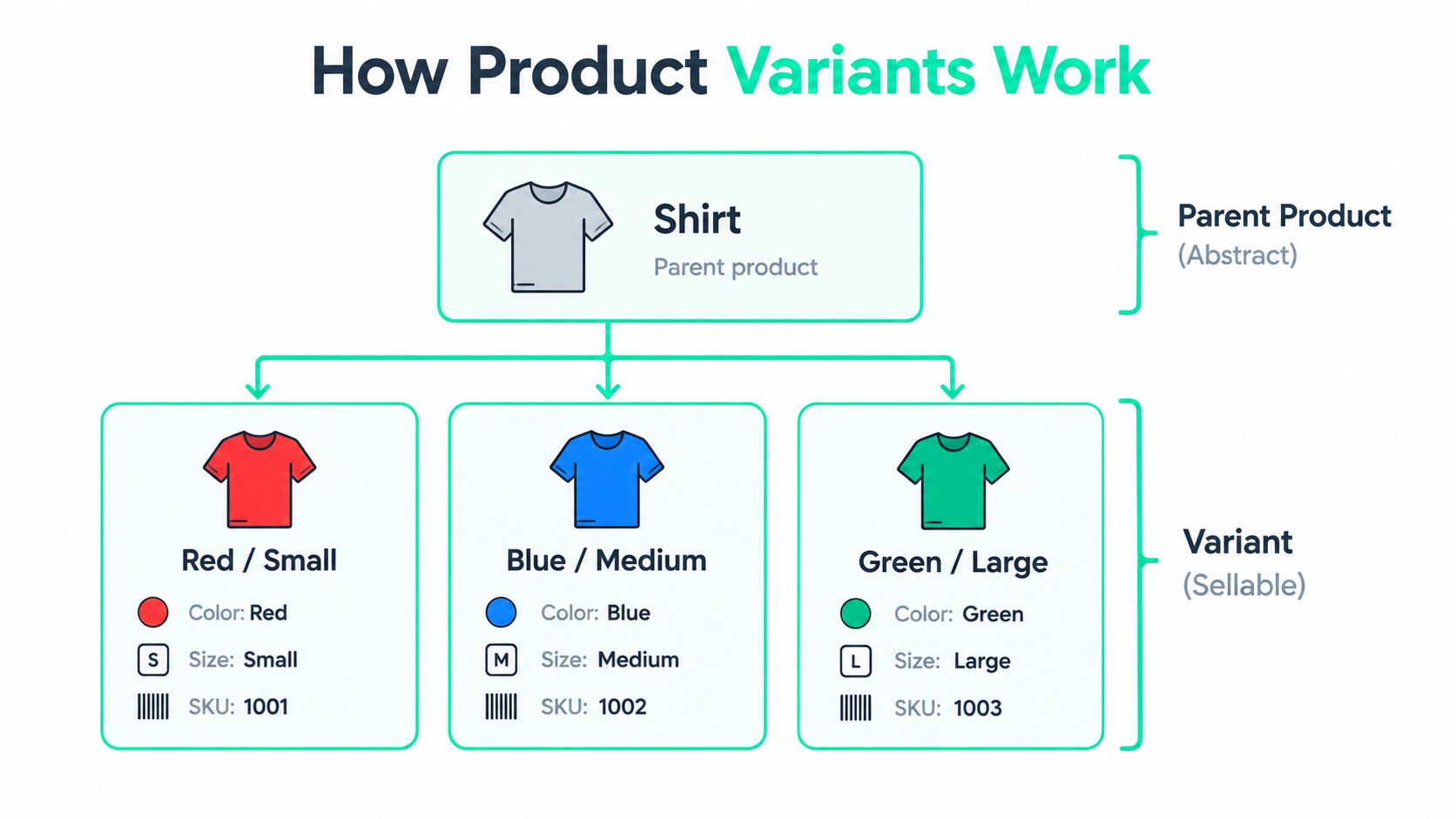
In practice, those changing fields are often things like size, color, finish, price, stock status, and variant-specific assets. A practical modeling guide recommends a parent-child hierarchy where the parent stores shared attributes and the child stores only these delta fields, because that reduces duplication and makes inheritance rules explicit for PIM and MDM workflows (variant modeling guidance).
Why inheritance matters
Inheritance is what keeps a variant system from turning into copy-paste debt.
If your brand team updates the master product description, you want that update to flow everywhere it should. If each variant contains its own full duplicate description, image set, and compliance text, someone has to remember to update every record manually. They won't. That's how catalogs drift.
Here's a plain-language comparison:
| Structure choice | What happens |
|---|---|
| Parent holds shared fields | Updates stay centralized and cleaner |
| Child holds only delta fields | Variant records stay lighter and easier to govern |
| Every variant is a full duplicate | Teams create inconsistency, extra edits, and sync errors |
Practical rule: Put shared content at the master level. Store only the differences at the variant level.
Where PIM and ERP fit
This structure isn't just a data-cleanliness preference. It's what lets systems agree.
In ERP-grade setups, variants are typically generated from combinations of characteristics on a configurable product master. The product master plus its dimension set becomes the integration key that upstream and downstream systems can exchange without ambiguity, according to the same modeling guidance linked above.
That's why a merch ops lead should care about what sounds like technical architecture. If the structure is wrong at the source, every later process gets shakier:
- Storefront display becomes messy because duplicate products compete with each other.
- Inventory sync breaks because stock belongs to a sellable child, not to an abstract parent.
- Reporting gets distorted because sales roll up inconsistently.
- Asset QA gets harder because teams don't know whether an image belongs to the parent or a specific child.
A short walkthrough helps make this concrete.
If you remember one thing, make it this: the parent is for meaning, the variant is for execution.
Essential Data and Taxonomy for Every Sellable Variant
A variant isn't operational because it exists in the catalog. It's operational because it has the minimum data needed for teams and systems to act on it.
That's the shift many retail and merch teams had to make over the last decade. Instead of thinking “this product has options,” they now think “each option is a distinct sellable unit with its own behavior.”
The minimum fields that make a variant real
A current retail guide recommends storing at least the following data for each variant: variant name, internal SKU, barcode or label, purchase price, sales price, supplier reference, lead time, and a replenishment rule such as reorder point or min/max (retail guide to variant-level management).
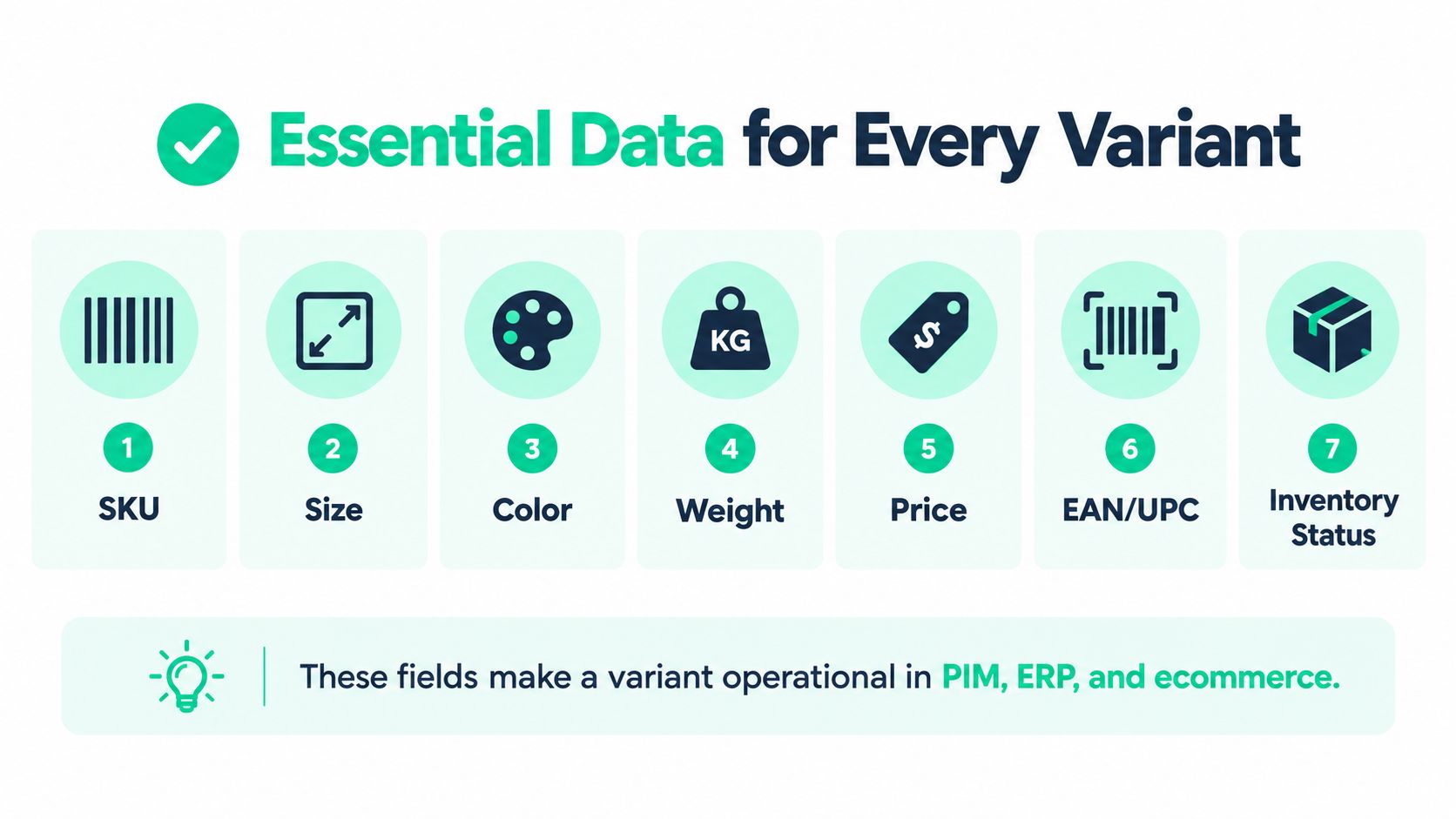
For enterprise merch, I'd translate those fields like this:
- SKU and barcode: These are the operational identity of the variant. If two variants can be confused in picking, they need distinct IDs.
- Supplier reference and lead time: Procurement needs these to plan replenishment and substitutions.
- Purchase and sales price: Finance and merchandising need cost and pricing logic at the variant level, not just the parent level.
- Replenishment rule: This is what stops a fast-moving size or color from going dark while slower variants sit in stock.
Why parent-product thinking breaks down
The parent matters for storytelling. The variant matters for commerce.
A navy branded backpack for EMEA and a black branded backpack for North America may look like a simple brand assortment choice. But if they route through different suppliers or have different shipping logic, they're not interchangeable operationally. Treating them as one generic product hides the work that has to happen later.
That's why variant-level analysis is so important. The same retail guide advises reviewing sales by variant over the past 30 or 90 days and notes that often only a few variants drive most sales. You don't need a forecasting model to benefit from that habit. Even a recurring review of variant performance can reveal which options deserve replenishment priority and which ones mostly add maintenance overhead.
A useful taxonomy for merch teams
Here's a simple taxonomy that helps non-technical teams speak the same language:
| Layer | What belongs there |
|---|---|
| Parent product | Shared name, description, category, brand assets |
| Variant attributes | Size, color, finish, region, packaging type |
| Operational fields | SKU, barcode, supplier ref, lead time, stock rule |
| Merchandising signals | Visibility, selection, add-to-cart behavior, returns |
The moment a choice changes stock, price, fulfillment, or reporting, treat it as a variant, not as a decorative attribute.
That one rule clears up a surprising amount of internal debate.
Controlling SKU Proliferation Without Limiting Choice
SKU proliferation usually doesn't happen because teams love complexity. It happens because every new request sounds reasonable on its own.
Add one more color for the event team. Add one more fit for EMEA. Add one more packaging option for onboarding. Add one more decoration version for leadership gifts. No single request looks dangerous. The multiplication happens in the background.
The hidden math of combinations
Variant complexity grows when dimensions stack on top of each other. Size times color times material times region doesn't create a longer list. It creates a larger grid.
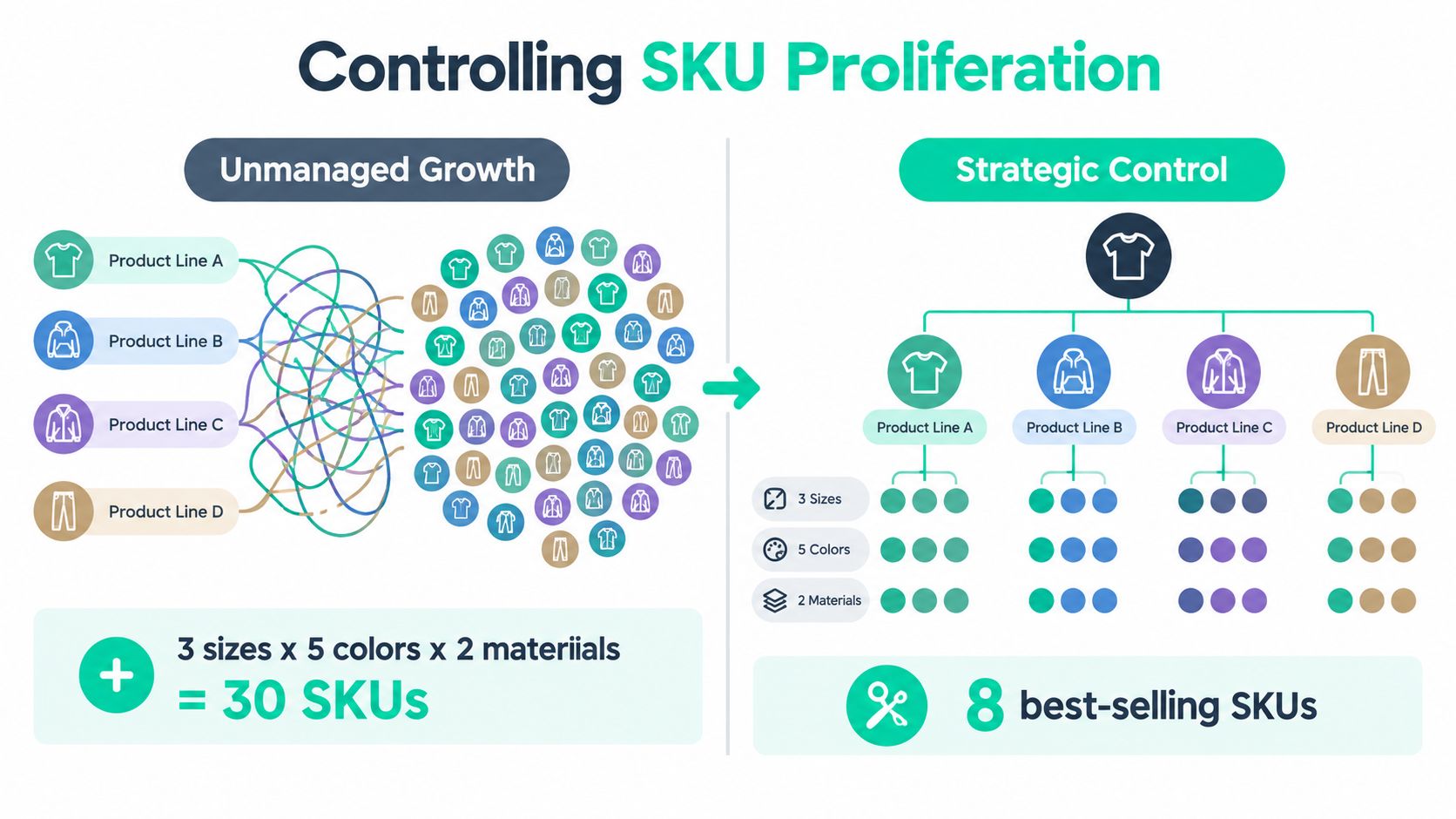
Microsoft's product information guidance shows variant-suggestion interfaces that enumerate all possible combinations from defined dimensions and let teams select only the required ones, instead of generating every permutation automatically (predefined variant controls in Dynamics 365). That's one of the clearest practical controls available: define the valid space, but persist only the combinations you need.
SAP guidance makes a related point. For configurations that occur frequently, teams should create stock variants in advance so manufacturing and inventory are ready. That's different from saying every theoretical configuration should exist in stock. It's a selective strategy.
Controlled creation versus uncontrolled expansion
The difference is easier to see side by side:
| Approach | Result |
|---|---|
| Generate every possible combination | More catalog maintenance, more fragmented stock, more confusion |
| Define allowed dimensions and select only demanded combinations | Cleaner assortment, better replenishment focus |
| Predefine common configurations for stock | Faster operational readiness on repeat demand |
If you're working through this issue, a practical companion topic is SKU rationalization methods for assortments. The useful lens isn't “how do we cut SKUs aggressively?” It's “which choices add value, and which only add administrative drag?”
A decision filter that preserves choice
You don't have to force every assortment discussion into a yes-or-no debate.
Use a three-part filter instead:
- Keep it when the variant has repeat demand, fits existing operational rules, and doesn't create avoidable confusion.
- Retire it when the variant rarely gets selected, complicates inventory planning, or duplicates another option too closely.
- Split it into a separate listing when the option behaves so differently that it needs different storytelling, assets, or fulfillment logic.
Too many teams simplify by counting SKUs. Smarter teams simplify by removing low-value combinations.
That distinction matters. Sometimes the right answer is fewer variants under one parent. Sometimes the right answer is creating a separate product family because the customer intent is different.
Inventory Fulfillment and QA Implications for Enterprise Merch
A launch can look healthy in the catalog and still fail in operations.
A new hire in Germany orders an onboarding kit. The storefront shows the right hoodie color, the right notebook language, and the right power adapter. The warehouse receives a pick list that collapses two child variants into one generic line. The wrong plug ships. The replacement costs more than the item, and People Ops now has to explain why a simple welcome kit arrived half-right. Variant management stops being a catalog question at that point. It becomes a service-level and margin question.
Fulfillment teams feel variant mistakes faster than merchandising teams do because every extra branch in the assortment creates another branch in sourcing, stocking, picking, packing, and exception handling. The practical question is not only how many SKUs exist. It is which variants earn their space by converting often enough, shipping cleanly enough, and pooling inventory well enough to justify the operational overhead.
Why predefined variants improve readiness
Repeated demand should trigger repeated preparation.
Microsoft and SAP both reflect the same pattern in enterprise product setup. Teams work better when common combinations are defined in advance instead of assembled manually at the last minute. In merch operations, that usually means standard shirt-size runs, approved regional inserts, known kitting configurations, and country-specific power or compliance components.
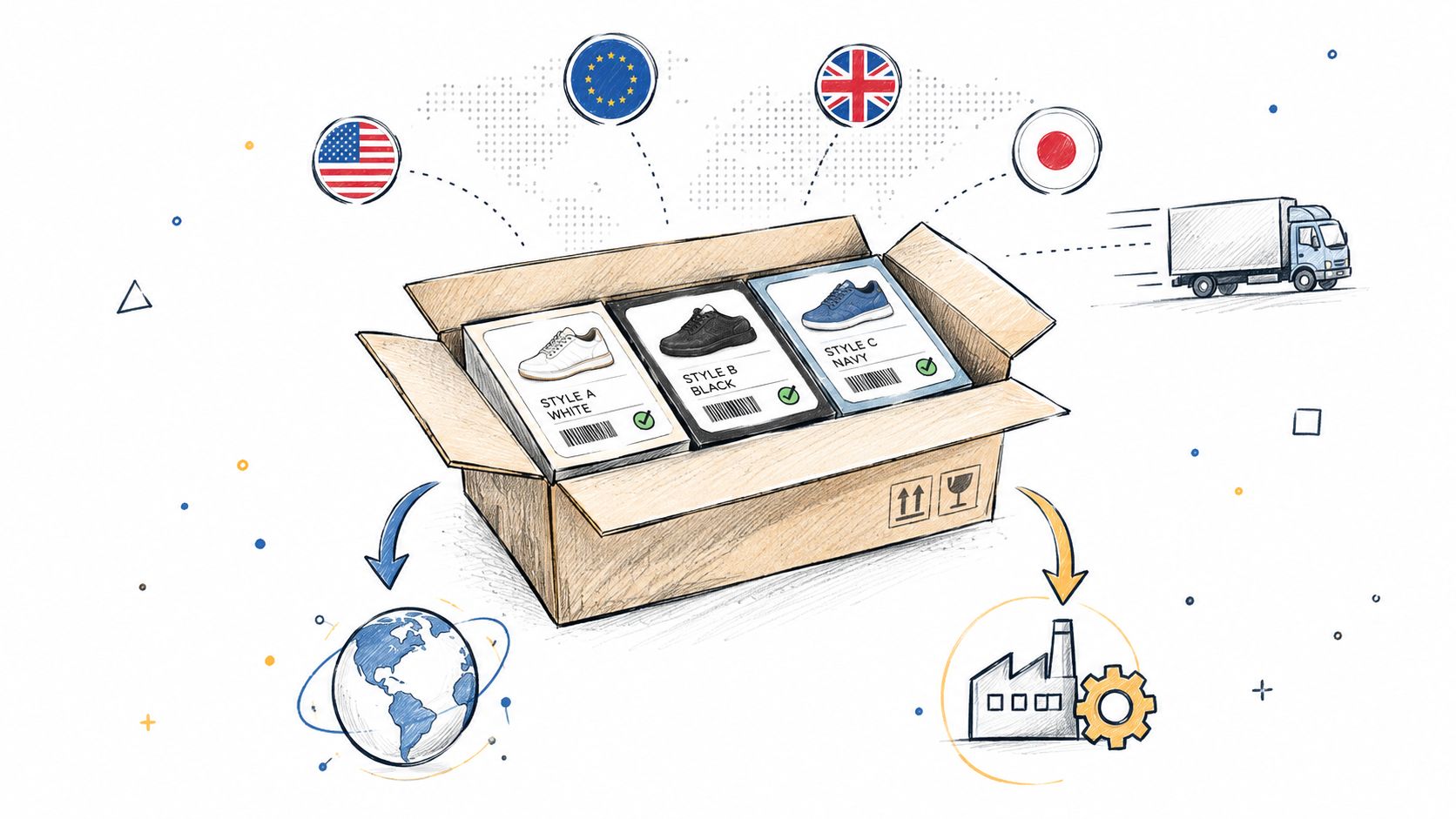
The warehouse analogy is simple. Predefined variants work like marked lanes on a highway. Traffic still moves to different destinations, but the route is clear before the rush starts.
That matters in three places:
- Onboarding kits: Size, language, destination country, and plug type change what must be packed and what can be substituted.
- Event programs: Demand spikes expose every fuzzy rule around size curves, decoration files, and replenishment timing.
- Employee-choice stores: The storefront may show one parent product, but fulfillment still executes against exact child records with exact warehouse mappings.
This is also where commercial performance should guide variant decisions. A variant with low exposure rate may not justify dedicated stock if it rarely appears in storefront traffic or curated assortments. A variant with chronic stock fragmentation can look like healthy inventory on paper while creating repeated partial shortages across locations. Those are good candidates to retire, consolidate, or move to a slower made-to-order path.
Where QA has to inspect at the child-variant level
Parent-level approval is only the first gate.
Child variants are where execution breaks. One colorway can carry the wrong image. One size can inherit an outdated barcode. One regional version can point to the wrong insert or decoration asset. QA needs to test the record that gets picked, packed, and shown to the buyer.
A reliable review flow checks each variant in four places:
Data accuracy
Confirm the SKU, barcode, supplier reference, and lead-time logic match the specific child record.Asset accuracy
Check that images, mockups, print files, and localized content are attached to the correct variant.Fulfillment behavior
Verify pick paths, packaging rules, country restrictions, and warehouse mappings.Commercial behavior
Confirm that the variant displays, prices, and routes correctly in the storefront or ordering flow.
Teams building stronger inspection routines can borrow ideas from AI for Manufacturing quality insights, especially the habit of placing checks close to the point where repeat defects originate. For merch-specific inspection examples, visual quality control for branded products gives a useful operational frame.
What centralized records change
Centralized variant records reduce rework because catalog intent and fulfillment logic stay tied to the same source of truth.
As noted earlier, research on PLM adoption found fewer handoff errors and faster variant readiness after teams aligned product records more tightly. The merch equivalent is straightforward. Fewer mismatches appear between what marketing publishes, what People Ops approves, and what the warehouse can ship.
That does not remove complexity. It contains it.
The commercial benefit is easy to miss if you only count SKUs. Better variant control improves exposure for the combinations that deserve demand, reduces stock stranded across near-duplicate options, and gives replenishment planners clearer signals about what should be kept in stock versus what should remain special-order. That is the operating payoff. Better variant structure protects revenue, service levels, and working capital at the same time.
Automation Rules and the Future of Variant Intelligence
A regional onboarding kit looks simple until one office needs a different power adapter, another requires local-language inserts, and a third cannot receive a branded gift at all. What looks like one product in the catalog is a set of permissions, constraints, and fulfillment paths. At enterprise scale, variant management stops being a naming exercise and becomes a rules system.
The old model treated variants as a static list. Keep the part numbers clean, publish the options, and try to control the combinations by process discipline. That approach breaks once assortment logic depends on geography, material compatibility, compliance, and post-purchase support.
Rules are becoming the core product logic
Independent industry coverage for 2026 describes a shift toward AI-assisted, rules-driven configuration where variant intelligence has to scale across software, localization, and post-sale feature states, not just physical geometry (PLM trends reshaping variant intelligence for 2026). The key question changes. Teams still need to know what variants exist, but they also need to define what makes each variant valid, available, compliant, and supportable.
For enterprise merch teams, the pattern is familiar:
- A gift item is allowed in one country and blocked in another.
- One decoration method is approved for cotton but not for a synthetic blend.
- A localized onboarding kit requires different inserts, language assets, or electrical accessories by region.
Those are variant rules. Many teams just store them in approvals, spreadsheets, or someone's memory instead of the variant system itself.
That distinction matters. A catalog can display options, but rules decide whether an option should be sellable in the first place.
Why CPQ and modular thinking matter
The same 2026 industry coverage argues that CPQ integration is becoming necessary in configure-to-order businesses, and that modular architecture needs to be designed in early instead of added later. The practical lesson is straightforward. If buyers or internal requesters can combine options dynamically, the system has to validate those choices at the moment of selection.
Merch programs already run into lighter versions of that same problem. Employee-choice stores, custom event assortments, and regional onboarding bundles behave like configuration systems even when nobody calls them that. As soon as one fixed kit becomes several approved combinations, manual memory stops scaling.
A useful analogy is a train switchyard. The parent product is the main line. Rules determine which child variants can route to which destination without causing a collision in pricing, compliance, or fulfillment.
When teams depend on tribal knowledge to validate combinations, variant management becomes slow, inconsistent, and hard to audit.
The commercial layer variant teams often miss
Rules keep bad combinations from going live. They do not tell you whether a variant deserves to stay in the assortment.
That decision needs performance signals. Recent neutral coverage points to a set of metrics that many organizations still underuse: active variant count, variant exposure rate, selection rate, add-to-cart rate, availability-adjusted conversion, stock fragmentation, and variant return rate (variant analytics and catalog complexity framework). Those measures help answer whether each variant earns its place in the assortment.
This is the shift from catalog design to commercial performance.
A low-selling variant is not always a weak variant. It may have low exposure because it sits too deep in the option order, lacks localized assets, or goes out of stock before demand can form. On the other hand, a variant with decent demand can still be expensive to keep if it fragments inventory across near-duplicates and creates replenishment noise. Good governance separates those cases instead of treating every low-volume SKU the same.
A workable model looks like this:
| Decision question | Metric lens |
|---|---|
| Is this option being seen? | Exposure rate |
| Do buyers choose it when they see it? | Selection rate |
| Does it improve conversion while available? | Availability-adjusted conversion |
| Does it spread inventory too thin across similar options? | Stock fragmentation |
| Does it create downstream dissatisfaction or avoidable handling? | Return rate |
This framing changes the conversation. Instead of asking how many variants exist, teams can ask which variants drive profitable choice, which ones trap working capital, and which ones need to be split into their own listing because they follow a different commercial path.
One operational tool that supports this style of governed merch execution is FLYP LTD, which runs enterprise merch programs with curation, QA, logistics, budgeting, and reporting as a managed workflow rather than a loose collection of manual handoffs.
Putting Product Variant Management Into Practice
Most companies don't need a perfect variant model on day one. They need a cleaner decision process than the one they have now.
Start by auditing one product family that already causes noise. A hoodie program, onboarding kit, or event store is usually enough. Map the parent product, list every active child variant, and mark which fields are shared versus variant-specific. If teams can't agree on that quickly, your structure needs work before you add more options.
A practical keep retire split framework
Use commercial and operational signals together.
- Keep variants that are selected consistently, stay available, and don't create unusual handling complexity.
- Retire variants that absorb maintenance work without meaningful demand or that repeatedly fragment stock.
- Split a variant into its own listing when it needs different messaging, different assets, or a meaningfully different buying path.
This is also where system discipline matters. A strong merchandise management system for enterprise workflows should let teams govern taxonomy, approvals, inventory logic, and reporting in one place instead of scattering those tasks across spreadsheets and ad hoc storefront edits.
What to put under governance first
Don't try to govern everything at once. Lock down the fields and rules that create the most downstream risk.
Focus first on:
- Variant identity through SKU and barcode consistency.
- Attribute validation so invalid combinations can't slip through.
- Asset QA ownership so teams know who approves child-level imagery and files.
- Performance review cadence using exposure, selection, availability, and return behavior.
If you do those four things well, the rest gets easier. Product variant management becomes less about cleaning up after mistakes and more about making deliberate assortment decisions before they become expensive.
FLYP LTD helps enterprise teams run global merch programs where variant-heavy workflows don't fall apart between design, QA, inventory, and fulfillment. If you're managing onboarding kits, recognition programs, event drops, or employee-choice stores across regions, visit FLYP LTD to see how a managed merch operating system can keep variant logic, brand control, and logistics aligned.