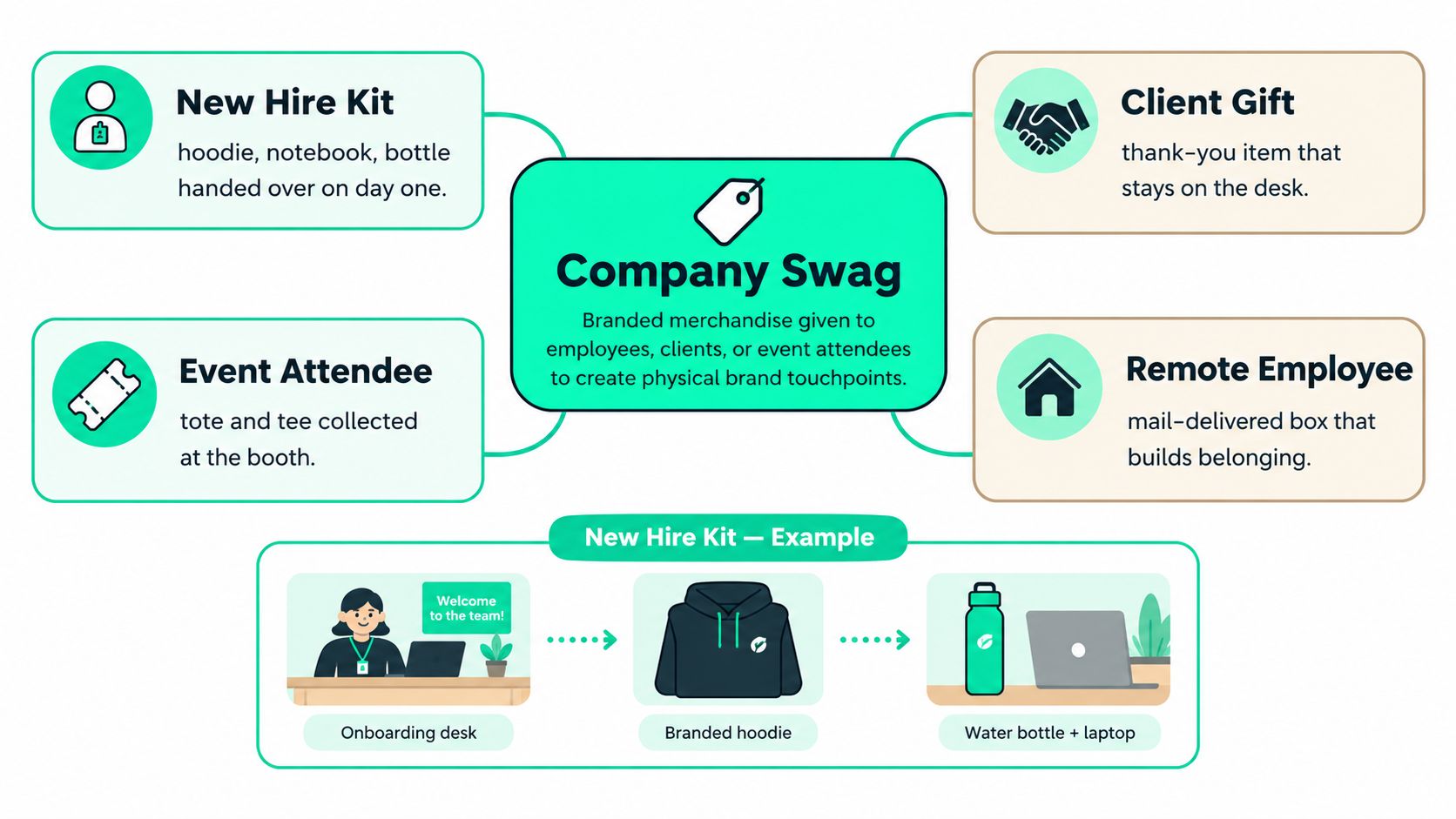
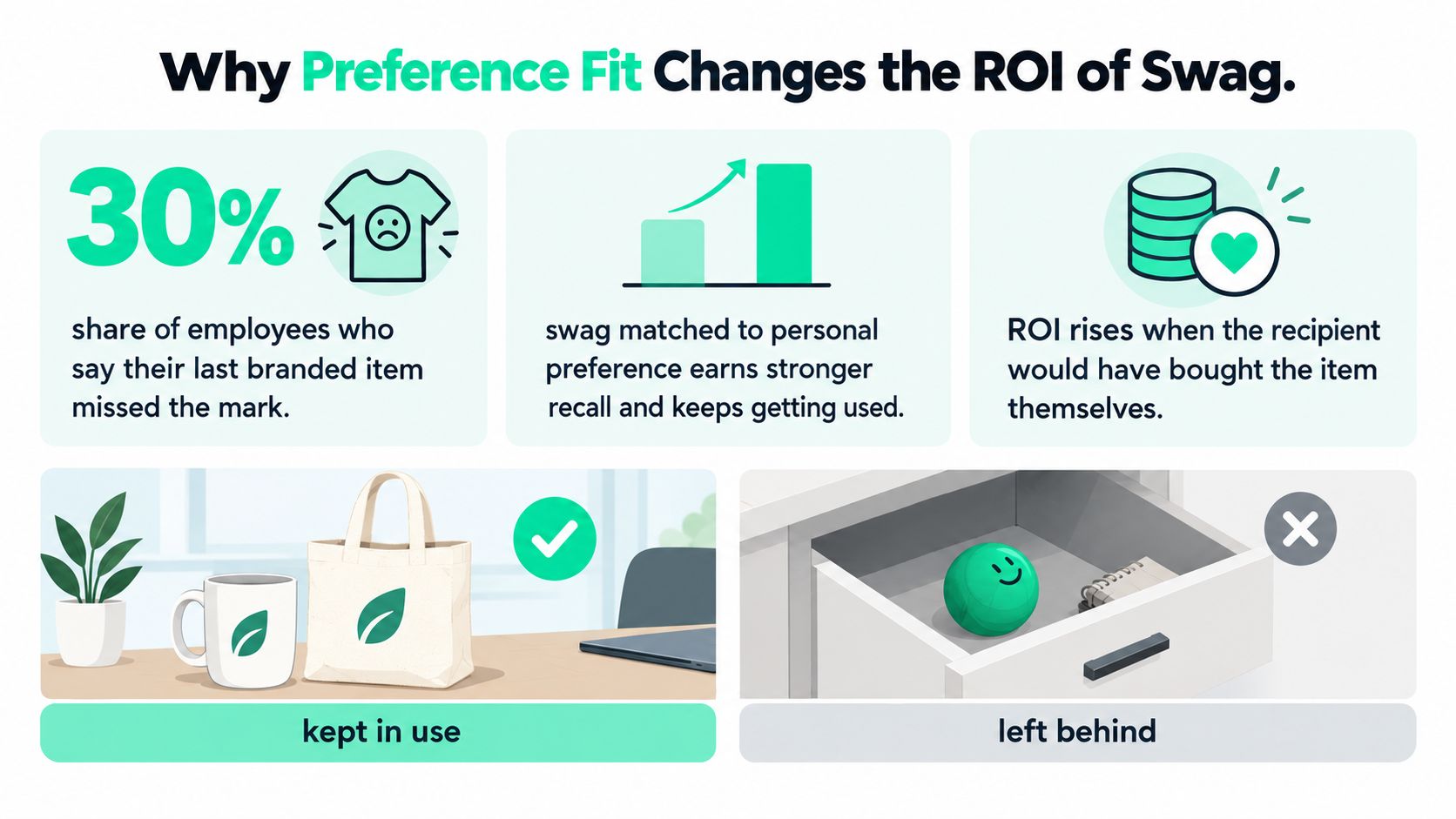
Company swag is branded merchandise given to employees, clients, or event attendees to create physical brand touchpoints. Only about 30% of employees say their last branded item was something they would have chosen for themselves.
That gap changes the question HR and marketing leaders should ask. The issue isn't whether a logo belongs on a hoodie, notebook, bottle, or tote. The issue is whether the right person receives a useful item at the right moment, through a process that protects the brand, controls waste, and works across locations.
Company swag sits inside a large, established commercial channel. U.S. promotional-products estimates place the market at $22.4 billion for 2026, while Promotional Products Association International reported $26.78 billion in U.S. distributor sales volume for 2024, compared with $26.09 billion in 2023. A separate estimate placed 2025 promotional sales at $27.1 billion, showing that branded merchandise remains a substantial business function rather than a collection of casual giveaways (industry market estimate).
For an enterprise, swag is therefore part of employee experience, gifting, procurement, logistics, and brand governance. A successful program makes people feel considered and gives them something they'll use. A weak one creates excess inventory, incorrect sizes, inconsistent decoration, and boxes of unwanted items.
Table of Contents
- What Company Swag Actually Means in 2026
- A Short History of Branded Merchandise
- The Main Ways Companies Use Swag Today
- Why Preference Fit Changes the ROI of Swag
- Governance and Brand-Safety Considerations
- Self-Managed, Distributor, or AI-Native Operating System
- How a Managed Merch Program Works End to End
- Choosing the Right Model for Your Team
What Company Swag Actually Means in 2026
Company swag is branded merchandise given to employees, clients, or event attendees to create physical brand touchpoints. A new hire receiving a curated welcome box on day one is a straightforward example. The box might contain a hoodie, notebook, water bottle, and a short welcome note, but its purpose isn't only to display a logo. It signals that the company prepared for the person's arrival.
Physical items still matter in a digital-first workplace. Employees may spend most of their day in video calls, email, and Slack, where brand interactions disappear into a stream of notifications. A well-made jacket worn on a commute or a bottle used beside a laptop creates a repeated, sensory reminder of the organization. Company swag turns an abstract employer brand into something people can touch, use, and share.
Swag isn't the same as advertising
Advertising usually targets a cold or broad audience. Swag typically reaches someone who already has a relationship with the company, such as an employee, customer, prospect, partner, or event attendee. The objective may be belonging, recognition, appreciation, conversation, or memory, not just reach.
The audience changes the item and the delivery method:
- Employee swag supports onboarding, recognition, team identity, and remote belonging.
- Client gifting expresses appreciation or marks an important relationship moment.
- Event merchandise helps attendees remember an interaction and can extend the event beyond the venue.
The medium is mature, but execution determines its value. In a 2026 survey of 2,500 employees at companies with at least 250 workers in the United States and Canada, 30.5% said their last branded item was exactly what they would have chosen. The remainder liked it but wouldn't have selected it, already owned something similar, or didn't keep it (employee preference survey). That preference gap is the central operating problem. A program can have attractive designs and still waste money if recipients don't want the products.
A Short History of Branded Merchandise
Branded merchandise has survived because it adapts to how people communicate and work. Historical accounts commonly trace an early promotional example to George Washington's 1789 presidential campaign, when commemorative buttons or badges helped build public awareness. The item was small, physical, and easy to recognize, but it carried a persuasive message beyond the moment of distribution.
A later milestone came in 1878, when Jasper Freemont Meek printed a shoe store's name on burlap book bags for local children. The example matters because it connected advertising with utility. The bag wasn't merely a sign. It was something children could carry and use, allowing the brand to travel through ordinary life (history of promotional products).
From novelty to operating channel
The industry gained formal structure in 1904, when 12 manufacturers formed what became the Promotional Products Association International. Over time, lower-cost garments, embroidery, and plastics made branded merchandise accessible to mainstream companies. Apparel eventually became one of the most recognizable surfaces for corporate identity.
That history explains why company swag isn't a passing trend. The objects and production methods changed, but the basic mechanism remained stable: give someone a useful item, and the brand gains a physical presence in that person's routine.
The modern difference is the amount of choice recipients have. A free pen once competed with very little else for attention. Today, a branded item must earn space in a crowded home, closet, or desk. Curation, quality, preference fit, and delivery experience now matter as much as the mark printed on the product.
The Main Ways Companies Use Swag Today
Most programs combine four use cases, but each one has a different trigger, audience, and success criterion. An onboarding kit should make a new employee feel expected. Recognition merchandise should make a specific contribution visible. Event items should support an interaction. Client gifts should reinforce a relationship without feeling generic.
| Use Case | Example Item | Trigger Event | Primary Audience |
|---|---|---|---|
| Onboarding | Hoodie, notebook, and bottle | First day or first week | New employees |
| Recognition | Premium gift selected through a peer-nominated program | Anniversary or achievement | Employees and teams |
| Events | Conference tote or limited-run pin set | Registration, booth visit, or session | Attendees and prospects |
| Client gifting | Curated box with a handwritten note | Renewal, milestone, or appreciation moment | Customers and partners |
Onboarding
A new engineer might receive a welcome kit containing a comfortable hoodie, notebook, and bottle before meeting the manager. The useful items establish a sense of belonging, especially when the employee works remotely and doesn't have a physical office to introduce the company.
The operational detail matters. HR needs a reliable way to collect size and shipping information, distinguish domestic and international addresses, and trigger fulfillment without making each manager assemble a box manually.
Recognition
Recognition works best when the item reflects the meaning of the moment. A five-year anniversary gift can feel more intentional when the employee chooses from a vetted catalog rather than receiving the same object as every other person.
The trigger might come from a work anniversary, peer nomination, completed project, or personal milestone. The important decision is not just what to buy. It's how to make the recipient feel that the company noticed a specific contribution. Teams looking for a broader range of creative employee gift ideas can use the occasion, role, and individual preference as filters rather than starting with a generic product list.
Events
At a conference, a tote or pin set can serve as both merchandise and a reminder of the interaction. A company might reserve a limited item for attendees who scan in at the booth, join a product demonstration, or complete a meeting. That approach gives the item a clear purpose and makes distribution easier to manage.
Client and prospect gifting
A curated box sent before a renewal conversation can acknowledge the relationship without replacing the commercial discussion. A handwritten note, relevant product selection, and accurate delivery often matter more than a large assortment.
The same bottle, jacket, or notebook can support very different goals. The better planning question is, “Who would I choose this for, and when?” Distribution mechanics often determine value more than the product itself.
Why Preference Fit Changes the ROI of Swag
A logo earns attention only briefly. Preference fit determines whether the item becomes useful, gets stored, or is discarded. An employee who already owns similar hoodies, has no use for a novelty desk item, or receives the wrong size cannot get much value from the purchase. The company has still paid for the product, decoration, packing, and delivery.
The ROI problem is therefore operational, not merely creative. The employee preference findings show that the 69.5% of recipients who did not actively choose their item represent spend without a durable preference match. That finding does not make every company-selected product ineffective. It shows why recipient choice should function as an operating control, alongside budget approval and brand review.
Design for choice without losing control
Self-selection does not require an unlimited catalog. HR can offer a short, approved range organized by role, location, tenure, season, or event. An employee might choose a jacket, bottle, bag, or home-office item within a defined allowance. The company still sets the colors, logos, materials, and spending limits. The recipient chooses the product most likely to be used.
Choice also improves the fulfillment model. A team that collects selections before production or shipping has clearer demand than one ordering a large mixed batch in advance. That can reduce stranded sizes, excess inventory, and avoidable replacement shipments. It also gives People Ops a record of what different groups select, which can guide later catalog changes.
Practical rule: Set the boundaries centrally, then give recipients meaningful control within them.
Preference fit should sit alongside occasion and delivery timing. A selected item connected to an anniversary or milestone can feel more intentional than an unplanned promotional drop. The broader principle described in this personalization-at-scale guide is practical: a relevant item, delivered at a relevant moment, has a better chance of being remembered and used.
Governance and Brand-Safety Considerations
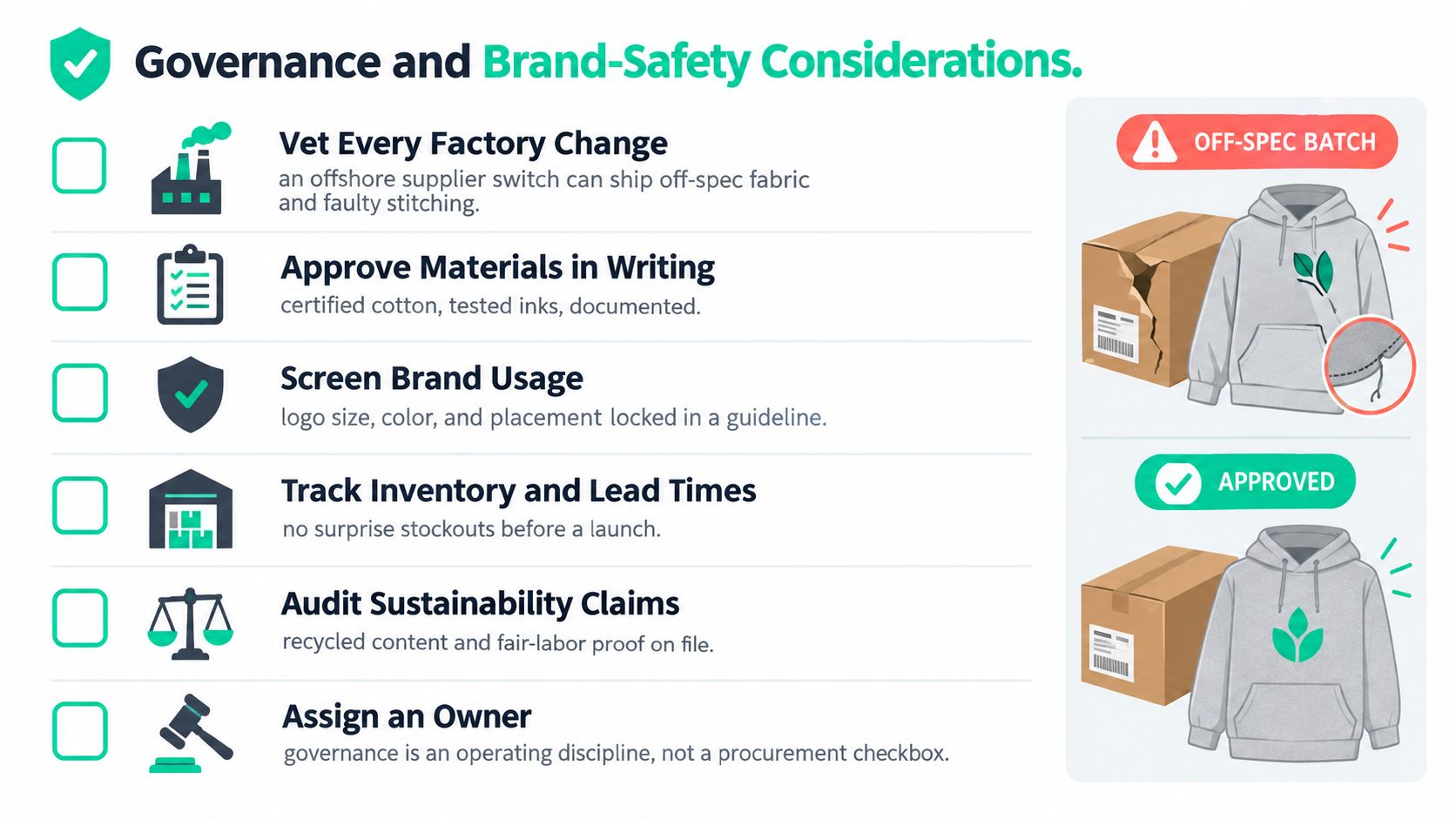
A swag program can fail even when the artwork is approved. An offshore factory may change a material, decoration method, or subcontractor and ship an item that no longer matches the approved sample. A crooked logo is visible, but a weak seam, untested ink, or unsuitable product can create a deeper brand and safety problem.
Governance should operate as a recurring workflow rather than a procurement checkbox.
Five controls belong in the program
Lock brand guidelines at the SKU level. Define approved logo size, placement, thread or ink colors, garment colors, and decoration methods. A general brand PDF isn't enough if vendors interpret it differently for every product.
Set budget rules before ordering. Establish caps by employee, event, recipient group, or occasion. Finance and People Ops should know whether shipping, duties, packaging, personalization, and returns sit inside or outside the allowance.
Sample and inspect. Approve a pre-shipment sample for new products and inspect production batches against it. Track defects, incorrect decoration, missing components, and late deliveries so the team can identify recurring supplier issues.
Protect recipient data. Home delivery requires careful handling of names, sizes, phone numbers, and shipping addresses. Access should be limited, retention should be defined, and regional privacy requirements should be reflected in vendor contracts. Teams building a broader policy framework can use this content governance guide from NanoPIM as a useful reference for ownership and approval discipline.
Document sustainability claims. Ask suppliers to substantiate recycled content, packaging choices, material composition, labor standards, and shipment information. A sustainability statement without supporting documentation shouldn't determine procurement.
Traceability becomes especially important when a program spans suppliers and regions. A practical guide to traceability in manufacturing can help teams think through supplier records, batch information, and handoffs.
Self-Managed, Distributor, or AI-Native Operating System
The operating model determines how much work sits with your team. A small company testing one welcome kit can manage products, artwork, orders, and shipping with spreadsheets. A distributed enterprise running onboarding, recognition, event drops, and client gifting needs a system that treats each trigger as part of one program.
Three models in practice
Self-managed programs offer direct control. A People Ops lead chooses products, contacts vendors, stores inventory, assembles kits, and tracks addresses. This can work for a small team with limited variation, but the administrative burden grows as soon as sizes, locations, events, and replenishment enter the picture.
Traditional distributors reduce sourcing work through an account representative and established supplier relationships. They're useful for large, one-off orders where product choice is standardized. Manual order forms, static catalogs, and separate fulfillment conversations can become constraints when employees need individual choice or when the company ships across multiple jurisdictions.
AI-native operating systems sit between the brand and supplier network. They can centralize approved designs, product curation, stores, recipient choice, fulfillment, and reporting. The important distinction isn't that artificial intelligence replaces every decision. It's that the operating system can turn a brief or company brand input into a controlled workflow instead of leaving each request in a separate spreadsheet.
| Dimension | Self-Managed | Traditional Distributor | AI-Native Operating System |
|---|---|---|---|
| Cost transparency | Direct product control, but hidden staff time | Quote and order dependent | Centralized spend and fulfillment view |
| Global reach | Team coordinates each destination | Depends on distributor network | Designed for distributed fulfillment |
| Personalization | Manual and difficult to maintain | Available, often order-based | Built into stores, triggers, and recipient flows |
| Data | Spreadsheets and disconnected records | Vendor reports and invoices | Dashboard by team, event, and recipient group |
| Operations overhead | High once volume and variety grow | Moderate, with manual coordination | Lower for repeatable, multi-use-case programs |
Design is one area where the models differ sharply. A team can create artwork manually, use a distributor's catalog, or test an AI design tool before sending approved concepts into production. Whatever tool is used, the brand owner still needs a review step for placement, color, product suitability, and production accuracy.
How a Managed Merch Program Works End to End
A managed program starts with a brief, not a product search. The brief identifies the audience, occasion, geography, budget boundary, timing, brand rules, and desired recipient experience. A welcome kit for remote hires has different requirements from a conference drop or customer renewal gift.
The operating flow
Intake the brief. The program owner records the trigger, audience, locations, sizes, delivery method, approval rules, and reporting needs.
Curate suitable products. The operator filters products by quality, utility, material, climate, role, and occasion. The result should be a focused selection, not an overwhelming catalog.
Review design and compliance. Brand owners approve decoration, placement, color, copy, and production samples. The team records the approved version so suppliers don't work from outdated files.
Prepare kits and orders. Products are decorated, packed, and matched to recipients. Choice-based programs collect sizes and addresses before fulfillment, while bulk event orders may ship to a central venue.
Fulfill by recipient or location. Individual redemption links let recipients enter their own size and shipping address. This replaces much of the bulk-shipping guesswork and can reduce mis-shipments for distributed teams, as described in current recipient fulfillment coverage.
Report after delivery. The program owner reviews fulfillment status, delivery exceptions, selection patterns, returns, defects, engagement signals, and spend by team or occasion.
The value of this workflow is coordination. Design, procurement, data handling, warehousing, shipping, and reporting share one operating record instead of living across email threads and disconnected vendor portals.
Choosing the Right Model for Your Team
Choose the model based on program maturity, distribution complexity, and the reason you're sending merchandise.
A small team testing a single onboarding idea can start with self-managed purchasing and a tightly limited product range. Keep the catalog short, record every order, and learn which items employees use before committing to a recurring program.
A large marketing team placing a standardized event order may prefer a traditional distributor. That model is practical when quantities, products, artwork, and delivery location are already known, and when recipients don't need individual selection.
A distributed company running continuous onboarding, anniversaries, events, and gifting needs an AI-native managed operating system. It becomes more appropriate when the team needs recipient choice, global delivery, brand controls, supplier coordination, and reporting in one place.
Common questions
What should we budget per employee?
There isn't a responsible universal figure. Set the allowance by occasion, audience, product quality, shipping geography, personalization, and tax treatment. Compare the full landed cost, not only the blank item price.
Do we need a minimum order quantity?
Not always. On-demand and recipient-choice models can avoid large pre-buys, but product and supplier rules vary. Confirm minimums for each approved SKU before promising employee choice.
How should we assess sustainability?
Request evidence for material content, packaging, labor standards, production location, and shipment practices. Prefer durable products that recipients select and use over large volumes of disposable giveaways.
Can employees receive swag at home?
Yes, but the program must treat addresses, sizes, and contact details as personal data. Limit access, define retention, use appropriate vendor agreements, and give recipients clear information about delivery and returns.
The best company swag program isn't the one with the most products. It's the one that gives the right people useful choices, delivers them reliably, and lets the organization learn from every order.
FLYP LTD helps enterprise teams run onboarding kits, recognition moments, event drops, and employee-choice stores through managed curation, brand-safe production, fulfillment, logistics, and reporting. Visit FLYP LTD to explore how your team can turn company swag into a controlled employee-experience program.