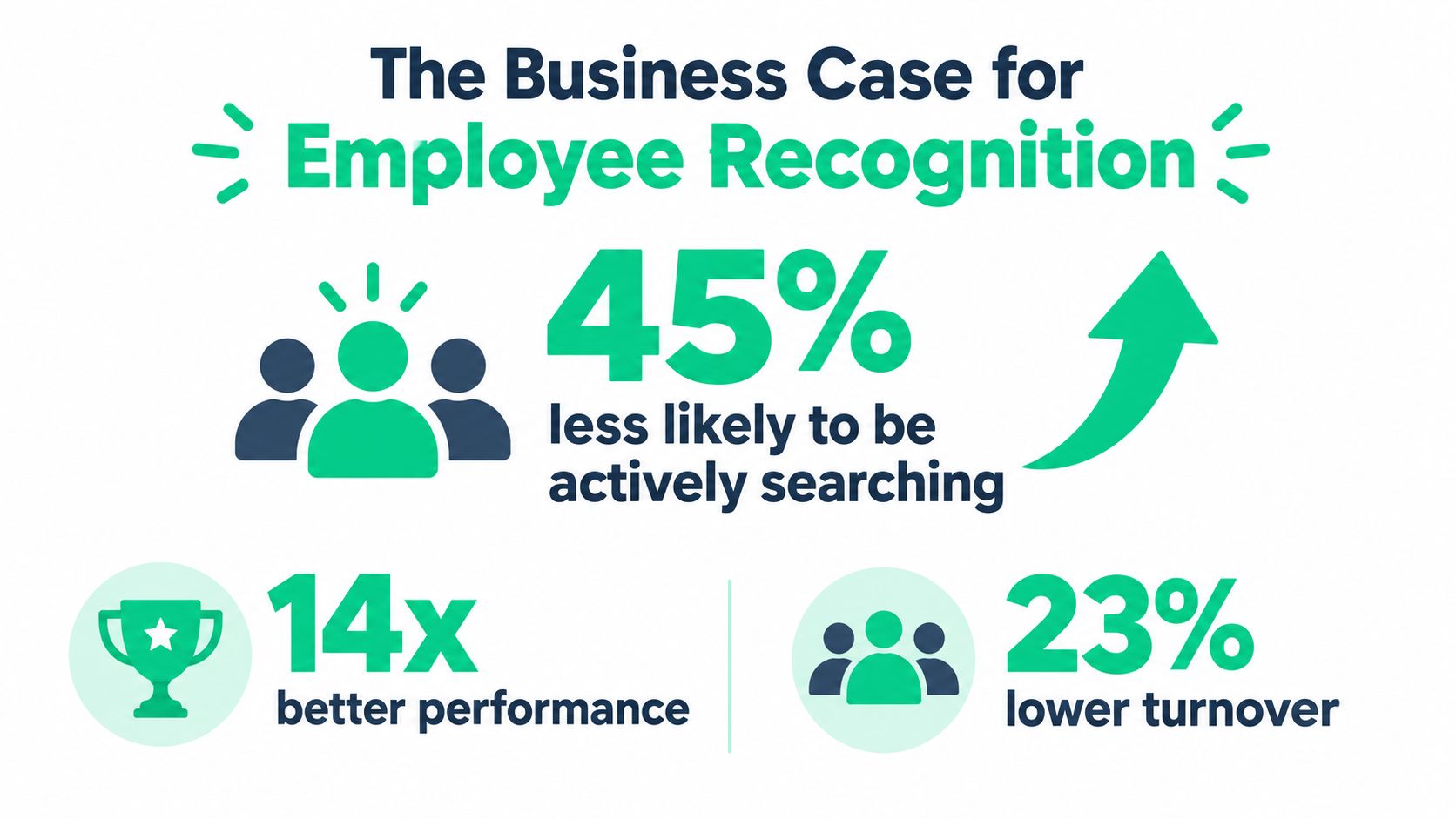
Well-recognized employees are 45% less likely to turn over after two years, making employee recognition a measurable retention tool rather than a soft workplace perk. Employee recognition is the deliberate acknowledgment of an employee's effort, behavior, contribution, or result in a way that reinforces value and purpose.
That definition matters because recognition isn't the same as giving everyone generic praise or sending a gift after a long tenure. Effective recognition connects a specific action to a meaningful outcome, company value, or team contribution. It can be private or public, formal or spontaneous, monetary or non-monetary.
For People Ops leaders, the practical question isn't whether recognition feels good. It's whether the organization can design recognition that employees experience as authentic and that leaders can evaluate through retention, engagement, and performance indicators.
Table of Contents
- The Business Case for Employee Recognition
- Understanding the Core Types of Recognition
- How Recognition Impacts Engagement and Performance
- Formal Versus Informal Recognition Programs
- Designing a Measurable Recognition Program
- Recognition Moments Across the Employee Lifecycle
- Scaling Recognition Globally with AI and Brand Safety
- Next Steps for Building a Recognition-First Culture
The Business Case for Employee Recognition
Gallup's longitudinal study tracked 3,447 employees from 2022 to 2024 and found that well-recognized employees were 45% less likely to have turned over after two years and 65% less likely to be actively looking for another job. Those findings connect recognition with workforce stability, which puts it in the same operational conversation as manager effectiveness, career development, and employee experience. Gallup's retention research treats recognition as a measurable workforce lever, not merely a morale activity.
The gap between impact and attention remains significant. Only 22% of employees said they received the right amount of recognition, while just 19% of senior leaders and managers viewed recognition as a major strategic priority at the time of the study. For an HR leadership team, that mismatch is a signal. Employees may experience recognition as a daily indicator of whether their work is visible, while executives may still treat it as an occasional engagement initiative.
Recognition as a management control
Recognition helps leaders reinforce the behaviors they need repeated. A manager who acknowledges careful customer communication, reliable project ownership, or effective cross-functional collaboration gives the employee a clearer performance signal than a generic “well done.” The organization also learns which contributions leaders notice and reward.
Recognition doesn't replace fair pay, manageable workloads, or credible career paths. It works alongside them by making contribution visible. Teams that need a practical way to document contributions can also use resources such as employee appreciation statements to make acknowledgment more specific and consistent.
The ROI conversation should therefore include measures such as regrettable turnover, intent to stay, recognition reach, and employee responses to questions about feeling valued. Recognition earns a place on the leadership agenda when People Ops connects those measures to business priorities instead of presenting appreciation as an isolated cultural benefit.
Understanding the Core Types of Recognition
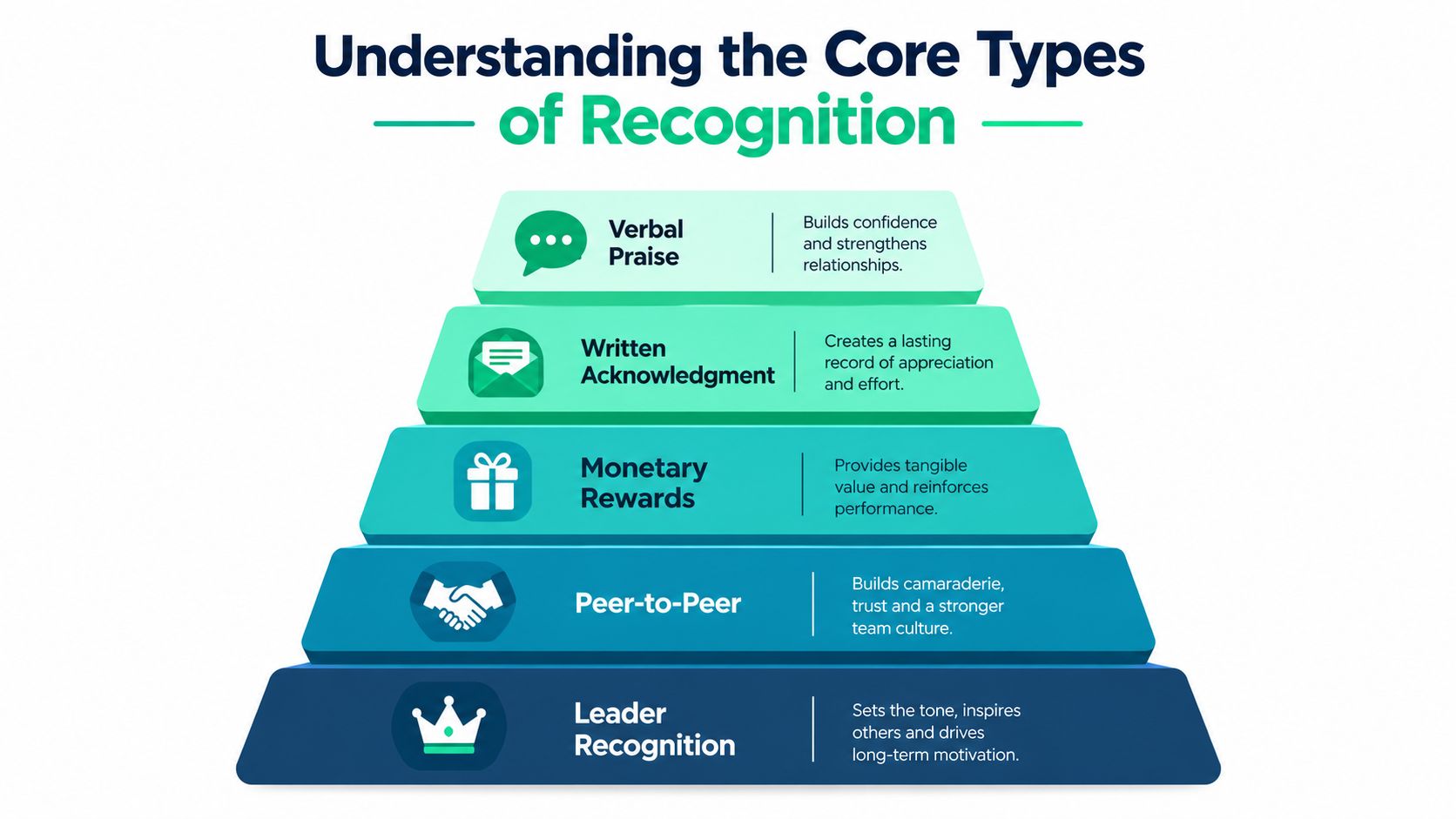
Employee recognition takes several forms, and each one solves a different workplace need. A manager's immediate praise can reinforce a behavior. A peer nomination can make collaboration visible. A milestone award can mark sustained contribution. Strong programs combine these forms instead of forcing every achievement into one annual ceremony.
Verbal praise
Verbal recognition is the fastest format. A team lead might say, “Your decision to clarify the customer requirement before development started prevented rework.” The specificity matters because it identifies both the action and its value. A vague compliment may feel pleasant, but a precise one teaches the employee what to repeat.
Written acknowledgment
A personal email, message, or handwritten note gives recognition a lasting form. Written acknowledgment works well after a demanding launch, a difficult customer interaction, or a behind-the-scenes contribution that could easily be missed in a group meeting. It can also help managers recognize employees who prefer private feedback.
Peer-to-peer recognition
Colleagues often see helpful behavior that managers don't. A message in a team channel thanking a coworker for answering urgent questions, sharing expertise, or supporting a new hire makes collaboration visible. Peer recognition also prevents appreciation from becoming entirely top-down.
Tangible rewards
A reward can accompany recognition, but it shouldn't carry the entire message. A choice of merchandise, a voucher, learning opportunity, or extra flexibility becomes more meaningful when the organization explains what contribution earned it. Reward ideas should reflect different preferences rather than assuming every employee values the same item. Teams looking for practical formats can review employee recognition awards ideas while keeping the acknowledgment specific.
Public celebration
A company meeting, internal newsletter, project demo, or anniversary event can celebrate individual or team achievements. Public recognition is useful when visibility itself matters, such as highlighting a safety improvement or demonstrating a company value. Ask the recipient's preference first, because public praise can energize one person and discomfort another.
How Recognition Impacts Engagement and Performance
Recognition affects performance most effectively when employees understand what they did well and why it mattered. “Great work” offers approval, but it doesn't provide much direction. “You simplified the implementation notes, which helped the support team answer customer questions faster” links behavior, capability, and outcome.
The CIPD evidence review on non-financial recognition concludes that recognition has a moderate-to-large effect on workplace performance. Its review found that performance increased by about 19% in low-meaning roles, while the incremental lift disappeared in high-meaning roles. That distinction is useful for program design. Recognition may act as a stronger performance amplifier when the work itself provides less intrinsic meaning.
Practical rule: Recognize the behavior, explain the consequence, and connect both to a value or goal.
Frequency doesn't equal meaning
A recognition program can create plenty of activity without creating much value. An automated badge, a repetitive message, or a monthly nomination that lacks context may register as administrative noise. Meaningful recognition answers three questions:
- What happened? Name the action, result, or behavior.
- Why did it matter? Explain the effect on customers, colleagues, quality, safety, or progress.
- What should continue? Identify the strength or value worth repeating.
This distinction matters because recognition quality can lag behind recognition frequency. People Ops teams should ask employees whether recognition feels specific, fair, timely, and connected to work that matters. Managers should also learn whether an employee prefers a private conversation, a written note, or public acknowledgment.
Recognition supports engagement when it makes contribution legible. Employees can see how their work fits into the wider operation, and managers gain a practical channel for reinforcing standards without waiting for a formal review. The result isn't guaranteed by praise alone, but a well-designed practice gives leaders a clearer way to shape performance and belonging.
Formal Versus Informal Recognition Programs
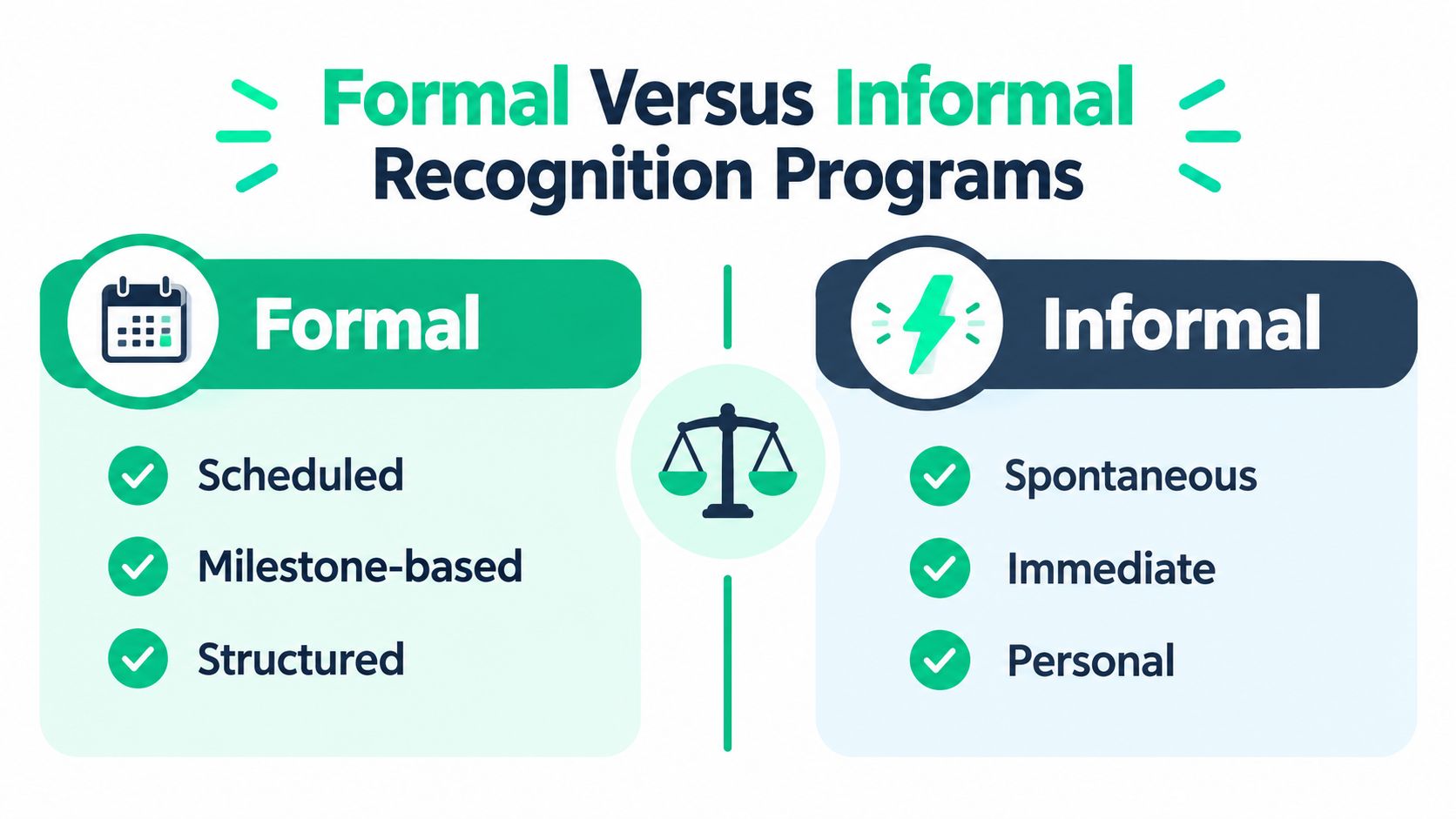
Formal and informal recognition solve different problems. A formal program gives the organization structure, eligibility rules, approval workflows, and an audit trail. Informal recognition gives managers and peers the freedom to respond immediately to work happening in real time.
| Formal recognition | Informal recognition |
|---|---|
| Scheduled or milestone-based | Spontaneous and immediate |
| Uses defined criteria | Responds to a specific moment |
| Supports consistency and reporting | Supports authenticity and personal connection |
| May include awards or rewards | Often uses words, messages, or small gestures |
| Requires program ownership | Depends heavily on manager and peer habits |
Where formal programs help
Formal recognition works well for work anniversaries, major launches, safety contributions, peer nominations, values awards, and team achievements. It can reduce the risk that recognition reaches only the employees who work closest to senior leaders. Clear criteria also help People Ops review whether different functions, locations, and working patterns receive comparable access.
The risk is transactionality. If employees must wait for a quarterly event to be recognized, the connection between action and acknowledgment weakens. A formal process can also become a popularity contest if nominations reward visibility rather than contribution.
Where informal recognition helps
Informal recognition belongs in one-to-ones, project retrospectives, team chats, customer feedback reviews, and daily manager conversations. It costs little to administer and can be highly personal. Its weakness is inconsistency. Some managers naturally recognize others, while equally capable managers may rarely do so.
Research on recognition quality illustrates why a blended approach matters. Achievers' employee recognition research found that 62% of employees reported receiving meaningful recognition in the past three months, while 43% said their manager recognized them at least monthly. The difference shows why more frequent contact doesn't automatically produce meaningful recognition.
Use employee recognition program examples as inspiration, then choose a model with both a reliable formal backbone and everyday manager behavior. The program should make recognition easy to give without making it feel automated.
Designing a Measurable Recognition Program
A measurable recognition program starts with a business question. If retention is the concern, track whether recognized employees report stronger intent to stay and whether turnover patterns change over time. If performance is the concern, connect recognition to observable behaviors such as quality, customer care, collaboration, or delivery reliability.
Build the operating model
Start with a short design brief that defines:
- Purpose: Specify the business outcome the program supports.
- Behaviors: List the actions and values leaders want to reinforce.
- Audiences: Include managers, peers, project leads, and distributed teams.
- Formats: Combine private praise, public acknowledgment, awards, and choice-based rewards.
- Governance: Set rules for eligibility, approvals, privacy, tax handling, and accessibility.
Don't measure only how many awards were issued. A high volume can hide weak quality or uneven participation. Track recognition reach, recognition frequency, time between contribution and acknowledgment, and employee ratings for specificity, fairness, and meaning.
Connect recognition to people data
Add recognition questions to engagement surveys, such as whether employees feel their contributions are noticed and whether recognition reflects the work that matters. Compare responses across teams and locations without using the data to rank individuals mechanically. Pair survey feedback with turnover rates, retention risk indicators, internal mobility, and manager effectiveness results.
Recognition data should help leaders notice patterns, not turn appreciation into a leaderboard.
Manager training is essential. Give managers a simple writing formula: describe the contribution, identify the impact, and connect it to a value or goal. Show examples from engineering, operations, sales, customer support, and corporate functions so the guidance doesn't privilege only highly visible work.
Technology can centralize nominations, trigger milestone reminders, distribute employee-choice credits, and produce reporting. It can't determine whether a message is sincere. For reward architecture and practical program formats, People teams can also review employee recognition gift programs. Pilot the model with a defined group, gather employee feedback, adjust the criteria, and then expand once the reporting and manager habits work together.
Recognition Moments Across the Employee Lifecycle
Recognition works best when it appears at moments employees already understand. A new hire might receive a welcome message from the team, a useful onboarding kit, and a personal note from the manager explaining why their role matters. The gesture isn't valuable because it is expensive. It signals that preparation happened before the employee arrived.

During the first project, recognition can focus on learning and contribution rather than final outcomes. A manager might acknowledge how a new employee asked useful questions, documented a process, or helped another colleague understand a system. That tells the employee which behaviors build trust while they're still forming an understanding of the workplace.
Project completion creates another natural moment. The project lead can thank the team for a specific problem solved, identify the collaboration that protected the deadline, and give each contributor a choice about how the team celebrates. Recognition becomes more credible when it includes less visible work, such as testing, coordination, documentation, or operational support.
Milestones need context
A work anniversary, promotion, certification, or major customer win deserves more than an automated notification. The manager should explain the employee's contribution across time and invite peers or customers to add relevant messages. A milestone then becomes a record of impact rather than a generic date marker.
Global teams need consistency without cultural uniformity. Set brand-safe templates, translation standards, accessibility requirements, privacy preferences, and local reward rules. Let local leaders choose the tone and format when public celebration has different meanings across offices. The operating principle is simple: create a dependable experience, then leave room for human judgment.
Scaling Recognition Globally with AI and Brand Safety
Technology can extend recognition across time zones, but scale creates a risk. If AI drafts every message, selects every reward, and sends every milestone automatically, employees may receive technically accurate recognition that feels emotionally empty.
A 2025 multi-country study found that 70% of employees said technology is important to recognition, yet 74% still expected in-person recognition to become dominant, and nearly two-thirds feared AI would make recognition less personal, according to O.C. Tanner's state of employee recognition research. Employees aren't rejecting technology. They're asking organizations to use it without outsourcing the human relationship.
Assign AI the administrative work
AI-assisted systems can identify milestone dates, suggest relevant reward options, translate draft messages, route approvals, and flag missing information. They can also help People Ops maintain consistent brand presentation across offices and prevent an employee from receiving an unsuitable or duplicate reward.
The manager should still provide the meaning. A useful workflow might generate a draft from a project record, then require the manager to add the specific action, verify the impact, and choose whether the recipient wants public or private recognition. That keeps automation in a supporting role.
Brand safety extends beyond logos. Global recognition teams should define approved product categories, imagery, language, cultural boundaries, accessibility standards, and escalation rules. Employee-choice stores can preserve personal agency, while curated options can protect quality and brand fit.
Use AI to remember the moment. Use a person to explain why it matters.
Review recognition output for bias as well. If the system only surfaces measurable sales or public project wins, it may overlook mentoring, documentation, care work, and operational reliability. Technology should widen visibility, not narrow the definition of contribution.
Next Steps for Building a Recognition-First Culture
A recognition-first culture doesn't begin with a platform. It begins with a clear agreement about what the organization values and how employees should experience that value in everyday work.
Start with an audit. Review recent recognition across functions, levels, locations, and working arrangements. Ask employees whether acknowledgment is timely, specific, fair, and aligned with their preferences. Look for blind spots, such as remote employees who rarely appear in public celebrations or operational teams whose contributions are noticed only when something goes wrong.
Next, pilot a focused program. Choose a business outcome, define the behaviors that support it, train managers, and combine informal acknowledgment with a formal mechanism. Track recognition reach, quality feedback, engagement responses, and turnover patterns. Treat the pilot as an operating experiment, not a publicity campaign.
Finally, scale only after the human process works. Technology can handle reminders, workflows, employee-choice rewards, reporting, and global logistics. Leaders still need to model specific recognition, protect fairness, and listen when employees say a reward or format doesn't feel meaningful.
The practical definition of success is straightforward. Employees know what contribution matters, managers recognize it close to the moment, peers can participate, and People Ops can see whether the practice supports retention and performance. That is how recognition moves from a soft perk to a credible management system.
FLYP LTD helps People Ops teams run onboarding kits, milestone gifts, recognition moments, event drops, and employee-choice stores with branded merchandise, curation, logistics, budgeting, and reporting managed end to end. Visit FLYP LTD to explore a practical way to scale recognition globally while keeping the employee experience personal.