A zero inventory production system can deliver measurable savings, not literal zero stock: one make-to-order study found average inventory savings of 18.1%, while NCR Dundee reduced inventory from 47 days to 5 days after switching to JIT. In another modeled operation, a three-day customer lead time reduced ancillary inventory by 50%, freeing $550K in capital and creating $122K in carrying-cost savings.
Your team may recognize the pattern. A product gets approved, a batch gets ordered, cartons occupy warehouse space, and months later someone is discounting the items nobody wanted. At the same time, the products customers do want may be unavailable because the forecast missed the moment.
A zero inventory production system changes the trigger. Instead of producing first and hoping demand follows, the business lets an actual order or consumption signal start the flow. That doesn't mean warehouses, raw materials, work in progress, or safety buffers disappear in every operation. It means the company treats inventory as a controlled operational choice rather than an automatic byproduct of forecasting.
For manufacturers, this is an advanced form of pull-based production. For creators and brands, print-on-demand platforms turn the same principle into a practical merchandise model. The operating question isn't whether stock can reach literal zero. It's whether a business can reduce idle goods without making customers absorb the consequences of unreliable production.
Table of Contents
- The Case Against Warehouse Waste
- How Zero Inventory Production Actually Works
- Proven Financial Benefits and Capital Release
- Hidden Risks of Speed and Supply Chain Fragility
- Real-World Applications for Creators and Enterprises
- Implementing an AI-Native Merchandise Strategy
- Navigating Compliance and Measuring ROI
The Case Against Warehouse Waste
The traditional push model begins with a forecast. A merchandising team predicts demand, procurement buys materials, a factory produces a batch, and the warehouse waits for customers to validate the decision. That sequence works when demand is stable and products change slowly. It becomes expensive when tastes shift, campaigns expire, or a creator's audience responds to a design in an unexpected way.
A warehouse doesn't just hold finished products. It holds cash, packaging, handling effort, floor space, and decisions that haven't yet been proven by a sale. Unsold stock can become obsolete, require markdowns, or compete for attention with newer products. The business may still report revenue growth while its working capital remains trapped in items that have not earned their place in the assortment.
The customer experience problem
Excess inventory is usually discussed as a finance issue, but it also affects what customers can buy. A brand with a large catalog may promote whatever it already has on hand, even when the audience is asking for a different size, color, or design. The warehouse dictates the offer instead of the customer shaping it.
A demand-triggered model reverses that relationship:
- Forecasting becomes a guide: Teams can use audience signals and historical demand, but they don't need to convert every prediction into physical stock.
- Product variety becomes less expensive to test: A brand can present more concepts without committing to a large batch before demand is known.
- Customer interest becomes an operating signal: An order can initiate production instead of merely reducing a pre-existing pile of goods.
- The assortment stays fresher: Products don't need to occupy storage space before a buyer has demonstrated interest.
The practical goal is not to eliminate every buffer. It is to stop treating unsold inventory as the price of having a broad, responsive offering. Teams reviewing the mechanics can use this guide to reduce inventory costs without sacrificing operational control.
Practical rule: Don't call an item lean because it isn't in your warehouse. Call it lean when the entire order-to-delivery flow is reliable enough to serve demand without forcing unnecessary stock upstream.
Zero inventory production proves valuable for creator merchandise here. A creator can launch a limited design, a company can offer an employee-choice store, and the production decision can wait until someone wants the item. The brand gets a wider creative surface, while the customer receives a product selected by demand rather than by a warehouse clearance plan.
How Zero Inventory Production Actually Works
Zero inventory production is a pull-based flow model, not a promise that no material exists anywhere. Replenishment starts with actual consumption, a confirmed customer order, or another verified demand signal. The operating objective is to keep on-hand balances as close to zero as practical by synchronizing supply, production, and transport timing.
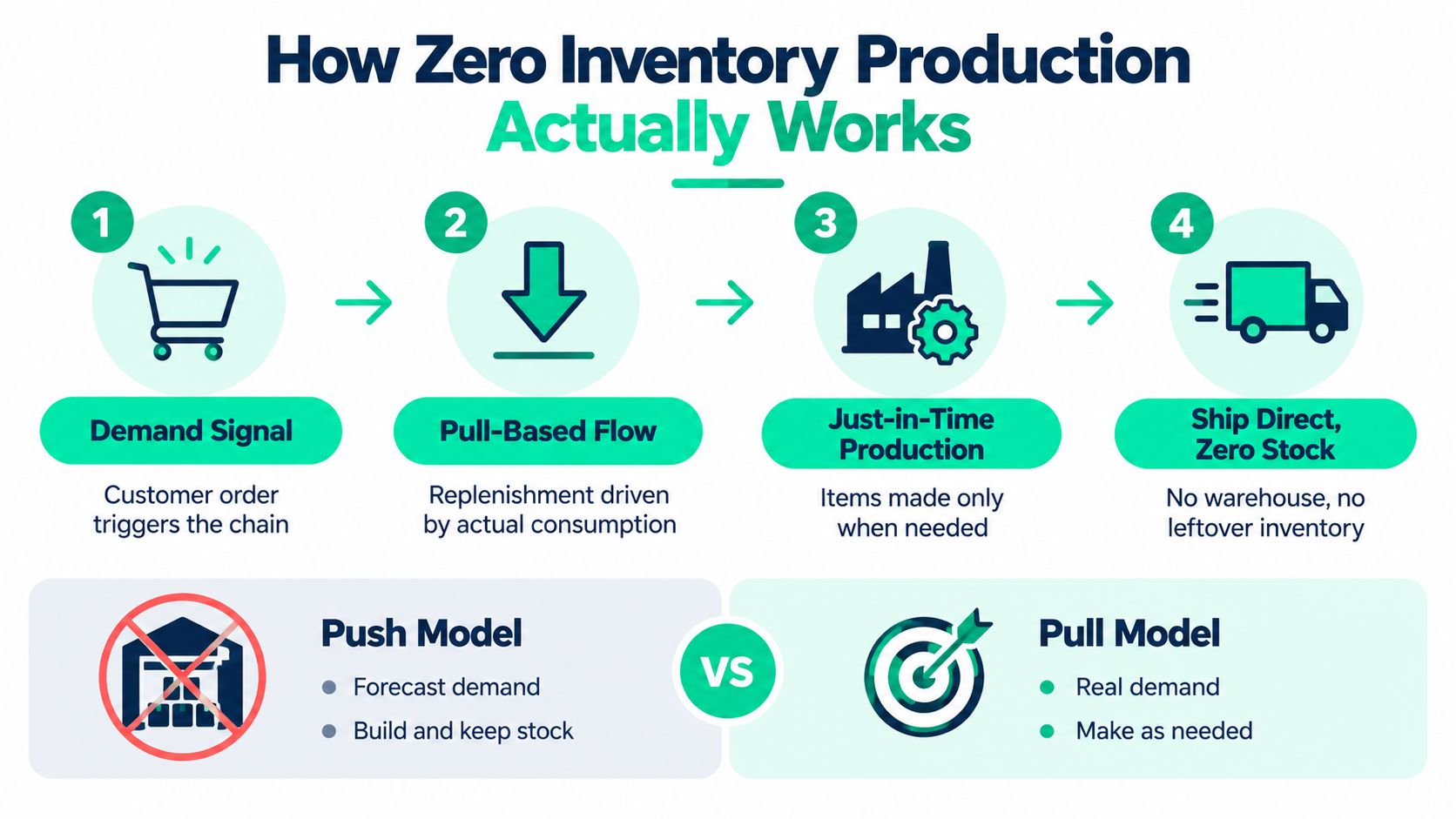
A push system produces ahead of demand and moves finished goods into storage. A pull system waits for downstream demand, then sends a signal upstream. That distinction changes what the operations team manages. Instead of asking how much stock to buy for an uncertain future, the team asks how quickly and reliably it can respond to a real order.
The four operating stages
Demand signal: A customer places an order, or a downstream process confirms that an item has been consumed. The signal needs accurate product, size, quantity, destination, and service information.
Pull-based flow: The order moves to the relevant production or fulfillment partner. The partner receives a specific requirement rather than a speculative batch request.
Just-in-time production: Manufacturing begins only when the order is authorized. Small-batch or single-unit production limits the time goods spend waiting between operations.
Direct shipment: The finished item moves to the customer, ideally without entering a conventional storage cycle. The less handling and dwell time the workflow contains, the closer the system gets to its intended economic model.
The mechanism depends on more than software. Short, predictable lead times, dependable suppliers, accurate product data, and clear handoffs reduce the need for safety stock. Real-time visibility helps the team know whether an order is queued, in production, held for quality review, or ready to ship. Small-batch replenishment reduces the capital tied up in goods that are waiting for their next process.
For marketplace sellers, the same logic applies beyond manufacturing. A storefront can accept an order first and route it to production afterward, but the seller still needs to protect account performance, communicate delivery expectations, and prevent overselling. A practical resource on how to protect TikTok Shop health without stock is useful because the absence of owned inventory doesn't remove channel responsibilities.
The distinction between a true demand-triggered flow and an empty warehouse is covered in more detail in this explanation of zero inventory. The warehouse may be smaller or located elsewhere, but the operating discipline remains the same. The business must know who owns each step after the order arrives.
Proven Financial Benefits and Capital Release
The financial case rests on a simple sequence. When a company produces only after demand is confirmed, it reduces the amount of cash committed before a sale. When it shortens the time between order and shipment, it can also reduce the amount of inventory needed to protect the process.
The documented evidence is stronger than the slogan but more nuanced than “zero inventory saves everything.” The make-to-order study reported average inventory savings of 18.1%. The 1998 NCR implementation in Dundee, Scotland switched to JIT over a weekend, eliminated buffer inventories, reduced inventory from 47 days to 5 days, cut flow time from 15 days to 2 days, moved 60% of purchased parts to JIT arrival, and sent 77% dock-to-line. MIT inventory automation research modeled a three-day customer lead time, a 50% reduction in ancillary inventory, $550K in released capital, and $122K in carrying-cost savings. These figures are documented together in the research on inventory savings and automated flow.
What the numbers actually prove
They don't prove that every company can reproduce the same result. Each operation has different suppliers, demand variability, product complexity, labor constraints, and transport conditions. They do show that inventory reduction is not merely an accounting exercise. Changes in lead time, delivery timing, and flow design can materially affect cash tied up in operations.
The Dundee example is particularly useful because it connects several mechanisms rather than showing only a stock reduction. Inventory fell, flow time fell, and more purchased parts arrived close to the point of use. That combination matters. If a business removes stock but leaves long queues, unclear handoffs, and unreliable replenishment, it has not created a responsive system. It has only removed one form of protection.
Where capital release comes from
A team should look for release in several places:
- Finished goods: Products no longer wait in storage before a buyer validates the demand.
- Components and blanks: Inputs arrive closer to the production event instead of accumulating for speculative batches.
- Work in progress: Shorter queues reduce the value trapped between production steps.
- Carrying effort: Less stock requires less space, movement, counting, and protection.
- Obsolescence exposure: Designs and product variants aren't produced far ahead of the moment when customers want them.
The best financial review separates inventory savings from service costs. A lower stock balance is not a win if expedited shipping, refunds, rework, or customer support consume the difference. Measure the full order economics, including production, fulfillment, returns, and failure recovery. A zero inventory production system creates value when the business can make the flow dependable enough that customers don't become the buffer.
Hidden Risks of Speed and Supply Chain Fragility
The most common mistake is to treat inventory reduction as a moral position. Lean operations aren't defined by having the smallest possible stock balance. They're defined by matching resources to demand while exposing and solving the causes of delay, defects, and excess work.
A pure order-only model has little room to absorb disruption. If a supplier misses an input, a printer has a quality problem, a carrier experiences a delay, or a production partner reaches capacity, the business can't easily pick a finished item from a shelf. The order is exposed immediately. Sources discussing manufacturing on demand describe this coordination pressure clearly, including the risk of delays, missed deadlines, and lost sales when the network slows down (manufacturing on demand and its operational limits).
Variability decides the fit
The right question is not whether JIT is good or bad. Ask how much variability the operation can tolerate and how quickly it can recover.
| Operating condition | More suitable approach |
|---|---|
| Stable demand and predictable suppliers | A lean pull model with minimal stock |
| Volatile demand and uncertain capacity | A hybrid model with deliberate buffers |
| Long or fragile replenishment routes | Selective safety stock for critical inputs |
| High-value or rapidly changing products | Demand-triggered production where service levels allow |
| Mission-critical deadlines | Protected capacity and contingency inventory |
A creator drop can tolerate a stated production window if the audience understands what it is buying. A time-sensitive event shipment may not. An employee onboarding kit may allow regional production, while a launch-day campaign may require finished goods positioned in advance. The operating design has to reflect the cost of delay, not just the cost of storage.
A buffer isn't automatically waste. An unmanaged buffer is waste. A deliberate buffer is a service decision.
The risk extends beyond delivery
On-demand production can require a business to share CAD files, artwork, specifications, approvals, and customer information with outside partners. That creates exposure to intellectual property leakage, unauthorized duplication, compliance failures, and inconsistent handling of proprietary designs. Cross-border networks add customs, geopolitical, currency, and route risk, especially when one supplier or country carries too much of the workload.
Neutral manufacturing coverage highlights these IP, compliance, and international supply-chain concerns in its discussion of on-demand manufacturing risk. A brand should therefore evaluate vendors as part of its risk architecture, not just as a way to avoid warehouse rent.
Use access controls for design files, documented approvals, supplier agreements, quality checkpoints, and a fallback plan for critical products. Segment production when the consequences of one partner failing are high. The strongest zero inventory system isn't the one with no contingency. It's the one that knows where a small, intentional buffer protects trust better than another hour of theoretical efficiency.
Real-World Applications for Creators and Enterprises
Creators and enterprises use the same production principle for different reasons. A creator wants to turn audience attention into a product without purchasing a speculative batch. An enterprise wants reliable merchandise for people, events, and internal programs without asking a People or marketing team to become a warehouse operator.
Creator drops
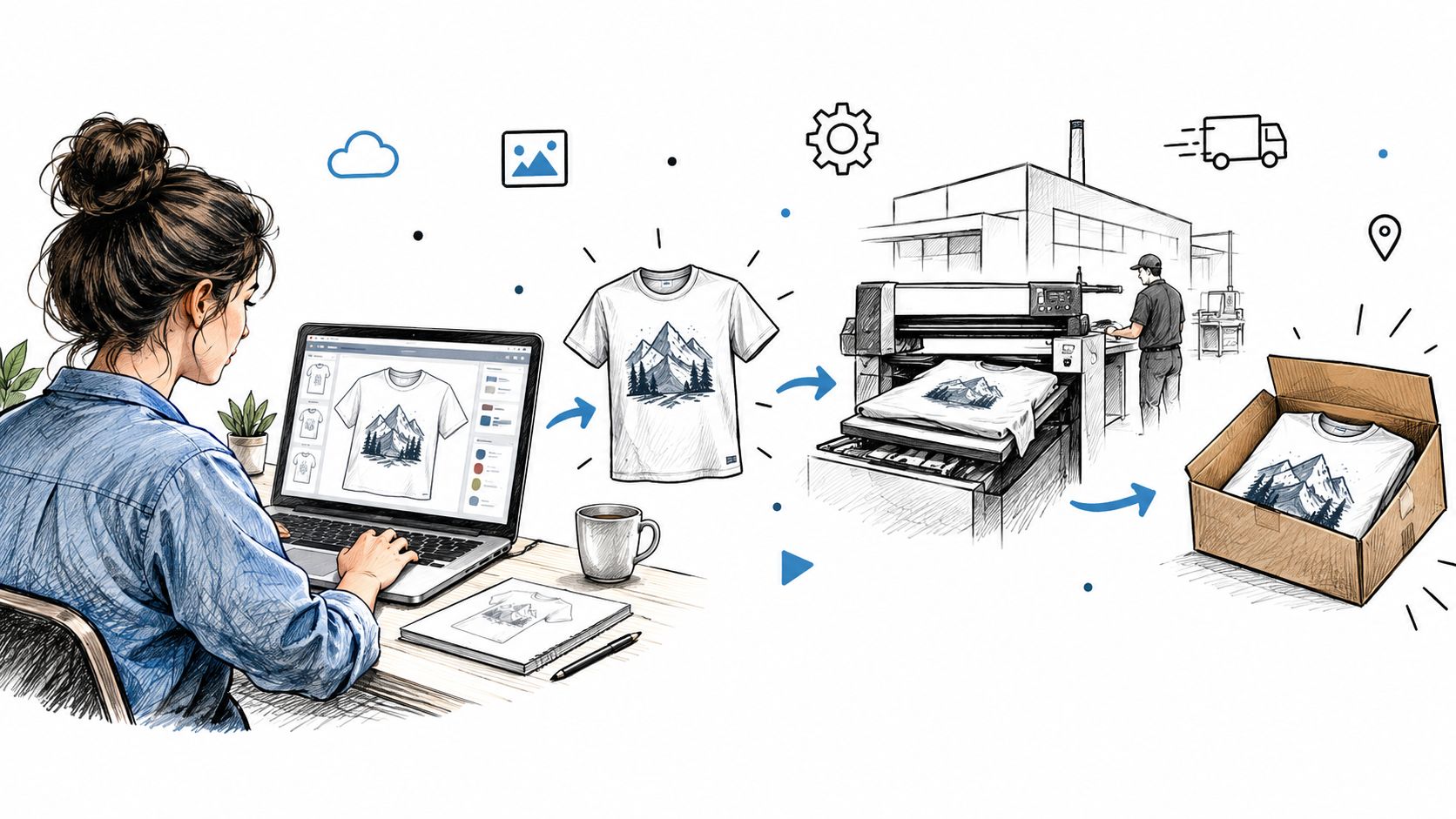
A creator can develop a design, publish it through a storefront, and let customer orders initiate production. That makes experimentation less dependent on upfront purchasing. It also supports a wider catalog, because the creator doesn't need to store every color and size before learning what the audience wants.
The operational burden shifts rather than disappears. The creator still needs accurate mockups, clear sizing information, realistic delivery messaging, approval control, and a plan for returns. A design that gets attention but produces poor garment quality can damage the relationship that made the drop possible.
An AI-native merchandise workflow can also turn a video, image, URL, or creative brief into product concepts. That helps creators move from an idea to a shoppable offer quickly, but speed should never replace a physical quality check. Review the actual garment, decoration placement, color treatment, packaging, and customer-facing description before promoting the item.
Enterprise programs
Enterprise merchandise has a different demand pattern. Teams may need onboarding kits for new hires, recognition gifts, event drops, internal stores, or employee-choice programs. These aren't identical to creator drops, but both benefit from separating curation from stock ownership.
| Use case | Primary operating need | Useful control |
|---|---|---|
| Creator merchandise drop | Fast launch and audience fit | Sample approval and delivery promise |
| New-hire kit | Consistent brand presentation | Regional fulfillment rules |
| Recognition reward | Choice and personalization | Approved catalog and budget limits |
| Event merchandise | Timing and coordinated delivery | Capacity reservation and cutoff dates |
| Internal store | Ongoing access without dead stock | Reporting by team, region, or program |
An enterprise may prefer a managed service because merchandise involves brand governance, budgets, approvals, shipping destinations, customer support, and returns. A creator may prioritize storefront simplicity and direct links from content. In both cases, the production system should keep the brand owner focused on selection and experience instead of cartons and replenishment spreadsheets.
The following video offers a visual reference for how a made-to-order merchandise workflow can connect design and fulfillment.
The model works best when the product promise matches the production reality. If a customer expects immediate shipment, a made-to-order process may need a local buffer or a different service design. If the customer values a distinctive product and accepts production time, demand-triggered fulfillment can be a strong fit.
Implementing an AI-Native Merchandise Strategy
An AI-native merchandise strategy should begin with operating rules, not with a large design library. The team needs to decide what it will sell, who can approve artwork, which products fit the brand, how customers will receive support, and what happens when production fails.
Build the workflow in sequence
Start with the brand input. Use a written brief, approved visual references, a campaign URL, a video, or product requirements. The input should describe the audience, tone, prohibited elements, garment preferences, and intended use. A vague prompt can produce attractive artwork that still violates brand or product requirements.
Generate and curate. Use an AI design tool to create concepts, then narrow them through human review. Check whether the graphic sits correctly on the garment, whether the colors reproduce well, and whether the design is appropriate for every channel where it will appear. The AI design tool workflow can help teams think through this stage as a production process rather than a one-off creative exercise.
Approve the physical product. Don't approve only a digital preview. Confirm the blank, decoration method, placement, sizing, color, packaging, and expected customer experience. For enterprise programs, record the approved version so local teams can't introduce unreviewed substitutions.
Connect the sales channel. Publish the approved products through the relevant storefront, employee portal, creator channel, or commerce integration. Map product variants carefully. An inaccurate size or color mapping creates avoidable customer service work and can undermine the pull signal.
Assign fulfillment ownership. The production partner or platform should receive the order, manufacture the item, ship it, and provide status information. Define who handles address changes, damaged goods, returns, refunds, and customs questions before the first order arrives.
Review the operating data. Look for failed designs, repeated defects, late orders, return reasons, and products that attract interest but don't convert. Use those signals to improve the catalog and supplier configuration rather than expanding inventory.
The AI layer reduces creative and administrative friction, but it doesn't remove operational accountability. Human approval remains necessary for intellectual property, brand safety, garment quality, and customer promises. The most mature implementation treats AI as the front end of a controlled production system, not as a shortcut around quality assurance.
Navigating Compliance and Measuring ROI
A zero inventory production system earns its place when it improves the whole customer and financial outcome. Inventory reduction alone isn't enough. Track the order from confirmation through production, quality review, shipment, delivery, support, and return so the team can see where the model creates value and where it creates friction.
Start with a small group of products or use cases that have clear ownership. Define the acceptable production window, quality standard, return policy, and escalation path. Then compare the results with the previous approach using consistent measurements.
Useful operating measures include:
- Order turnaround: How long orders spend waiting, in production, in quality review, and in transit.
- Defect and rework rate: Whether made-to-order production meets the approved standard consistently.
- Fulfillment cost per order: Include production, packaging, shipping, support, and returns rather than looking only at the manufacturing charge.
- Customer service burden: Monitor tickets caused by delays, wrong variants, damage, and unclear expectations.
- Conversion by product: Identify which designs earn demand without expanding the physical assortment.
- Compliance exceptions: Record customs holds, restricted products, data-handling issues, and unapproved artwork.
- Supplier concentration: Know how much of the program depends on one production site, route, or partner.
Cross-border fulfillment also requires clear product descriptions, tax and customs processes, consumer-protection policies, and documented ownership of customer data. Design files should move only through approved channels, and suppliers should receive the minimum information needed to complete their role.
The final decision is a service-level decision. If customers value variety and accept a defined production window, near-zero inventory can provide a disciplined path to more responsive merchandise. If a deadline is immovable or the supply network is fragile, retain a targeted buffer instead of forcing a pure model that makes customers pay for operational uncertainty.
FLYP LTD offers AI-native merchandise creation, made-to-order production, storefronts, fulfillment, international shipping, customer service, and returns for creators and enterprise teams. If you're replacing speculative stock with a demand-triggered merchandise workflow, visit FLYP LTD to evaluate how the platform can support your designs, stores, and fulfillment operations.