The best corporate holiday gift basket is usually a curated choice set or regionally sourced package, not a single universal hamper. That's because 52% of employees prefer choosing among several gifts, while 70% report receiving a holiday gift they didn't want or use.
Most buying guides start with the box: premium snacks, polished packaging, a branded card, and enough visual volume to look generous in a photo. That's the wrong starting point. The first question should be whether the recipient will use, share, select, or remember what arrives.
A beautiful hamper can still communicate poor judgment when it contains unwanted food, alcohol for someone who doesn't drink, products that don't suit a household, or items that can't clear customs. The best corporate holiday gift baskets solve those problems through choice, regional relevance, reliable fulfillment, and a personal recognition moment.
| Basket approach | Best fit | Main strength | Main risk |
|---|---|---|---|
| Classic consumable hamper | Single-country teams with shared preferences | Immediate enjoyment | Dietary and cultural mismatch |
| Consumable-plus-durable hybrid | Broad employee populations | Useful balance of treats and utility | Durable item may still go unused |
| Wellness or self-care basket | Teams that value relaxation and home use | Personal, low-clutter experience | Fragrance and product sensitivities |
| Premium non-food box | Food-restricted or globally dispersed teams | Easier compliance | Can feel generic without choice |
| Curated choice set | Distributed or preference-diverse teams | Highest control for recipients | Requires stronger operations |
Table of Contents
- Why Most Corporate Holiday Gift Baskets Miss the Mark
- The Five Evaluation Criteria That Actually Matter
- Comparing the Main Basket Archetypes
- Total Delivered Cost Beyond the Catalog Price
- A Global Inclusion Checklist for Distributed Teams
- Matching Basket Structures to Real Enterprise Scenarios
- A Repeatable 8-Week Workflow for Enterprise Gifting
- The Shortlist Decision Rule You Can Use Tomorrow
Why Most Corporate Holiday Gift Baskets Miss the Mark
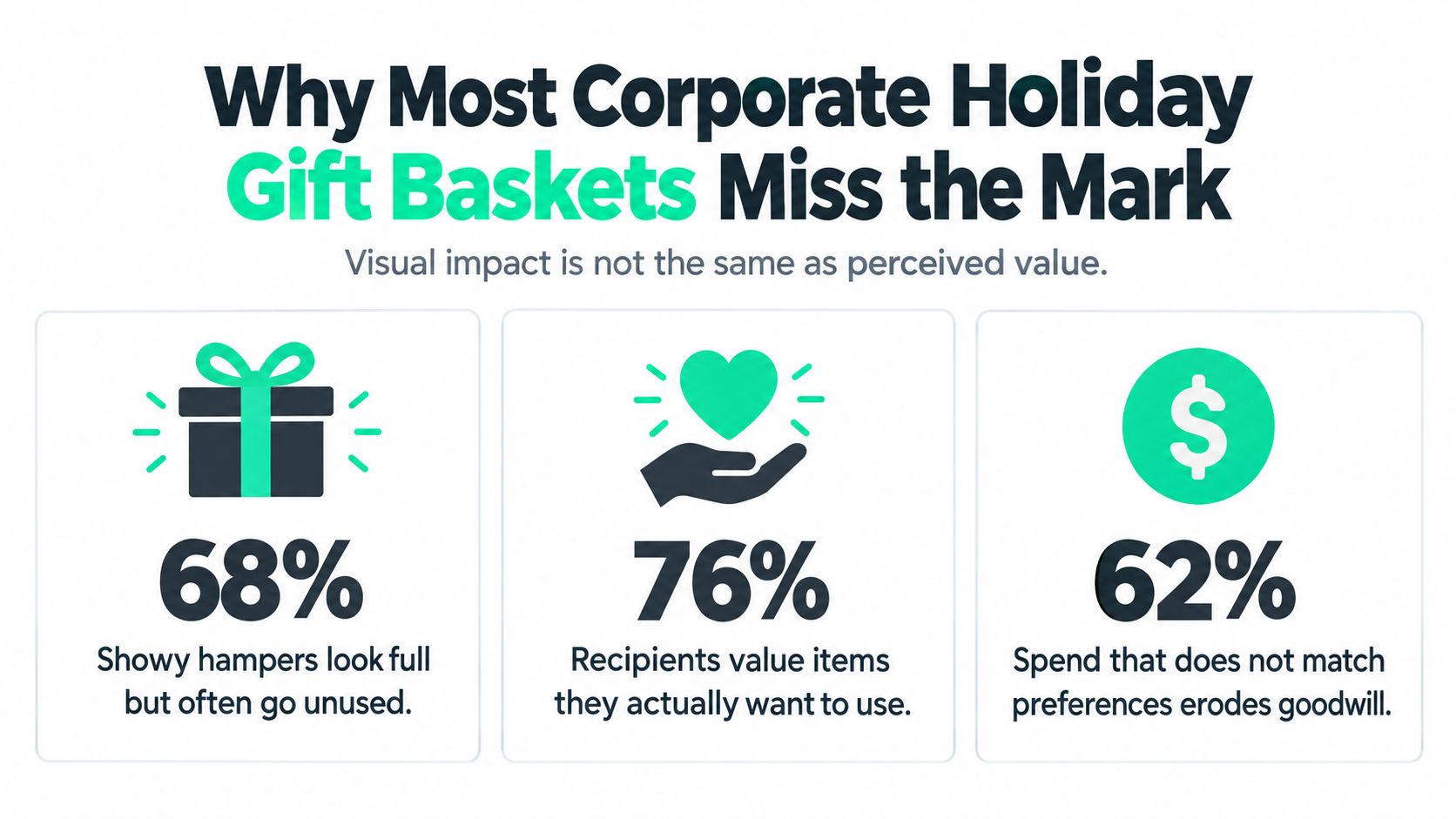
The basket is often the wrong place to start. A polished box can still become waste, clutter, or an awkward substitute request if its contents do not fit the recipient. In a 2025 survey of 1,051 U.S. employees at companies with more than 10 people, 42% said a bad holiday gift made them feel less appreciated than receiving nothing. The survey results reported by Snappy show why gift selection belongs in the recognition strategy, not only in procurement.
The box is not the experience
Recipients judge a gift by usefulness, fit, and personal relevance. A large assortment of sweets suits one household and creates waste in another. A branded mug may sit unused in a cupboard. Wine can exclude non-drinkers and force People Ops to arrange an awkward replacement.
Choice solves more of these failures than better packaging. Give employees a curated set of suitable options, a cash-equivalent benefit, or a locally fulfilled alternative when a standard hamper does not fit. A physical basket still works for teams with shared tastes, but it should be one route through the program, not the default for everyone.
The strongest architecture combines a clear value level with recipient control. Employees might select a food box, a non-food item, a wellness option, or a local gift card. Regional fulfillment can then reduce customs problems, shorten delivery routes, and reflect local food standards without making the program feel fragmented.
Distributed teams expose weak programs
A single-country hamper is manageable when addresses, product standards, and delivery routes are consistent. Distributed teams introduce different languages, dietary rules, customs requirements, household sizes, and expectations around alcohol or religious observance. Sending one box everywhere creates unequal experiences even when the catalog value is identical.
Set success measures before choosing the vendor:
- Utilization: Recipients consume, use, share, or intentionally select the contents.
- Fairness: Employees receive comparable value and credible regional alternatives.
- Reliability: Packages arrive intact, on time, and at the correct address.
- Recognition: The message feels personal rather than automated.
- Measurement: People Ops can review selection, delivery, damage, and satisfaction data.
For dietary planning, keto-friendly food gift ideas can help buyers move beyond generic sweets and consider lower-sugar alternatives. Keep the card, sleeve, or insert consistent while adapting the contents by location. FLYP's guidance on corporate gifts and branding supports a simple rule: use branding to identify the recognition moment, not to turn useful gifts into logo-heavy merchandise.
The Five Evaluation Criteria That Actually Matter
A vendor shortlist should fit on one spreadsheet. If the evaluation focuses mainly on basket appearance, it's measuring the least important part of the program.
1. Budget and value
The historical employer benchmark is useful, but don't treat an average as a recommendation. The Advertising Specialty Institute reported average planned spending of $65 per employee and median spending of $37 in its 2018 U.S. employer study, showing how higher-budget programs lifted the average above the typical employer spend. ASI's study supports a practical rule: set a clear base value, then model shipping and alternatives separately.
Pass test: The vendor provides a per-recipient price, regional landed-cost estimate, replacement policy, and an executive option that doesn't make the standard employee gift feel second-rate.
2. Recipient fit
Ask whether the program captures preferences before production. The pass test should include food restrictions, alcohol preference, non-food alternatives, language, and an opt-out route.
Pass test: A recipient can choose a suitable option without emailing People Ops for manual intervention.
3. Brand expression
Branding should make the gift recognizable, not turn it into a trade-show giveaway. Put the identity on the note, packaging detail, or card, then spend the remaining budget on products people want.
Pass test: The vendor can provide a proof showing accurate names, approved colors, accessible typography, and restrained logo placement.
4. Fulfillment reliability
Shipping is part of the product. Review address collection, validation, tracking, regional fulfillment, delivery windows, damage handling, and escalation ownership.
Pass test: The vendor can explain who contacts an employee with an invalid address and who pays for a replacement.
5. Sustainability through relevance
A recyclable box doesn't solve the waste created by an unwanted gift. The stronger sustainability decision is often preventing mismatch, excess packaging, failed delivery, and undeliverable food.
Pass test: The vendor reports packaging choices, substitution rules, local sourcing options, and disposal or donation handling.
Use this scorecard during a pilot, not after the full order:
| Criterion | Suggested weight | Pass test |
|---|---|---|
| Budget and delivered value | 25% | Complete landed-cost model and equal-value alternatives |
| Recipient fit and choice | 25% | Preference capture and selectable options |
| Fulfillment reliability | 20% | Tracking, address workflow, replacement ownership |
| Product quality and compliance | 20% | Ingredient, allergen, expiration, and packaging controls |
| Brand expression and sustainability | 10% | Approved proof and responsible packaging plan |
For deeper procurement controls, connect the gift pilot to a documented vendor quality management process. The same discipline used for other suppliers belongs here too.
Comparing the Main Basket Archetypes
There isn't one universal winner. The right structure depends on team geography, recipient preferences, household context, and how much operational complexity People Ops can absorb.
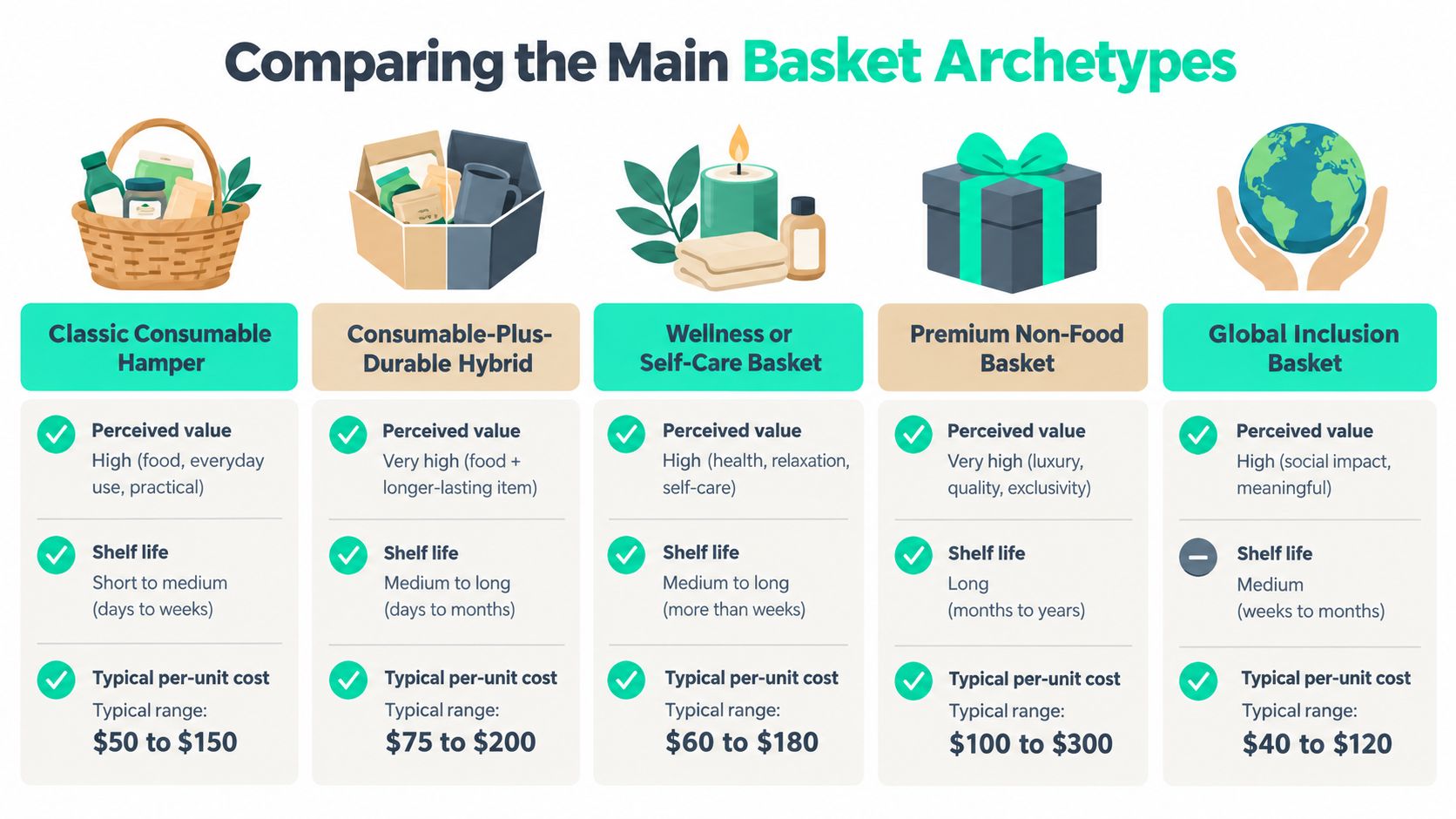
| Archetype | Where it wins | Failure mode | Pricing anchor |
|---|---|---|---|
| Classic consumable hamper | A single office or region with shared tastes | Food, alcohol, or allergen mismatch | Set a clear per-person cap |
| Consumable-plus-durable hybrid | Mixed teams that appreciate practical items | The mug, tote, or accessory becomes clutter | Allocate more value to useful contents |
| Wellness or self-care basket | Home-based teams and personal recognition | Fragrance or skincare sensitivity | Offer fragrance-free or non-food alternatives |
| Premium non-food gift box | Teams with complex dietary requirements | Feels impersonal without recipient input | Invest in quality rather than volume |
| Curated choice set | Distributed and preference-diverse workforces | Requires good preference and delivery data | Keep options within an equal-value band |
Classic consumable hamper
This is the familiar choice: snacks, confectionery, coffee, tea, spreads, or regional specialties in a festive box. It works best when recipients live in the same country and the company knows the products can be used safely. It fails when the buyer confuses abundance with relevance.
A carefully sourced hamper can still be excellent. Buyers comparing artisan cheese, plant-based products, or festive assortments can browse the festive favourites as one example of how a theme can be built around a clear dietary position rather than a random collection of treats.
Consumable-plus-durable hybrid
This is my default for a relatively homogeneous team. Pair consumables with one functional item, such as insulated drinkware, a premium mug, or a reusable tote. A 2025 survey of 1,000 U.S. employees found that 56% preferred snacks or coffee and tea, 51% identified quality as important, and 41% preferred items usable every day. VistaPrint's survey supports the hybrid structure, but only when the durable product earns its space.
Wellness and premium non-food boxes
Wellness baskets can feel thoughtful because they create a pause outside the workday. Avoid strong scents, unverified health claims, and products that assume a particular lifestyle. Premium non-food boxes are safer for food-restricted teams, but they need personalization through materials, design, or selection.
Curated choice sets
This is the strongest architecture for most enterprise programs. A 2025 U.S. employee survey found that 82% valued personalized gifts more, 52% preferred choosing among several gifts, and 81% valued gifts more when they included a name, personal message, or comparable personal element. The employee-gifting survey makes the operational case for offering several themed options instead of shipping one standardized box.
A choice set doesn't mean giving everyone an unlimited budget. It means creating a controlled menu, such as premium snacks, coffee or tea, wellness, non-food, and digital alternatives, with consistent value and clear selection rules. For additional ideas, use a structured list of employee gift ideas as a starting point, then remove anything that lacks a fulfillment or inclusion plan.
Total Delivered Cost Beyond the Catalog Price
The catalog price is the easiest number to quote and the least useful number to budget. A global program can add taxes, duties, brokerage, customs handling, address collection, failed delivery, replacement, returns, support labor, and regional substitutions.
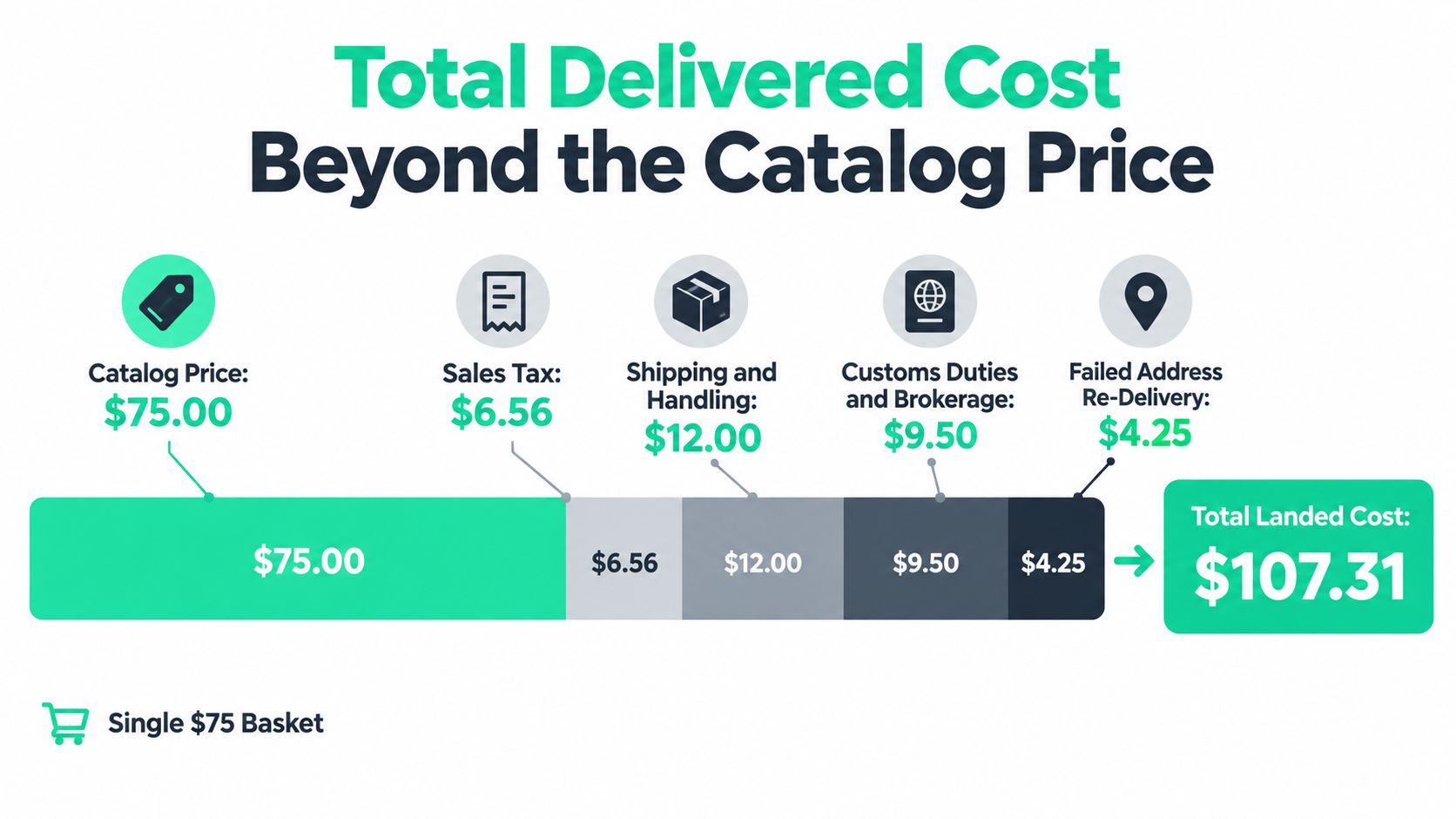
Platform data from 2025 showed that flexible monetary and gift-card options remained the most popular selections, with an average gift denomination of $62 and a median of $25. Snappy's platform data gives finance teams a useful reference point for comparing a physical basket with a flexible alternative, but the catalog value alone still doesn't determine the final cost.
Build the landed-cost model
Use one row per region and include:
- Product cost: Contents, packaging, personalization, and inserts.
- Domestic logistics: Pick-and-pack, parcel shipping, and handling.
- Cross-border charges: Tax, duties, brokerage, and customs processing.
- Data operations: Address collection, validation, reminders, and corrections.
- Exceptions: Failed delivery, damage, replacement, return, and substitution.
- Internal labor: People Ops, finance, procurement, and employee support time.
A $50 catalog basket might be appropriate in one market and uneconomic in another. Don't apply a universal multiplier without vendor evidence. Request a delivered-cost quote that includes the exact destination mix, product restrictions, delivery window, and replacement terms.
The soft cost matters too. A bad gift can create extra tickets, negative internal conversation, and a weaker recognition signal. That's why a smaller, relevant gift often beats a larger package with predictable waste.
Finance rule: Approve the program against cost per successful delivery, not cost per catalog item.
A Global Inclusion Checklist for Distributed Teams
Inclusion requires acceptance criteria. “We'll handle exceptions” is not a program design. It leaves recipients to solve predictable problems themselves.
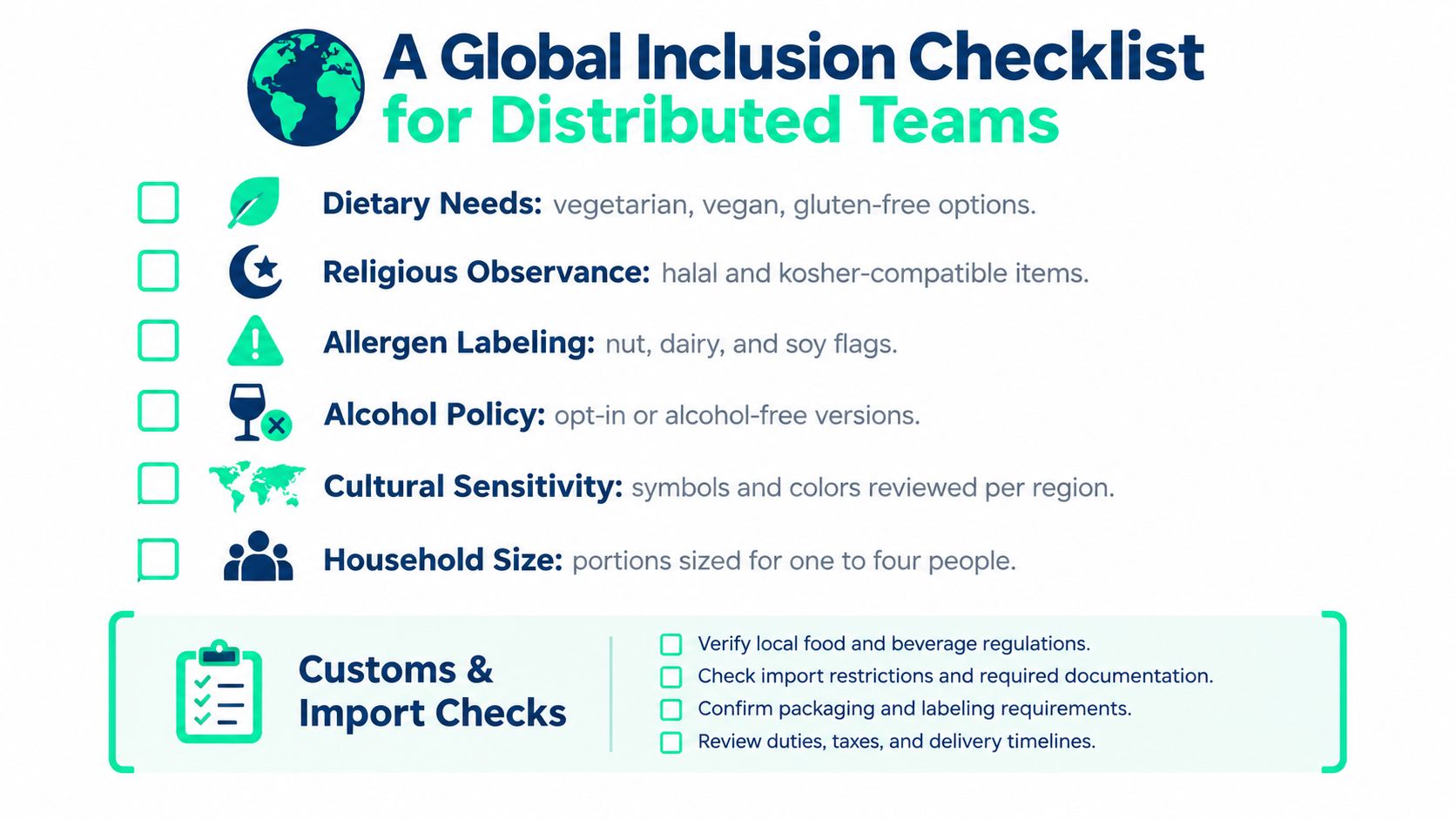
Start with recipient needs, not the basket:
- Dietary needs: Offer vegetarian, vegan, gluten-free, allergen-aware, and non-food options.
- Religious observance: Check halal and kosher compatibility, ingredient origins, preparation standards, and seasonal timing.
- Allergens: Display clear nut, dairy, soy, and other relevant labeling before selection.
- Alcohol policy: Make alcohol-free the default. Allow opt-in alcohol only where local rules permit delivery.
- Cultural context: Review symbols, colors, messages, and product associations by region.
- Household fit: Let recipients choose a format for an individual, couple, family, or shared home.
Control the logistics
Food shipments face import restrictions, customs delays, labeling requirements, and local rules that do not affect domestic orders. Regional sourcing reduces these risks and usually feels more relevant than exporting an identical box from one country.
Address collection needs the same discipline. Request only necessary information, display the local address format, validate details before production, and provide a clear correction window. Cards should use the correct language, readable typography, and accurate names.
Build a non-physical route into the default program. Because flexible alternatives are often preferred over parties or fixed hampers, recipients should be able to choose a gift card, flexible allowance, or donation when a physical basket does not suit them. The same poll supports this approach without requiring anyone to accept an unsuitable item.
A charitable donation option protects dignity and choice. Employees should not have to explain why they cannot use the company's selected hamper. The basket should be one route, supported by locally sourced fulfillment and recipient-controlled alternatives, rather than the starting assumption for everyone.
Matching Basket Structures to Real Enterprise Scenarios
The same vendor can be right for one team and wrong for another. Start with the operating conditions, then choose the basket format.
A 50-person single-office team
Choose a classic consumable hamper or hybrid box from a vendor with domestic delivery and hands-on customization. A local supplier can often manage names, cards, and dietary substitutions without introducing complex international logistics.
Track delivered-in-full rate, damage, and a short satisfaction pulse. Keep the assortment recognizable and avoid spending the budget on oversized packaging.
Decision note: If recipients work in one office and share a region, optimize for quality and personal notes before adding a complicated choice platform.
A 500-person company across two countries
Use a hybrid or curated choice program with country-specific fulfillment. Keep the brand layer consistent, but allow local products and compliant substitutions. Procurement should require two landed-cost models rather than one blended quote.
Track selection by country, delivery success, substitution frequency, and support tickets. A vendor that handles only one market will create avoidable work for the regional People team.
A global team of 5,000 or more
Choose a recipient-controlled architecture with regional sourcing, local currency or equivalent-value rules, address validation, and reporting. Physical food should be one option, not the only option. Add non-food, digital, donation, and alcohol-free routes from the start.
The strongest global vendor profile combines catalog curation with managed logistics, customer support, and consolidated reporting. Track regional parity, selection rates, failed addresses, replacement costs, and recipient satisfaction.
Sales, client-facing, and brand-sensitive teams
Use a premium non-food or hybrid box with restrained co-branding and a carefully written message. The recipient should feel recognized, not marketed to. Check whether the packaging, logo placement, and insert meet brand standards before ordering at volume.
Track recipient response, delivery quality, and any client-service escalations. For external recipients, approval workflows matter as much as product choice.
Remote-first scaleups with limited People Ops capacity
Buy operational capacity, not just products. A managed-service vendor can collect addresses, run reminders, manage choice windows, coordinate fulfillment, and provide reporting. FLYP LTD is one option in this category, offering branded kits, recipient shipping, curated boxes, and consolidated program management for enterprise gifting.
Track internal hours spent, exception volume, delivery completion, and satisfaction. A low catalog price isn't efficient if the People team spends weeks resolving preventable issues.
A Repeatable 8-Week Workflow for Enterprise Gifting
A reliable program starts before the holiday rush. Use an eight-week operating cycle and assign one accountable owner for every handoff.
- Week 1, brief: People Ops defines recipients, regions, recognition goal, budget, restrictions, brand requirements, and success metrics. Finance approves the delivered-cost model.
- Week 2, vendor selection: Procurement compares two or more vendors against the weighted scorecard. Require samples, proofs, regional coverage, and exception policies.
- Week 3, pilot: A small internal group tests the selection flow, packaging, message, address form, and tracking experience. Fix confusing steps before launch.
- Week 4, address collection: Employees confirm addresses, language, preferences, and alternatives. Send reminders and close corrections before production.
- Week 5, production: The vendor locks selections, validates names, checks ingredients and expiration thresholds, and approves final packaging.
- Week 6, fulfillment: The vendor picks, packs, seals, labels, and assigns tracking. People Ops receives an exception report rather than manually checking every shipment.
- Week 7, delivery: Support handles failed addresses, damage, substitutions, and recipient questions. Keep replacement authority with one operational owner.
- Week 8, reporting: Review delivered-in-full rate, damage rate, selection rate, replacement cost, support volume, and recipient satisfaction.
The most expensive mistake is starting address collection too late. Late data forces substitutions, creates delivery risk, and leaves no time to correct an employee record.
Managed platforms can reduce coordination work, but they don't remove the need for a clear brief, approved budget, regional policy, or accountable internal owner. Decide what you want to outsource before comparing vendors.
The Shortlist Decision Rule You Can Use Tomorrow
Choose the basket structure by team profile, then add recipient choice wherever the operating model allows it. Source regionally for distributed teams, keep flexible alternatives available, and judge the program by utilization, delivery quality, and satisfaction rather than by how impressive the catalog page looks.
Tomorrow, take three actions:
- Define the recipient groups and regions.
- Ask shortlisted vendors for a full delivered-cost model and a choice-enabled sample.
- Pilot the workflow with a small group before committing to volume.
The basket is only one part of recognition. The message, fairness of the options, quality of delivery, and evidence that the company understood its people determine whether the gift lands well.
FLYP LTD helps People Ops teams run branded employee-choice kits, recognition drops, and holiday gifting with curation, production, recipient shipping, logistics, and reporting handled in one managed program. If you need a global gifting partner that can connect brand standards with practical recipient choice, visit FLYP LTD to discuss your next program.