The most popular advice about the best merch platform is to compare catalogs, mockup tools, and the price of a blank. That's the wrong starting point for People Ops and marketing teams. A cheap shirt becomes expensive when the fit is wrong, a delivery fails, an employee needs support, or returned stock sits unused.
Choose the operating model that fits the program. For enterprise merchandise, compare cost per item delivered and kept, brand control, fulfillment, and reporting. For creator merchandise, add another test: can a fan buy the product where they discover it, and can you connect that purchase to the content that prompted it?
Table of Contents
- Best Merch Platform Picks by Program Type
- Enterprise Capabilities Side by Side
- Cost per Kept Item Beats Sticker Price
- People Ops Events and Creator Scenarios
- How to Score a Platform Before You Commit
- Choose the Platform That Matches the Program
Best Merch Platform Picks by Program Type
The best merch platform is the one built for your program, not the one with the longest catalog. A fan drop, a new-hire kit, a multi-country event, and a one-time office order have different buyers, delivery needs, and rules. Start by eliminating models that can't pass three basic gates: digital ordering, credible sustainable product options, and the ability to serve the channels and locations your program needs.
Those gates reflect an established market that's moving online. The 2024 PPAI Sales Volume Report puts U.S. promotional-products sales at $26.78 billion in 2024, up 2.63% from $26.09 billion in 2023. Online sales through online stores and distributor websites reached $6.83 billion, or 25.5% of total industry revenue, compared with $5.03 billion and 19.3% in 2023. The report also estimated sustainable-product sales at $3.69 billion. Use those figures as a procurement baseline: a modern platform should support online ordering and make sustainability-conscious choices available, not leave every request to a sales rep and email thread.
| Platform model | Best when | Brand control | Inventory | Delivery shape | Knock-out failure |
|---|---|---|---|---|---|
| Creator print-on-demand marketplace | Fan drops with no stock | Shared or limited | None | Printer network, uneven by country | Mandatory brand or legal review |
| YouTube or social-native store | Products are discovered inside content | Can be fully branded | None if on-demand | Delivery terms must be clear before checkout | Onboarding kits and HR allowances |
| Enterprise merch operating system | Onboarding, recognition, and global events | Rules, caps, private catalog | On-demand, no minimums | Region-local, direct to the person | One bulk tee to a single address |
| Promo distributor | A dated bulk buy to one site | Art proof, not a live store | Bulk made or held | Freight to an office | Weekly employee self-serve |
Match the model to the job
Creator print-on-demand marketplaces remove the need to hold stock and can suit a simple fan drop. They're a poor fit when a company needs strict brand or legal approval, or when garment-specific fit guidance and consistent delivery matter. A storefront can be live while the buyer still lacks control over the full customer experience.
YouTube or social-native stores make sense when the product belongs alongside a video or post. They're not an HR allowance system: they don't solve onboarding triggers, employee eligibility, or program budgets. For teams building a broader ambassador initiative around content and merch, Sup's guide to starting a brand ambassador program can help define the people, content, and participation model before choosing the store.
Enterprise merch operating systems fit People Ops and global marketing programs that need approved products, spend rules, QA, and direct delivery. They're excessive for one bulk tee sent to one office.
Promo distributors remain practical for a dated bulk order to one location, especially when a buyer wants a rep to coordinate proofs and freight. They're a poor choice for repeated self-serve requests across a distributed workforce.
Use the table to rule out mismatches before comparing features. A wide catalog can't compensate for a model that fails mandatory approval, employee self-service, or the delivery pattern your program requires.
Enterprise Capabilities Side by Side
Once you've narrowed the model, compare the work it takes off your team's plate. An enterprise platform should give administrators control over approved products, logos, and spending, while giving employees a straightforward way to choose something they'll wear. That means a private catalog with clear rules, not a public store with a company logo placed on top.
| Requirement | What good looks like | POD marketplace | Enterprise merch OS | Promo distributor |
|---|---|---|---|---|
| Brand safety | Approved SKUs, spend caps, no foreign branding | Weak to mixed | Rules, caps, private catalog | Art proof only |
| QA and fit | Size charts, samples, reprints | Often left to the buyer | Managed pre-production QA | Sample on request |
| Fulfillment | Direct, bulk kits, or both | Ships to the buyer | Direct-to-door and kits | Bulk to an office |
| International shipping | Duties, tracking, and local returns clear before payment | Uneven by printer | Region-local on-demand | Freight quote per job |
| Reporting | Funded, redeemed, on-time by country | Store sales | One program dashboard | Invoices and rep updates |
| Scalability | Add a country without adding a vendor | Add products quickly | One operating layer | New quote each wave |
Brand safety should be enforceable, not aspirational. Administrators need to lock logos, product choices, and spending caps, and prevent an unapproved item from shipping. Our stores use a custom domain, logo, colors, type, and tone, without shared platform branding. Admins set brand rules, approved products, and wallet caps; no off-brand merch ships from the store.
Quality assurance starts before production. Require garment-specific size charts, measured samples, and a written reprint path if embroidery or print misses the approved result. For product imagery, teams can also explore approaches to scaling clothing photography with AI, while keeping approved garment references and production samples as the standard for judging fit and finish.
Fulfillment needs to cover the actual program shape: bulk shipments to an office, direct-to-employee kits, or on-demand orders. An operating system should let a company run these together rather than forcing HR to manage a different vendor for each one. Our company swag platform supports on-demand production and region-local fulfillment. For a deeper look at how service design affects cross-border delivery, see this guide to global fulfillment services.
DHL reports that 92% of global shoppers expect fast, free delivery and easy returns, nearly eight in ten won't complete a purchase if they don't trust the delivery or returns provider, and 81% abandon purchases when their preferred delivery option is unavailable. DHL's delivery and returns analysis makes the procurement point clear: delivery terms affect conversion, not just warehouse operations.
Show destination-specific shipping and duties before payment, provide tracking, and make return eligibility and costs easy to find. For a serious comparison, require service-level reporting on on-time-in-full delivery, production lead time, split shipments, failed deliveries, returns, refund cycle time, and support response time by country. A sales total doesn't tell you whether a global program is working.
Finally, test scalability and integrations. Ask whether adding a country or a hiring wave requires another vendor, and test HRIS and SSO integration, data ownership for employee and creator records, and whether creator royalties and payouts sit in the same reporting view as orders. Compare quotes using the same garment, quantity, destination, deadline, and return scenario. Judge landed cost and reliability alongside the quoted unit price.
Cost per Kept Item Beats Sticker Price
The lowest production price isn't the right buying metric. Compare cost per item that arrives and stays with the recipient, including fit-related returns and the work required to resolve them. The Radial State of Returns report found that apparel and footwear brands reported return rates at or above 30% in 56% of cases in 2025, while 65% identified customer-service costs as a leading returns expense.
Here's a simple hypothetical comparison to show how to structure your own calculation. Say an $18 tee has a 30% return rate, while a $28 premium blank has an 8% return rate. Before adding reshipping, refunds, support time, or unusable returned goods, the production cost per kept item is about $25.71 for the first tee ($18 divided by 70% kept) and about $30.43 for the premium one ($28 divided by 92% kept). That doesn't prove the premium tee is cheaper; it shows why a sticker-price comparison can't settle the question.
Add the operational costs that decorator quotes often leave out: duties, failed delivery, split shipments, size exchanges, reprint waste, and bulk inventory left in a closet. Ask for garment-specific size charts, measured samples, regionally appropriate sizing, fit guidance, and pre-production QA. A premium blank or stronger quality-control process can cost more at the start and still reduce the total cost of returns, support, and wasted stock.
Make budget leakage visible
A prepaid wallet gives Finance a different kind of control from open purchase orders. With FLYP, an allowance can be funded per employee, team, or milestone, and Finance can see what's funded, redeemed, and left. That makes unused balances and spending patterns easier to review than a stream of orders reconciled at month-end.
A wallet doesn't replace program rules. Set the eligible products, allowance, and recipient group before launch, then compare redemption and delivery outcomes with the budget. For help thinking through the inventory side of the equation, use this practical guide to reducing inventory costs.
No-minimum on-demand production can avoid dead stock, but its unit price may be higher. A single conference order to one address can still favor bulk buying on unit cost; recurring programs across countries need a broader calculation that includes delivery, returns, and administration.
Procurement rule: Put return rate and support cost on the same sheet as blank price. Negotiate the garment only after you can see the cost of getting it to the right person and keeping it there.
People Ops Events and Creator Scenarios
A platform's fit becomes clearer when you map it to a real program. Don't give every recipient the same ordering path just because one vendor can make every product. Build around what the recipient needs to do, what the team needs to control, and the outcome you'll measure.
People Ops onboarding
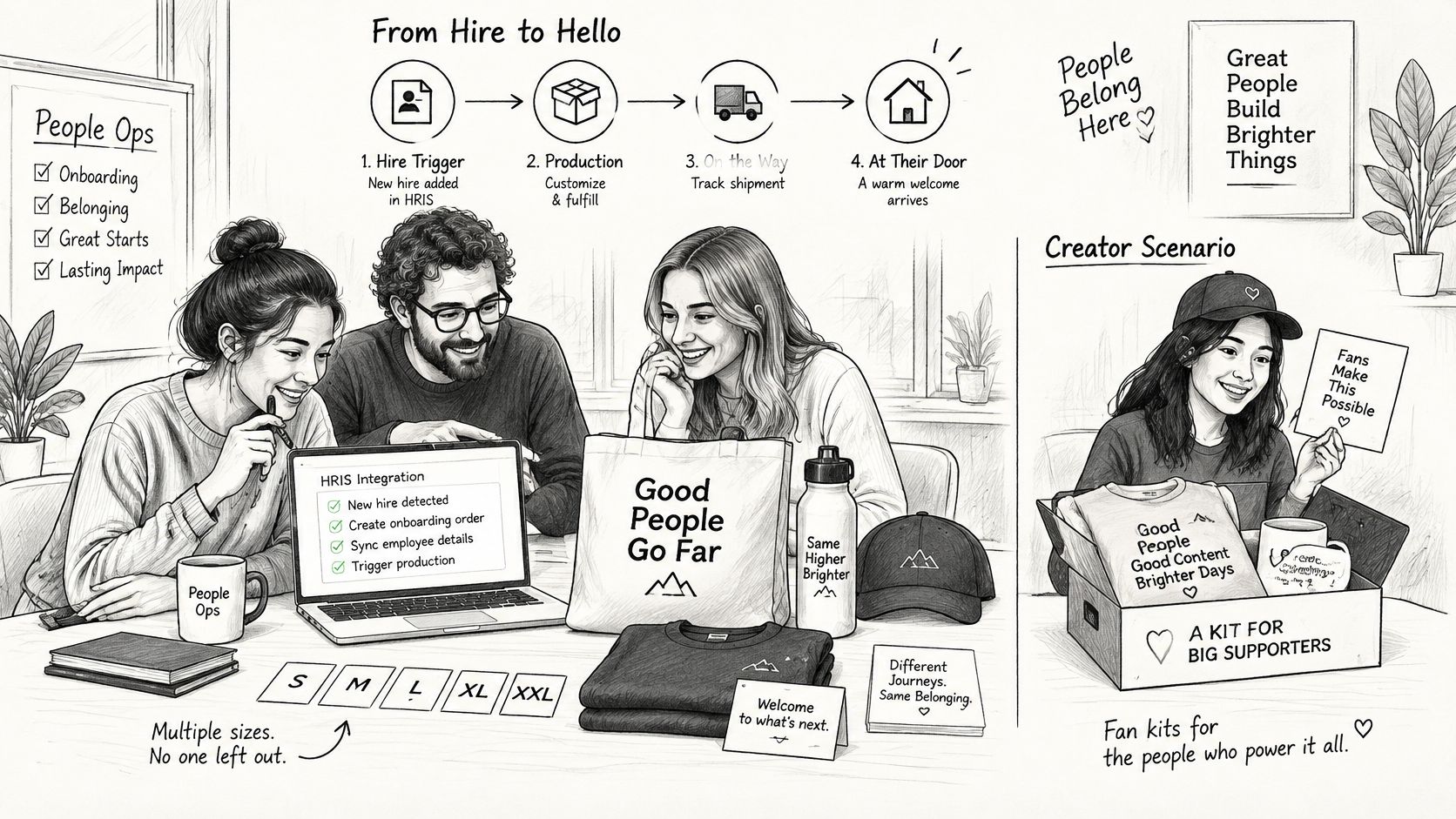
When a new hire starts, a kit should arrive in time to welcome them, and the recipient should have a reasonable choice of size and style. Connect the workflow to the HRIS so a hire can trigger production, then offer a curated catalog for fit and selection. FLYP integrates with major HRIS providers for onboarding-triggered kits, and staff choose fit, size, and style from a brand-safe catalog.
A hybrid program works better than forcing every request into a shipped kit. Send welcome, anniversary, and executive gifts directly; keep everyday and self-service requests in a swag store. FLYP supports this hybrid pattern. Measure arrival before day one and the exchange rate, then eliminate a social-native store that can't handle onboarding workflows.
Global events
For a multi-country event, let attendees choose fit and style through a branded micro-portal connected to the event experience. The selection can include a named item, such as an embroidered tote with an attendee's name. FLYP lets attendees confirm size, fit, and style through a branded micro-portal pushed from the customer's event platform.
Track on-time-in-full delivery by country, not just the number of orders placed. A traditional distributor may still suit one event and one office, but repeated events across markets need a repeatable operating layer. For physical packaging decisions around a kit or gift, teams can compare gift box printing options alongside the merch selection.
Creator drops
Creator merch is an audience-behavior and conversion problem, not only a storefront decision. YouTube's 2025 shopping analysis examined the 5,000 most-purchased products and the 1,000 highest-transaction videos using tagged products, making native shopping behavior measurable at ecosystem scale. YouTube's shopping analysis supports a practical checklist: can the creator tag a product in a video, can fans check out close to the content, and can the order be attributed to the video or post?
A smaller set of relevant, well-branded products can outperform a generic catalog if fans choose and wear the items. Measure the share of buyers who wear or reorder after 60 days, not just units shipped. FLYP offers a program for selling merch on YouTube; see this overview of creator monetization platforms when comparing how merch fits into a broader creator business. Don't choose a print-on-demand marketplace that leaves fans to hunt for the product when the program depends on an in-content purchase path.
How to Score a Platform Before You Commit
Run a controlled pilot with two finalists. Give both vendors the same scope, require the same evidence, and keep the scorecard with Finance. A live storefront or polished mockup is not a substitute for proof that the product fits, the checkout works, and the order reaches the intended recipient.
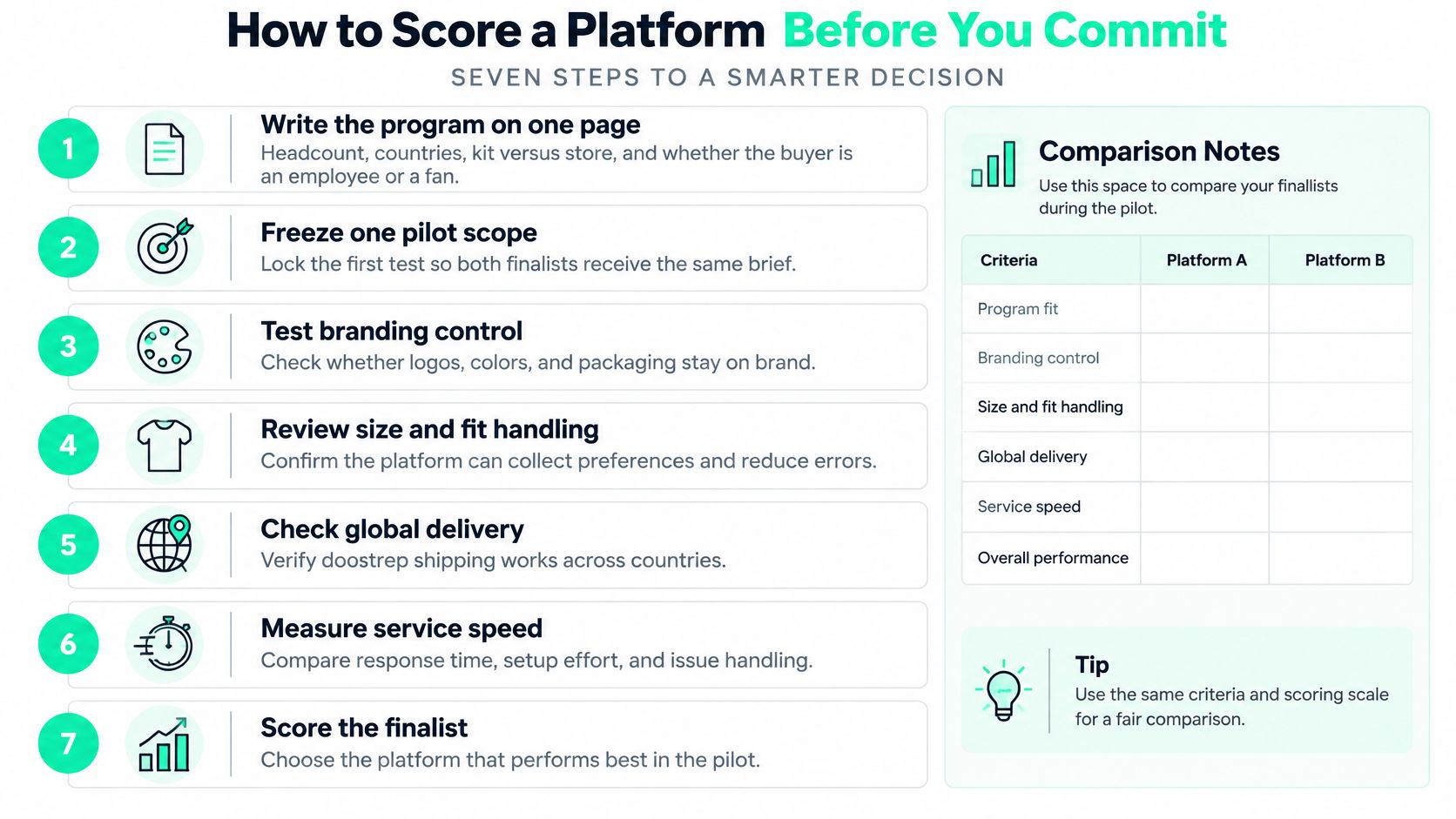
Write the program on one page. Record headcount, countries, whether you need kits or a store, and whether the buyer is an employee or a fan. The model should follow the actual recipient and purchasing journey.
Freeze one pilot scope. Choose one garment, one quantity, three destinations, and one deadline. Give both finalists the same brief so the quotes and delivery promises are comparable.
Require fit and production evidence. Collect the garment's size chart, a measured sample, and the written reprint policy before approving artwork. Record who checks the sample and who authorizes a reprint.
Inspect brand control and checkout. Confirm the store uses a branded domain or managed subdomain, has no shared platform branding, and lets administrators cap products and spend. Test guest checkout on a phone, with clear landed costs and returns terms.
Demand checkout reporting. Baymard's benchmark of 344 leading U.S. and European ecommerce sites found that 65% scored mediocre or worse, only 2% scored good, and the average site had 32 actionable checkout improvements available. Baymard estimates improved checkout UX could produce an average 35% conversion-rate increase for large-scale ecommerce sites. Treat this as a directional baseline, not a guaranteed result for merch. Baymard's checkout usability benchmark supports measuring add-to-cart, checkout starts, payment failure, completion, and abandonment by device, geography, traffic source, and checkout step.
Test a small cohort. Log production lead time, failed delivery, support response, and on-time-in-full performance against your target. Keep issues tied to the relevant country, item, and program.
Pass the gates before debating price. Fail any option that can't meet brand safety or provide a credible landed-cost comparison. Archive the scorecard and pilot results for Finance. Our administrators can set brand rules, approved products, and merch-wallet caps; a FLYP employee store is shown in a mockup as going live in 48 hours.
The pilot should tell you which vendor can run the program, not which proposal has the most persuasive feature list. If employees abandon checkout, deliveries miss the deadline, or fit creates avoidable exchanges, those are buying signals. Resolve them before scaling.
Choose the Platform That Matches the Program
Make the decision in this order.
First, who's buying? If employees need onboarding, recognition, or event merchandise under brand rules and direct delivery, choose an enterprise merch operating system with one reporting view. FLYP offers company swag programs with on-demand production and a single reporting dashboard. Teams at ClickUp and NewStore run their merch with FLYP.
Second, does revenue depend on fans buying inside content? Choose a YouTube or social-native route that tags products where fans discover them, rather than sending them through a separate shop detour.
Third, is this one dated bulk buy to one site? A classic promo distributor may be the simplest fit. Don't keep that model for recurring employee self-service or programs that span countries.
Don't select the cheapest blank when returns and support dominate the retained-cost sheet. List the countries, allowance per employee or milestone, and approved products, then launch a branded on-demand store and measure cost per kept item after the first cohort. FLYP creates the merch collection and store, then handles production, delivery, and support. If both employee merchandise and a creator channel are in scope, run them as two programs on one operating layer rather than two unrelated vendor relationships.
FLYP LTD runs managed merch programs with branded stores, on-demand production, delivery, and support for enterprise teams and creators. Bring your countries, approved products, and allowance plan, then visit FLYP LTD to explore a managed enterprise path.