The popular advice is simple: choose the softest, heaviest blank T-shirt you can afford. That shortcut works for a sample table, but it fails in enterprise merch programs. A shirt that feels impressive before washing may shrink, lose collar recovery, accept decoration unevenly, or become impractical in a warm market.
The best premium blank T-shirts are the ones that remain consistent after washing, decoration, climate variation, and repeat procurement. That means evaluating GSM, yarn, construction, fit, certifications, colorfastness, and reorder controls together, then measuring the cost of a garment that gets worn successfully rather than the unit price alone.
Table of Contents
- Why Premium Means More Than Fabric Weight
- The Six Evaluation Criteria That Actually Matter
- Comparing the Top Premium Blank Categories
- Matching Blanks to Print Methods
- Fit Governance and Wash Performance for Global Teams
- Brand Safety and Supply Continuity Checks
- Recommendations by Program Type and Next Steps
Why Premium Means More Than Fabric Weight
GSM is useful, but it isn't a quality verdict. Two T-shirts can carry the same stated weight while differing substantially in yarn quality, knit density, finishing, shrinkage, collar recovery, seam strength, and opacity. A very heavy blank can also feel stiff, hot, or uncomfortable in warm climates, while a lighter, denser knit may drape better and survive regular wear more gracefully. Cloprod's analysis of premium blanks makes the same central point: fabric weight needs to be assessed alongside construction and use case.
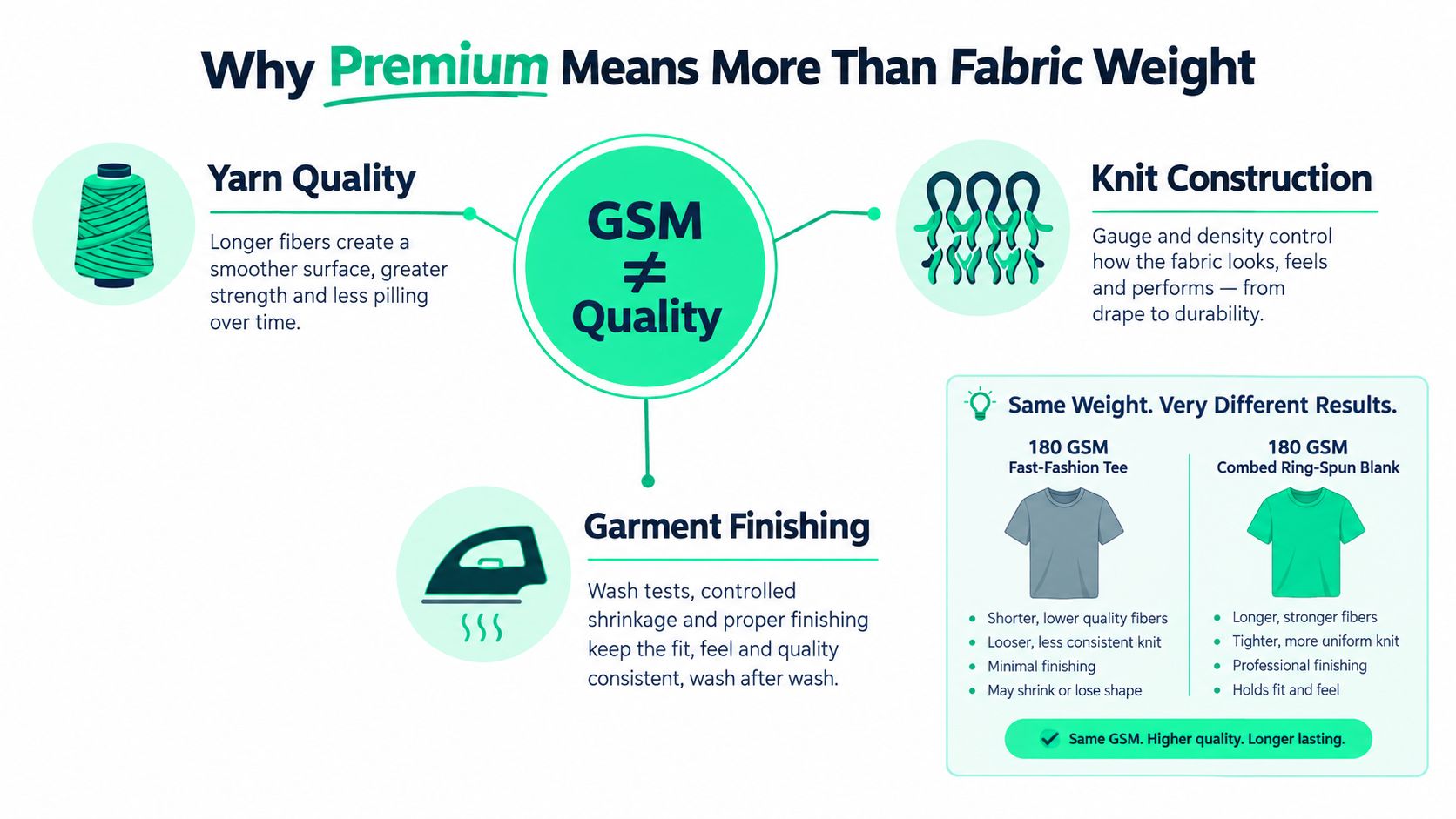
A structured blank around 180–220 GSM can work well for an opaque, substantial tee, but that range doesn't automatically make every garment premium. A combed ring-spun fabric may feel smoother than a carded fabric at a comparable weight, and finishing can determine whether the shirt keeps its dimensions and color after laundering. Buyers who need a quick explanation of fabric weight can also consult this GSM buying guide from SEYANTE, while remembering that GSM describes mass, not the entire garment system.
Procurement rule: Treat GSM as a specification to verify, not as a shortcut for judging quality.
The more useful question is operational: will this blank behave predictably after decoration and reordering? A one-time sample can hide dye-lot variation, unstable collars, twisting side seams, weak shoulder construction, or a finish that changes after washing. Those defects become expensive when a company ships the same garment to employees in several countries or reorders it months later.
Premium quality therefore has three dimensions:
- Material performance: Yarn, knit density, opacity, hand feel, and breathability must suit the climate and intended wear.
- Garment stability: Measurements, collar shape, seams, color, and print surface should remain within agreed tolerances.
- Program reliability: The supplier needs to reproduce the same blank profile, shade, grading, and decoration result over time.
That is why a slightly lighter shirt can outperform a heavier one in an employee-choice store, and why a softer sample can be the wrong choice for a high-volume onboarding program. The winning blank isn't the one that feels most luxurious for five minutes. It's the one people still choose to wear after washing, travel, seasonal changes, and ordinary workdays.
The Six Evaluation Criteria That Actually Matter
A buyer-ready blank specification should fit on a supplier brief, not live in a subjective ranking. Use the following criteria to separate a premium garment from a premium-sounding product description.
Start with measurable fabric specifications
For a structured, opaque tee, a practical target is approximately 180–220 GSM. A lighter 160–180 GSM range can provide a better balance of comfort and durability where breathability and drape matter more. Specify a tolerance of about ±5%, verify mass using ISO 3801 or ASTM D3776, and approve a physical sample because actual weight, fit, and finish can vary between dye lots. These specifications are outlined in this cotton T-shirt fabric guide.
Yarn matters just as much. Combed ring-spun cotton generally offers a smoother hand feel than carded cotton at comparable weight, while finer yarn can create a cleaner decoration surface. Then inspect knit density, opacity, shoulder tape, collar rib, stitch regularity, and seam stability. A heavy fabric with a weak collar is still a poor enterprise blank.
Put the checks into the purchase order
| Criterion | Target Range | Verification Method |
|---|---|---|
| Fabric weight | 160–180 GSM for lighter use, approximately 180–220 GSM for structured blanks | Verify with ISO 3801 or ASTM D3776, using a physical sample |
| GSM tolerance | About ±5% from the agreed target | Compare production samples with the approved reference |
| Yarn and surface | Combed ring-spun cotton where a smoother hand feel and decoration surface are required | Review fiber specification and inspect the approved sample |
| Construction | Stable collar, seams, shoulder areas, and knit density | Visual inspection, measurement, and sample wear testing |
| Fit consistency | Agreed measurements by size, cut, and market | Measure samples before and after laundering |
| Decoration compatibility | Surface and density suited to the chosen method | Decorate the exact blank, then wash-test the finished sample |
This checklist prevents a common purchasing mistake: accepting a catalog description as evidence. Ask for the fiber composition, target GSM, size measurements, dye or wash treatment, and production tolerances in writing. If the supplier can't provide those details, the word “premium” isn't doing useful work.
Approve the garment, not just the fabric
The final approval sample should be the exact style, color, size range, and decoration route intended for production. Test the collar, shoulder seams, side seams, hem, opacity, surface smoothness, and print placement before releasing the order. Never approve a large run from a fabric swatch or an unrelated colorway.
Comparing the Top Premium Blank Categories
Procurement teams do not need one "best" premium blank. They need a category they can reorder without fit drift, decoration surprises, or avoidable returns across markets. In practice, that usually means choosing among three profiles with very different risk patterns. Heavyweight structured blanks win on presence. Mid-weight combed ring-spun staples usually give the widest wear acceptance. Cotton-poly blends tend to make repeat programs easier when stability matters more than a fully natural hand feel.
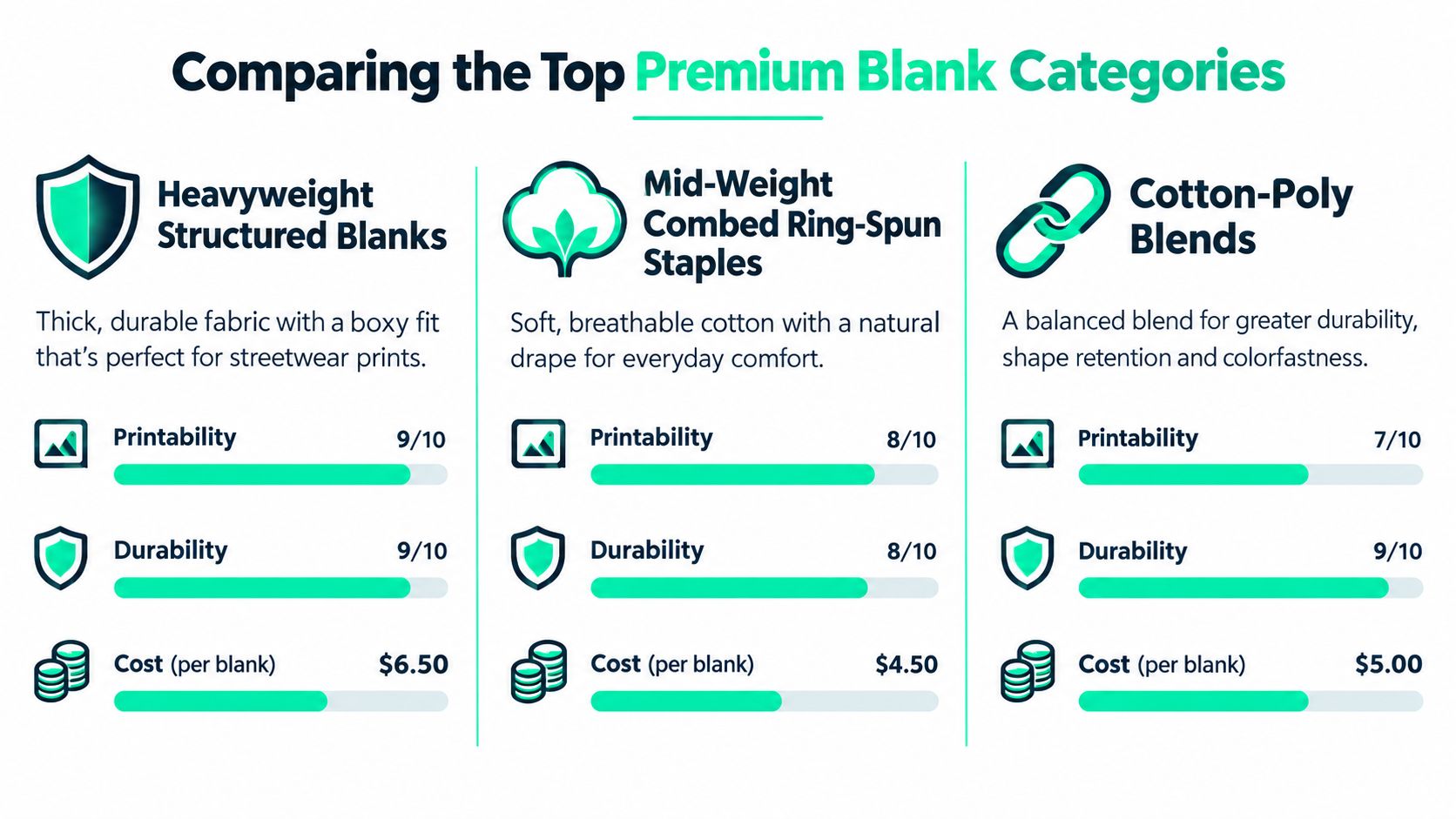
| Blank category | Weight and feel | Shrinkage behavior | Decoration fit | Reorder reliability |
|---|---|---|---|---|
| Heavyweight structured | Substantial, boxy, and opaque, but potentially warm or stiff | Requires careful wash testing | Strong base for bold screen prints and embroidery | Good when the exact style and dye treatment remain available |
| Mid-weight combed ring-spun | Smooth, comfortable, and easier to wear across settings | Depends on finishing and laundering controls | Versatile for DTG, DTF, screen print, and lighter embroidery | Strong choice when measurements and color references are locked |
| Cotton-poly blend | Stable shape and useful color retention | Can reduce shrinkage compared with cotton | Suitable for many prints, but surface and heat response need validation | Often practical for repeat programs when blend specifications stay fixed |
Heavyweight blanks earn their place when the shirt itself is part of the statement. They suit recognition pieces, fashion-led drops, and graphics that benefit from a firmer print base. The trade-off is easy to miss if you only approve on hanger appeal. Warmer climates, office wear, and broad size runs often expose the limits fast, especially when the cut is boxy and the wearer expects a more standard silhouette.
Mid-weight combed ring-spun cotton and cotton-poly blends cover more programs, but for different reasons. Mid-weight combed ring-spun is usually the safer first pilot if the audience, climate, and dress norms are mixed. It gives you a cleaner hand feel and broad decoration flexibility, but only if the supplier holds measurements, finishing, and shade consistency. Cotton-poly blends are often the better operations choice for replenishment programs that need shape retention and steadier color appearance over time. They can feel less natural, and some blends need closer heat and wash validation before scale. I would choose between those two based less on softness claims and more on reorder discipline, decoration method, and landed cost per shirt that still looks acceptable after real wear.
Heavyweight structured blanks: The differentiator is presence, not universal comfort.
Mid-weight combed ring-spun staples: The differentiator is everyday wearability across more settings.
Cotton-poly blends: The differentiator is stability, provided the hand feel suits the audience.
Use the category that matches the job. Standardize specs where consistency affects reorders, but do not force one blank across every region, climate, and wearer expectation.
Matching Blanks to Print Methods
Decoration changes the blank decision. A smooth, stable surface can support fine detail, while a loose or heavily treated fabric may introduce texture, color variation, or adhesion problems. The exact blank, ink, curing process, artwork, and wash routine need to be tested together.
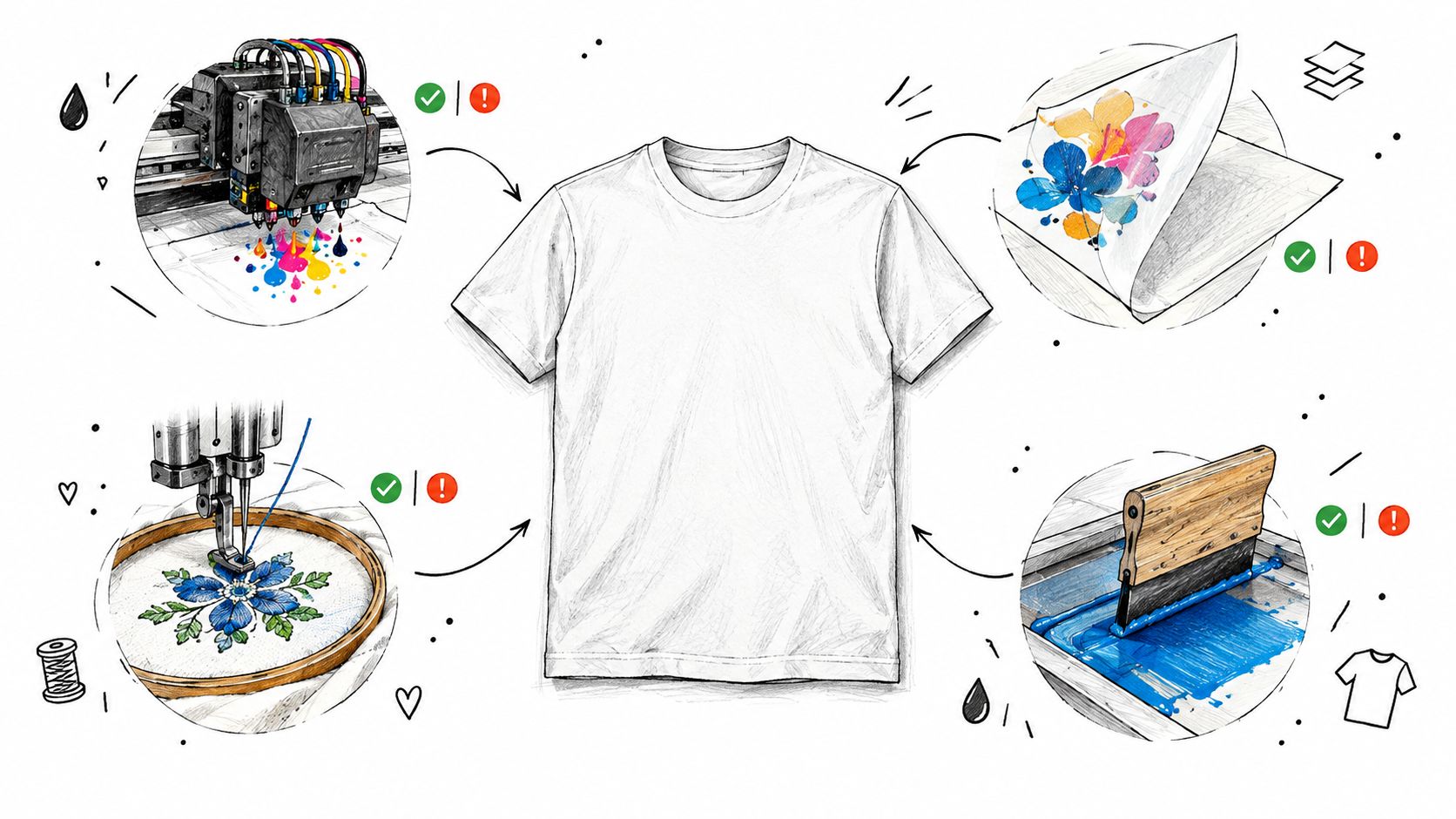
DTG generally benefits from a smooth, even cotton surface and a predictable pretreatment response. It suits detailed artwork and tonal graphics, but the finished result can vary with garment dye, fabric treatment, and color. Request a print test on the exact shade, not just the same style in white.
DTF can work across a wider range of fabric compositions, but the transfer's hand feel and edge behavior need checking. A dense or highly elastic surface may change how the transfer sits after laundering. Test the print for lifting, cracking, and unwanted stiffness.
Embroidery needs structural support. A lightweight or unstable fabric may pucker around dense artwork, especially when the design is large or heavily stitched. Structured blanks, reinforced placement zones, or smaller chest marks usually provide a safer starting point.
Screen printing rewards a consistent, reasonably smooth surface and accurate production controls. Dense knits can respond differently to ink coverage and curing heat, while garment-dyed or vintage-washed blanks may create intentional variation that should be approved rather than treated as a defect. Teams comparing production approaches can use this practical resource on screen printing for headwear for broader decoration context, then apply the same discipline to T-shirts.
The decoration sample should be washed using the intended care process before approval. If you're deciding between stitched and printed branding for employee apparel, this comparison of embroidery versus print for company apparel helps frame the decision around use, appearance, and garment behavior.
Practical rule: Approve the decorated garment, not the undecorated blank. A premium fabric can still produce a poor result when the decoration process doesn't match its surface or treatment.
Fit Governance and Wash Performance for Global Teams
Soft hand feel gets too much attention. For global blank programs, the harder problem is keeping fit, wash performance, and reorder consistency stable across markets, size ranges, and repeat buys. A premium tee that feels great on day one can still fail the program if it shrinks, twists, or fits differently by region.
Returns make that expensive fast. Online apparel returns are estimated at roughly 24–30%, and size and fit account for as much as 70% of returns, according to AiCERTs' fit recommendation and apparel returns analysis from AiCERTs. That is why fit governance belongs with procurement, quality control, and vendor management, not only with brand or creative teams.
Build a measurement system people can use
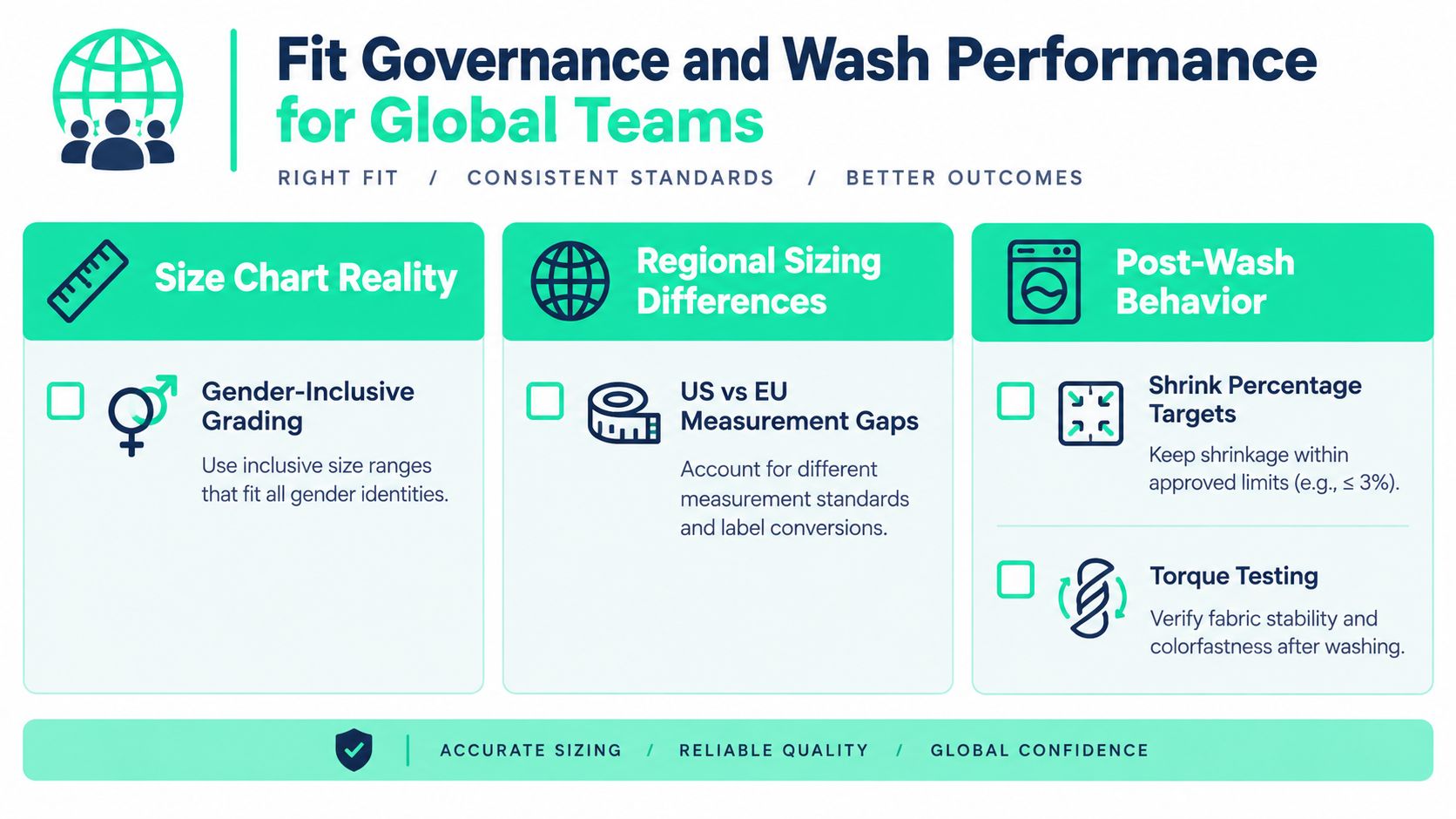
Start with actual garment measurements, not a generic S to XXL chart. Publish chest, body length, shoulder width, and sleeve length. State the block clearly as relaxed, boxy, unisex, or athletic. If you are running one program across multiple countries, explain how measurements are taken and what the fit is meant to look like, because the same size label does not mean the same thing everywhere.
Keep the system easy to use. Ask wearers to compare against a shirt they already like, provide a measurement diagram, and give a clear recommendation for people between sizes. For reorders, attach the approved spec table to every PO and keep the tolerance rules fixed. A stable reorder depends on agreed quality thresholds, as covered in this apparel quality standards guide from FLYP.
Put wash behavior into the specification
Wash performance needs named test methods and agreed thresholds. Request dimensional-change testing under ISO 6330 and ISO 5077 or AATCC 135. For many cotton blanks, a workable target is no more than roughly 3–5% shrinkage, while suitable blends often need to stay under 2%, depending on the approved fit block. For dyed styles, set washing colorfastness at around Grade 4 or higher under ISO 105-C06, then check rubbing colorfastness at approximately Grade 4 dry and 3.5 wet under ISO 105-X12, as outlined in the shrinkage and colorfastness testing guide from Ruhrose.
Then inspect the garment after wash, not just the lab report. Check collar recovery, torque, pilling, print adhesion, and measurement drift. The size profiling insights from ClothME help translate those specs into clearer wearer guidance.
The best value often comes from the blank that survives repeated wear with fewer replacements, not the one that wins a first-touch softness test. Climate matters too. Heavyweight tees can work in cooler regions or event use, but warm-market programs usually perform better with blanks people will wear and wash often.
Brand Safety and Supply Continuity Checks
Cotton remains a foundational input for premium blanks because its supply chain operates at enormous global scale. The U.S. Department of Agriculture projected world cotton production at 119.0 million bales for the 2024/25 marketing year, an increase of 5.5 million bales, or 5%, from 2023/24, as reported in the GOTS certification overview from Organic Connection. That scale supports broad size runs and repeat replenishment, but it also creates variation between cotton grades, mills, knitting systems, dye houses, and finishing processes.
The sourcing question isn't “Is this cotton premium?” It is “Which fiber, mill, facility, process, and quality controls produced this exact style?” Record the approved fabric composition, target GSM, tolerance, color reference, measurements, finish, decoration route, and replacement policy. Then ask what happens if the original blank becomes unavailable.
Read certifications precisely
GOTS is a supply-chain standard, not merely a finished-shirt claim. It began being codified in 2002 and covers organic fibers from raw-material harvesting through processing, labeling, and distribution. OEKO-TEX STANDARD 100 focuses on product safety and tests every component of an article, including fibers, thread, buttons, and accessories, against a list of more than 1,000 potentially harmful substances. These distinctions are explained in ECOCERT's overview of organic textile certification.
Neither certification proves the best fit, heaviest fabric, or longest lifespan. Confirm the exact certified product, facility, and scope. One certified material or factory doesn't automatically cover every blank style in a supplier's catalog.
Calculate delivered value
Unit price is only one input. A garment that shrinks out of tolerance, arrives in an inconsistent shade, or gets replaced after a fit failure carries additional handling, shipping, and waste costs. For global programs, evaluate landed cost per successfully worn garment, including replacement risk, return handling, reorder matching, and the likelihood that employees choose the garment again.
A sourcing process that documents material and certification scope is easier to maintain through the broader material sourcing framework from FLYP. It also gives marketing and People teams defensible answers when they need to explain why one blank was approved over another.
Recommendations by Program Type and Next Steps
There isn't one best premium blank T-shirt for every program. The right choice depends on how long the garment needs to remain available, where people will wear it, how it will be decorated, and how much fit variation the program must absorb.
For onboarding kits ordered across countries and years, start with a mid-weight combed ring-spun blank or another stable profile with documented measurements, color references, and reorder controls. A slightly less fashionable silhouette is often the safer choice when employees need dependable sizing and comfortable daily wear.
For recognition moments, a heavyweight structured or garment-treated blank can communicate more visual presence, especially with embroidery or a restrained screen print. Confirm that the cut and fabric weight suit the recipient's climate before treating substantial weight as a universal quality signal.
For event drops, prioritize dependable availability, decoration compatibility, and turnaround. A mid-weight staple usually provides more flexible wear than a highly specialized blank, while a cotton-poly blend may help where shape retention and color stability matter more than natural hand feel.
For warm-climate programs, avoid selecting heavyweight fabric solely because it feels expensive in a showroom. Choose breathability, drape, and repeat wear, then validate the finished decoration through washing.
Use a controlled approval workflow
- Shortlist profiles: Match weight, fit, fiber, and decoration to the program.
- Order physical samples: Include the intended colors and size range.
- Decorate the exact blanks: Test DTG, DTF, embroidery, or screen print as planned.
- Wash-test finished samples: Measure shrinkage, collar recovery, colorfastness, pilling, and print behavior.
- Verify certification scope: Confirm the product, facility, and applicable certificate.
- Lock the reorder specification: Record measurements, GSM tolerance, color reference, finish, and approved decoration.
- Review delivered value: Track returns, replacements, reorder matching, and actual wear.
A managed merch operating system such as FLYP LTD can handle blank curation, garment-accurate design production, QA, logistics, brand controls, and reorder coordination for enterprise programs that don't want to run every step internally. The platform's role is operational consistency, not replacing the buyer's approval standards.
FLYP LTD helps enterprise teams curate premium blanks, test decoration, and manage onboarding kits, recognition merchandise, event drops, fulfillment, and reorders through one managed workflow. Visit FLYP LTD to turn your blank-T-shirt specification into a controlled global merch program.