A People team has onboarding kits to send to new hires in several countries, a work-anniversary gift to arrange, and client thank-yous that need to arrive across time zones. Finance wants a clear budget, HR needs to protect employee data, and the event date won't move if a shipment gets held at customs. Buying corporate gifts online can simplify ordering, but it won't make those operational details disappear.
The reliable approach is to treat gifting as a repeatable procurement workflow. Decide who's eligible, vet vendors, set the choice and budget controls, then plan shipping, returns, and reporting before placing the order.
Table of Contents
- What Online Corporate Gifting Involves Today
- Vetting Online Gift Vendors Before You Order
- Comparing Fixed Catalogs and Employee Choice Stores
- Setting Up an Order Workflow That Scales
- Planning Lead Times and International Shipping
- Handling Returns and Taking Your Next Step
What Online Corporate Gifting Involves Today
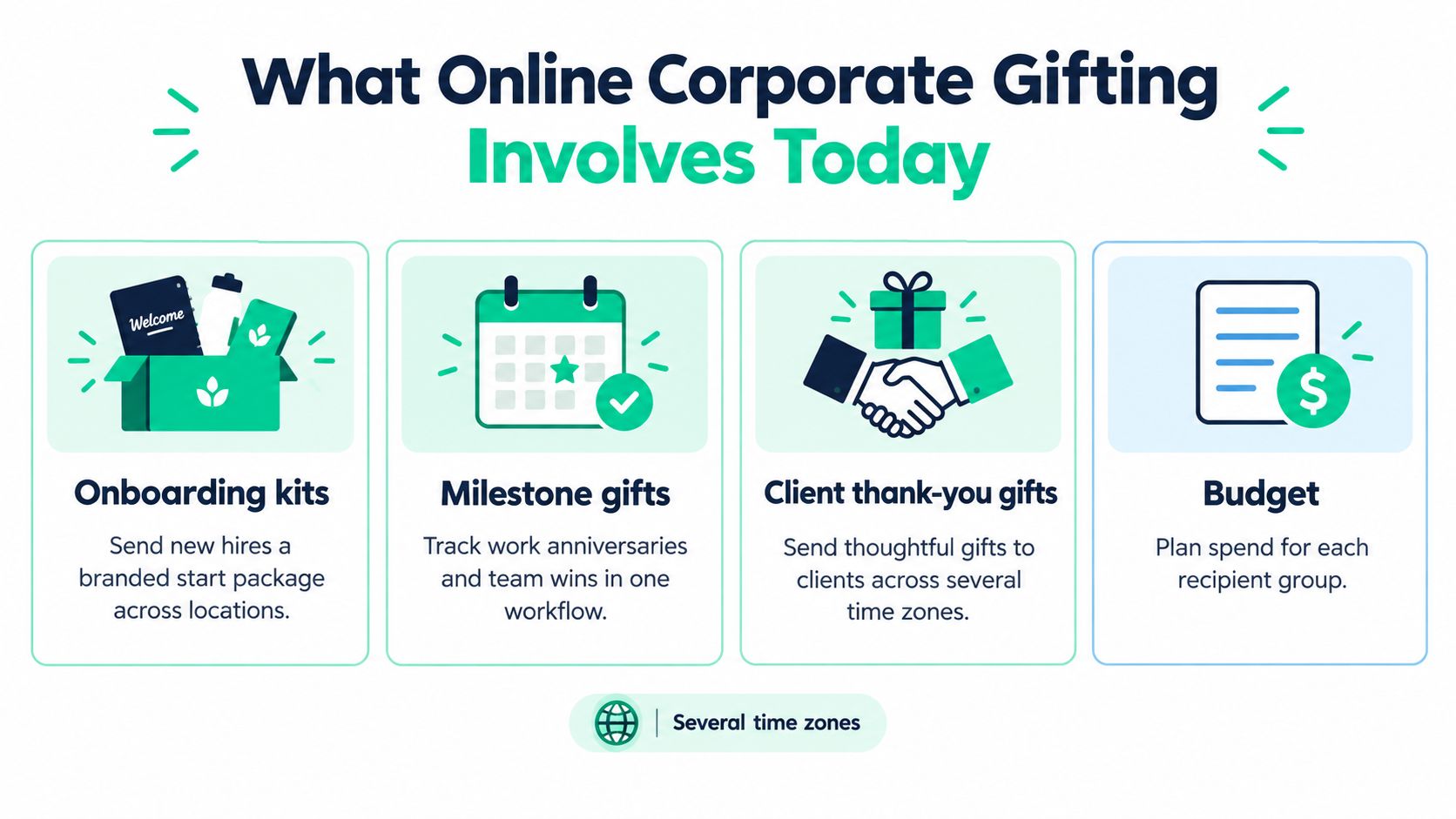
One checkout screen can hide three distinct jobs. An onboarding kit has to reach a new hire at the right address during the right week. A milestone gift should suit the person and the occasion. A client gift needs to match the relationship, the brand, and the delivery expectation. Each job calls for different recipient data, timing, and approval, even when one platform processes the payment.
Budget sits underneath all three as a fourth component. Finance wants a spend cap per gift, reporting split by program, and charges it can reconcile without chasing down invoices. Set those controls early. Retrofitting them after the first order ships is slower and messier.
Programs handling all four pieces start to look like procurement work: approvals, vendor reviews, repeatable spend. Market size points in the same direction. One forecast estimated the global corporate-gifting market at approximately $764.6 billion in 2025, with a projection of $1.61 trillion by 2034 and an 8.6% compound annual growth rate (Research and Markets' corporate-gifting market overview). Other published forecasts come in higher or lower because researchers define the category differently, so read any figure as directional rather than a precise measurement.
Match the occasion to the supplier
A supplier that can ship a single client gift may not be equipped to run a recurring employee-choice program. Define the work before you compare catalogs. The vendor may need to collect addresses, coordinate personalization, ship to multiple countries, report spend, or process exchanges.
Product decisions come second. A useful everyday item fits a new-hire kit, while a personal milestone may call for a choice of apparel, accessories, or a handwritten note. For a reusable option, reusable branded gifts for companies can serve as a starting point for judging whether the product suits the recipient and the intended use.
Treat the platform as part of the process
A gifting platform can pull recipient details, budgets, product selection, personalization, fulfillment, and reporting into one workflow. It still needs sound inputs and a named owner. Someone has to confirm eligibility, check addresses, and keep spend inside the approved limit.
Set the rules before browsing products. Otherwise a simple order turns into a chain of exceptions: a missing size, an unapproved item, an international delivery question, a charge Finance cannot reconcile.
Vetting Online Gift Vendors Before You Order
A polished storefront doesn't prove a vendor can handle your program. Vet the supplier against the work you need done, starting with product quality and ending with exception handling. If you're placing repeat orders, ask how the vendor preserves product specifications and pricing across batches, and how it handles an item going out of stock.
Request concrete answers, not general assurances. Who confirms the order? Who contacts a recipient about a delivery issue? Can the vendor ship to every destination on your list? What information does it need for apparel sizing or customs? If customer service refers you back to a generic inbox, establish who owns the issue before you pay.
Run a small operational test
A paid sample order tests more than the item itself. Check whether the delivery estimate matches what happens, whether the packaging arrives in good condition, and whether the product matches its approved description. Ask the vendor how it responds to an incomplete address or a recipient who needs an exchange. You're testing the process, not trying to create a real delivery failure.
Record the answers in a vendor scorecard. Include product consistency, communication, address support, destination coverage, and the steps for resolving a damaged or delayed shipment. A repeat-order process should be easy to explain: who submits the order, who approves changes, and how the vendor confirms what it can fulfill.
Practical rule: Don't judge a quote by the item price alone. Ask what personalization, packaging, shipping, duties, and return handling add to the delivered cost.
Compare the quote with the full budget
A survey-based industry summary reported that typical spending per gift ranged from $25 to $125, with many organizations clustering around $75 to $100. It also reported that 64% of corporate gifting occasions involved employee appreciation or recognition, while 60% of spending went to clients and outside partners and 40% to internal stakeholders and employees (corporate gifting spending and occasion data). Use these figures as a broad benchmark, not a required price point. What matters is whether your quote covers the actual product, delivery, personalization, and exceptions within your approved budget.
For a structured way to assess a supplier's repeatable processes, use this vendor quality management resource. Then compare vendors on the same requirements. If one quote excludes shipping or doesn't specify how it handles returns, ask for a complete delivered-cost estimate before deciding.
Comparing Fixed Catalogs and Employee Choice Stores
A fixed item is easy to order. Everyone receives the same product, so purchasing and branding stay straightforward. The trade-off is that one item may not suit every recipient. Apparel can miss on size or style; a branded accessory may not match someone's preferences or work context.
A curated choice program gives recipients options within boundaries set by the company. Procurement can preapprove the products, set a spend ceiling, and restrict the catalog to items that meet brand and quality requirements. Employees then select what fits them, rather than receiving a universal item by default.
A 2025 survey of 1,051 U.S. employees at companies with more than 10 employees found that 82% valued personalized gifts more, and 52% preferred choosing among several gifts (survey findings on personalized gifts and choice). Those preferences are useful inputs, not proof that a choice program will automatically improve retention or financial results.
| Factor | Fixed Item for Everyone | Curated Employee Choice |
|---|---|---|
| Administration | Simple to approve and place as a single order | Requires a selection window and recipient follow-up |
| Recipient fit | One item may not suit every size, style, or preference | People choose from approved options that better fit them |
| Budget control | Set a budget through the selected item and order quantity | Set a ceiling and keep the catalog within that limit |
| Brand control | Consistent product and branding across recipients | Consistent standards, with choice among approved products |
| Common risk | Unsuitable gifts, exchanges, or unused merchandise | Late selections, incomplete recipient details, or fulfillment exceptions |
Put boundaries around choice
A choice store isn't an unrestricted shopping cart. Approve product specifications in advance, cap the available spend, and collect only the information needed to fulfill the selection. Use a privacy-conscious form for size and delivery details, validate addresses before dispatch, and review destination-specific product and customs requirements. Monitor unselected gifts and delivery exceptions rather than assuming every recipient will complete the process.
Compare the models with a small pilot. Track selection completion, fulfillment cost, delivery success, exchange rate, and recipient satisfaction. Keep these measures distinct: a favorable survey response doesn't establish business impact by itself.
For a program that needs managed curation and fulfillment, FLYP is one option. Its AI-native merch operating system turns brand inputs into garment-accurate designs across 600+ premium blanks, and its managed service supports employee-choice stores, onboarding kits, and recognition moments with curation, quality assurance, logistics, budgeting, brand safety, and reporting. Teams considering a store can also review this guide to setting up a corporate swag store. For a narrower gift category, a Grainmark Leather gift collection can help buyers assess whether personalized leather goods suit the recipient and occasion.
Setting Up an Order Workflow That Scales
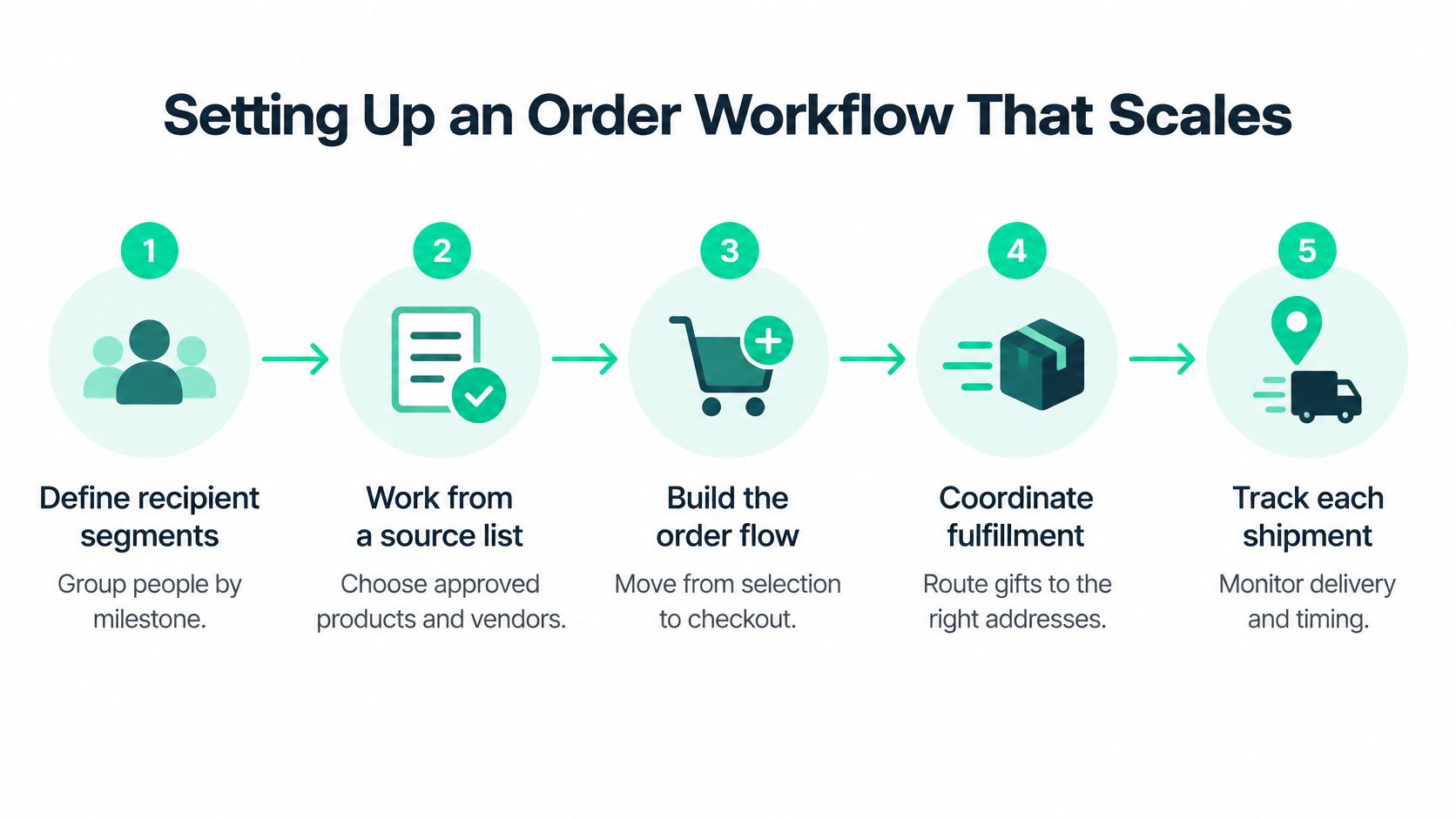
A scalable order starts with a clean recipient list and a clear reason for each gift. Don't start by importing every employee into a vendor portal. First define who qualifies, which event triggers the gift, what information is necessary, and who approves the spend.
Then separate selection from fulfillment. That gives employees room to choose without handing over budget control, and it lets the operations team catch address or availability problems before dispatch. A practical workflow moves through distinct stages, each with its own owner and record.
Use milestones instead of a single annual send
Segment recipients by milestone, work context, and fulfillment constraints. A promotion gift may need a manager's approval; a remote employee's anniversary gift needs a verified delivery address; a client thank-you may need a different catalog and budget owner.
A U.S. survey of 1,000 employed respondents found that promotions were the most meaningful occasion for recognition, at 59%, followed by work anniversaries at 54%. It also found that 50% said a handwritten note makes a gift more memorable (survey findings on recognition occasions and notes). Use these results as a planning reference, not a rule for every workforce. A short message tied to the specific milestone is more useful than a generic note added at the last minute.
Build the order around a trigger, such as a promotion date or anniversary, rather than relying only on a year-end campaign. A milestone workflow spreads the work across the calendar and gives the team a better chance to confirm each recipient's details before ordering.
Keep operations and outcomes separate
Measure delivery completion, address accuracy, return rate, and cost per recipient as operational metrics. Track perceived value and motivation separately as recipient outcomes. Don't treat a timely shipment as proof that the gift felt meaningful, or a positive response as proof that delivery ran efficiently.
Keep an auditable record of the order: the eligibility rule, recipient data used, selection made, approval, shipping date, delivery status, and any exchange or return. Limit access to the people who need it, and make sure the record supports reconciliation without keeping unnecessary personal information. A clear process lets HR, Finance, and Procurement answer what was sent, to whom, at what cost, and what happened afterward.
Planning Lead Times and International Shipping
Ordering online doesn't make international delivery frictionless. It can shift the work from manual purchasing into customs, duties, payroll reporting, privacy, and returns. The risk rises when the employee, employing entity, funding entity, and delivery country don't match, because different teams may need to make decisions about the same gift (global compliance and employee-data considerations).
Work backward from the date the gift needs to arrive. Ask the vendor to confirm production time, dispatch timing, transit expectations, and the process for correcting an address. Leave room to resolve missing recipient details and delivery exceptions. For destinations that need local-language communication or additional customs steps, plan those requirements separately instead of assuming the same timeline applies everywhere.

Assign the decisions before placing the order
HR should confirm who's eligible and what recipient information is required. Finance should define the budget and determine how the spend will be recorded. Legal and privacy colleagues should review the relevant data-handling and cross-border requirements. Procurement should set vendor expectations and approvals. The fulfillment provider should explain shipping options, address validation, customs fields, and the process for reporting delivery problems.
An employee's name, home address, personal email, phone number, preferences, and delivery history can all be personal data. Decide why each detail is needed, who can access it, how long it's retained, and how it will be deleted. Don't collect extra information just because a vendor's form asks for it. Confirm the lawful basis, processor responsibilities, and any required transfer arrangements with the appropriate internal teams.
Digital ordering removes some manual steps. It doesn't remove the need to decide who owns tax, privacy, customs, and reconciliation.
Settle these questions before dispatch
- Customs and duties: Who's responsible for duties, and how will the recipient be told if charges apply?
- Tax and payroll: Has the relevant team validated how the gift is handled in each destination?
- Address quality: Which fields are required, and who resolves an incomplete or rejected address?
- Delivery exceptions: How will the vendor report delays, unsuccessful deliveries, or a return to sender?
- Data handling: What data is shared, with whom, for what purpose, and when will it be removed?
For time-sensitive food or other perishable gifts, compare what the vendor means by delivery timing with the actual event date. This IFM Gourmet Food Store delivery guide can help frame questions about delivery expectations, but confirm the service and destination details directly with the supplier. For broader cross-border logistics planning, use this guide to international shipping management.
Handling Returns and Taking Your Next Step
The order isn't finished when a tracking page says delivered. A recipient may need a different size, an item may arrive damaged, or a shipment may come back because the address was incomplete. If nobody owns those cases, recipients get passed between HR, the vendor, and Finance while the original order stays unresolved.
Set the return and exchange process before opening the order. Decide who approves a replacement, who contacts the recipient, which items can be exchanged, and how the vendor records the change. Reconcile each return against the original order so inventory and budget reports reflect what was received, replaced, or refunded.
Use exceptions to improve the next order
Review exchange and return rates alongside delivery success and cost per recipient after each campaign. These measures can point to different problems. Address issues suggest that the recipient-data process needs attention. Repeated apparel exchanges may indicate that the choice catalog or sizing information needs work. Damaged items may call for a vendor or packaging review.
Keep the recipient experience in view, too. A return isn't just a line in a report. It's a moment when a person needs clear instructions and a timely response. Assign an owner for questions, set expectations about how exchanges work, and make sure a person can resolve an issue without navigating an unclear chain of support.
Start with one upcoming milestone or event. Choose two vendors and ask each the same questions about product quality, shipping, customer service, and returns. Run a small choice-based pilot with a fixed budget ceiling, then check selection completion, delivery success, exchange rate, and recipient feedback before expanding. That gives you a useful operational test without committing the whole program to an untested process.
Review the results with HR, Finance, and Procurement. If the workflow works, keep the records and approval steps so the next order is easier to repeat. If it doesn't, fix the specific breakdown, whether that's address collection, a confusing choice window, late dispatch, or unclear ownership of exchanges. For teams that want a managed service, confirm exactly which parts of curation, fulfillment, international shipping, customer service, and returns the provider will handle after designs are approved.
If you're planning a corporate gifting pilot, choose one milestone, set the budget ceiling, and write down who owns recipient data, shipping exceptions, and returns before ordering. Visit FLYP LTD to review its managed merch services for employee-choice stores, onboarding kits, recognition gifts, and global fulfillment.