You're probably not buying one shirt. You're buying a program.
An HR team needs onboarding kits for hires spread across multiple offices. An events lead needs race-day shirts that won't feel swampy by noon. A creator wants a performance tee that still reads like merch, not gym surplus. In all three cases, the mistake is treating custom shirts Dri Fit as a simple print job.
Performance shirts fail in boring, operational ways. The logo cures too hot and leaves press marks. The knit is technically polyester but feels plastic because the fabric construction is wrong. The size run looked normal on paper, then the bodies wearing it said otherwise. Legal catches “Dri-FIT” in the item name after approvals are done, because the product wasn't a Nike blank.
That's why I treat this category as a sourcing decision first. The shirt body, knit structure, decoration method, fit block, and fulfillment flow all have to match the use case. If they don't, the print quality won't save you.
Table of Contents
- Why Ordering Custom Dri-FIT-Style Shirts Is Harder Than It Looks
- What Dri-FIT Actually Means and How to Read a Spec Sheet
- Branded Dri-FIT, Generic Polyester, and Poly-Spandex Compared
- Choosing a Decoration Method That Preserves Performance
- Sizing Strategy and Fit Testing for Bulk Orders
- Trademark Rules and the Sustainability Tradeoff
- Matching the Right Shirt to Your Buyer Scenario
Why Ordering Custom Dri-FIT-Style Shirts Is Harder Than It Looks
A common scenario looks simple until it hits production. A People team needs performance tees for new-hire kits going to employees in different climates, under one brand standard, on a fixed deadline. Someone picks a moisture-wicking blank, uploads the logo, and assumes the hard part is done.
It isn't.
The shirt choice sets off a chain of dependencies. Fabric weight can drift slightly between dye lots. Sizing can shift across factories even when the style name stays the same. Decoration approval has to account for polyester heat sensitivity. Fulfillment has to work with individually packed shipments, not one bulk carton going to a single office.
The hidden variables buyers miss
The first trap is believing all performance polyester behaves the same. It doesn't. A smooth interlock, an open mesh, and a stretch-heavy blend can all be sold as moisture-wicking, but they won't wear, print, or fit the same way.
The second trap is language. “Dri-FIT” often gets used as a catch-all term, but buyers need to separate Nike-branded product from generic moisture-wicking product early. That's especially important when legal, procurement, and brand teams all touch the PO.
For teams still comparing fabric behavior at a high level, this overview of Dirt Cheap Product moisture wicking is useful because it frames the material question before you get into decoration.
Practical rule: If the vendor only wants to talk about print method and not blank specs, you're talking to a printer, not a sourcing partner.
What actually makes these orders hard
Most failed orders trace back to one of these issues:
- Blank inconsistency: The approved sample and the production run don't have the same hand feel, opacity, or drape.
- Decoration mismatch: Large chest graphics look good in mockups but turn a technical tee into a hot patch over the sternum.
- Fit assumptions: A unisex cut gets approved by committee and then disappoints the actual wearers.
- Fulfillment friction: Individually shipped kits expose every labeling, folding, and packing weakness in the workflow.
That's why custom shirts Dri Fit need a spec-first process. Buyers should lock fabric details, verify decoration limits, and fit-test the garment before artwork approval becomes the bottleneck.
What Dri-FIT Actually Means and How to Read a Spec Sheet
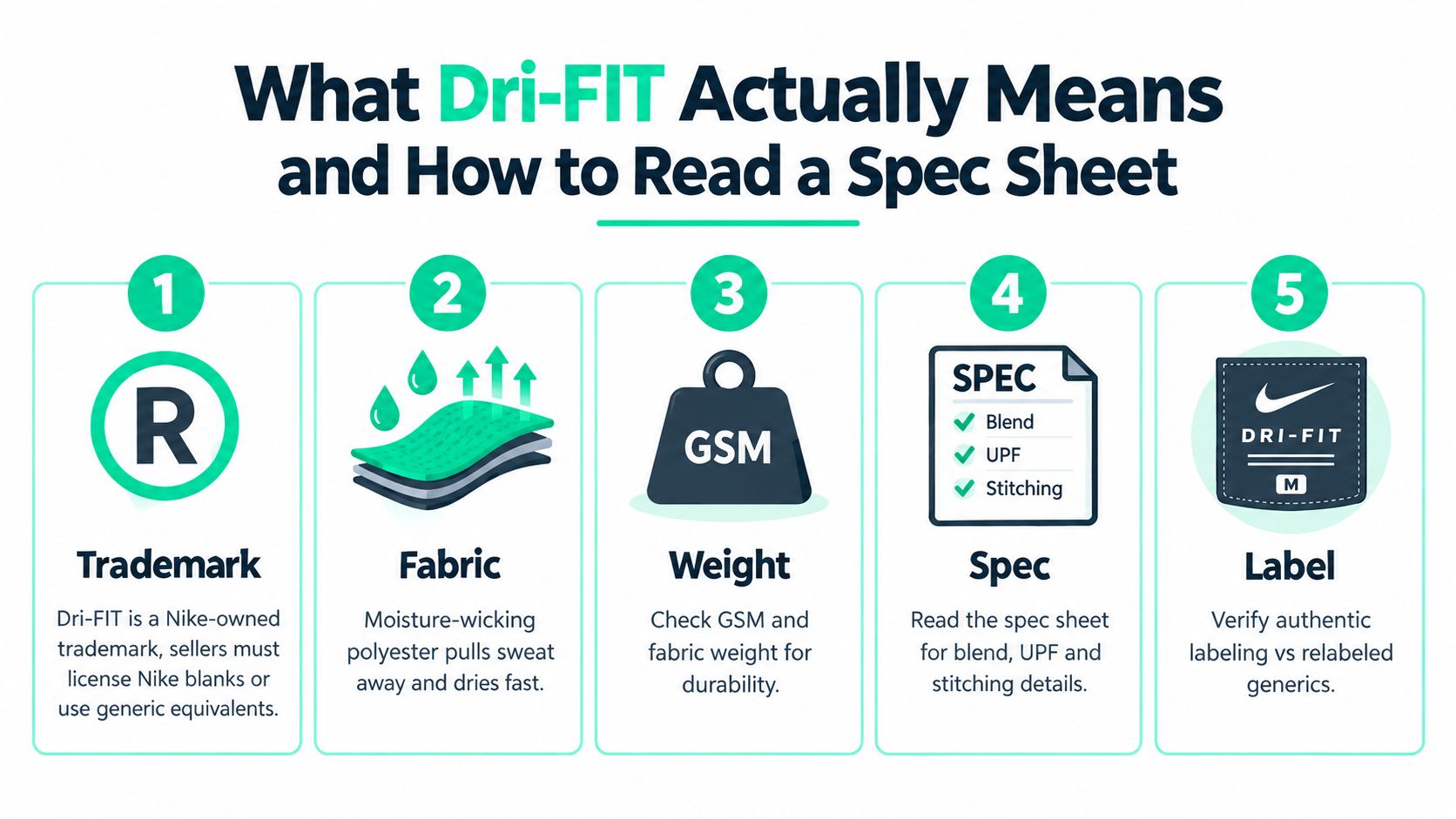
Dri-FIT is a Nike trademark. That matters more than most buyers think. If you're buying Nike blanks from an authorized channel, use the branded language that goes with that product. If you're buying non-Nike performance shirts, call them what they are: moisture-wicking polyester, performance knit, or performance blend.
Under the hood, the generic concept is straightforward. Polyester fibers don't absorb water the way cotton does. Performance versions use fabric engineering and yarn structure to move moisture away from the skin so it can evaporate faster. In better constructions, the fiber and knit do that work mechanically. In weaker ones, the shirt relies more heavily on a finish that may not age as gracefully.
The spec fields that matter
If a supplier sends only marketing bullets, push for a real spec sheet. These fields tell you far more than the product name:
- Fiber content: Start with whether it's 100% polyester or a blend.
- Knit structure: This affects airflow, stretch, surface texture, and print behavior.
- Fabric weight: Lighter isn't always better. Too light can go sheer or clingy.
- Finish type: Ask whether the wicking behavior is built into the fabric construction or added as a chemical finish.
- Country of cut-and-sew: Not because one country is universally better, but because consistency often follows factory discipline.
- Care and performance notes: These reveal whether the mill expects the shirt to hold up as activewear or resemble it.
One textile study is especially useful here. It found that micro-polyester sportswear fabrics outperformed standard polyester and polyester-spandex blends in moisture management, and it identified plain single-jersey knit as the most porous and most suitable for moisture comfort among the tested knit structures in that set of fabrics, which is a strong clue that fabric construction matters as much as fiber label for active use (textile research on micro-polyester moisture management).
Read quality drift before it hits production
A lot of shirt programs go wrong because buyers focus on the front-page spec and miss the stability questions.
Here's the checklist I'd ask for before issuing a PO:
- Full fiber breakdown for body and any contrast panels
- Knit construction named clearly, not just “performance fabric”
- Fabric weight with stated tolerance
- Wicking method described as mechanical, finish-based, or both
- Measurement spec for each size and cut
- Factory or mill consistency notes if reorders are likely
If your team needs a broader QA framework around apparel approvals, this guide to apparel quality standards is a practical companion to the fabric spec itself.
The shirt that performs best in the field usually has the most boring, complete spec sheet.
Branded Dri-FIT, Generic Polyester, and Poly-Spandex Compared
These are three different sourcing paths. They shouldn't be treated like three versions of the same thing.
Licensed Nike Dri-FIT blanks are usually chosen when brand recognition matters as much as function. You're paying for a known retail label, a familiar hand feel, and tighter presentation standards. The tradeoff is less freedom. You may face logo review constraints, narrower style availability, and higher program complexity.
Generic 100% performance polyester is the workhorse. It gives buyers the broadest sourcing flexibility, the easiest replenishment path, and the widest decoration compatibility. It's also the category with the most variance. Two “performance tees” from different mills can feel like completely different products.
Poly-spandex blends sit in a different lane. They're chosen for stretch, recovery, body-skimming fit, and a more retail-coded silhouette. They can work beautifully for the right audience and create avoidable return pain for the wrong one.
How the three paths compare
| Fabric Path | Fit Profile | Feel & Hand | Durability Notes | Decoration Latitude | Best Fit For |
|---|---|---|---|---|---|
| Licensed Nike Dri-FIT blanks | Athletic, branded retail fit | Refined, performance-first hand feel | Usually consistent if sourced through authorized channels | Moderate, with brand and placement constraints | Premium corporate merch, executive event wear, branded athletic programs |
| Generic 100% polyester | Ranges from relaxed to athletic | Can be smooth, slick, or lightly textured | Depends heavily on mill and knit quality | Broadest flexibility across common decoration methods | Onboarding, large event programs, field teams |
| Poly-spandex | Close to body, stretch-driven fit | Softer drape with more recovery | Good recovery, but fit complaints rise if the cut is too lean | More restrictive, especially for large graphics and heat-sensitive applications | Creator drops, fitted event apparel, active team wear |
A strong sourcing team compares these paths the same way they'd compare packaging vendors or 3PLs. You're balancing end use, reorder risk, decoration limitations, and audience expectations. If you need help structuring those vendor choices, this overview of material sourcing is useful at the procurement stage.
When each one is the wrong choice
Nike blanks are the wrong move when budget control, color breadth, or rapid replenishment matter more than the label. Generic polyester is the wrong move when you need a premium retail perception and the audience will notice the difference. Poly-spandex is the wrong move when the size run includes a broad body range and you can't afford fit-related friction.
Buyers get in trouble when they rank these options instead of matching them to the job.
Choosing a Decoration Method That Preserves Performance
With performance shirts, decoration is a heat-management problem before it's a design problem. Polyester doesn't forgive sloppy pressing. Too much heat or pressure can leave marks, flatten texture, or compromise the shirt's feel.
That's why the blank test matters. Don't approve art placement in the abstract. Decorate the actual garment, with the actual method, at production settings close to the run.
What the production guidance says
Vendor guidance for Dri-FIT-specific decoration recommends lowering heat, increasing dwell time, and using a heat-press pillow to spread pressure more evenly because polyester is prone to press marks and performance loss when over-pressed. The same guidance warns that bulky graphics can block airflow, so smaller strategic logos or sublimation are usually better when preserving technical performance is the priority (Printify guidance on printing on Dri-Fit).
That aligns with what holds up in practice. A left chest mark, sleeve hit, or small upper-back logo usually causes fewer complaints than a heavy full-front block on a shirt people sweat in.
Method choices that work differently
| Method | Best Order Size | Heat Risk | Hand Feel | Best Placement |
|---|---|---|---|---|
| Screen print | Bulk programs | Moderate | Noticeable ink hand | Chest, upper back, sleeves |
| DTG | Smaller art-driven runs | Moderate to high if mishandled | Softer than heavy plastisol in many cases | Front graphic zones on compatible blanks |
| Embroidery | Smaller logos, uniform use | Low during decoration itself | Raised texture | Left chest, sleeve, hat-compatible branding |
| Sublimation | Full-garment or allover polyester work | Managed through process, but fabric-dependent | Zero hand on finished surface | Entire garment or engineered panels |
Placement matters more than buyers think
Avoid stacking heavy decoration over the places people heat up fastest. Mid-back, underarm-adjacent zones, and large upper-chest coverage tend to create comfort complaints. Seams also deserve respect. Printing too close to side seams, shoulder joins, or mesh transitions increases distortion risk.
For teams experimenting with smaller custom touches or prototype ideas before committing to bulk production, this roundup on ways to transform tees with your sewing machine is useful because it widens the conversation beyond standard front-print thinking.
Shop-floor reality: The best-looking mockup often becomes the worst-wearing shirt.
A simpler logo usually scales better on performance apparel than a louder one.
Sizing Strategy and Fit Testing for Bulk Orders
Most bulk returns come from fit disappointment, not catastrophic quality issues. Buyers spend hours debating logo size and then approve sizing from a PDF without testing it on actual people. That's backwards.
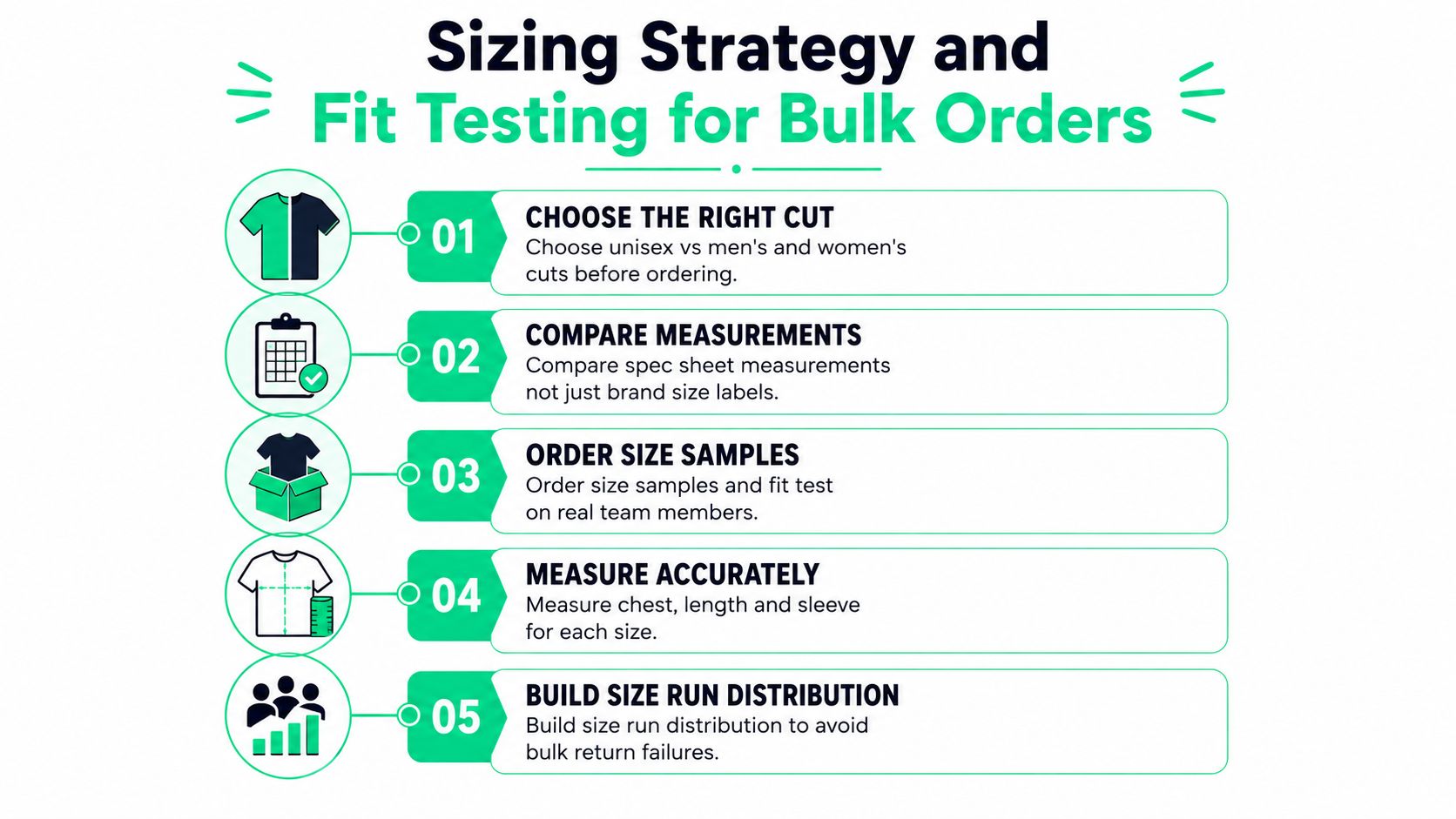
Start with the cut decision. Unisex can work well for broad internal distribution, especially where comfort and simplicity matter more than silhouette. It can also look boxy, long, or awkward on customer-facing teams and creator merch audiences.
Here's a visual checklist teams can use before locking the size run:
What to test before you approve
Ask for a size kit. Not a chart. Actual garments.
Then fit-test on real bodies across the likely range of wearers. Standing still in front of a mirror doesn't tell you much. Have people sit, reach, bend, and move around. Performance shirts that look fine on a hanger can pull at the chest, ride up at the hem, or cling in ways that recipients hate.
- Check body width: Most comfort complaints show up here first.
- Check body length: Too long feels sloppy, too short feels cheap.
- Check sleeve opening and sleeve length: Performance cuts often miss here.
- Check tolerance expectations: Ask what variance the supplier allows from spec.
A quick walkthrough can also help teams align on fit review before production:
How to build the order
Use your own employee or customer data if you have it. Past order history is better than guesswork. If you don't have reliable history, stay conservative with fitted styles and avoid overcommitting to the middle sizes.
I'd also hold extra units for replacements, late hires, and swap requests rather than trying to predict the exact distribution too tightly. The reorder that saves a program is usually the one you don't need because you planned for movement.
Trademark Rules and the Sustainability Tradeoff
The trademark issue is clean-cut. Dri-FIT is a Nike-owned mark. If the shirt didn't come from Nike or an authorized license path, don't use “Dri-FIT” in the product title, invoice description, hang tag, or product copy. Use terms like moisture-wicking polyester or performance knit instead.
This isn't just legal housekeeping. It affects catalog naming, internal approvals, marketplace listings, and customer support language. Clean naming at the sourcing stage prevents awkward relabeling later.
The sustainability question buyers should ask
The harder conversation is sustainability. Performance polyester is popular because it dries quickly and wears well, but polyester also sheds microplastics during washing and wear. One cited estimate referenced in sustainability coverage put the release at about 496,030 microfibers per 6kg wash, and the same coverage noted that recycled polyester can shed 55% more microplastic particles than virgin polyester (Sustainable Jungle discussion of polyester impacts).
That doesn't mean recycled polyester is automatically the wrong choice. It means buyers should stop treating “recycled” as the end of the environmental conversation.
A better way to talk about claims
If your company has ESG language around merch, keep it disciplined:
- Ask for recycled-content documentation: Certificates matter more than sales copy.
- Avoid sweeping eco claims: A recycled fiber claim doesn't erase shedding concerns.
- Add care guidance: Cold washing and lower-friction care are more defensible than vague sustainability language.
- Request durability data when available: Longer garment life can matter as much as material story.
The practical goal is brand-safe honesty. A shirt can be useful, durable, and thoughtfully sourced without pretending the tradeoffs don't exist.
Matching the Right Shirt to Your Buyer Scenario
The right custom shirts Dri Fit program depends on who's wearing the shirt, how long they'll wear it, and how the order needs to move through operations.
For enterprise onboarding, I'd usually steer toward a stable 100% polyester performance tee with a conservative decoration footprint. The priority is broad fit acceptance, easy replenishment, and individual shipment readiness. If the company is running recurring programs across regions, a managed platform like FLYP can handle design-to-fulfillment workflows for distributed merch operations without forcing the People team to manage every production step manually.
For event teams and race-day jerseys, the shirt can be more purpose-built. Full-coverage graphics, sponsor placements, and one-time event timing often point toward sublimated polyester-based product, especially when all units ship to one location for day-of distribution.
For creator drops, the decision changes again. The audience notices silhouette, drape, and hand feel fast. A stretch-forward or more fashion-leaning performance body can work, but only if the fit profile is explicit and the fulfillment model can absorb exchanges cleanly.
Scenario to sourcing recommendation
| Buyer Scenario | Recommended Fabric | Decoration Method | Fulfillment Model |
|---|---|---|---|
| Enterprise onboarding | 100% polyester performance knit with stable fit | Small screen print, DTG, or restrained logo placement | Inventory held for staggered ship-to-home programs |
| Event teams and race-day jerseys | Polyester-based event jersey or stretch performance build | Sublimation for integrated graphics and numbering | One bulk shipment to event site |
| Creator drop | Fit-forward performance blend or stretch performance tee | DTG, embroidery, or selective placement based on garment | On-demand fulfillment or pre-positioned limited inventory |
If your use case sits between corporate swag and branded merchandise, this guide to custom apparel for businesses is a useful next step because it frames the operational model, not just the garment choice.
The big takeaway is simple. Don't ask, “What's the best Dri-FIT shirt?” Ask, “What shirt spec, decoration method, and fulfillment path fit this exact program?” That question gets better outcomes.
FLYP LTD helps enterprise teams and creators run custom apparel programs with the operational pieces handled together, including design generation, blank selection, production, QA, and fulfillment. If you're sourcing performance shirts for onboarding, events, or merch drops and want a cleaner system than chasing separate vendors, visit FLYP LTD.