What happens when the employees doing the most important work are the least likely to appear on your employee recognition board? A wall filled with familiar names may look active while rewarding proximity to leadership, office visibility, or comfort with digital tools.
A well-designed board is more than a collection of thank-you notes. It's a governed recognition system with clear standards, multiple access routes, privacy choices, fair distribution, and enough operational discipline to reach deskless and behind-the-scenes employees. The board is the visible layer. The real work happens underneath.
Table of Contents
- Beyond the Wall of Fame
- Physical or Digital Choosing the Right Format
- Designing the Board with Clear Templates and Workflows
- Governance and Fairness Audits
- Linking Recognition to Rewards and Merchandise
- Launching and Maintaining Your Recognition Board
Beyond the Wall of Fame
A recognition board often starts with good intentions. Someone creates a digital channel, prints a few cards, or pins handwritten notes to a corkboard. Managers are invited to add praise, employees receive congratulations, and the organization assumes the culture will take care of itself.
That approach usually fades. The board becomes a decorative archive rather than a reliable workplace habit. Recognition gets posted when a senior leader remembers, when a team has an obvious win, or when someone is already highly visible.

Gallup and Workhuman's 2022 study of more than 12,000 employees across 12 countries found that only 36% said their organization had a recognition program, while 22% reported access to a digital recognition platform or software. Only 21% received recognition from a manager, supervisor, or other leader at least a few times a week. The figures come from the Gallup and Workhuman recognition study.
The implication is practical. A board can make appreciation easier to see, but it can't create a recognition habit by itself. People leaders need to connect the board to manager routines, peer participation, customer feedback, milestone processes, and team-level conversations.
Recognition needs an operating model
Start by defining what belongs on the board. A customer compliment, a colleague who prevented a recurring problem, a warehouse worker who improved safety, and a project team that supported a difficult launch may all deserve recognition. Their contributions don't look alike, so a generic “great job” standard won't produce fair coverage.
A useful post identifies:
- The recipient: Name the employee or team accurately.
- The contribution: Describe the action, decision, or behavior.
- The impact: Explain what became safer, faster, clearer, easier, or more successful.
- The value: Connect the contribution to a company value or operating principle.
- The visibility choice: Confirm whether the post is public, team-level, or private.
Behavioral frameworks can help managers describe contribution consistently. A resource such as Synopsix behavioral competencies can support that work by giving People teams a clearer vocabulary for observable behaviors rather than personality labels.
Practical rule: If a post could apply to anyone, it doesn't yet explain why this person deserves recognition.
The board should also preserve contributions that are easy to overlook. Behind-the-scenes work, shift coverage, documentation, quality checks, maintenance, translation, and emotional support often keep teams functioning without producing a dramatic announcement. A governance process that only celebrates visible launches will systematically miss this work.
Physical or Digital Choosing the Right Format
The format should follow the workforce, not the other way around. A polished digital employee recognition board isn't inclusive if many employees can't access it during their working day. A physical board isn't communal if only headquarters employees ever see it.
Physical boards work well where employees share a site and naturally pass through the same spaces. A warehouse break room, retail staff area, factory entrance, or clinic corridor can turn recognition into part of the daily environment. Physical displays also make appreciation tangible, especially for employees who don't spend their shifts inside collaboration software.
Their limitations are equally clear. Updates depend on someone being present, old posts can become difficult to archive, and remote employees may never see the board. A physical display also needs a process for translation, consent, replacement, and safe handling of personal information.
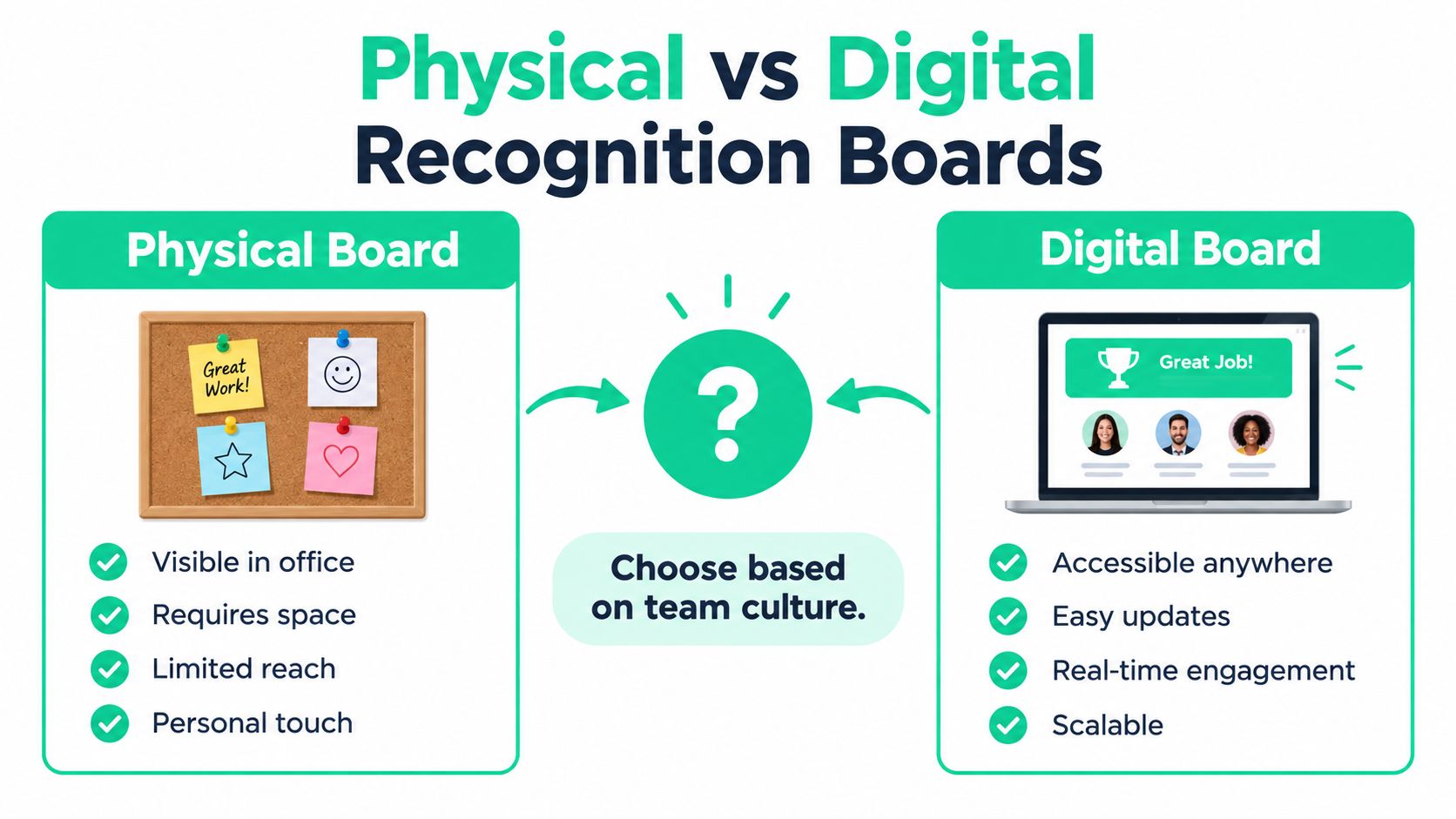
Digital boards offer searchable history, faster publishing, permissions, regional access, and easier reporting. They can include text, photographs, customer comments, and links to team achievements. They also allow employees in different locations to participate without waiting for a physical display to be updated.
The trade-off is access and participation. Employees may lack a company account, share devices, work in areas where phones aren't permitted, or have limited time for online tools. A digital channel can also become noisy if the organization doesn't moderate posts or make the contribution standard clear.
A practical format decision
| Workforce condition | More suitable approach | Operating safeguard |
|---|---|---|
| Shared on-site workforce | Physical board with local ownership | Add a capture process so posts enter a searchable record |
| Distributed office teams | Digital board | Use permissions, search, and a clear posting template |
| Deskless or shift-based teams | Hybrid board with kiosk, SMS, manager, or paper routes | Audit recognition by shift and location |
| Global and multilingual workforce | Digital system with local display options | Standardize data fields while allowing local-language messages |
| Mixed workforce | Hybrid model | Give every group at least one direct nomination route |
The strongest model is often hybrid. A manager can capture a paper nomination from a production floor, People Ops can enter it into the central system, and the local site can display a translated version. The digital record provides continuity, while the physical display meets employees where work takes place.
Designing the Board with Clear Templates and Workflows
A board becomes useful when employees know exactly how to contribute. Remove the guesswork from both the nomination and review process.
Begin with the behaviors and outcomes the organization wants to reinforce. Values such as collaboration or customer focus are too broad unless managers can recognize what they look like in daily work. Define examples for different functions, including operations, support, engineering, sales, facilities, finance, and field work.
Build the post template first
Use a short form that creates enough evidence without turning appreciation into paperwork:
- Who are you recognizing? Include the employee, team, location, and role where relevant.
- What did they do? Describe the observable action rather than a personality trait.
- What changed because of it? Add customer, team, quality, safety, process, or business impact.
- Which value or behavior did they demonstrate? Select from a controlled list.
- Where should it appear? Offer public, team-only, or private recognition.
- Who submitted it? Keep the source visible to administrators, even if the display is anonymous.
“Great job supporting the project” is weak because it provides no usable example. “You rebuilt the handover checklist after the late shift identified recurring omissions, giving the morning team a clearer starting point” gives the recipient useful feedback and gives other employees something they can learn from.
Use a searchable, permission-controlled channel rather than scattering posts across email, chat, and physical notes. A board that can't be searched or reviewed becomes a memory aid for the recipient, not an operating record for People Ops. Teams documenting the process can also use a structured design review process to test the template, approval rules, and user experience before launch.
Create more than one route to recognition
Manager nominations matter, but managers aren't present for every contribution. Open the workflow to peers, customers, senior leaders, project leads, and designated site coordinators. Each route should feed the same core fields so the organization can compare coverage without flattening local context.
A simple workflow looks like this:
- Submission: The nominator completes the template through the channel available to them.
- Screening: A local owner checks accuracy, consent, confidentiality, and minimum specificity.
- Publication: Approved posts appear in the appropriate public, team, or private space.
- Follow-up: The recipient receives the message and any associated reward or manager acknowledgement.
- Review: People Ops examines participation, distribution, and quality on a recurring schedule.
Gallup reports that only about one-third of U.S. employees strongly agree they received praise for good work in the previous seven days, and employees who lack adequate recognition are twice as likely to say they'll quit within a year, as described in its employee recognition guidance. A weekly visibility rhythm is therefore a useful operating benchmark, but it shouldn't become a quota that encourages shallow posts.
Don't add individual leaderboards based on nomination counts. They reward popularity, create pressure to post low-value praise, and disadvantage employees whose work happens away from the office or outside normal hours. Measure whether recognition reaches people fairly, not who can accumulate the most mentions.
Governance and Fairness Audits
Recognition programs carry the same risks as other people processes. If the rules are vague, managers apply them differently. If access is uneven, participation reflects tool availability rather than contribution. If leaders recognize people near them, the board can amplify proximity bias while appearing objective.
Gallup found that only 26% of employees strongly agreed they received a similar amount of recognition to colleagues performing at comparable levels. In the U.S., 28% of White employees strongly agreed recognition was equitable, compared with 19% of Black employees and 21% of Hispanic employees, according to the Gallup analysis of fairness in employee recognition. Those figures make fairness a governance responsibility, not a communications preference.
Define the control points
Assign ownership before launch. A local site lead may manage submissions, a People partner may review patterns, and an HR operations owner may maintain permissions and reporting. Managers should understand that recognition isn't a substitute for performance management, compensation decisions, or promotion evidence.
Set written rules for:
- Eligibility: Clarify whether contractors, temporary workers, interns, apprentices, and shared-service colleagues can be recognized.
- Privacy: Explain what can be published and how employees can request removal or correction.
- Evidence: Require a specific contribution and a credible description of impact.
- Conflicts: Prevent managers from using recognition to influence formal decisions improperly.
- Rewards: Separate symbolic appreciation from guaranteed financial outcomes.
- Moderation: Establish who can reject inaccurate, discriminatory, confidential, or embarrassing content.
A baseline survey should measure recognition frequency, specificity, fairness, authenticity, and connection to company values on a five-point scale. Repeat it at 30, 90, and 180 days, then compare recognized and unrecognized employees on engagement, intent to leave, absenteeism, and internal mobility. These measurement recommendations and the importance of authenticity are covered in how to measure employee satisfaction.
Audit distribution and quality
Count more than posts. A high-volume board may still exclude entire groups. Build a monthly dashboard with these measures:
| Measure | What it reveals |
|---|---|
| Eligible employees | The population that could receive recognition |
| Unique recipients | Whether recognition reaches a broad group |
| Posts per 100 employees | Participation intensity without relying on raw volume |
| Median time from achievement to post | Whether recognition is timely |
| Posts with specific impact evidence | Quality of the narrative |
| Recipient distribution by group | Potential access or proximity bias |
| Recognition source | Whether managers, peers, customers, and leaders participate |
| Recognition by location and shift | Whether deskless and remote groups are covered |
A monthly audit should sample 10% of posts for specificity, factual accuracy, value alignment, inclusion, and consent, following the quality-control approach in Gallup's research on getting recognition right for retention. Track which posts are corrected or removed, and investigate teams with high activity but low recipient diversity.
Recognition can correlate with strong managers or healthier teams, so don't claim that a board caused an engagement or retention change only because scores moved after launch. Use matched team comparisons or a phased rollout where possible. The operational question isn't only whether the board is busy. It's whether the right people can access it, whether the messages contain evidence, and whether employees believe the system treats comparable contributions consistently.
Linking Recognition to Rewards and Merchandise
A thoughtful message can make contribution visible. A well-chosen reward can give the moment a longer life. The two should remain connected without making merchandise the only reason someone receives appreciation.
Start with choice. Employees have different sizes, climates, cultural preferences, household needs, and opinions about branded products. A catalog or employee-choice store is usually more inclusive than sending everyone the same item. Offer alternatives where possible, including wearable products, practical accessories, and non-merchandise options.
The board post should explain the contribution first. The reward can then appear as a separate field or follow-up message. That distinction matters because a person who receives a smaller symbolic item shouldn't appear less valued than someone whose recognition includes a larger package.
Build a reliable reward workflow
An enterprise merch operating system can turn approved brand inputs into accurate designs across a broad product catalog, then coordinate manufacturing, fulfillment, international shipping, customer service, and returns. That type of managed process is useful when recognition spans multiple offices and local teams shouldn't have to negotiate suppliers for every award.
The workflow should answer five questions:
- Trigger: What qualifies for a reward, and who approves it?
- Choice: Can the recipient choose the product, size, color, or delivery location?
- Budget: Which team or program owns the cost?
- Fulfillment: Who handles production, shipping, returns, and address changes?
- Reporting: Can People Ops see delivery status without exposing unnecessary personal data?
A certificate of appreciation can suit employees who prefer a formal, printable record rather than merchandise. It can also work for team contributions where an individual product would create an awkward hierarchy. The important factor is not the object itself. It's whether the reward matches the contribution, the employee's preferences, and the recognition policy.
Keep reward rules transparent. If employees don't understand why one contribution produces a product, another produces a certificate, and another receives public thanks only, they may interpret the difference as favoritism. A recognition system can offer tiers, but each tier needs a clear rationale.
For teams considering physical awards, custom employee recognition awards can help translate values and milestones into consistent objects. Use those items as reinforcements for meaningful contributions, not as a substitute for specific feedback from a manager or colleague.
Launching and Maintaining Your Recognition Board
The launch should make participation easy without forcing public performance. Employees differ in their comfort with attention, hierarchy, public praise, and symbolic rewards. Cultural expectations also vary across countries and teams, so a single public-display rule will create avoidable friction.
Give employees a choice between public, team-level, and private recognition. Let recipients flag an inaccurate message, request a correction, or ask for a post to be removed. Public appreciation can motivate some people, while others may experience it as pressure or embarrassment. The CIPD evidence review on non-financial recognition notes that the meaning of recognition shapes its impact and that no single study provides definitive evidence across all contexts.
Launch with access built in
Use a short pilot with representative teams rather than launching everywhere at once. Include an office team, a remote team, a shift-based group, a frontline location, and at least one multilingual population. Test the nomination process at the point where work happens.
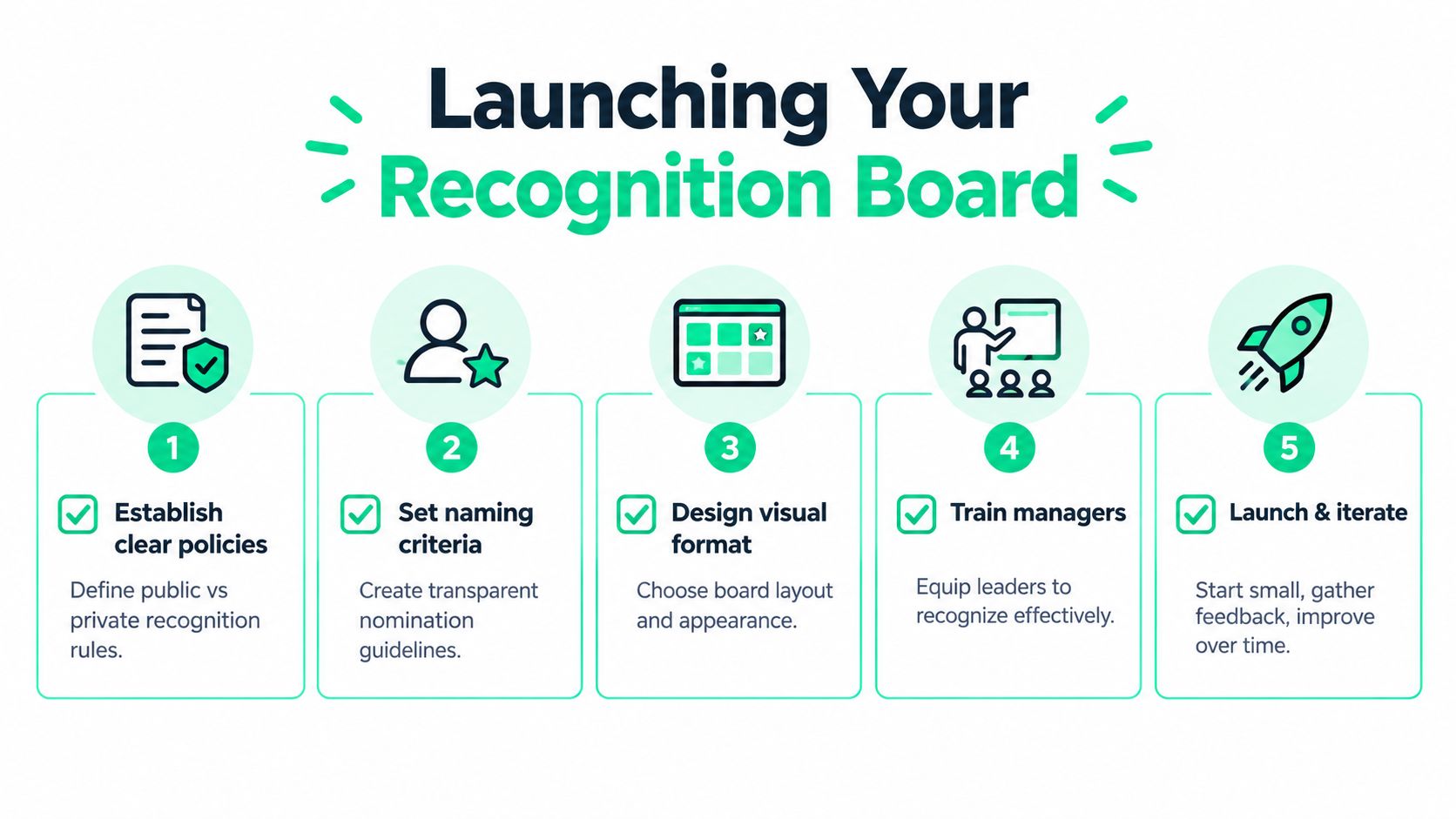
Your launch checklist should include:
- Publish the policy: Explain public versus private recognition, consent, moderation, eligibility, and rewards.
- Set naming criteria: Show strong and weak examples, and define what evidence a post needs.
- Create parallel channels: Offer manager submission, SMS, kiosk, paper-to-digital capture, physical displays, and local-language templates where access requires them.
- Train managers: Teach specific praise, inclusive nomination, and the difference between recognition and performance evaluation.
- Assign local owners: Give each location or function a named person responsible for intake and follow-up.
- Pilot and listen: Ask recipients and non-recipients what feels useful, awkward, inaccessible, or missing.
- Publish the changes: Show employees how their feedback changed the board or its operating rules.
Employees with limited technology access were 57% less likely to believe recognition programs were equally accessible to everyone and 46% more likely to view recognition as an empty gesture, according to the O.C. Tanner 2025 State of Employee Recognition research. That makes parallel access a design requirement. Adding more software can worsen inequity when the people who need recognition most can't use the software reliably.
Maintain the system visibly
Review the board every month. Remove outdated or inaccurate posts, follow up on unclaimed rewards, and check whether recognition reaches different shifts, locations, employment types, genders, tenures, and accessibility groups. Don't publish demographic information about individual recipients. Use aggregated reporting to identify coverage gaps and investigate patterns responsibly.
Refresh prompts so the board doesn't become a stream of the same accomplishment. Ask about customer care, risk prevention, knowledge sharing, mentoring, process improvement, translation, teamwork, and recovery after a difficult incident. Invite local teams to adapt examples while keeping the core fields consistent.
Recognition can also sit alongside broader engagement activities, provided they don't replace everyday manager attention. For teams looking to add an inclusive shared experience, expert guided VR wellness activities may complement recognition moments, particularly when participation options are designed for different locations and comfort levels.
The board should earn its place by helping employees see meaningful work, not by generating activity for its own sake. Keep reviewing what it rewards, who can access it, who remains absent, and whether recipients experience the attention as respectful.
FLYP LTD offers an enterprise merch operating system for recognition moments, employee-choice stores, onboarding kits, and global fulfillment, with design, production, shipping, returns, and reporting managed through one service. If you're building an employee recognition board that connects specific appreciation with inclusive, practical rewards, visit FLYP LTD to explore how the workflow could fit your People Ops program.