74% of employees believe service awards help them feel valued and improve engagement, while organizations with formal length-of-service programs report engagement scores 25 points higher than those without them. The practical answer is to recognize service with a consistent policy, timely delivery, manager-led impact messaging, and employee choice that works across countries, job types, and working arrangements.
Years-of-service recognition has earned its place in People Ops, but the old model is under pressure. A plaque sent to every employee at the same milestone may be easy to administer, yet it often ignores tenure patterns, cultural preferences, tax rules, shipping realities, and the difference between celebrating time served and recognizing contribution.
A modern program treats the anniversary as a structured moment of appreciation, not an automatic gift transaction. It gives People teams a common operating framework while allowing employees to decide what meaningful recognition looks like for them.
Table of Contents
- Why Years-of-Service Recognition Still Matters in Modern Workforces
- Building the Operational Foundation for Service Recognition
- Award Ideas That Actually Resonate Across Diverse Workforces
- Budgeting and Equity Framework for Global Programs
- Communication Strategies That Make Recognition Meaningful
- Measuring Impact and Avoiding Common Evaluation Pitfalls
- From Implementation to Excellence - The Strategic Roadmap
Why Years-of-Service Recognition Still Matters in Modern Workforces
3.9 years was the median tenure for U.S. wage-and-salary workers in January 2024, down from 4.1 years in January 2022. For employees aged 25 to 34, median tenure was 2.7 years, compared with 9.6 years for those aged 55 to 64. The tenure figures and workforce implications point to a practical design question: how many employees will reach a five-year milestone before setting that as the program's first meaningful award?
Audit that share by location, job type, employment status, and manager group. The answer affects whether your program recognizes a broad workforce or mainly rewards long-tenured specialists. Earlier touchpoints can acknowledge contribution before the traditional milestone, while longer anniversaries retain their symbolic weight.
The case for formal service recognition is also established. By the mid-2000s, 83% of responding companies in the Society for Human Resource Management's 2005 survey recognized employee length-of-service milestones. Awards commonly appeared at five, 10, 15, 20, or 25 years. SHRM's coverage of service awards describes how award values historically increased with tenure, but a historical pattern is not a complete operating model for a distributed workforce.

The program has to separate service from performance. A five-year employee may have rebuilt a process, supported colleagues through repeated change, or developed customer relationships that are absent from a job description. Another employee may have made a narrower contribution over the same period. The award should recognize sustained commitment without implying that tenure alone determines performance.
Employee choice helps resolve part of that tension. Offer a consistent recognition value and a controlled set of options, then let employees choose what fits their circumstances. A frontline worker may prefer flexibility, while a remote employee may value an experience or practical item. International transfers and contractors who become permanent employees also need clear service-date treatment, eligibility rules, and equivalent recognition value.
The service-award survey methodology and findings provide a useful benchmark for why organizations continue investing in the practice. They do not establish that awards caused stronger engagement, so program owners should treat the findings as context rather than a guaranteed result.
The operational test is simple: can the same policy recognize a warehouse employee, remote specialist, international transfer, and long-tenured expert fairly while still allowing personal choice? If not, the issue is program design, not employee appreciation.
Building the Operational Foundation for Service Recognition
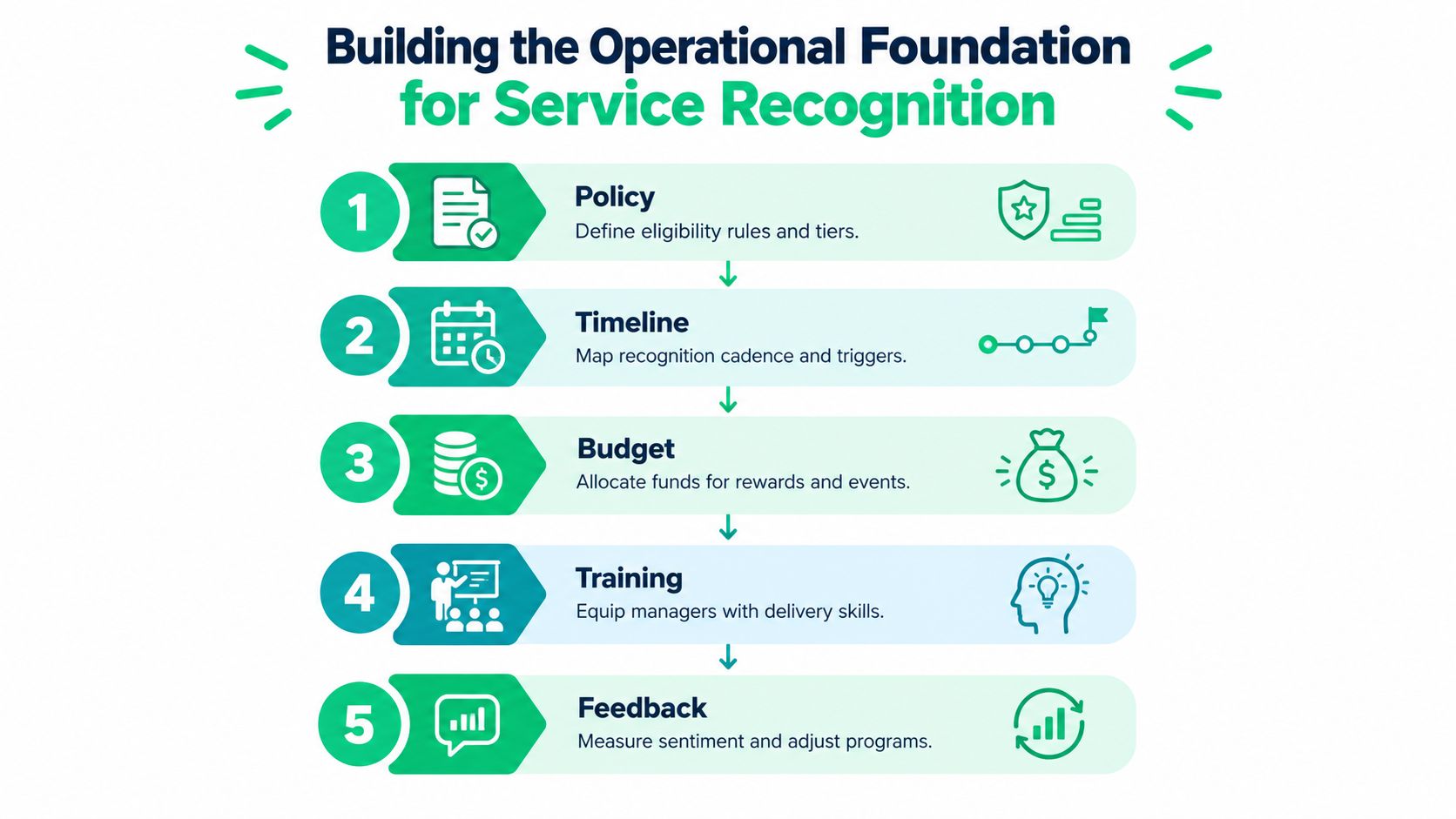
Strong employee recognition for years of service depends less on the size of the gift than on the quality of the operating system behind it. Five decisions determine whether the program feels dependable or improvised.
Start with eligibility governance
Write the rules before selecting awards. Define whether service includes approved leave, acquisitions, international transfers, mergers, rehires, and time spent as a contractor. Decide which worker types qualify, how service dates are corrected, and who approves exceptions.
An HRIS-controlled service-date field should be the authoritative record. Store the original hire date, adjusted service date where relevant, worker type, country, manager, and eligibility status. People Ops should own the policy, while HRIS or payroll owns the data controls.
Practical rule: If two employees could reasonably receive different answers about whether their service counts, the policy isn't finished.
Use a cadence that reflects the workforce
A practical milestone structure can include 1, 3, 5, 10, and 15 years, with earlier recognition layered around onboarding and contribution milestones. The point isn't to make every event equally expensive. It's to avoid asking a large share of employees to wait for a milestone they may never reach.
Trigger recognition before or at the anniversary. Annual batching creates avoidable errors, turns personal moments into an administrative cycle, and makes late delivery feel like an afterthought. Build automated reminders far enough ahead for managers to prepare a message and employees to make a choice.
Prepare managers to name impact
A manager message should answer three questions:
- What changed: Which project, process, customer relationship, or team capability did the employee influence?
- How it helped: Who benefited, and what did the contribution make possible?
- Why it matters now: How does that work connect to the team or organization's purpose?
“Thank you for five years” is accurate but incomplete. “Your work redesigning the handoff between support and engineering gave new hires a process they could rely on” recognizes contribution without pretending that tenure alone is performance.
Give employees real choice
Choice needs guardrails. Curate options by country, tax treatment, delivery capability, worker context, and brand standards. Include physical goods where they make sense, but consider learning, wellness, charitable giving, experiences, or time flexibility where those options are more useful.
Measure fulfillment and perceived value
Track participation, on-time delivery, choice completion, employee-rated value, recognition reach by location and demographic group, engagement, and voluntary turnover against a baseline. Review the data quarterly, including a sample of anniversaries and exceptions.
Common failures are predictable: incorrect dates, generic gifts, unavailable international shipping, unclear tax handling, remote employees excluded from ceremonies, and awards that celebrate tenure without explaining impact. A policy, workflow, and audit rhythm address those failures before they become employee stories.
Award Ideas That Actually Resonate Across Diverse Workforces
The award itself should make the recognition easier to personalize, not replace the personal moment. In a 2025 cross-market study covering the United States, Canada, Australia, India, and the United Kingdom, 74% of employees said personalized appreciation makes recognition more valuable. Awards highlighting employee impact were reported as 11 times more meaningful, while awards symbolizing that the person is valued were reported as 12 times more meaningful. The study on personalized service recognition points to a useful design principle: the object matters, but the meaning attached to it matters more.
Match the reward to the employee segment
Experiences work well when employees value flexibility and can use them locally. They also create problems when the catalog assumes one country, one currency, or one definition of leisure. Merchandise is more visible and can create a lasting connection to the organization, but generic branded items often become unused inventory.
| Award Type | Best For | Implementation Notes | Cost Considerations |
|---|---|---|---|
| Employee-choice merchandise | Employees who want a tangible keepsake or wearable item | Offer curated products by region, size, role, and delivery location | Control spend through a defined catalog and milestone tiers |
| Local experiences | Employees who value dining, travel, culture, or leisure | Confirm local availability, accessibility, tax treatment, and expiry rules | Prices and usefulness vary by market |
| Learning or development | Employees focused on growth or professional identity | Let the employee choose a course, certification, or learning format | Budget for different provider prices and approval workflows |
| Charitable giving | Employees who prefer purpose-linked recognition | Offer compliant charities and let employees select where possible | Validate local donation rules and reporting |
| Time flexibility | Caregivers, frontline employees, and people who value time over goods | Coordinate with scheduling, payroll, and local employment rules | Operational coverage may matter more than purchase price |
A curated merch store can work when the company wants brand consistency without forcing everyone into the same product. FLYP LTD turns prompts, URLs, videos, images, or briefs into branded designs, manages curation and fulfillment, and supports employee-choice stores across a catalog of 600+ premium blanks. That makes it relevant for teams that need garment accuracy and operational control, but it doesn't remove the need to localize options or verify tax and shipping rules.
For high-tenure milestones, symbolic items can be appropriate when employees value them. A premium keepsake, engraved piece, or family-inclusive experience may suit a 25-year celebration better than a standard kit. Teams exploring that category can review luxury 25th anniversary ideas for inspiration, then adapt the principle to the employee's preferences and the organization's budget.
Watch the following demonstration with a specific question in mind: can the workflow support choice, approvals, fulfillment, and reporting across the locations where your employees work?
Use a portfolio instead of a single default
A five-year employee might choose a custom jacket, a local experience, or a contribution to a cause. A ten-year employee might prefer a premium keepsake, additional time flexibility, or a development budget. A longer-tenured employee may appreciate a family-inclusive event and a peer tribute more than another branded object.
The employee recognition gifts guide is useful for building that broader portfolio. The operating decision is to offer meaningful alternatives without allowing manager discretion to create unequal outcomes.
Budgeting and Equity Framework for Global Programs
A global service-recognition budget depends on more than headcount multiplied by a gift value. Milestone frequency, tenure distribution, country requirements, fulfillment costs, and employee choice determine the actual obligation.
Forecast cost by milestone tier using current headcount and service-date data. Add separate operating lines for shipping, customs, local taxes, translation, event delivery, and exceptions. This prevents a program from appearing affordable until fulfillment begins.
Build a tiered budget with guardrails
Set a budget band for each milestone and review expected eligibility by location and job type. A five-year milestone may affect many more employees than a longer-tenure award, so equal per-person assumptions can distort the annual forecast. Reserve capacity for late corrections, missed service dates, and employees whose work location changes.
Use one global framework with controlled local flexibility. The company can set the same milestone definitions, message standard, approval rules, and budget bands for everyone, then offer region-specific rewards within those limits. Document who approves exceptions and how unused or unclaimed awards are handled.
Treat equity as practical value
Equal nominal value does not guarantee equal benefit. Currency differences affect purchasing power, some products cannot cross borders, and a public ceremony may suit an office-based employee while making a remote or frontline employee uncomfortable. Caregiving responsibilities, accessibility needs, sizing, and shift schedules also shape whether an award is usable.
Review every catalog option for delivery reliability, tax treatment, accessibility, sizing, and relevance to hourly, frontline, remote, hybrid, and caregiving employees. Ask employees how they prefer to be recognized. Only 10% of employees reportedly say their workplace has asked that question, according to the global recognition equity findings.
Choice should operate inside clear controls. Standardize eligibility, milestone timing, budget limits, catalog governance, and reporting, while letting each employee choose the form of appreciation. A curated portfolio reduces manager-by-manager variation and makes regional administration easier. For examples of structuring options for different recipients and occasions, review these corporate recognition gifts.
Track awards by milestone, country, employee group, fulfillment status, and actual cost. That reporting shows whether a nominally equal program delivers comparable value across the workforce.
Communication Strategies That Make Recognition Meaningful
A reward can be perfectly delivered and still feel empty if the message says nothing about the person's work. The communication plan should make the employee's contribution visible to the manager, the team, and the employee themselves.

Give managers a usable briefing
Send the manager a prompt before the anniversary, not on the morning of delivery. Ask for one concrete contribution, one example of influence, and one sentence connecting the work to the team's purpose.
A practical manager template is:
“For your [milestone], I want to recognize the way you [specific contribution]. That work helped [team, customer, or colleague] by [specific effect]. Your judgment and consistency have shaped [purpose, capability, or outcome], and we're grateful you've built that with us.”
The template should guide thought, not produce identical messages. Managers should also know whether the employee prefers private or public recognition and whether colleagues can contribute messages.
Design the communication sequence
A dependable workflow might look like this:
- Advance reminder: HRIS automation alerts the manager before the anniversary and confirms the service date.
- Manager preparation: The manager submits the impact message and selects the appropriate delivery format.
- Employee choice: The employee receives a localized catalog or approved reward options.
- Recognition moment: The manager delivers the message in a dedicated meeting, team channel, or event.
- Peer contribution: Colleagues add short notes, audio messages, or written reflections where appropriate.
- Follow-up: People Ops confirms delivery, choice completion, and employee-rated value.
Remote employees need an equivalent experience, not a lower-effort substitute. A dedicated video moment, asynchronous messages from colleagues, or a private manager conversation can work when the employee has a choice about visibility.
Write for different milestones
For an early anniversary, the message can emphasize belonging: “You took ownership of the customer handoff process and made it easier for new teammates to contribute.”
For a longer milestone, name continuity and adaptation: “You carried critical context through several changes and helped the team make better decisions when the usual answers no longer applied.”
The employee recognition messages resource can help managers build a stronger starting point, but People teams should still require specific evidence rather than allowing templates to become a substitute for preparation.
Country-specific reward rules, automated approvals, and quarterly audit sampling complete the control layer. Review missed dates, late shipments, manager participation, and message quality as operational measures, not just employee-relations anecdotes.
Measuring Impact and Avoiding Common Evaluation Pitfalls
A post-award satisfaction survey can tell you whether employees liked the moment. It can't tell you whether the program caused better retention or engagement. For that, the evaluation design needs a comparison.
A staggered rollout works well when the organization is introducing the program in phases. A matched comparison can also compare recognized employees with similar eligible employees whose anniversaries haven't occurred yet. Segment both groups by tenure band, geography, worker type, and manager.
Measure the experience at multiple points
Track outcomes at 30, 90, and 180 days after recognition:
- Delivery: Was the award delivered on time, and did the employee complete their choice?
- Perceived value: Did the employee feel appreciated and believe the recognition fit their preferences?
- Belonging: Did the moment strengthen connection to the team or organization?
- Workforce outcomes: Did intent to stay, absence, or voluntary exits change?
- Equity: Did access, fulfillment, and perceived value differ by location, demographic group, or worker type?
Use confidence intervals and control for baseline engagement, compensation changes, promotion, and manager turnover. Without those controls, a program may receive credit for a promotion cycle, a new leader, or broader improvements that happened at the same time.
One U.S. milestone-program survey reported average prior tenure of 6.7 years where career-milestone recognition was offered, compared with 4.7 years where it wasn't, and estimated future tenure of 11.5 years versus 8.6 years. The survey discussion and methodology present these as directional correlations, not a guaranteed retention lift.
Another benchmark found that 93% of organizations offered rewards and 95% offered recognition, but only 32% rated recognition highly or very highly effective. The lesson is operational: coverage isn't quality. Measure whether recognition arrives on time, feels personal, reaches employees equitably, and changes monitored outcomes.
From Implementation to Excellence - The Strategic Roadmap
A mature program rests on one operating principle: service is the occasion, contribution is the story, and choice is the mechanism for equity.
Start with an audit of the employee experience. Reconcile service dates, list each milestone, flag late or missed awards, and compare access across countries, locations, worker types, and employment arrangements. Ask employees which recognition formats they value, including public or private thanks, tangible or experiential rewards, learning, charitable giving, or time-based options.
Make the operating architecture explicit:
- Eligibility: Define how the program handles service dates, leave, transfers, acquisitions, rehires, contractors, and contingent workers.
- Cadence: Add earlier milestones so recognition does not depend only on five-year anniversaries.
- Personalization: Require a contribution narrative and provide curated employee choice.
- Equity: Set rules for local fulfillment, tax treatment, currency, shipping, accessibility, and communication formats.
- Controls: Connect the workflow to the HRIS, automate reminders, require approvals, and sample cases during quarterly audits.
- Measurement: Compare recognized employees with comparable not-yet-recognized cohorts, then monitor delivery, appreciation, belonging, intent to stay, absence, and exits.
Pilot before expanding globally. Run the revised model in one region for one quarter with 30 to 50 anniversaries. Track on-time delivery and choice completion weekly, review employee-rated value and fulfillment reliability, correct the catalog and workflow, and expand only after fulfillment exceeds 95%. A smaller program with accurate dates, relevant messages, and usable choices builds more trust than a worldwide launch producing late deliveries or unsuitable gifts.
Deloitte's 2025 total-rewards research found that mature rewards organizations were more likely to use data and analytics to understand worker preferences and personalize recognition. The global recognition research summarized here reinforces the same operating shift: measure preferences instead of assuming them.
The final test is practical. Can an employee in any eligible role understand why they were recognized, receive it on time, choose something useful, and see colleagues in different locations or working arrangements receive an equally credible experience? If not, fix the operating model before increasing reward value.
FLYP LTD helps People teams run years-of-service recognition through employee-choice stores, on-brand merchandise, managed fulfillment, and reporting across global programs. Visit FLYP LTD to explore its approach to personalized recognition delivery.