A manager posts, “Great job, everyone,” after a difficult launch. The message is positive, but it doesn't tell the team what they did well, why it mattered, or who made the difference. A major employee moment gets flattened into a generic compliment that could have been written for any project.
Effective employee recognition messages sound earned because they name the contribution, connect it to an outcome or value, and arrive through a channel that fits the moment. A private note may suit a quiet achievement, while a team announcement can reinforce shared pride. A physical reminder, such as optional branded merchandise, can add meaning when it reflects the achievement instead of serving as an automatic reward.
The eight examples below cover milestones, peer appreciation, onboarding, promotions, team wins, values, tenure, and company events. Each includes an adaptable message, guidance on tone and delivery, and practical details for pairing digital recognition with merchandise through FLYP when a tangible keepsake makes sense.
Table of Contents
- 1. Milestone Achievement Recognition Messages
- 2. Peer-to-Peer Recognition Messages
- 3. Onboarding Welcome and Acceptance Messages
- 4. Performance and Promotion Recognition Messages
- 5. Department and Team Achievement Recognition Messages
- 6. Values-Aligned Behavior Recognition Messages
- 7. Tenure and Loyalty Recognition Messages
- 8. Event-Based and Campaign Recognition Messages
- Comparison of 8 Employee Recognition Message Types
- Turn the Right Words Into a Repeatable Recognition System
1. Milestone Achievement Recognition Messages
Milestones deserve more than a date and a stock congratulation. A completed project, performance target, or work anniversary marks a specific contribution, so the message should identify what happened and explain why the achievement matters.
Message example
Five years with us is a meaningful milestone, Maya. Your steady leadership through the platform migration, your support for new teammates, and your focus on customers have shaped how this team works. Thank you for the impact you've made, and congratulations on this anniversary.
This message works because it combines the milestone with observable behaviors. It doesn't imply that time alone created the recognition. For a project completion, replace the opening with the result: “You helped take the product launch from final testing to a confident release.” For a target, name the team or customer impact rather than relying on “You crushed it.”
A digital announcement can create immediate visibility, while an optional physical gift gives the moment a longer life. FLYP can support a personalized card or branded item with the employee's name, milestone, manager note, or team message. Its employee recognition guidance is useful when People teams are defining how recognition should connect words, timing, and tangible rewards.
Match the gift to the milestone
Avoid sending the same hoodie for every occasion. A project team might appreciate a shared launch design, while an anniversary recipient may prefer a personal item they can keep. FLYP's AI design system can turn a company brief into milestone-specific concepts, and its managed service can coordinate production and delivery across locations.
Use a consistent calendar so anniversaries and major completions don't depend on whether a manager remembers them. Before presenting merchandise, confirm sizing, delivery details, and whether the employee is comfortable with a photo or public announcement. Recognition should feel personal, not like a campaign asset that happens to include someone's name.
2. Peer-to-Peer Recognition Messages
A colleague often sees contributions that a manager misses. The engineer who explains a complex issue patiently, the operations specialist who notices a handoff problem, or the designer who helps another team meet a deadline may not receive formal recognition unless peers have a simple way to speak up.
Message example
Jordan, thanks for stepping in during the customer escalation. You translated the technical issue into clear next steps, stayed with the account team through the resolution, and helped us protect the relationship. Your calm collaboration made a difficult situation easier for everyone.
The strongest peer messages describe an action and its effect. “You're amazing” may feel friendly, but it gives the recipient and the wider team little guidance about which behavior deserves repetition. Keep the tone conversational, especially in Slack or an internal recognition feed, but don't let informality remove the evidence.
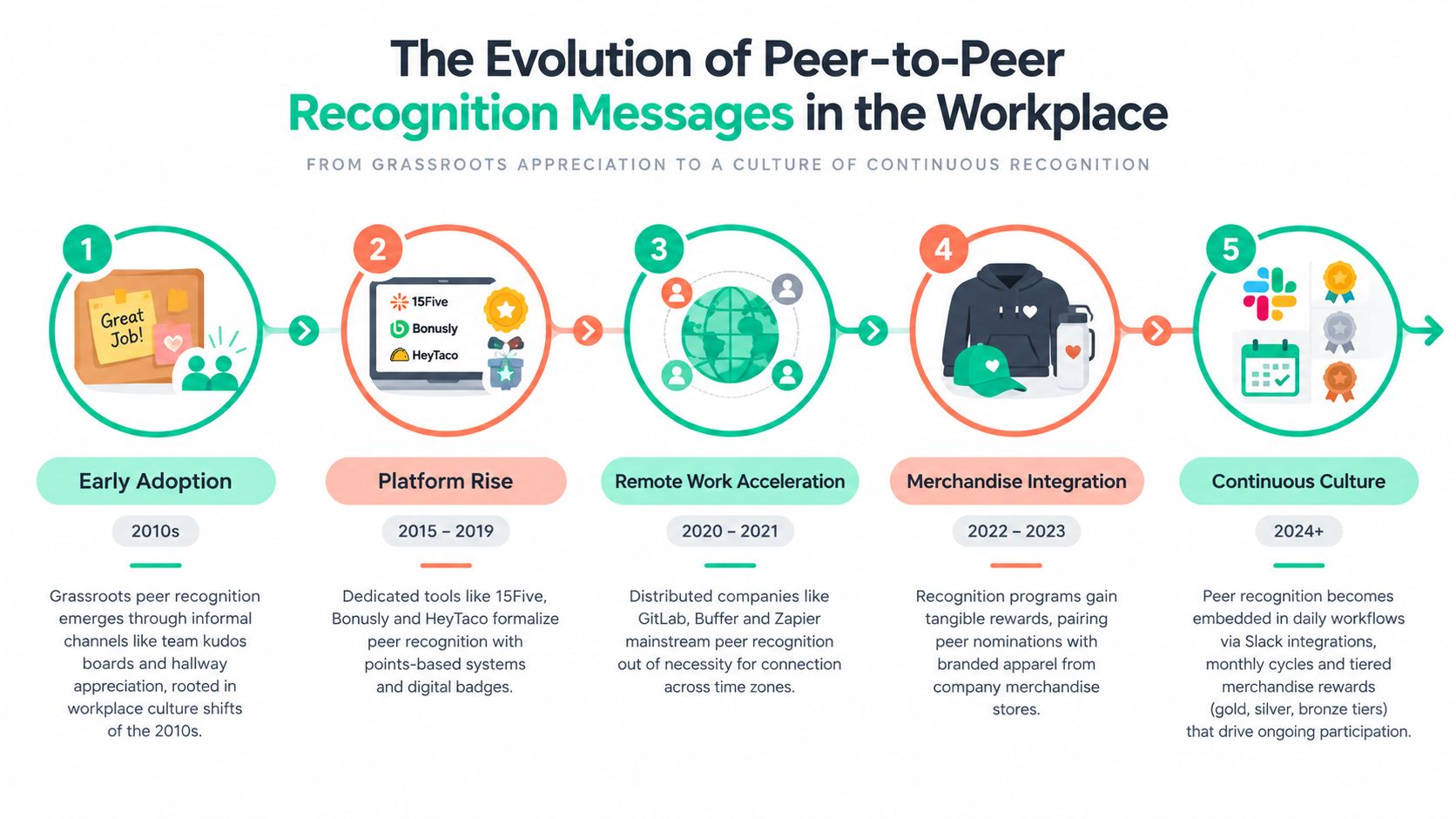
A peer program can include optional merchandise, but rewards shouldn't turn appreciation into a popularity contest. Teams can nominate colleagues during a recurring recognition cycle, then let recipients choose from a small set of branded items. FLYP's employee recognition program examples can help teams think through nomination workflows and reward formats.
Make visibility supportive
Public recognition can reinforce collaboration, yet leaderboards may encourage employees to collect attention instead of helping colleagues. Use prompts that ask, “What did this person do, and who benefited?” rather than “Who deserves to win?”
- Keep nominations specific: Ask for the behavior, context, and impact.
- Offer choice: Let recipients select an item, size, or no merchandise at all.
- Recognize quiet work: Include documentation, mentoring, incident support, and behind-the-scenes coordination.
- Review patterns: Check whether recognition consistently favors certain roles, locations, or communication styles.
FLYP can help produce different merchandise variants for recognition tiers or team themes, while managed fulfillment reduces the administrative burden when several peers are recognized at once. The message remains the main reward. Merchandise should reinforce it, not replace it.
3. Onboarding Welcome and Acceptance Messages
The first recognition message arrives before a new employee has produced work. It says, “We're ready for you,” and sets expectations about belonging, clarity, and care. A welcome note that only lists paperwork and start instructions can make the relationship feel transactional.
Message example
Welcome to the product team, Elena. We're excited to have your research experience and customer perspective with us. Before your first day, you'll meet your onboarding partner, receive your week-one plan, and get time with the team to learn how we work. We're looking forward to what you'll bring.
This message recognizes the employee's decision to join without pretending they've already earned performance praise. It also gives the welcome practical substance. A team lead can send a short version by email, then follow up with a personal note or recorded greeting. For frontline employees or people with limited access to company systems, provide a printed or manager-delivered version too.
A welcome kit can arrive before the start date, but avoid making merchandise the entire experience. Collect size and preference information during preboarding, and don't assume every new hire wants visible branding. FLYP's new-hire welcome package guidance can help People teams connect a personalized letter with a curated kit.
Build for different roles and locations
A software engineer, field employee, executive, and contractor may need different items and delivery methods. FLYP can create role-specific designs from a brief and manage fulfillment across locations, while local sourcing may make sense where faster delivery or cultural fit matters.
Practical rule: The welcome message should explain how the person will be supported. The merchandise should make that support tangible, not ask the employee to advertise the company.
For onboarding teams, onboarding engineers best practices offers additional context on structuring the early employee experience. Include the manager's name, the first practical step, and a point of contact. A branded shirt without a human welcome is just inventory.
A short welcome video can add warmth when the team is distributed, provided it complements rather than replaces direct contact.
4. Performance and Promotion Recognition Messages
Promotion messages carry more weight than routine praise because they communicate a change in responsibility, trust, and identity. Public wording should be accurate and respectful. Don't disclose compensation, personal circumstances, or details the employee hasn't agreed to share.
Message example
Please join us in congratulating Priya on her promotion to Senior Account Executive. Over the past year, she has built strong customer relationships, improved our account planning process, and helped newer colleagues prepare for important conversations. Priya's promotion reflects the judgment and consistent execution she brings to the team.
The message names the new role, gives evidence, and explains the decision without overselling. A direct manager can follow the announcement with a private note that acknowledges the emotional side of the transition: “You've earned this opportunity, and I'm committed to helping you succeed in the role.”
Premium merchandise can commemorate the promotion, but it should match the employee's preferences and the seriousness of the occasion. A role-specific notebook, jacket, bag, or other useful item may feel more considered than a generic promotional product. FLYP's selection of premium blanks can support different choices, and its design tools can incorporate a role title or achievement detail without making the item look like a novelty award.
Coordinate words, timing, and fulfillment
HR, the manager, communications team, and merchandise supplier need one schedule. If the gift arrives weeks after the announcement, the emotional connection weakens. If it arrives early, it may reveal the promotion before the organization is ready.
- Confirm the public wording: Get the employee's approval for name, title, image, and personal details.
- Write the private note: Add context that doesn't belong in the company-wide announcement.
- Choose useful personalization: A name, role, or date can work if the employee wants it.
- Protect the moment: Use FLYP-managed production and fulfillment only after the timeline and recipient details are confirmed.
A handwritten message from the direct leader or executive can add authenticity. The object matters less than the visible care behind it.
5. Department and Team Achievement Recognition Messages
A team win shouldn't become a list of individual heroes. When several functions contribute to a launch, sale, conference, or recovery effort, the recognition message should show how the parts fit together.
Message example
The customer portal is live because Engineering, Product, Design, Support, and Operations kept solving problems together. You worked through late changes, shared context across handoffs, and protected the customer experience through launch. Thank you for delivering a complicated project with discipline and care.
This format avoids vague applause while keeping credit collective. It also names the behaviors that made the result possible. For a sales target, focus on preparation, account coordination, and customer trust. For a hackathon, recognize experimentation, knowledge sharing, and follow-through, not only the winning idea.
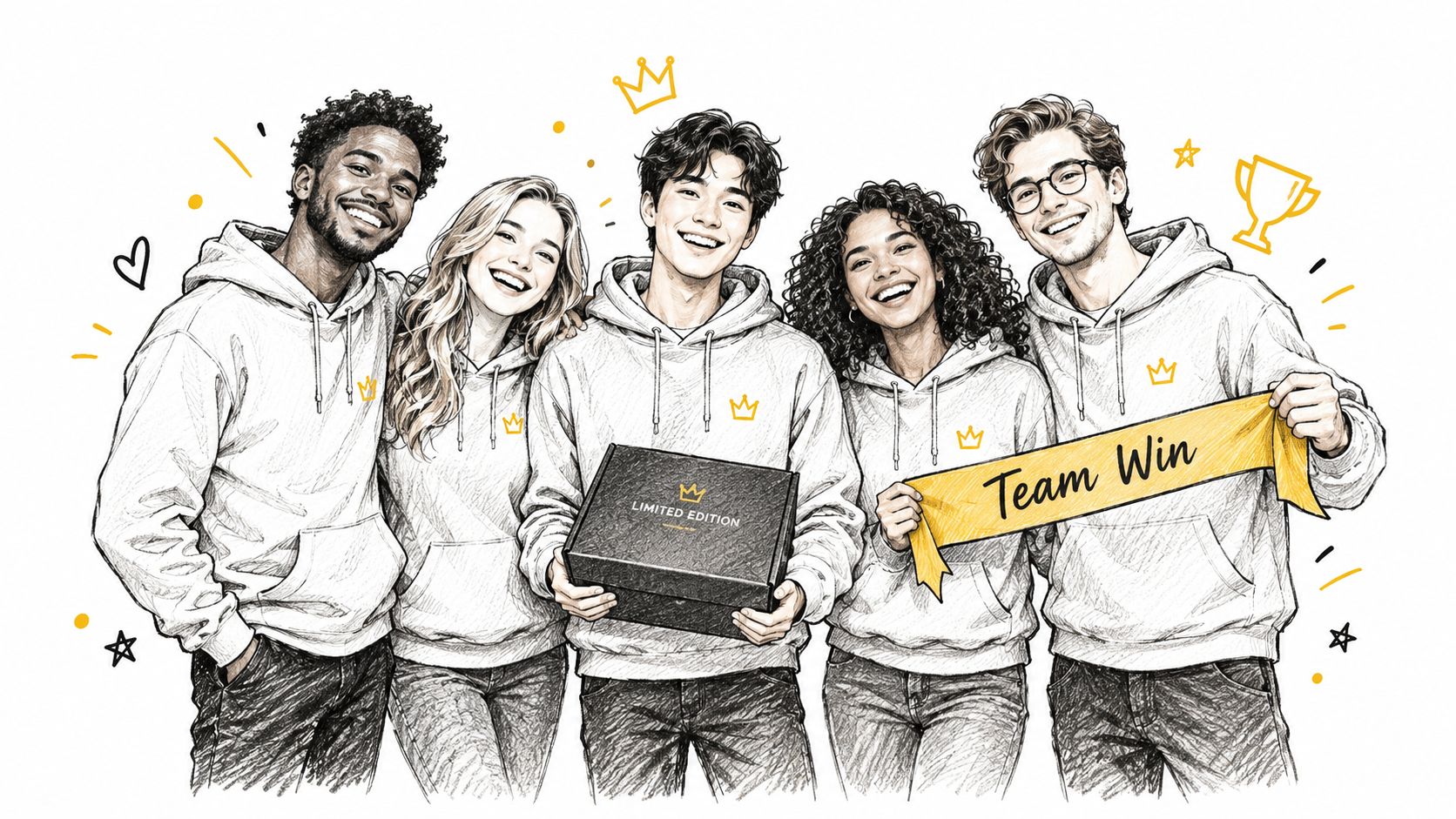
Team merchandise works best when it creates a shared memory rather than a uniform requirement. A limited launch hoodie, team jacket, or event item can carry the project name, date, or a design chosen by the group. FLYP's employee-choice store model can let people select preferred sizes and styles, which is more inclusive than sending everyone the same garment.
Protect equity in collective recognition
Distributed teams need equal access to the announcement and the physical item. Include shift workers, contractors where appropriate, remote employees, and people who supported the work from outside the central office. A digital post alone may favor employees who spend more time in internal channels.
Invite the team to vote on design directions, but keep the final choice usable and on-brand. FLYP's AI design tools can produce alternatives from a launch brief, while managed fulfillment can coordinate delivery to homes or offices.
Avoid manufacturing scarcity merely to create pressure. If the item commemorates a genuine achievement, people will value the connection. Offer an alternative for employees who don't want apparel, and don't make wearing the item a test of team loyalty.
6. Values-Aligned Behavior Recognition Messages
Company values become credible when leaders connect them to decisions employees can observe. “Great example of innovation” is weak on its own. It doesn't show what the employee changed, what risk they managed, or how the behavior helped others.
Message example
Amir demonstrated collaboration when he brought Support into the discovery process before the feature was finalized. That early input helped the team address customer concerns before release and gave Support clearer guidance for launch. Amir showed that collaboration means sharing ownership, not simply attending the same meeting.
The final sentence makes the value concrete. It also gives colleagues a model they can follow. Use the same standard for integrity, inclusion, customer focus, sustainability, or operational excellence. A values message should describe a choice, not attach a flattering label to a person.
A town hall or internal newsletter can create broader visibility, while the employee may prefer a private message from the manager. Ask about the preferred channel and audience rather than assuming public praise is always better. Recognition preferences vary, and personalization means adapting the experience, not just inserting a first name.
Use merchandise as a symbol, not proof
A value-themed badge, apparel design, or employee-choice item can reinforce the story, but the design shouldn't stereotype employees or reduce a complex value to a slogan. FLYP's AI design workflow can use a brand values brief to explore concepts, while a human reviewer checks cultural fit, accessibility, and visual quality.
Run nominations through clear examples. A rotating focus can give different values attention, but don't create artificial monthly quotas that force weak nominations. Archive approved stories internally so employees can see what the organization means by its principles. The story should remain useful even if the recipient declines the merchandise.
7. Tenure and Loyalty Recognition Messages
Long service deserves a message that remembers contribution, not just duration. A tenure announcement that says “Thanks for all the years” may be sincere, but it misses the institutional knowledge, relationships, and changes the employee helped shape.
Message example
Congratulations on ten years with the company, Daniel. You helped build the customer operations practice from an informal process into a team others can rely on, and you've coached colleagues through several major changes. Thank you for the judgment, patience, and care you've brought to that work.
This language makes the milestone personal without turning the employee into a symbol of loyalty. A CEO or founder can add a handwritten note, especially when the employee's impact spans departments. The manager should also speak directly to what the employee may want next, because tenure recognition shouldn't imply that the person's best contribution is behind them.
A keepsake can suit a service milestone, particularly when it's made for the recipient rather than pulled from a standard award catalog. Consider a useful jacket, watch, bag, or other premium item, but confirm preferences before ordering. FLYP can help create a tenure-specific design with a name, service year, or understated anniversary detail, then coordinate packaging and delivery.
Give the moment ceremony without pressure
A formal presentation can work for employees who enjoy public recognition. Others may prefer a private conversation, a written note, or a small team gathering. Offer choices around audience, channel, and merchandise. Recognition becomes uncomfortable when leaders assume that a long-serving employee wants a stage and a photograph.
Tenure is the occasion. The employee's specific impact is the substance.
Schedule service milestones in the People calendar so they don't depend on manager memory. For global teams, coordinate local delivery and time zones rather than forcing every region into one live event. Record the recognition in the employee's internal history, but don't use it as a substitute for ongoing feedback, development, or fair career conversations.
8. Event-Based and Campaign Recognition Messages
Events create concentrated moments for recognition. A product launch, annual meeting, retreat, hackathon, or sustainability campaign gives teams a shared context, but the message still needs to identify what people contributed.
Message example
Today's launch reflects weeks of testing, customer feedback, content work, incident planning, and coordination across regions. Thank you to everyone who made time for the release while continuing to support customers and one another. We're celebrating the launch because the work behind it showed persistence and shared ownership.
For a hackathon, recognize the winning team's idea and the participants who helped test, document, or present it. For a conference, thank speakers, organizers, volunteers, and behind-the-scenes staff separately. A single broad message can include everyone, but customized follow-ups make recognition more credible.
Event merchandise should be designed for repeated use, not just a one-day photo. A conference hoodie, launch jacket, or limited-edition item can become a cultural artifact when people want to wear it. FLYP can turn an event brief, brand assets, or theme into design options, then support delivery to event venues or employees' homes.
Plan the operational details early
Event production has more failure points than message writing. Confirm quantities, sizes, destinations, packaging, customs requirements, and replacement processes before the announcement. Build the design review into the event calendar, and use FLYP-managed fulfillment when the audience is distributed or the program includes multiple item choices.
- Start with the audience: Separate attendee, speaker, organizer, and winner recognition.
- Make the item useful: Choose a garment or object people can use after the event.
- Tie design to meaning: Include the event theme, date, or achievement without overcrowding the item.
- Plan the remainder: Sell excess through an internal store, reserve it for future recognition, or donate usable stock.
A merchandise reveal can support event energy, but don't make attendance or public posting the condition for receiving appreciation. People should be able to participate in the recognition experience without sharing personal images online.
Comparison of 8 Employee Recognition Message Types
| Recognition Type | Implementation Complexity 🔄 | Resource & Logistics ⚡ | Expected Outcomes 📊⭐ | Ideal Use Cases 💡 | Key Advantages ⭐ |
|---|---|---|---|---|---|
| Milestone Achievement Recognition Messages | 🔄 Medium, personalized copy + merch lead time | ⚡ Moderate, design, production, global shipping | 📊 Measurable engagement; ⭐ High memorability and shareability | Individual anniversaries, project completions, sales targets | Creates tangible keepsakes; scalable with localized swag |
| Peer-to-Peer Recognition Messages | 🔄 Medium–High, platform integration & moderation | ⚡ High throughput, platform costs, frequent reward fulfillment | 📊 Increased daily engagement; ⭐ Authentic, grassroots recognition | Ongoing peer appreciation, distributed/remote teams | Drives frequent participation; uncovers organic high-performers |
| Onboarding Welcome & Acceptance Messages | 🔄 Medium, pre-hire coordination and sizing | ⚡ High predictable volume, bulk kits, early shipping | 📊 Strong first-day connection; ⭐ Improves early retention and employer brand | New-hire onboarding, pre-boarding experiences | Immediate cultural signal; reduces first-day anxiety |
| Performance & Promotion Recognition Messages | 🔄 High, confidential timing + premium procurement | ⚡ High, premium items, personalization, tight schedules | 📊 Signals advancement; ⭐ High prestige and aspirational impact | Promotions, role changes, performance bonuses | Elevates employee status; premium items convey prestige |
| Department/Team Achievement Recognition Messages | 🔄 Medium–High, bulk production & coordinated drop | ⚡ Moderate, volume discounts but complex distribution | 📊 Strengthens team cohesion; ⭐ Visual unity and collective pride | Product launches, team targets, hackathon wins | Economies of scale; creates shared identity and momentum |
| Values-Aligned Behavior Recognition Messages | 🔄 Medium, requires values framework & nomination process | ⚡ Moderate, badges/merch design, communications | 📊 Reinforces desired behaviors; ⭐ Aligns culture with actions | Values programs, monthly awards, culture campaigns | Clarifies rewarded behaviors; merchandise embodies values |
| Tenure & Loyalty Recognition Messages | 🔄 High, ceremonial planning & personalization | ⚡ High, premium/luxury items, long lead times | 📊 Boosts retention; ⭐ Deep emotional and long-term value | 5/10/20+ year anniversaries, legacy recognition | Heirloom-quality keepsakes; signals long-term appreciation |
| Event-Based & Campaign Recognition Messages | 🔄 Medium, tight deadlines, limited-edition runs | ⚡ Moderate–High, fast turnaround, inventory management | 📊 Drives attendance and buzz; ⭐ Collectible, time-bound appeal | Conferences, launches, retreats, campaign milestones | Creates event memories; extends event impact via wearable merch |
Turn the Right Words Into a Repeatable Recognition System
A strong recognition message starts with the occasion, not the template. Identify whether you're acknowledging a milestone, a peer contribution, a new hire, a promotion, a team result, a values-aligned behavior, tenure, or event participation. Each occasion carries a different emotional weight, so the same tone won't work everywhere.
Then name the observable contribution. Replace “great work” with the action the person took, the problem they solved, the people they supported, or the decision they improved. Connect that contribution to a business result, customer experience, team outcome, or company value. If you can't explain the impact, ask the manager or project lead for context before writing.
Choose the audience and channel deliberately. A private manager note can create intimacy, while a public team message can teach others what good collaboration looks like. Email suits a formal promotion record, Slack can deliver immediate peer appreciation, a town hall can celebrate a collective achievement, and an offline handoff may be essential for frontline employees or people with limited digital access.
Use the recipient's preferences as part of the design. Some employees welcome public praise, while others prefer a quiet message. Some want merchandise, others would rather choose an item, receive a development opportunity, or get no physical reward. Recognition should never assume that personalization means adding a name to a standard package.
Timing matters too. A message delayed until the next annual cycle loses connection to the behavior. Recognition programs should create regular opportunities for managers, peers, leaders, and customers to contribute, rather than concentrating appreciation in formal awards. Gallup's workplace analysis found that immediate managers were the most frequently identified source of memorable recognition at 28%, followed by high-level leaders or CEOs at 24%, managers' managers at 12%, customers at 10%, and peers at 9%. Those figures support a multi-source approach, especially one that helps direct managers recognize contributions close to the moment.
Recognition quality also has a retention dimension. In Gallup's longitudinal analysis of data collected from 2022 through 2024, employees receiving high-quality recognition were 45% less likely to have turned over two years later and 65% less likely to be actively looking for another job than employees receiving lower-quality recognition. Only 22% said they received the right amount of recognition, while 55% either received none or received recognition that didn't meet any of five strategic criteria. Gallup's retention analysis makes the operational point clear: a repeatable system matters more than occasional enthusiasm.
Test the program without reducing recognition to open rates. A controlled field experiment involving more than 300 employees found that public thank-you cards increased subsequent performance by 5.2% when every employee in an eight-person workgroup received one, and by 7.3% when the three strongest performers were recognized. The field experiment report also shows why fairness and team-level effects deserve attention. Broad appreciation and selective excellence recognition can produce different responses, so People teams should define the intended behavior before choosing the format.
For digital campaigns, measure delivery, participation, and the action that recognition is meant to support. A NASA field experiment emailed recognition messages to 11,192 employees and measured return visits to the NASA@WORK problem-solving platform during the following week. The intervention produced 682 users, approximately 4% of the user population, and the reported number responding to managerial recognition was 59, compared with 32 for peer recognition and 59 for mission or platform recognition. The NASA study supports a practical measurement approach: define a control group where possible, compare message sources, and track a specific downstream action instead of treating a message view as success.
Finally, coordinate physical recognition only where it adds meaning. Digital messages provide speed and access. Optional FLYP-managed merchandise can add a tangible reminder for milestones, onboarding, promotions, tenure, team achievements, and events, with employee choice, personalization, fulfillment, and delivery handled as part of the operational plan. The best employee recognition messages aren't elaborate. They're specific, timely, human, and connected to something the recipient did.
FLYP LTD helps People and HR teams turn recognition messages into personalized merchandise moments for onboarding, anniversaries, promotions, team wins, and events. Use FLYP LTD to create on-brand designs, offer employee choice, and coordinate production and fulfillment alongside the message.