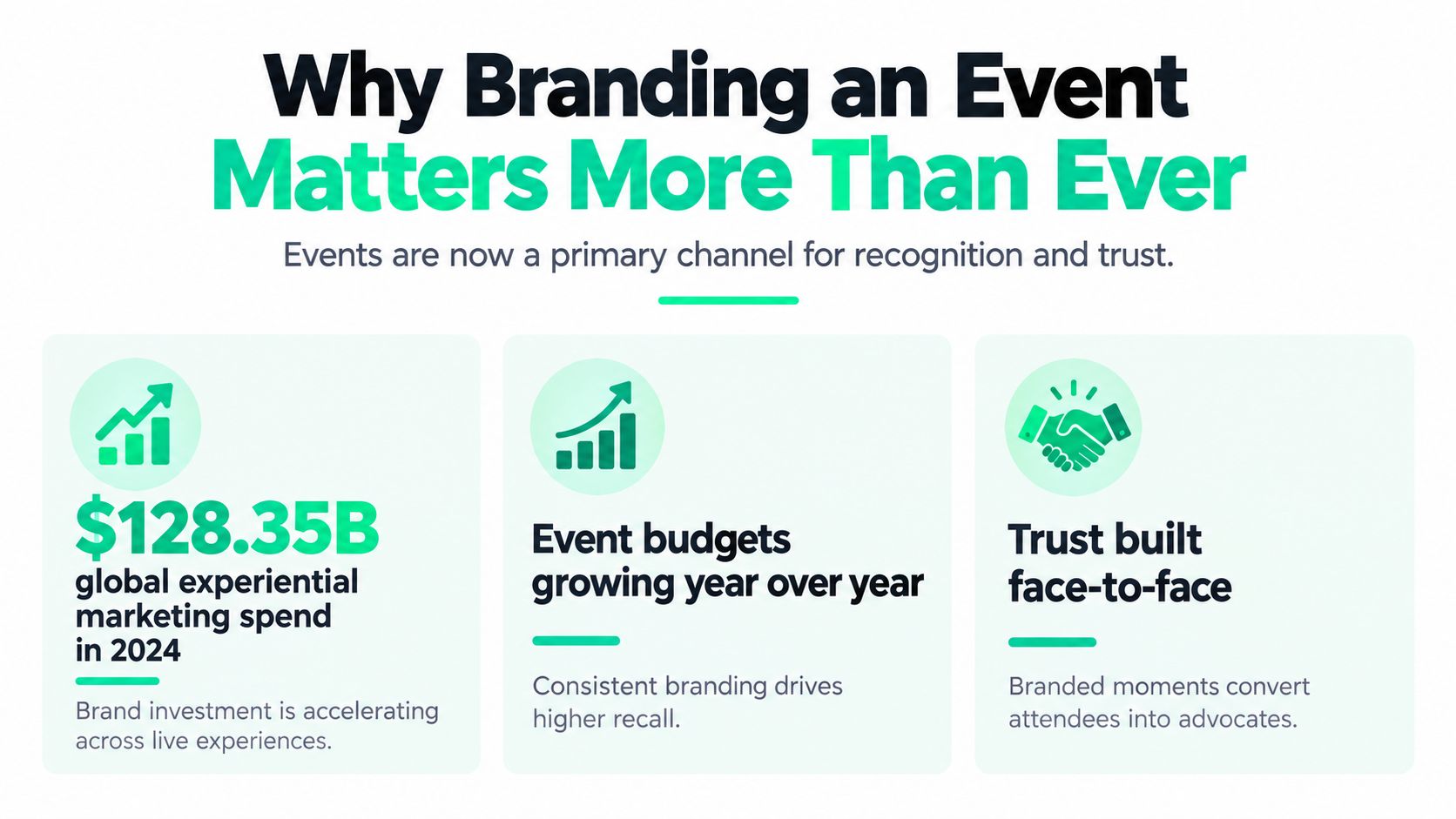
Global experiential marketing spend reached $128.35 billion in 2024, showing that events are now a major branded channel rather than a supporting tactic. To brand an event well, build a unified identity system that connects the promise, message, visuals, governance, attendee experience, and post-event lifecycle.
A logo and color palette can make an event recognizable, but they can't make it coherent on their own. The difficult work happens between design approval and teardown, when sponsors request exceptions, speakers need customized materials, vendors work from outdated files, and the team must decide whether another branded giveaway is useful or destined for a bin.
Strong event branding gives everyone a clear operating system. It tells creative teams what to make, vendors what to produce, stakeholders what they can approve, and attendees what kind of experience they should expect.
Table of Contents
- Why Branding an Event Matters More Than Ever
- Defining Objectives and Building a Unified Identity System
- Mapping Brand Touchpoints Across Digital, Physical, and Merch
- Coordinating Production, Vendors, Timelines, and Budgets
- Measuring Success and Ensuring Sustainable Brand Impact
Why Branding an Event Matters More Than Ever
Global experiential marketing spend reached $128.35 billion in 2024, including $90.3 billion from B2C companies and $38 billion from B2B companies, according to Revenue Memo's experiential marketing statistics. Event marketing averages 14% of total marketing budgets, while 80% of companies increased experiential marketing spend. Budgets commonly represent 10–30% of total marketing allocations.
Higher investment raises the cost of inconsistency. An invitation can promise a considered, premium experience, while a generic registration page weakens that promise before anyone arrives. Later, mismatched stage graphics, email templates, badges, sponsor zones, and follow-up content make the event feel assembled instead of deliberately built.
Event branding also receives budget priority. Event budgets are growing at 10.9% for 2025/26, while overall B2B marketing spend is projected to decline 3.1%. 72% of marketers consider events their organization's most effective marketing channel, according to Revenue Memo's event marketing statistics. These figures do not guarantee performance. They explain why branding needs operating rules, not just a visual concept.
Recognition depends on repetition
Attendees meet an event brand in fragments: a social post before registration, a confirmation email, venue signage, a keynote backdrop, a staff interaction, and a recap after departure. Each contact is brief. Their combined pattern becomes the event's identity.
Consistency means carrying one promise through different formats. A networking event can express participation through concise copy, welcoming wayfinding, conversation prompts, and a stage layout that supports interaction. A product launch may require sharper language, controlled reveals, and visual rules that work from the invitation through the demo environment.
Audience variation complicates the system. Sponsors may need visible recognition, speakers may require custom materials, staff need fast answers, and attendees may encounter the brand in different physical and digital contexts. Define which elements can change, which must remain fixed, and who approves exceptions before production begins.
Merchandise should reinforce the experience, not become an automatic add-on. A useful guide to promotional merchandise meaning helps teams separate objects that support the event message from items chosen only because they are easy to order. Quantity, usefulness, storage, and disposal belong in the branding decision.
A reliable operating sequence
Use this sequence to keep creative decisions connected to delivery:
- Define the brand objective. Decide whether the event should build recognition, deepen trust, support a launch, strengthen community, or create a specific perception.
- Create the identity system. Set the concept, message hierarchy, visual rules, verbal style, and application guidance.
- Map touchpoints and audiences. Include digital communication, physical environments, human interactions, merchandise, sponsors, speakers, staff, and follow-up.
- Assign decision rights. Name the brand owner, exception approver, and person authorized to release production files.
- Coordinate production. Lock specifications, vendors, deadlines, quantities, quality checks, and reuse plans.
- Measure the experience. Compare intended brand signals with attendee behavior, feedback, recall, and operational results.
This sequence prevents a common failure: an attractive concept that offers no practical guidance once multiple teams, vendors, and audience needs enter the work.
Defining Objectives and Building a Unified Identity System
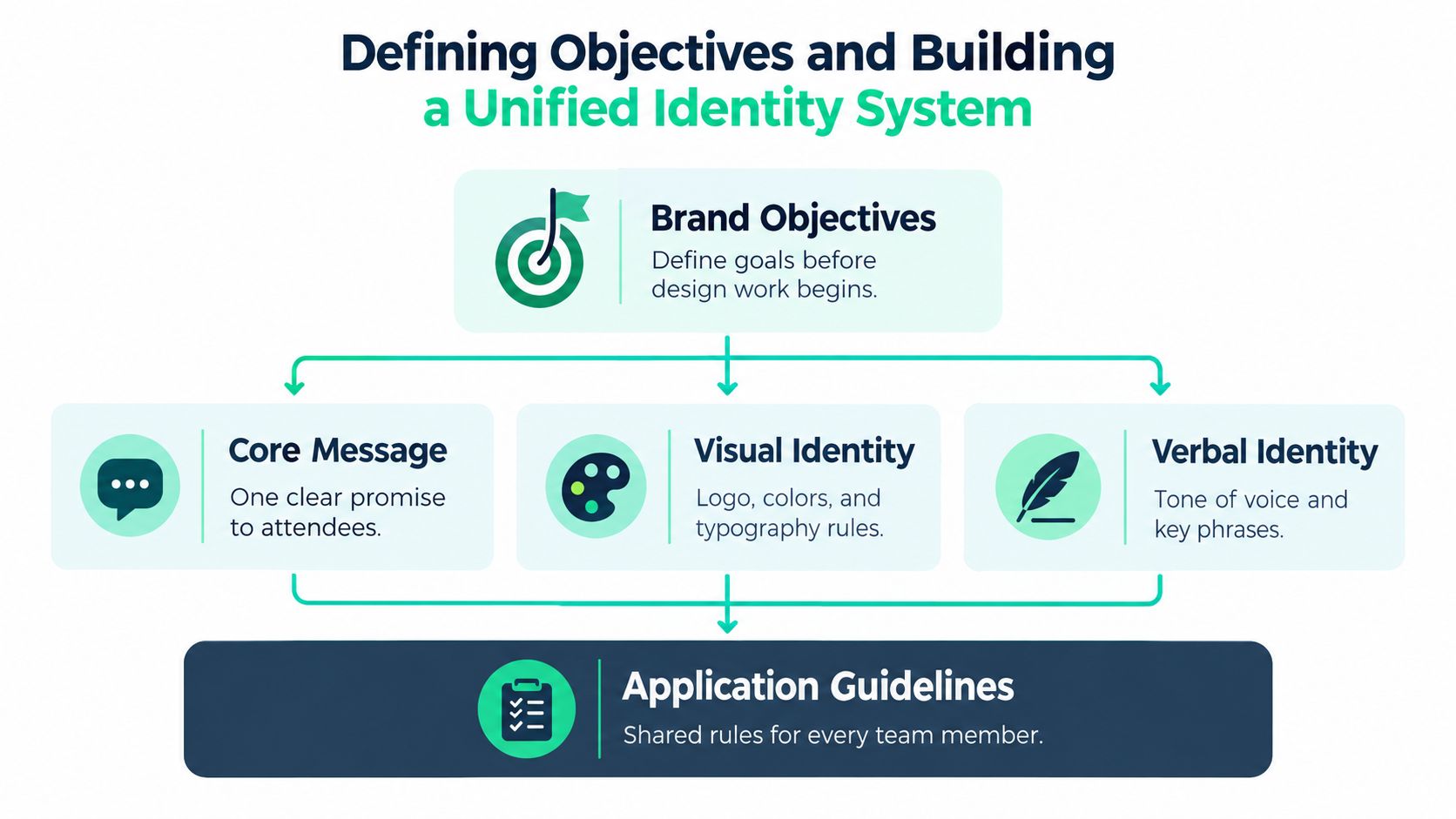
A memorable event is not a sufficient objective. Start with the decision the event should help the organization make, then define the change expected from the audience. That change might be greater confidence in the company, clearer understanding of a new offer, or a stronger association with a community. The objective gives creative and operational teams a standard for judging choices when time and budget become tight.
The practical event-branding workflow from Helms Workshop starts with the objective and translates it into an identity system covering concept, messaging, visuals, and attendee touchpoints. The sequence matters. If design begins first, the team can produce attractive assets without knowing what they need to communicate or how success will be recognized.
Write the promise before the palette
Put the event promise into one sentence. It should tell the team what attendees should understand or feel, rather than just describing the program.
Build the message hierarchy around that promise:
- Primary promise: The idea every audience should encounter.
- Supporting proof: Speakers, sessions, demonstrations, community elements, or customer evidence that make the promise credible.
- Action language: The behavior you want, such as registering, joining a discussion, visiting a demo, or continuing the conversation.
- Language boundaries: Terms, claims, jokes, and visual references that do not fit the event or the parent brand.
A unified identity system needs more than a logo file. Document the event name, lockup rules, color use, typography, image direction, icon style, motion principles, tone, approved phrases, accessibility requirements, and examples of correct application. Add a simple “don't” page. Vendors and busy internal teams need clear examples of what failure looks like, especially when production decisions are made without the creative lead present.
Keep the core consistent, vary the layer
One event can serve several audiences with different requirements. Attendees need clarity and relevance. Sponsors need visibility within agreed limits. Speakers need confidence that their expertise will remain visible. Internal stakeholders need control over business-critical information.
Keep the core identity fixed, then vary the application layer:
| Element | Keep consistent | Allow to vary |
|---|---|---|
| Event promise | The central audience benefit | The supporting explanation |
| Visual foundation | Core colors, type system, logo rules | Layout, imagery, and content density |
| Voice | Tone and prohibited claims | Copy length and technical detail |
| Experience | Key moments and recognition cues | Session paths, sponsor modules, or speaker formats |
| Approvals | Final brand authority | Working owners for each audience stream |
This structure handles a real production trade-off. Total uniformity can make sponsor communications and speaker materials feel impersonal. Unlimited variation creates competing interpretations, increases review time, and weakens recognition across the event.
Create governance before production
Assign one brand owner who can resolve conflicts. Give each workstream a named operator, and define who can approve exceptions and release final files. Shared review is useful for input, but collective ownership leaves decisions unresolved until a printer, fabricator, or software team is waiting.
The Eventbrite guidance on event branding describes branding as a system spanning touchpoints and audiences. Apply that principle through a decision log, one current master-file location, an exception register, and a deadline after which changes require a documented trade-off. This record protects the identity when staff change, vendors work from older files, or a fast approval bypasses the normal process.
Practical rule: If a variation needs an explanation every time someone sees it, put it in the guidelines rather than an informal message thread.
Mapping Brand Touchpoints Across Digital, Physical, and Merch
An event brand becomes credible when attendees recognize its logic before they notice the logo. Map the journey from first exposure through registration, arrival, participation, departure, and follow-up. Record where expectations change, where questions arise, and which moments need a clear recognition cue.
Digital touchpoints establish the promise early. The website, email subject lines, registration copy, and app should use the same vocabulary and visual rules. An app can extend the identity through navigation, session labels, notifications, and networking prompts, but a default software template should not create a second system.
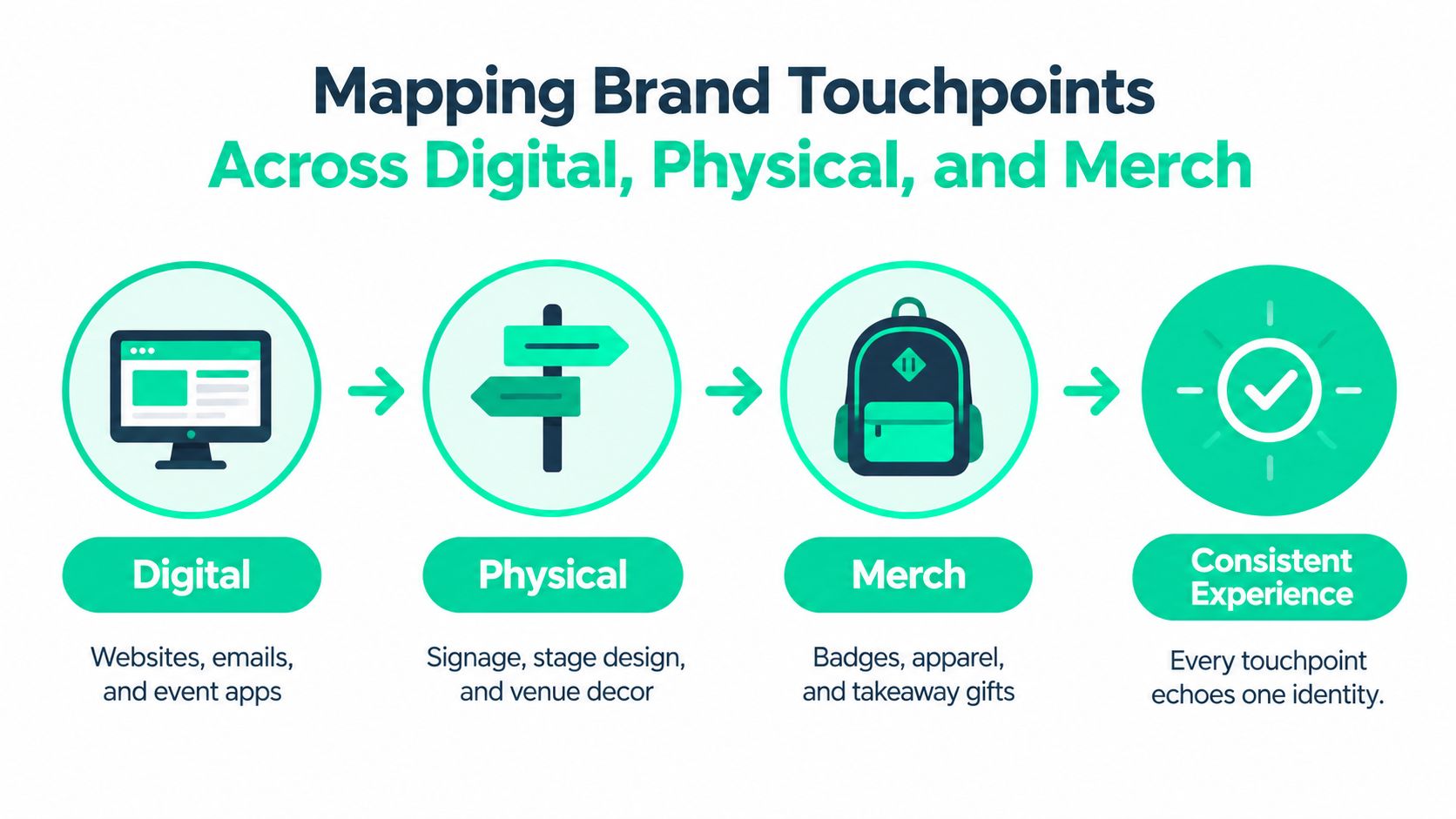
Physical applications turn the promise into something people can use. Directional signs should answer practical questions without competing with the stage. A registration desk can apply a restrained version of the event system, while the main stage needs stronger emphasis because it anchors shared attention. Sponsor zones require clear boundaries. Paid visibility should support the event rather than make the venue feel like unrelated advertising.
An exhibition area adds another operating challenge. Review expo booth design guidance for visitor flow, sightlines, messaging hierarchy, and the relationship between each booth and the wider environment. A booth can follow the event identity while still giving its owner enough space to communicate.
Merchandise has a second life
Merchandise often receives less scrutiny than digital and venue assets. Teams choose an inexpensive item, add a logo, and close the task. The object then has to work after the event, when it may remain useful, be worn, start a conversation, or disappear into storage.
Assess each item against three questions:
- Will people use it? Match utility to the audience and setting.
- Does it carry the identity without shouting? A restrained treatment can travel further than a large event mark.
- Can the team manage the lifecycle? Plan for packaging, quantities, storage, shipping, repairs, returns, and leftover stock.
A badge, garment, notebook, or take-home kit can reinforce belonging when its design and quality support the event promise. Compare examples of branded merchandise for events to assess practical applications, not to copy a style.
The following video provides a visual reference for turning an event concept into physical brand moments. Use the ideas as prompts, then test them against venue constraints, accessibility, production lead times, and post-event utility.
A useful touchpoint map records the owner, source file, production deadline, audience, purpose, and approval status for every major asset. It should also show which assets serve different audience groups and how long each item remains in use. Consistency depends on that operating record, not on adding more branded objects.
Coordinating Production, Vendors, Timelines, and Budgets
A brand system becomes real when someone must print it, build it, ship it, install it, and remove it. Production exposes weak planning quickly. A vendor may use an outdated logo, a sponsor may submit artwork after approval, or a stage graphic may look accurate on a laptop and fail at venue scale. Strong event branding depends on governance, not just creative quality.
Demand for corporate events continues to grow, but volume does not simplify production. It makes repeatable operating discipline more valuable. Teams that deliver several audience variations, channels, and physical assets need clear ownership before work reaches vendors.
Build one production source of truth
Use a master production tracker instead of scattered email approvals. At minimum, record:
| Field | What to record |
|---|---|
| Asset | Sign, email, badge, slide, garment, or installation |
| Owner | Person accountable for the next action |
| Vendor | Supplier and production contact |
| Specification | Size, material, finish, format, and accessibility needs |
| Status | Draft, approved, proofed, in production, delivered |
| Risk | Missing content, late approval, shipping, or quality concern |
| Decision deadline | The date after which the cost or schedule changes |
Separate creative approval from production approval. A stakeholder can approve the visual direction without checking dimensions, copy accuracy, fabric color, file format, or installation requirements. Assign those checks to people with the relevant knowledge, and name the final decision-maker for each asset.
Record audience variations in the same system. A sponsor, speaker, attendee, staff member, and remote participant may need different versions of the identity. Without a controlled file structure and naming convention, vendors can receive the wrong artwork even when the master design is correct.
Work backward from the venue
Set the installation and show dates first. Work backward through proofing, vendor production, artwork lock, content lock, and final approval. Add time for physical samples when color, material, garment fit, print quality, or dimensional signage affects the result.
Choose vendors by capability rather than convenience. A large-format graphics specialist may not suit apparel, packaging, scenic fabrication, or digital motion. Teams managing many variations can adapt practices from scaling fashion creative workflows to control versions, approvals, and production handoffs.
Protect the budget by separating fixed commitments from optional upgrades:
- Creative and strategy: Concept, copy, identity system, and templates.
- Digital production: Website, email, app, registration, and motion assets.
- Physical environment: Signage, stage, lighting, decor, and installation.
- Merchandise: Product, decoration, packaging, warehousing, and distribution.
- People and logistics: Crew, transport, setup, teardown, and onsite support.
- Contingency: A reserved amount for approved risks, separate from scope creep.
Use a campaign-planning workflow to align dependencies across invitations, content, onsite moments, and follow-up. The fastest process is rarely the one with the fewest review steps. It is the one with clear authority, early specifications, and fewer late changes.
Measuring Success and Ensuring Sustainable Brand Impact
A branded event needs a measurement plan before the first invitation goes out. Otherwise, the team will count whatever is easiest to collect, usually attendance and social activity, without knowing whether the event changed perception or created useful next actions.
Use a baseline and a follow-up. Before the event, measure unaided or aided awareness, association with the event promise, intent to attend or engage, and the audience's familiarity with the organization. Afterward, repeat the relevant questions and add attendee satisfaction, message recall, content engagement, lead quality, media tone, and the actions that matter to the event objective.
Use operational metrics correctly
Event teams often mix funnel stages. Keep the definitions explicit:
- RSVP rate: Confirmed RSVPs divided by invitations sent.
- Attendance rate: Attendees divided by RSVPs.
- Overall conversion: Attendees divided by invitations sent.
A benchmark set from Launchmetrics' event measurement guidance reports typical no-show rates of 25–40% for in-person events, 43–60% for virtual events and webinars, and 40–65% for hybrid formats. Use these as planning context, not as a verdict on brand quality. A low attendance rate may reflect poor targeting, scheduling, reminders, access friction, or a weak promise. Branding is one possible cause, not the only one.
Build a dashboard that connects operational and brand signals:
| Question | Useful evidence |
|---|---|
| Did the right people arrive? | Audience fit, registration source, attendance |
| Did the promise land? | Message recall, awareness, qualitative feedback |
| Did people participate? | Session engagement, questions, meetings, content interaction |
| Did the experience feel coherent? | Touchpoint feedback and satisfaction comments |
| Did the event create follow-on value? | Qualified conversations, content use, repeat engagement |
| What should change? | Drop-off points, complaints, unused assets, approval delays |
Treat sustainability as brand behavior
Sustainability isn't only a materials question. It includes how much you produce, whether attendees use it, how you transport it, and what happens to leftovers. A small, useful merchandise range can communicate more care than a large collection of disposable items.
Ask suppliers about material composition, packaging, decoration methods, minimum quantities, repairability, shipping routes, and end-of-life options. Order against confirmed audience needs where possible, and create a plan for remaining stock before production begins. A garment someone wears after the event has a longer brand life than an item that exists only for the photo opportunity.
Values also shape brand decisions. The 2024 Edelman Trust Barometer Special Report on Brand and Social Justice found that 64% of consumers buy, choose, or boycott brands based on social or political beliefs, as reported by ZoomInfo's event-branding analysis. That doesn't mean every event needs a public position on every issue. It does mean audiences can interpret sourcing, accessibility, inclusivity, waste, and supplier choices as evidence of what the organization values.
Measure the object after the applause. Ask whether the badge was recycled, whether the garment was worn, whether the kit helped someone do their job, and whether the event promise remained recognizable after attendees went home.
Close the loop with a post-event review that combines numbers, comments, photographs, vendor notes, and discarded materials. Record which assets were reused, which messages were remembered, which variations caused confusion, and which approvals slowed production. The next event should inherit those decisions instead of starting with a blank brief.
FLYP LTD helps enterprise teams and creators turn event themes, brand URLs, briefs, and visual references into on-brand merchandise concepts and production-ready drops, with manufacturing, fulfillment, shipping, customer service, and returns managed through the platform. Visit FLYP LTD to explore a practical way to connect event identity with useful merchandise and repeatable delivery.