Most advice on international shipping methods tells you to pick the cheapest rate that still arrives on time. That sounds tidy until a new hire gets a duty bill at the door, refuses a welcome kit, or starts work empty handed because a cheap lane sat in customs. Freight is only one line. The decision is landed cost plus a promised date, and whether the person receiving the box has to pay, wait, or chase support to get it.
Table of Contents
- International Shipping Methods at a Glance
- How Freight Modes Move Merchandise
- Cost, Time and Chokepoint Risk Set the Mode
- Who Pays Duties under DDP and DDU
- Emissions and Speed Are a Service Trade-off
- Shipping Choices for Enterprise Merch Programs
- Lock a Shipping Policy Before the Next Drop
International Shipping Methods at a Glance
The lowest freight invoice can still lose the program. A procurement team may save on transport, then People Ops pays in replacement kits, rushed reships, and messages from employees who were asked for a card before a carrier would release a gift. That's why you shouldn't start by asking which method is cheapest. Start by asking what job the shipment has to do, how firm the date is, and who pays duty.
Use the table below to shortlist methods today. Read left to right. Pick a lane by its typical door-to-door band and cost position, check whether that fits the merch job, then confirm the duty handling before you book anything.
| Method | Typical door-to-door | Cost position | Best merch use | Duty handling |
|---|---|---|---|---|
| Express courier | 1-5 days | Highest per kg | Late hire kits, VIP gifts, event saves | Strong DDP at parcel level |
| Air freight | 5-10 days including airport handling | About 12-16 times sea | Urgent cartons above courier weight | DDP or DAP if the forwarder files entry |
| Sea-air | About 25 days on a worked example | 30-40% below all-air | Medium urgency between ocean and air | Broker on air leg, DDP or DAP by contract |
| Ocean FCL | Often 25-45 days port to port plus inland | Lowest per unit at full-box volume | Forecast replenishment and large drops | Broker entry, usually DAP or DDP by contract |
| Ocean LCL | Often longer than FCL because of consolidation | Low, but higher per unit than FCL | Partial containers and mixed SKUs | Same as ocean, plus deconsolidation delay |
| International postal | Often 7-21 days or more | Low for light pieces | Single low-value items with flexible dates | Recipient often pays; tracking and DDP are weaker |
| Consolidated freight | Set by the sailing or flight cutoff | Lower than shipping each order alone | Batched store replenishment | One customs entry can cover many orders |
How to Read Each Row
Express courier is for one to a few urgent parcels. At 1-5 days and the highest cost per kg, it fits a late hire kit, a VIP gift, or the box that saves an event. Its strength isn't just speed. A courier can usually offer strong parcel level DDP, so duty is handled before the recipient sees the parcel.
Air freight takes over when cartons get too heavy or numerous for courier pricing. Plan on 5-10 days including airport handling, not just flight time, at a high cost position. Use it for urgent event cartons or a regional top-up that can't wait for a sailing.
Sea-air splits the journey. Goods sail to a hub, then fly the last long leg. The worked example in the table sits at about 25 days, with a mid cost position below all-air. It's the practical middle lane when a few weeks are acceptable but a full ocean transit misses the date.
The Slower, Cheaper Rows
Ocean FCL, or full container load, gives you the lowest cost per unit when forecastable blanks or finished kits fill a box. Ocean LCL, or less than container load, is still low cost when volume fills only part of a container, but consolidation at both ends makes it slower than FCL and costs more per unit.
International postal is low cost for a single light piece, but it carries the weakest promise. Dates stretch, tracking can be thin, and the recipient often pays duty. Consolidated freight works differently. Many small orders share one departure and can share one customs entry, so the unit cost drops below shipping each order alone, while timing is set by the cutoff you either make or miss.
Circle two rows now: one default you'll use when you can plan, and one exception you'll pay for when the date won't move.
Treat every band as a planning range, not a promise. Customs and ports can stretch any of them, and that stretch is exactly what your exception row is for.
How Freight Modes Move Merchandise
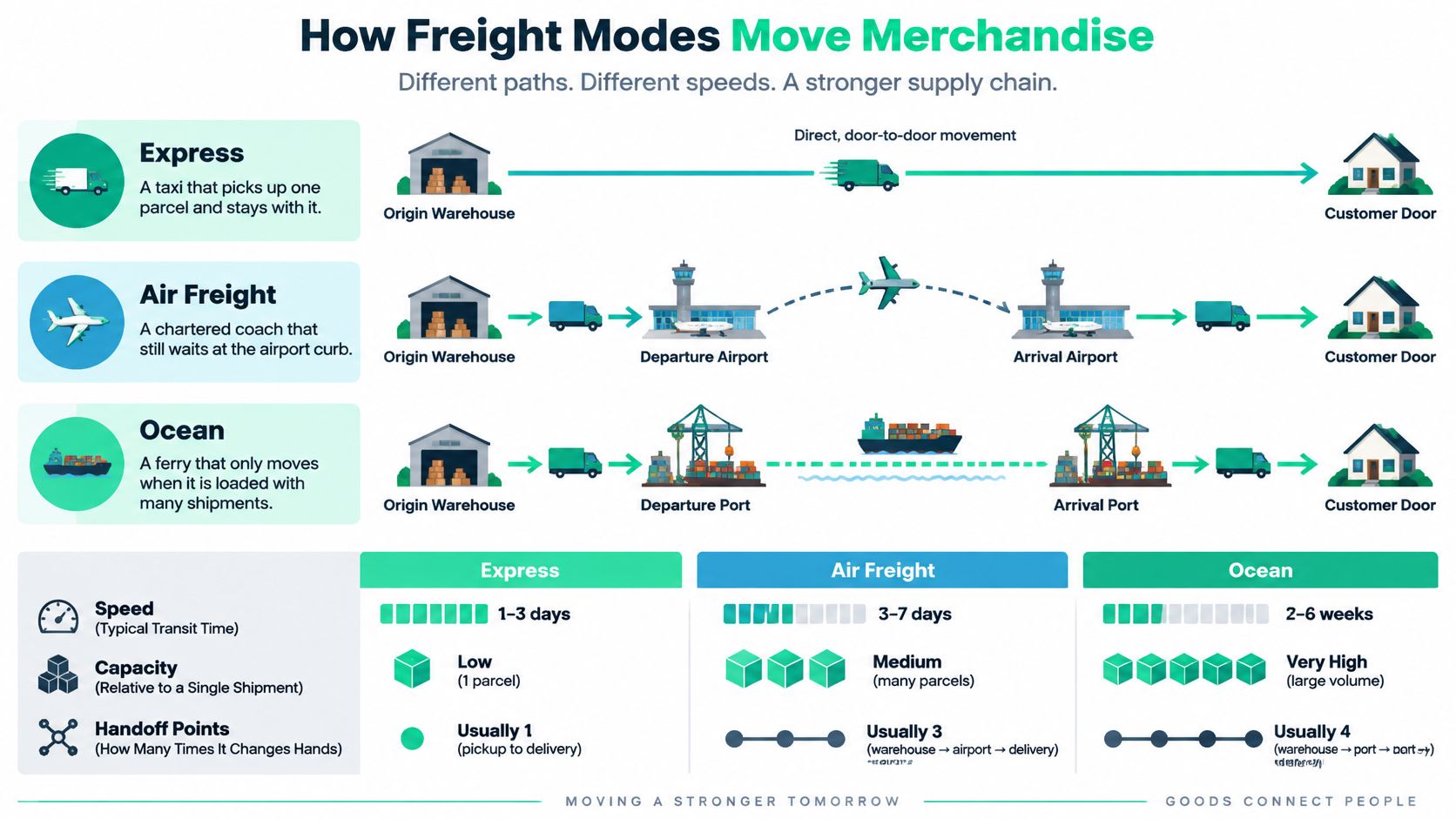
A warehouse-to-door analogy helps here. Think of express as a taxi that picks up one parcel and stays with it. Air freight is a chartered coach that still waits at the airport curb for handling and clearance. Ocean is a ferry that only pays off when many shipments share the hull, and postal is the public bus, with more stops and less hand-holding.
The visual below maps those differences in speed, capacity, and handoffs.
What Actually Carries Your Merch at Sea
Not every ship is relevant to a hoodie order. The UNCTAD Review of Maritime Transport 2024 overview describes how container ships carry standardized boxes of manufactured goods and merchandise, while bulk carriers move unpackaged commodities such as iron ore, coal, and grain, and tankers move crude oil, refined petroleum, chemicals, and liquefied gases. Your apparel and kits travel on the container path.
That path is concentrated. In 2023, the major East-West container routes represented more than 36% of global containerized trade volumes, with the Trans-Pacific route from East Asia to North America and the Asia-Europe route among the most important corridors. If your blanks are made in Asia and your teams sit in North America or Europe, those are likely your lanes.
This short video walks through how containerized freight moves between modes.
FCL and LCL in Plain Terms
FCL means one shipper's goods fill a container. Workers seal it at origin and open it at destination, so there's less handling in between. Say one brand ships 1,000 hoodies for a global drop. That volume can fill a box, travel sealed, and clear as one entry.
- FCL example: a single brand's kit components fill the container end to end.
- LCL example: a 150-piece partial order tops up a regional closet and shares space with other shippers.
LCL means several shippers share one box. That requires a consolidation warehouse at origin to pack everyone's freight together, and another at destination to split it apart. Those two extra stops explain the longer timeline.
A container is rarely the whole journey. After the port, a truck or train carries the goods to an office, event venue, warehouse, or customer. Mode choice is really a choice about how many handoffs your goods can tolerate before the date or condition suffers.
Cost, Time and Chokepoint Risk Set the Mode
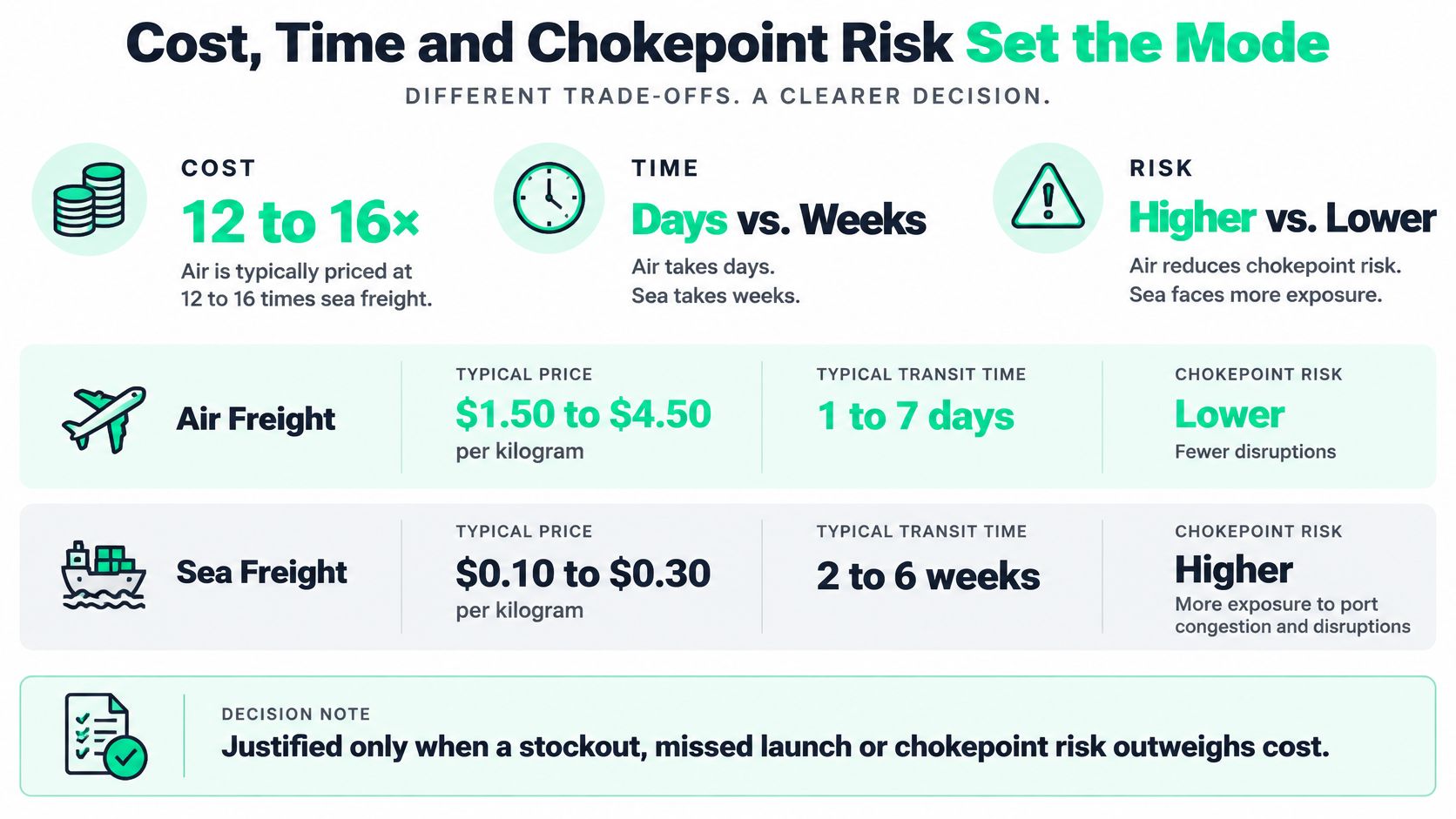
Start with the numbers that set the decision. The World Bank air freight study reports that air freight is typically priced at 12-16 times the cost of sea freight and commonly ranges from $1.50-$4.50 per kilogram. That premium is only justified when a stockout, a missed launch, or a replacement kit costs more than the upgrade.
The chart below puts that multiple next to the time and risk trade-off.
A Worked Transit Comparison
Consider one long lane. The World Bank transport facilitation analysis found that in a Northern Europe-Australia example, a sea-air service routed through Singapore reduced rates by 30-40% versus all-air freight while providing approximately 25-day transit, and sea-only transit was about 40 days. Sea-air doesn't beat air on speed. It buys back roughly two weeks versus ocean without paying the full air price.
The same analysis explains why carrier quotes mislead. Port delays, terminal productivity constraints, customs clearance, and administrative friction can account for roughly 29-45% of total origin-to-destination time, while the ocean leg itself represents about 29-36%, depending on the seaport. A fast vessel attached to a slow terminal is still a slow delivery.
When Geography Rewrites the Quote
Chokepoints can change your lane overnight. The UNCTAD Review of Maritime Transport 2024 reports that by mid-2024, ship capacity crossing the Gulf of Aden had fallen 76%, while tonnage transiting the Suez Canal had declined 70%. In response, arrivals around the Cape of Good Hope increased 89%.
Longer routes mean more transport work for the same goods. UNCTAD estimated that these diversions increased global vessel ton-mile demand by 3% and container-ship demand by 12%. A ton-mile is one tonne of cargo moved one mile. The estimated average voyage also rose from 4,675 miles in 2000 to 5,186 miles in 2024, so distance was growing before the diversions added more.
Price Three Numbers on Every Lane
- Freight per unit: what each delivered kit costs to move.
- Door-to-door days: pickup to the employee's hands, not port to port.
- Cost of being late: reships, empty booths, or a hire starting without kit.
Track four SLA clocks separately: customs release, terminal dwell, transshipment, and final-mile handoff. Airport dwell and slow customs files can erase a flight's advantage, which is why dashboards should track total cycle time, not airborne hours. Our breakdown of shipping cost optimization shows how to structure that comparison lane by lane.
Use ocean or consolidated freight for forecast volume, sea-air when the date is firm, and air only for exceptions.
Hold buffer inventory on lanes tied to fixed people dates. Agree in advance which alert triggers a switch to sea-air or air, so nobody debates the upgrade while the cutoff passes.
Who Pays Duties under DDP and DDU
A $40 hoodie ships on the cheapest postal lane you can find. The freight looks great on a spreadsheet. Then duty, VAT or GST, a disbursement fee, and a brokerage minimum land on the new hire or fan who receives it. They didn't order a tax bill. Some will refuse the parcel, and your team inherits the support ticket.
Delivered Duty Paid (DDP) means the shipper or seller has prepaid duties, taxes, and the broker. The box arrives like a domestic parcel. Delivered Duty Unpaid (DDU), often contracted as DAP, means the goods arrive and the recipient or their importer must pay to release them. One way to frame it: DDP is a gift that arrives finished, while DDU is a gift that arrives with a toll booth in front of it.
| Term | Who pays duties and tax | When the recipient learns | Failure mode | Use it when |
|---|---|---|---|---|
| DDP | Seller or program budget | Before checkout or in the internal PO | Margin miss if duty was not forecast | Employee gifts, event handouts, consumer merch |
| DDU or DAP | Recipient or local importer | At clearance or the door | Refusal, delay, angry support ticket | A local entity already acts as importer of record |
| Postal with duties due | Usually the recipient | On delivery or at the post office | Abandoned low-value gifts | Only if the item is truly optional and the date is flexible |
The Low-Value Exemption You Can't Rely On
Small parcels no longer slip through in the United States. The CBP announcement on low-value shipment processing covers the change under which the United States indefinitely suspended duty-free de minimis treatment for imports valued at $800 or less, requiring applicable duties and more detailed shipment data across transport modes.
That changes the math on "cheap" lanes. Surveys of cross-border shoppers consistently show that people want delivery charges made clear before they buy, and a surprise fee at the door is one of the fastest ways to lose them. For merch, the recipient never chose to buy anything, so the tolerance for a surprise charge is even lower. If they learn about charges at the door, you get refusals, delays, and complaints. If they learn before checkout, or never see a charge because DDP covered it, the gift stays a gift.
Teams that need to navigate cross-border freight shipping will find the entry and routing mechanics easier to plan once duty responsibility is settled first.
Set a Default and Name the Filer
Use DDP for onboarding, recognition, and creator checkout, where the recipient didn't choose to import anything. Use DAP only when a local entity is the importer of record and has been told the amount in advance. Our guide to international shipping and customs covers the documentation side in more detail.
Every parcel or entry needs a commercial invoice, an HS code per SKU, and a declared value, because fuller shipment data is now required across modes. Name who files that data in your policy, whether it's the forwarder, the supplier, or the local importer of record, so the duty bill and the entry match before the box moves.
Returns need one line too. A DDP shipment that comes back can still leave duty recovery as a separate claim, so write down who files it. Otherwise the prepaid duty sits unclaimed while finance assumes shipping handled it.
Emissions and Speed Are a Service Trade-off
Consolidated ocean is the lower-emissions default for non-urgent merch, and it still has a footprint. The European Commission report on EU ETS maritime emissions173_0/090166e52cd79d40) records that monitored voyages in the EU Emissions Trading System emitted 144.9 million tonnes of CO2 in 2024. The useful question is which shipments justify a faster, heavier footprint and which can wait for a slower one.
Speed is not a universal upgrade. Lane performance varies by origin, destination, carrier and season, so check your own delivery data before paying to move every carton faster. The expensive failure is rarely the slow boat itself; it is a missed promise that turns into remakes, reships and refused parcels. A cheap lane can become the costliest customer experience once duties, refusal risk and a broken date are counted, so judge each lane on landed cost plus the date you promised.
A Simple Decision Rule
When the date is flexible, choose consolidated ocean and let orders batch like seats on a scheduled bus. When a launch date is fixed, buy sea-air or air for the units that must arrive, then leave the balance on the slower sailing. A 500 kit program might fly 40 kits for people starting next week and sail the other 460 into regional stock. That split protects the date without putting every unit on a plane.
Avoid blanket claims in either direction. Express can be the responsible choice when it prevents a wasted booth or an empty award table. Sea can be the wrong choice when a missed date forces the same goods to be made again and shipped twice, because one delivered kit then carries the transport of two.
The Data to Request Before the Next Drop
- Weight and volume per SKU: so emissions and freight can be estimated per unit rather than per vague carton.
- Origin and destination country: for every lane, including the inland legs at both ends.
- Carrier emissions reporting: where the carrier or forwarder can provide it per shipment.
- Expedite log with reason codes: each paid upgrade tagged as late order, stockout, event save, or planning miss.
The expedite log does the most work over time. A cluster of planning miss codes points to earlier forecasting, while repeated event saves may justify a standing exception budget for real deadlines.
Ask your forwarder for those four items before the next drop, in writing. Shipment level assumptions make the speed choice easier to defend than a generic green claim, and they keep the debate tied to cost, emissions and the promise already made.
Shipping Choices for Enterprise Merch Programs
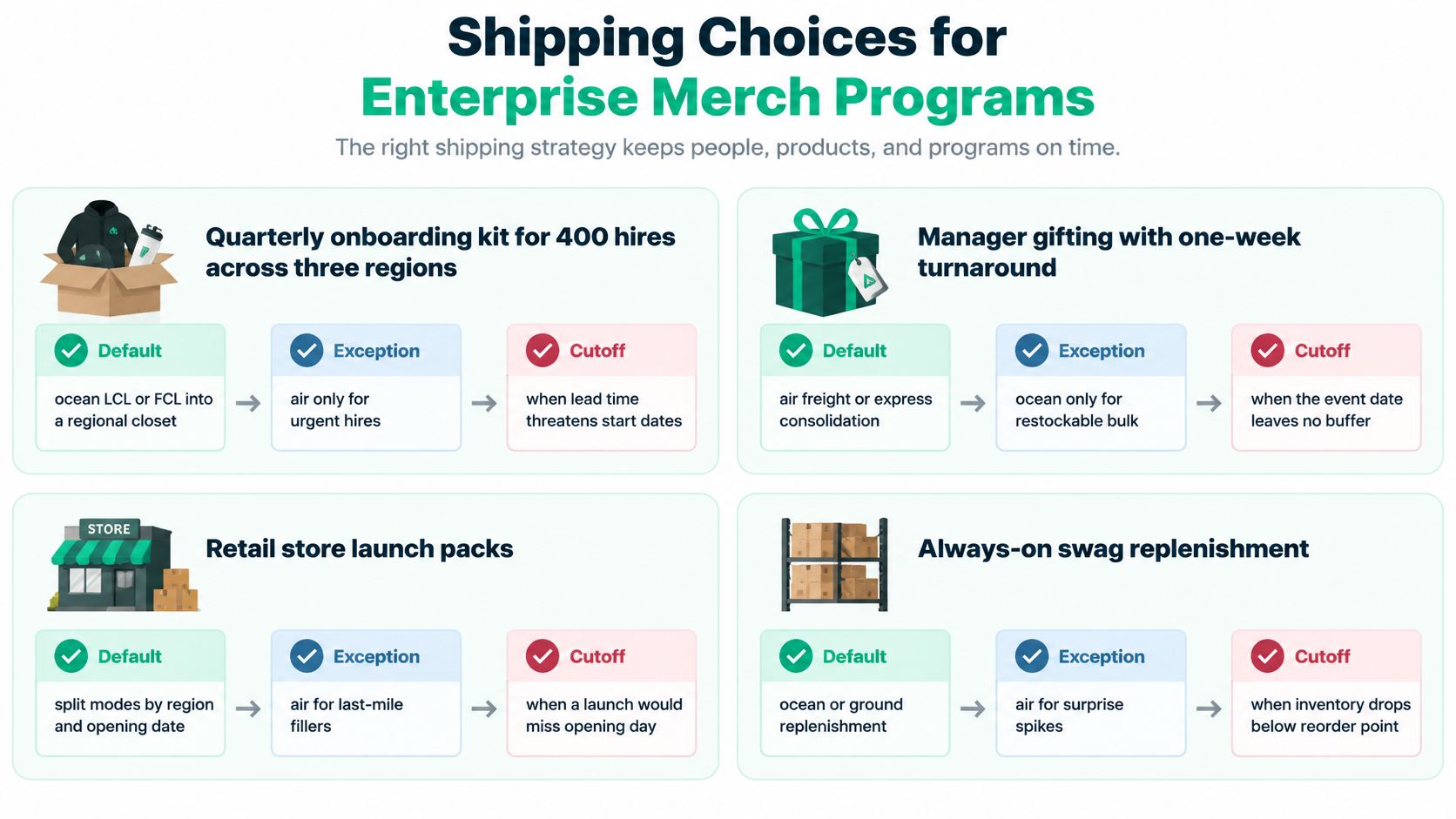
Abstract mode comparisons only help so far. Real programs have a shape, a headcount, and a date that someone in People Ops or events has already promised. The four patterns below cover most enterprise merch, each with a default, an exception, and the trigger that switches between them.
The checklist below summarizes those program shapes at a glance.
| Program | Default | Exception | Switch trigger |
|---|---|---|---|
| Quarterly onboarding kit for 400 hires | Ocean LCL or FCL to regional closet, DDP | Air for hires added inside two weeks of start | Start date within two weeks |
| 200-piece event drop with fixed booth date | Ocean only if the ship-by date is already booked | Air or express if under about 3 weeks remain; sea-air at 4 to 6 weeks | Remaining weeks before booth date |
| Recognition gifts | Express DDP | Postal only if the date is flexible | Any fixed award date |
| Employee-choice store | Consolidated ocean to regional stock | Air when a size runs out before next sailing | Stock-out before next sailing |
Onboarding Kits and Event Drops
A quarterly onboarding kit for 400 hires across three regions is forecastable, so treat it that way. Ship ocean LCL or FCL into a regional closet under DDP, then fulfill locally as start dates land. Hold air for hires added inside two weeks of their start date. That two week line is the single date that forces the upgrade.
A 200-piece event drop works backwards from the booth date. With four to six weeks left, sea-air protects the date at a mid cost. Under about three weeks, go air or express. Ocean only belongs here if the ship-by date is already on a booking, not on a wish list.
Recognition and the Employee Store
Recognition moments are small and personal. Express DDP costs more per parcel, but a cheap postal label that asks an employee to pay a fee to collect their own award undoes the gesture. Any fixed award date is the trigger to stay on express.
An employee-choice store is a replenishment problem, not a parcel problem. Move consolidated ocean into regional stock on a rhythm, and use air only when a size runs out before the next sailing. Teams running larger warehouse operations behind that store may find practical guidance on SAP EWM useful for structuring stock and picking rules. Our overview of global fulfillment services shows how regional stock changes the shipping math.
A managed merch operator such as FLYP can sit on top of this mix for enterprises, taking approved designs through manufacturing, fulfillment, and international shipping so People teams aren't booking each mode themselves. Whether you run it in-house or through an operator, print the cutoff dates on the brief. Slower consolidated ocean stays the lower-impact default for non-urgent employee merch, while a paid expedite stays available for the event that can't slip.
Lock a Shipping Policy Before the Next Drop
A shipping policy usually fails for a boring reason: nobody wrote one. The default mode gets set by whichever forwarder answered first, air freight creeps in through panic, and finance meets the full cost on an invoice after the event. One page, agreed by People, events, and finance before the next cohort, prevents all three.
The One Page Policy
- Name the default mode per program type: onboarding, events, recognition, and the employee store each get one lane, chosen while the calendar is still open.
- Fund air as an exception pool: give upgrades a named budget line. An expedite paid out of program budget never gets questioned, so it becomes the everyday lane.
- Require DDP on anything a person didn't order for themselves, so gifts never arrive with a bill attached.
- Set the order cutoff as ocean lead time plus a port buffer, then publish that date on every brief so late artwork triggers the late path instead of a debate.
- Write the late path in order: sea-air first, then air, with the named person who approves each step. An approval chain invented at midnight before an event is a coin flip.
The situation picks the mode in three lines. Ocean or consolidation when your team controls the calendar. Sea-air when the calendar is shared with an event. Express or air when a specific person is waiting on a specific day.
Compare every quote on landed cost per delivered unit, never on the freight line alone. A quote that excludes duty, brokerage, and the inland leg is missing the charges that decide whether the parcel gets accepted at all. The cheapest mode often produces the most expensive customer experience once duties, shifting de minimis thresholds, and recipient refusal are counted, so the decision is landed cost plus a promised date. That logic carries into creator merch checkout, where surprise fees lose the order entirely. If you sell direct, tools that diagnose Shopify checkout friction show where unclear delivery charges cost you the sale.
The method is a date decision, not a checkout afterthought.
A managed service can run this whole policy for teams that lack a freight function, carrying global onboarding kits, recognition moments, and event drops through manufacturing, international shipping, service, and returns after design approval. It suits a team whose real job is the hiring plan or the event itself. Freight procurement stays off their desk.
Pick the default and the exception for your next cohort before designs are approved. Once artwork is signed off and the start dates are fixed, your cheap options have already left the port.
FLYP LTD runs global merch as a managed service for enterprises and creators, handling manufacturing, fulfillment, international shipping, and returns once your designs are approved, so you can set your default and exception lanes once. Visit FLYP LTD to plan your next onboarding kit, recognition program, or event drop.