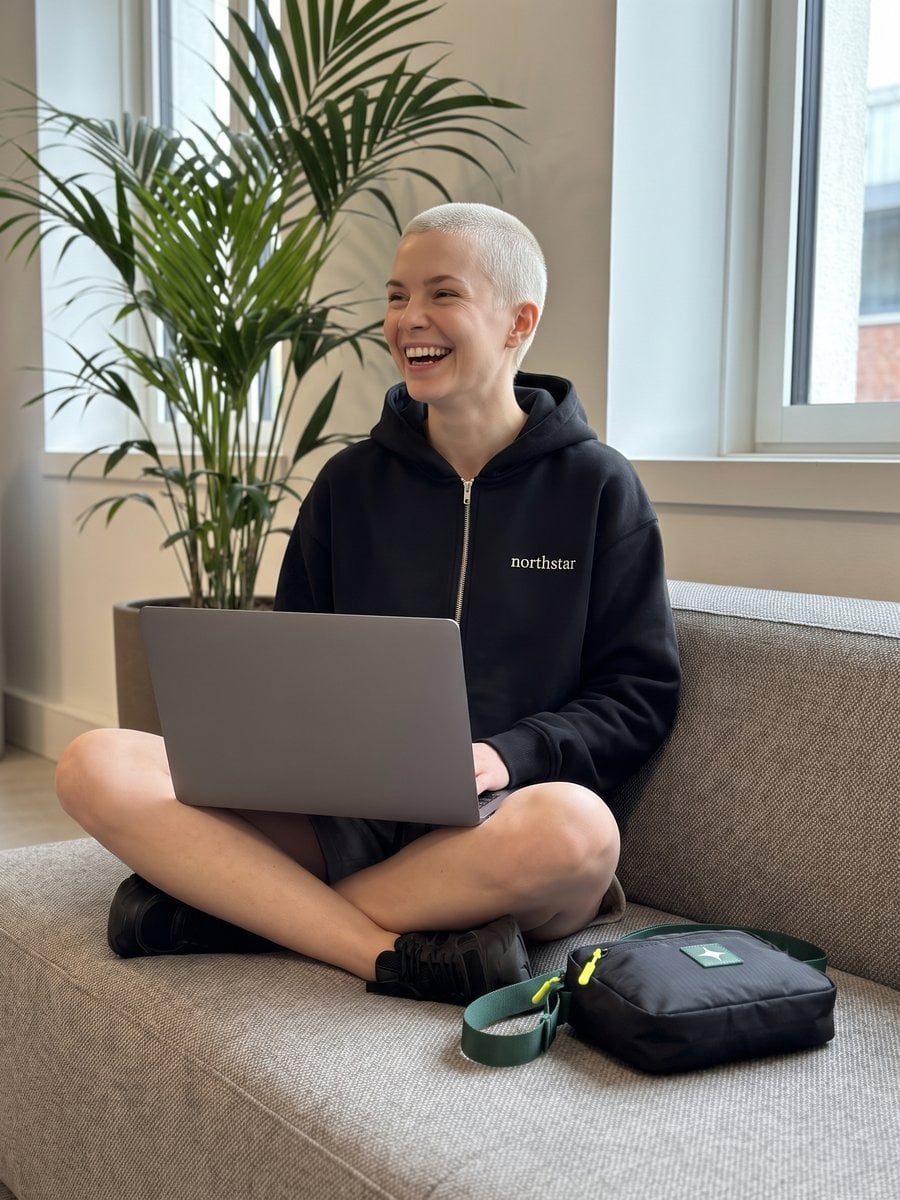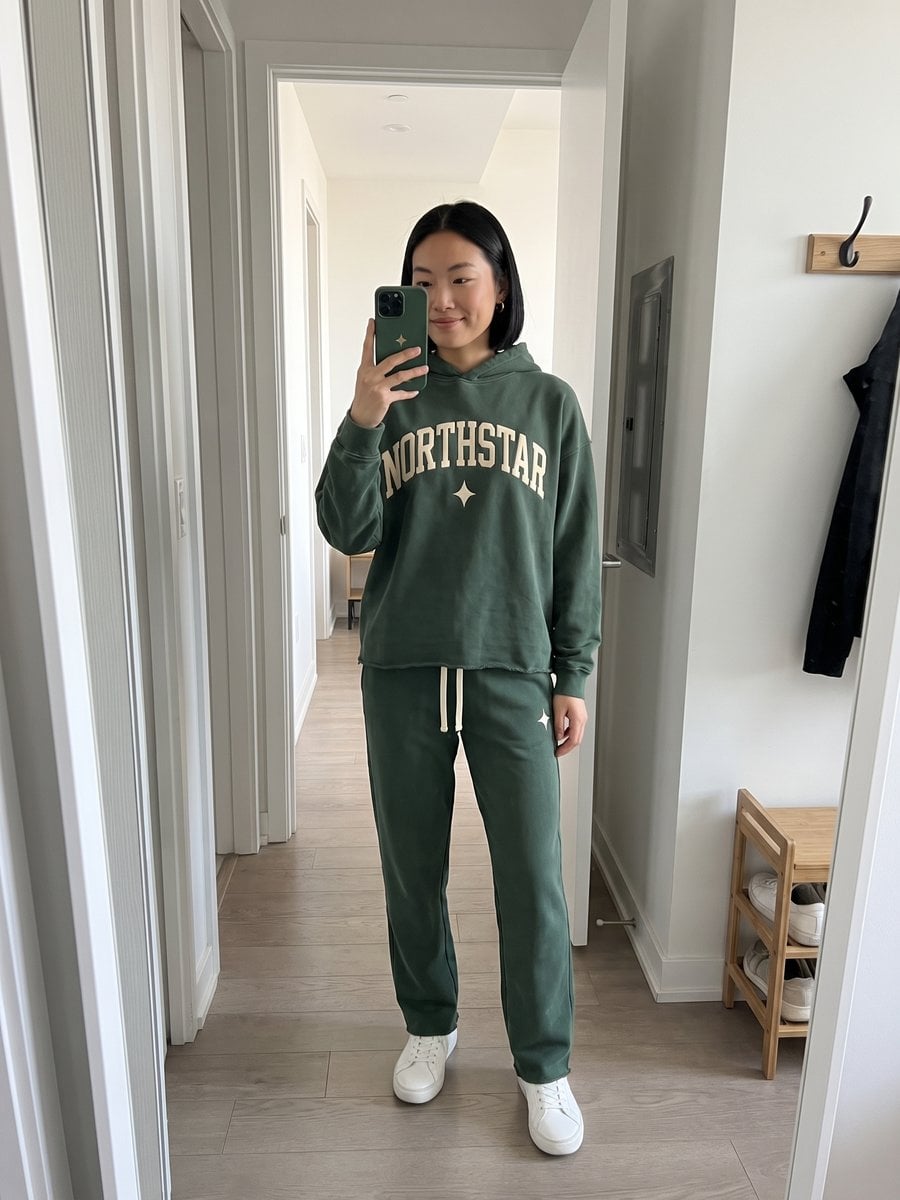
The offsite is six weeks out, or a channel anniversary just landed on the calendar, and the chat is already full of hoodie mockups. Nobody has locked the blank, the size curve, or the number that counts as a win after refunds. A sell-out on day one can still lose money once fit returns, duties, and exchanges show up.
I would run the next launch as a staged experiment. The score is returns-adjusted margin after landed cost, and fit gets checked before any reorder. If the window, the audience, and that metric aren't written down, the graphic can wait.
Table of Contents
- What a Merch Drop Is and When It Works
- Merch Drop Timeline From Brief to Review
- How to Write the Brief and Lock the Product
- Choose Between Preorder, Zero Inventory and Staged Release
- Promote the Drop and Plan Fulfillment
- Size, Fit and Post-Drop Metrics That Decide a Reorder
- Confirm the Pilot Size and Run Your Next Drop
What a Merch Drop Is and When It Works
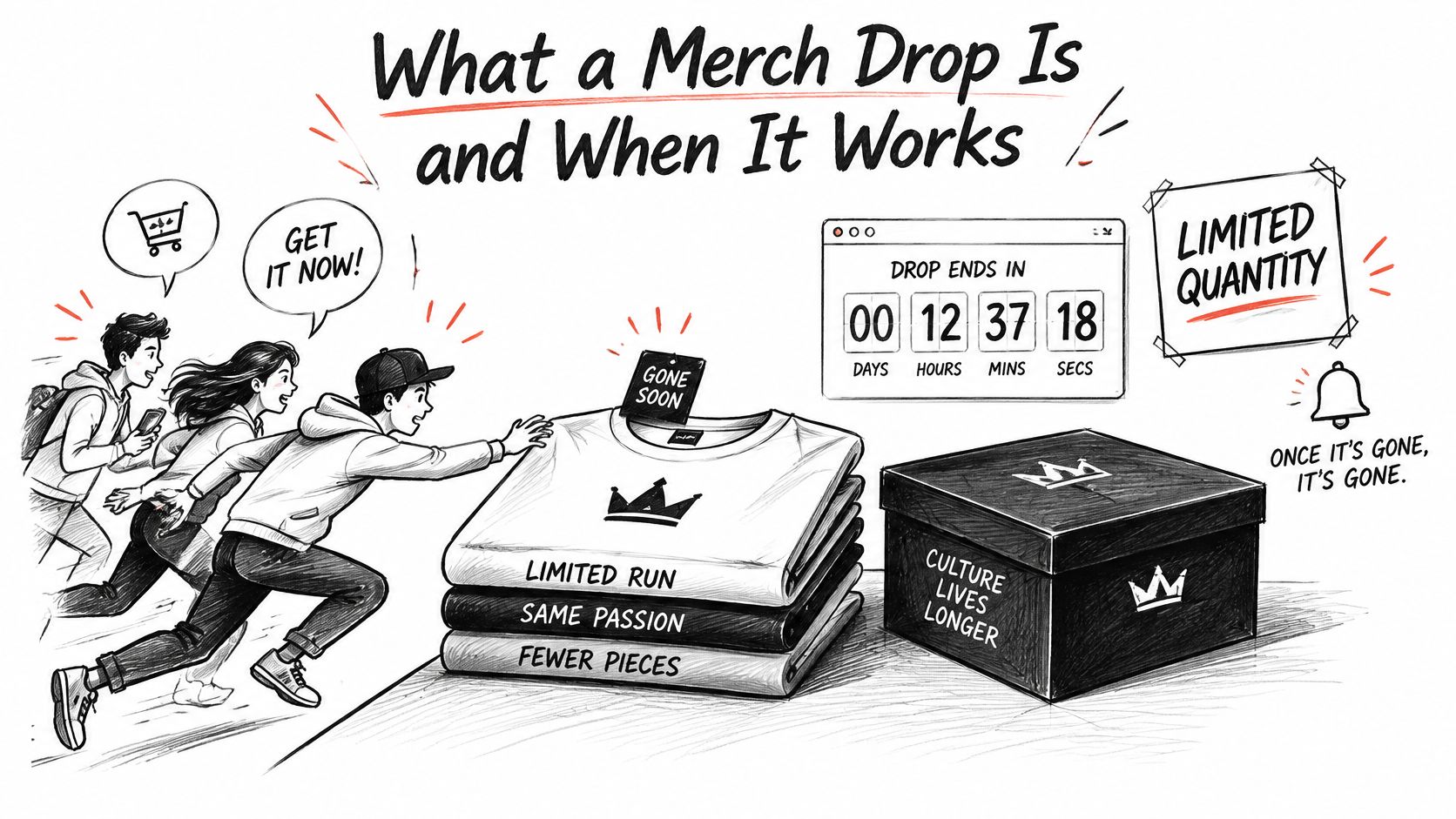
A merch drop is a product released for a short window or in a fixed quantity, so buyers act now instead of treating the item as always in stock. Streetwear brands used small runs and short sales windows in the 1990s, and sneakers and creator products later used the same model. Shopify's guide to limited drops reports that a 2025 survey of more than 2,000 U.S. shoppers found 43% had joined a product drop, flash sale, or private sale in the preceding month. The format is mainstream, not a niche trick.
Decide with three questions.
- Dated moment. Is there a conference, product launch, or creator milestone people can plan around?
- Known audience. Do you already know who can buy, whether fans, employees, or one region?
- Paid orders. Will you score checkout, not clicks?
If any answer is no, fix that first or stay with an always-on catalog. A drop fails for evergreen products people can buy any time.
Clear brand identities for fashion and beauty keep the mark readable when the item has one glance in a short window. Creators tying the launch to video can follow how to sell merch on YouTube.
If those three answers are yes, the format fits. Set the dates before design starts.
Merch Drop Timeline From Brief to Review
| Phase | When | Owner | Output |
|---|---|---|---|
| Brief and goal | 8 weeks before launch | Marketing or People lead | Event window, audience and success metric |
| Blank and spec lock | 6 weeks before launch | Product owner | Garment, colours and size matrix |
| Waitlist or pre-registration | 5 weeks before launch | Community or HR lead | Demand split by size and country |
| Creative and copy approval | 4 weeks before launch | Brand team | Approved designs and fit language |
| Stock or preorder cutoff | 2-3 weeks before launch | Operations lead | Production capacity and delivery cutoff |
| Launch and monitoring | Launch day to day 3 | Whole team | Hourly sell-through and reserved replacement stock |
| Post-drop review | 1-2 weeks after close | Finance and operations | Returns, margin and lessons learned |
Read that table as a countdown. Each output has to exist before the next phase starts. The lead times assume a typical blank and standard decoration. Move every date earlier by your supplier's production lead time, and add the extra days international freight needs so the delivery promise still holds. Embroidery on a heavyweight hoodie eats more calendar than a direct-to-garment print on a stock tee.
Shift the dates for real production
Put a name on each sign-off. The People or marketing lead owns the window and the metric. The brand team owns art and fit language. Operations owns capacity and the cutoff. If a name is missing, that phase slips, and the public date should move with it rather than the quality bar.
Say the factory quotes four weeks and air freight to distant offices adds another week. The brief then starts ten weeks out, not eight. Don't squeeze creative approval to protect a social post. Shorten the teaser, or move the event. A cutoff that ignores freight becomes late boxes and refunds.
- Start the brief before designers see the product. Art drawn on the wrong blank gets redrawn, and the redraw burns the buffer.
- Keep two working days of buffer before the cutoff so late size changes from the waitlist can still enter the order.
- Don't launch on a day when support cover is thin. Size questions stack in the first hours, and a missed reply becomes a cancellation.
Copy the table into the project plan and fill the actual dates before any design work begins.
How to Write the Brief and Lock the Product
Define the number and the window
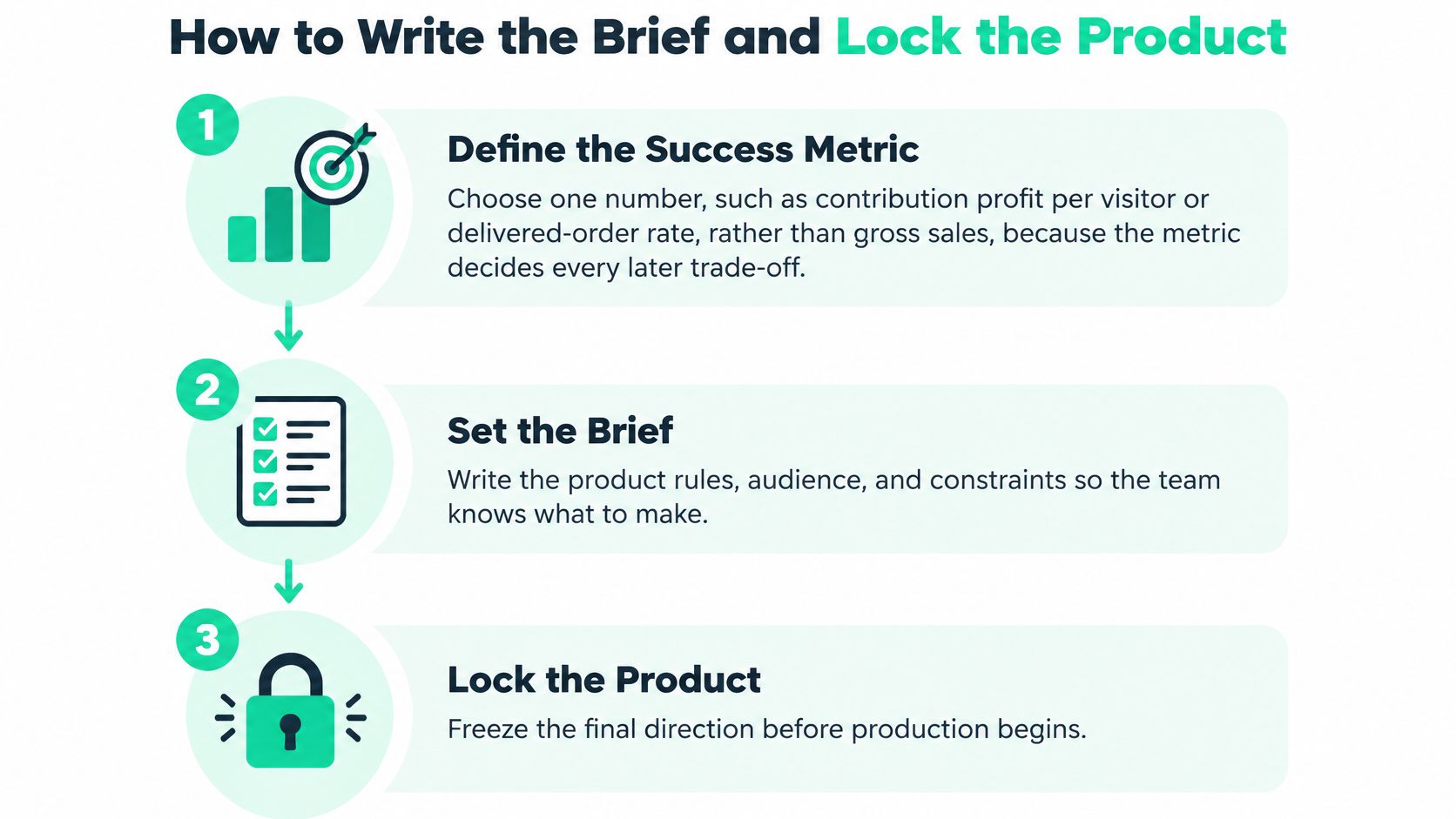
Pick one success metric. Use contribution profit per visitor or delivered-order rate, not gross sales. That single number decides every later trade-off, including whether you add a colour. The usual slip is celebrating units shipped before refunds post.
Write the window and who may buy. Put the exact start and end, with the time zone, and state fans, employees, or one region. A vague "this month" invites orders you can't make. The slip is opening checkout to everyone after the link leaks.
Build the SKU and size matrix. List every size in every colour with a maximum quantity, including long-tail sizes such as XS and 3XL. Those sizes are where complaints start if you forget them. The slip is stocking only M through XL because those samples photograph well.
Lock the blank before the art
Choose the garment and the production spec first, then design to it. A chest mark that sits clean on a heavyweight tee can crawl onto the seam of an oversized hoodie. The slip is approving a flat mockup of a different fabric weight.
Cap capacity in units you can finish by the close date. Write that number down and stop the store at it. The slip is letting demand outrun the decorator and the carrier.
Keep the creative brief to one page. Audience, tone, one core message, logo placement, banned claims, and the person who approves final artwork. Creating product visuals with Nereo lets the team see the graphic on the actual garment before that approval. The slip is a folder of options and no named approver.
Before creative sign-off, publish chest, body length, sleeve length, and tolerance next to body-size guidance, and show fit photos across several body types. Treat fit as a conversion and margin variable, not a support chore. Into The AM's account of return costs puts online apparel return rates around 24.4% in the United States, and 53% of apparel decision-makers name size or fit as the leading return reason.
One chart per blank
Don't paste one generic size chart across different blanks. A heavyweight tee and an oversized hoodie in the same drop need separate charts, separate tolerances, and separate fit lines.
The brief is complete when you can tick all of these:
- Metric. One number, and it isn't gross sales.
- Window and audience. Start, end, time zone, and who can buy.
- Matrix. Every size and colour has a cap, including the long tail.
- Blank. Spec locked before any art file.
- Measurements. Chest, length, sleeve, tolerance, plus photos on more than one body.
- Approver. One name on the final file.
Choose Between Preorder, Zero Inventory and Staged Release
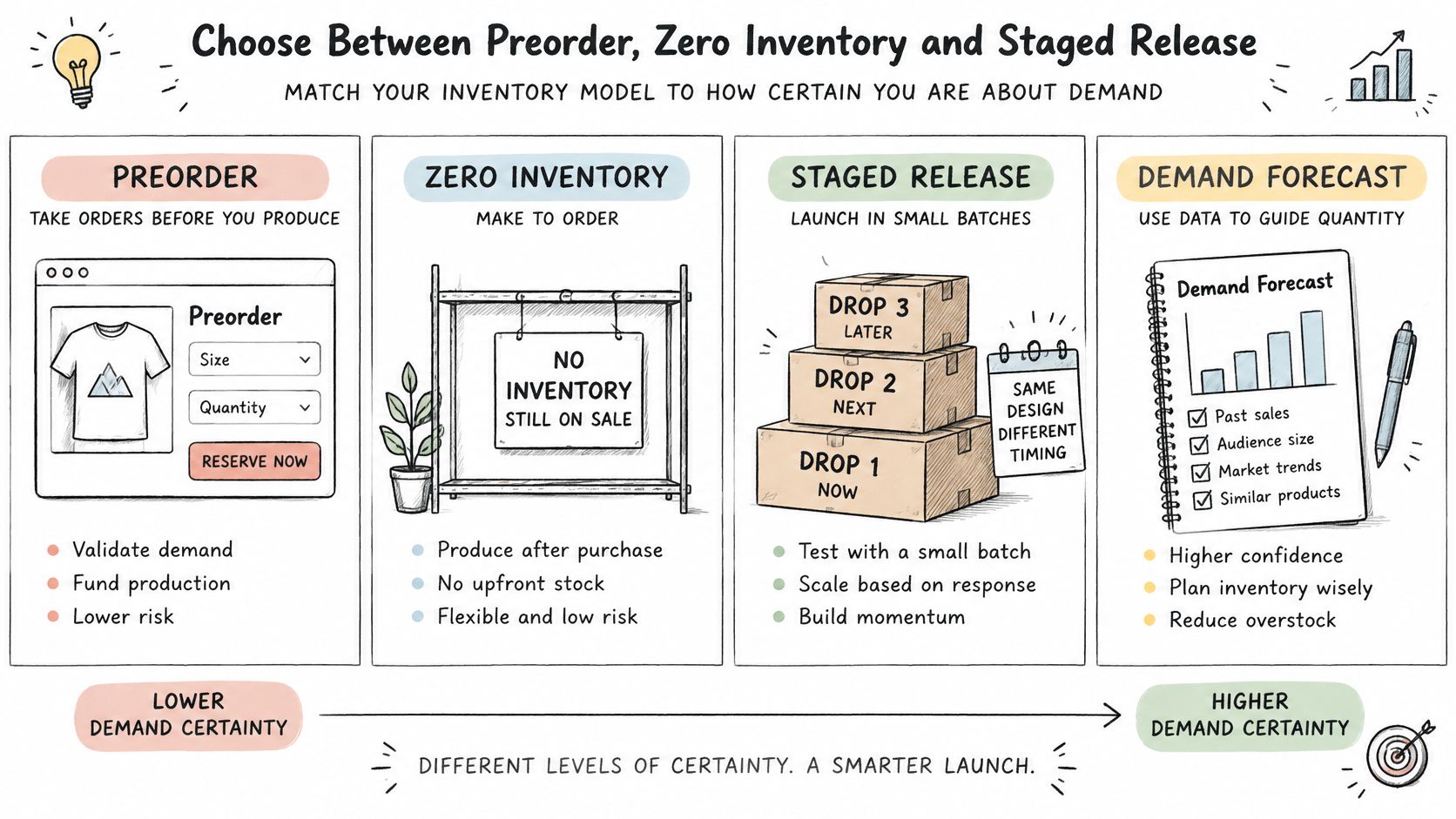
Match the inventory model to how sure you are about demand. Cash tied up before the first paid order is the trade-off, not the slogan on the product page.
| Model | Best for | Main risk | Cash exposure |
|---|---|---|---|
| Limited preorder | Known audience with a firm deadline | Low demand misses the deadline | Low, collected before production |
| Zero inventory, made to order | Creators with steady demand and fast fulfilment | Quality control and delivery reliability | Low, paid per order |
| Bulk stock release | Events with a fixed headcount, such as offsites | Unsold units and excess waste | High, paid upfront |
| Staged release | Unknown demand or new sizes | Slower sell-through and a longer campaign | Medium, controlled by batch size |
A limited preorder fits a named list and a hard end date. Zero inventory fits creators with steady demand and a decorator who hits dates, but unsold stock isn't the risk anymore. Quality, late boxes, and margin swings are. Bulk stock fits a fixed headcount, such as an offsite, and you will hold what people don't take. For a company store that stays open between events, how to build a company swag store is the standing path, not a countdown.
Run a staged release
Use a staged release when demand or a new size run is unproven. Corso's guide to common ecommerce return reasons is why the sequence matters. Published estimates place apparel return rates between roughly 20% and 30%, with fit or style responsible for as much as 70% of fashion returns in the McKinsey research it cites.
- Take the brief's window, audience, and capacity cap as the ceiling on the first allocation.
- Collect intent on a waitlist or pre-registration, split by country and size, before you cut goods.
- Release a small first batch, watch sell-through by hour, size, channel, and country, and hold units back for replacements and exchanges.
- Add units only when paid conversion, cancellation rate, delivery performance, and return-adjusted margin all still hold.
Practical rule: Don't promise scarcity unless inventory controls can actually stop the cart. A "limited" label with an open warehouse becomes oversell and a support queue.
Enterprise drops need extra gates before that first batch ships: brand safety, regional compliance, tax and shipping rules, and a delivery cutoff per country. Creator drops need an attribution window, then a comparison of new-customer revenue, repeat purchase, and net revenue after refunds. Impressions don't make that list.
Promote the Drop and Plan Fulfillment
Plan promotion as a sequence, not one post. The IAB Creator Impact Report 2026 says creators typically need two to three posts before an audience acts. Schedule a teaser, a launch post, and a closing reminder, and give the waitlist early access before the public window opens.
Tag the product in the video itself. YouTube's shopping update states that product tags generate more than twice as many clicks as links placed in descriptions. A description link asks fans to leave the moment you just earned.
Landed cost before you open
Set fulfillment before the cart goes live.
- Confirm the delivery cutoff for each country against the carrier's international lead time. If the box can't arrive inside the promise, don't sell that lane in this window.
- Add duties, tax, and platform fees to the unit cost before you publish a price. A pretty margin at list price often disappears here.
- Book support cover for the full sales window, including the first weekend if you launch on a Friday.
- Hold replacement and exchange stock out of the first allocation so a size swap doesn't steal a paid order.
Build landed cost per order with sampling, failed deliveries, refunds, and exchanges included. For offices in several countries, how to send employee merch globally is the checklist for cutoffs and lanes. If production is outsourced, the contract should say who owns returns and who talks to the buyer. A drop that looks profitable at the sticker price can lose money once those lines are counted.
Size, Fit and Post-Drop Metrics That Decide a Reorder
Scale only when size-level sell-through, returns, and margin hold together. Launch-day orders are not that test.
Say a 300-unit hoodie sells out of XL and XXL on day one while small and 3XL sit. The empty racks look like a win until returns land. Check whether the fit language matched the measurements before you cut more of the sizes that vanished. If those sizes come back above the historical rate for that same garment category, fix the fit copy and the size guidance first. There isn't a universal return percentage that clears a reorder.
| Metric | Where to look | Scale signal | Hold signal |
|---|---|---|---|
| Size-level sell-through | Store reports by hour and size | Long-tail sizes sell through | Headline sizes sold out while the rest sit idle |
| Size-related return rate | Returns reason codes | At or below the category benchmark | Above benchmark, so fix the fit copy first |
| Contribution margin per order | Finance report after refunds | Positive after returns and shipping | Margin erased by refunds |
| Cancellation rate | Order log | Stable and low | Rising, so check the stock promise |
| Repeat buyers | Customer order history | Share of repeat buyers rising | Only one-time buyers |
Contribution margin per order comes after refunds, exchanges, shipping, duties, and platform fees, using the landed cost you built before launch. Write the scale threshold into the post-drop review before the window opens, not after the chart looks flattering.
Letting buyers fix the order themselves cuts a slice of those cancellations. Customer-managed order changes for Shopify stores give people a way to edit size or cancel before the parcel leaves, which is cheaper than a return label.
Confirm the Pilot Size and Run Your Next Drop
Lock three decisions before you touch another mockup. The success metric, the size of the pilot cohort, and the reorder threshold. A merch drop works as a repeatable cycle, not a single day of hype. Size-level sell-through and the margin after refunds should feed the next brief, including which long-tail sizes you cut.
I would keep the first cohort small enough that a bad fit note doesn't wipe the program. A few dozen units per size, or one office or one creator segment, is enough to see conversion, cancellations, and size-related returns against the category benchmark. If that pilot's return-adjusted margin is positive and the long-tail sizes moved, the next batch can grow. If the headline sizes returned hot, the next brief changes the fit line, not the print.
Teams that don't run fulfilment in-house can hand the making off. We create the merch collection and store, then handle production, delivery, and support, so your people stay on the brief and the metrics. Merch credits are prepaid and can be funded per employee, team, or milestone. Admins set brand rules and approved products, and no off-brand merch ships from the store.
Do this next.
- Choose one drop. One event, one milestone, or one creator date. Not a whole season.
- Write the brief with one metric, a named audience, a size matrix, and a locked blank.
- Book a small pilot cohort and a delivery cutoff you can reliably hit.
- Set the reorder threshold now, in writing, as positive contribution margin after refunds and a size-related return rate at or below the benchmark for that garment.
A drop is a measured launch, and it earns a reorder only when fit, returns, and margin hold up.
FLYP LTD runs merch drops for People teams and creators as a managed path from brief to delivery, including production, international shipping, support, and returns so you can judge the pilot on margin instead of chasing boxes. If your next offsite, new-hire class, or channel milestone needs a controlled launch rather than a pile of unsold stock, start with the brief and a small cohort. Visit FLYP LTD to set up the collection and the store.