You've approved a T-shirt design, but the order is still uncertain. Employees haven't confirmed their sizes, the event date is fixed, and a low printing quote doesn't tell you what replacements or overseas delivery will cost. On demand apparel printing can help you avoid guessing how much stock to buy, provided you judge the whole journey to a garment someone keeps.
Table of Contents
- What On-Demand Apparel Printing Is and Why It Matters
- Printing Methods Compared at a Glance
- How an Order Moves from Design to Doorstep
- Where Print Quality and Cost Trade Off
- Enterprise and Creator Fit Compared
- Sustainability and Scale Beyond the Print Run
- Choose Your Print Method and Merch Platform
What On-Demand Apparel Printing Is and Why It Matters
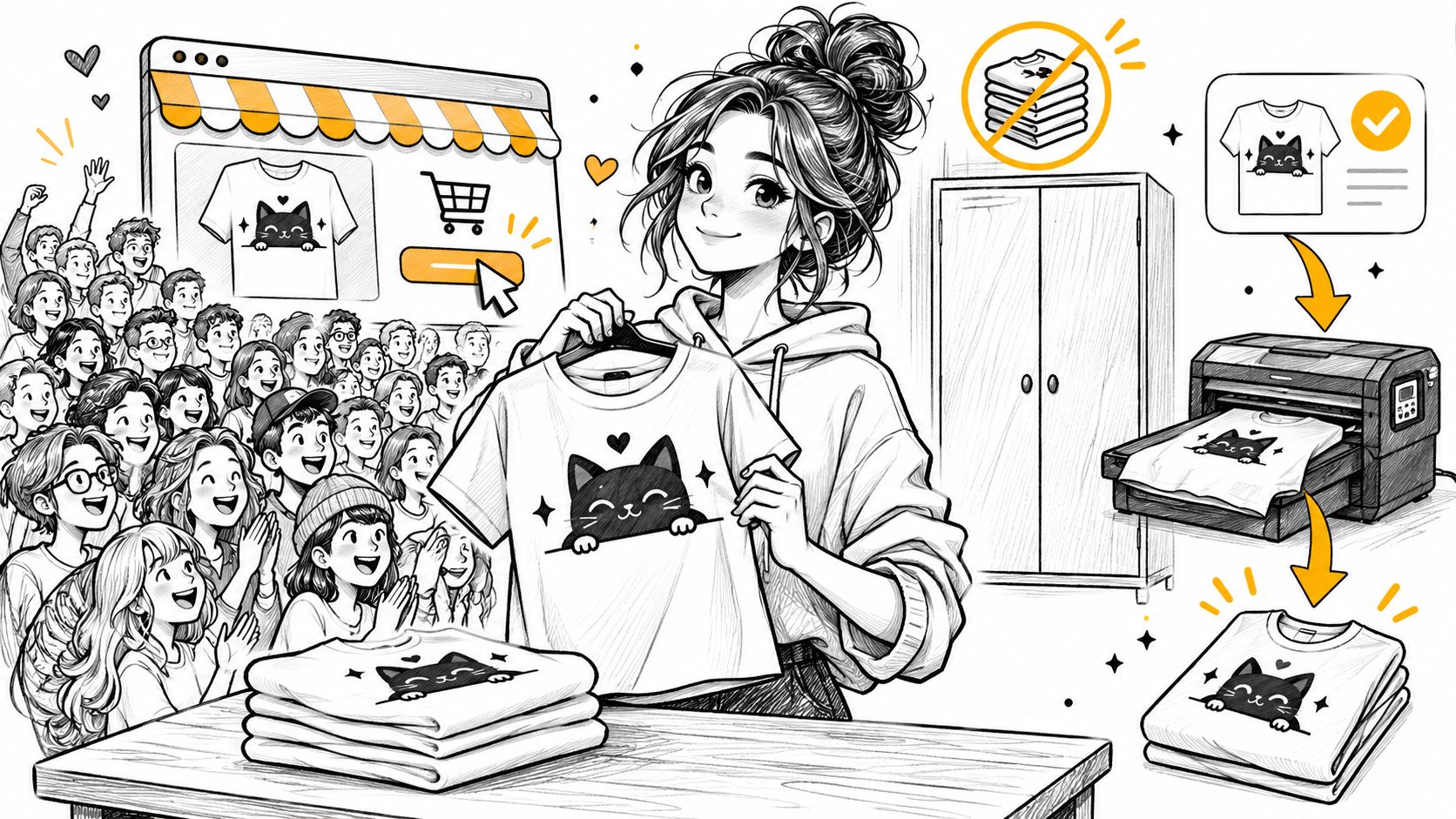
Say a creator launches a cat-themed T-shirt and prints each fan's order instead of filling a closet with speculative stock. On-demand apparel printing means decorating a garment after an order is placed, usually as an individual item or a small group of confirmed orders.
Think of a bakery making cakes against pre-orders rather than filling a display case that might not sell. Bulk apparel production works more like that display case: the buyer commits to finished stock before knowing exactly who'll want each size and colour.
What you hold instead of finished stock
Your working assets become approved artwork, garment specifications and production instructions. The printer still needs undecorated garments, so on-demand doesn't mean the supply chain holds no inventory.
For a storefront-level explanation of this arrangement, on-demand selling with PlatformDTC provides a useful reference for connecting sales with production.
The category is substantial: Credence Research valued the global print-on-demand market at USD 10.22 billion in 2024, with apparel representing approximately 54%. Yet a digital textile printing assessment reported that digital technology represented fewer than 10% of global textile printing in 2021.
Practical rule: Use on-demand for uncertain demand and changing designs. Compare bulk production when an identical design has predictable demand.
Neither model wins automatically. The useful comparison is what you spend to deliver garments recipients keep, not just what the printer charges to decorate them.
Printing Methods Compared at a Glance
Print methods by fabric, run size and cost pattern
| Method | Best Fabrics | Typical Run Size | Strength | Cost Pattern |
|---|---|---|---|---|
| DTG, direct-to-garment | Cotton and suitable cotton blends | Individual orders and short repeated runs | Full colour, photographic detail, potentially soft hand | Low setup; larger print areas increase ink use |
| Screen printing | Many fabrics with compatible inks | Repeated designs that spread setup across a batch | Bold spot colours and durable results when correctly cured | Separate setup costs; lower unit costs become possible at volume |
| DTF, direct-to-film | Cotton, polyester, blends and many dark garments | Individual pieces through batch production | Full colour and vivid coverage on dark garments | Transfer area, film, powder and application affect unit cost |
| Sublimation | Light polyester or compatible poly-coated surfaces | Individual orders through repeated batches | All-over graphics without a surface ink film | Coverage and garment construction affect cost; unsuitable for ordinary dark cotton |
These are production fits, not fixed quantity thresholds. A provider's equipment, artwork and labour costs determine where each method becomes economical.
DTG prints ink directly onto the garment. It's a useful starting point for detailed artwork on a cotton tee, but the blend and surface finish still need approval.
DTF prints onto film before the operator transfers the design using heat. It accommodates a broader range of blanks, although a large transfer can feel more substantial against the skin. For a closer look at edge definition and surface feel, use Cobra DTF's DTF versus DTG print quality comparison alongside physical samples.
Screen printing requires screens and setup for the artwork. That preparation can make a tiny order expensive, while a repeated spot-colour design gives the operator a stronger opportunity to spread setup costs.
Sublimation colours compatible polyester rather than leaving a conventional print layer on top. It doesn't provide an opaque white base, which is why dark fabric isn't a suitable starting point.
Find the actual break-even quantity
Ask for quotes using the same blank, artwork, placement and delivery destination:
- Screen total: Setup fee plus unit production price multiplied by quantity.
- Digital total: Any quoted preparation fees plus unit production price multiplied by quantity.
- Delivered total: Add packing, shipping and expected exception costs to either option.
Don't assume digital preparation is always free. Request a smaller-run quote and a larger-run quote, then identify where the screen total becomes lower.
For example, a small team hoodie order with a chest wordmark might suit DTG, DTF or embroidery. A large event order repeating a simple spot-colour logo deserves a screen-printing quote. The embroidery versus print guide for company apparel helps when the choice is between a stitched finish and a printed graphic.
Choose fabric first, run economics second and finish third. A cheaper method on an unsuitable blank isn't a saving.
How an Order Moves from Design to Doorstep
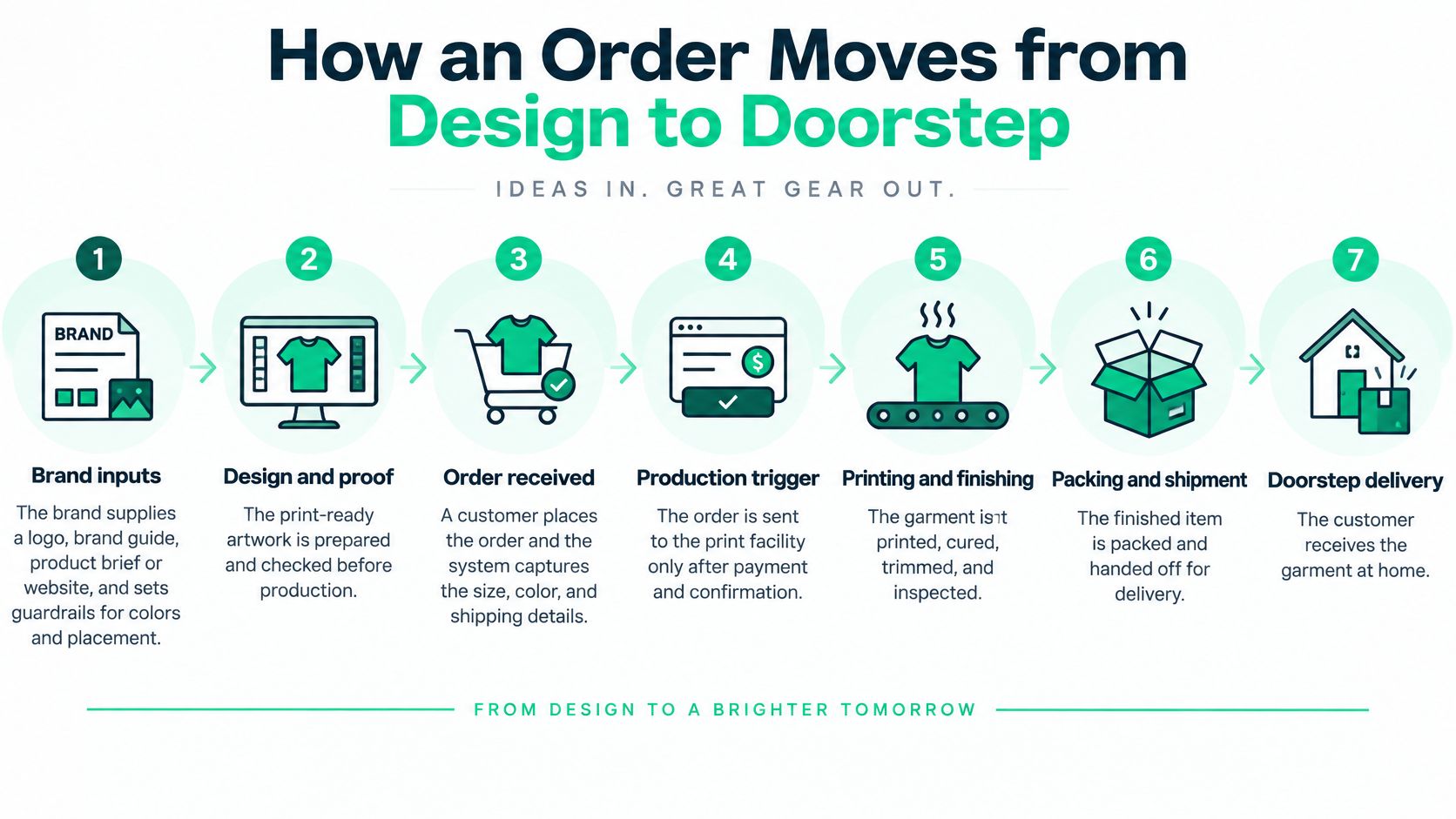
The order needs both a design approval path and a recipient information path. Production shouldn't start until the correct artwork, garment variant and delivery details meet in the same order record.
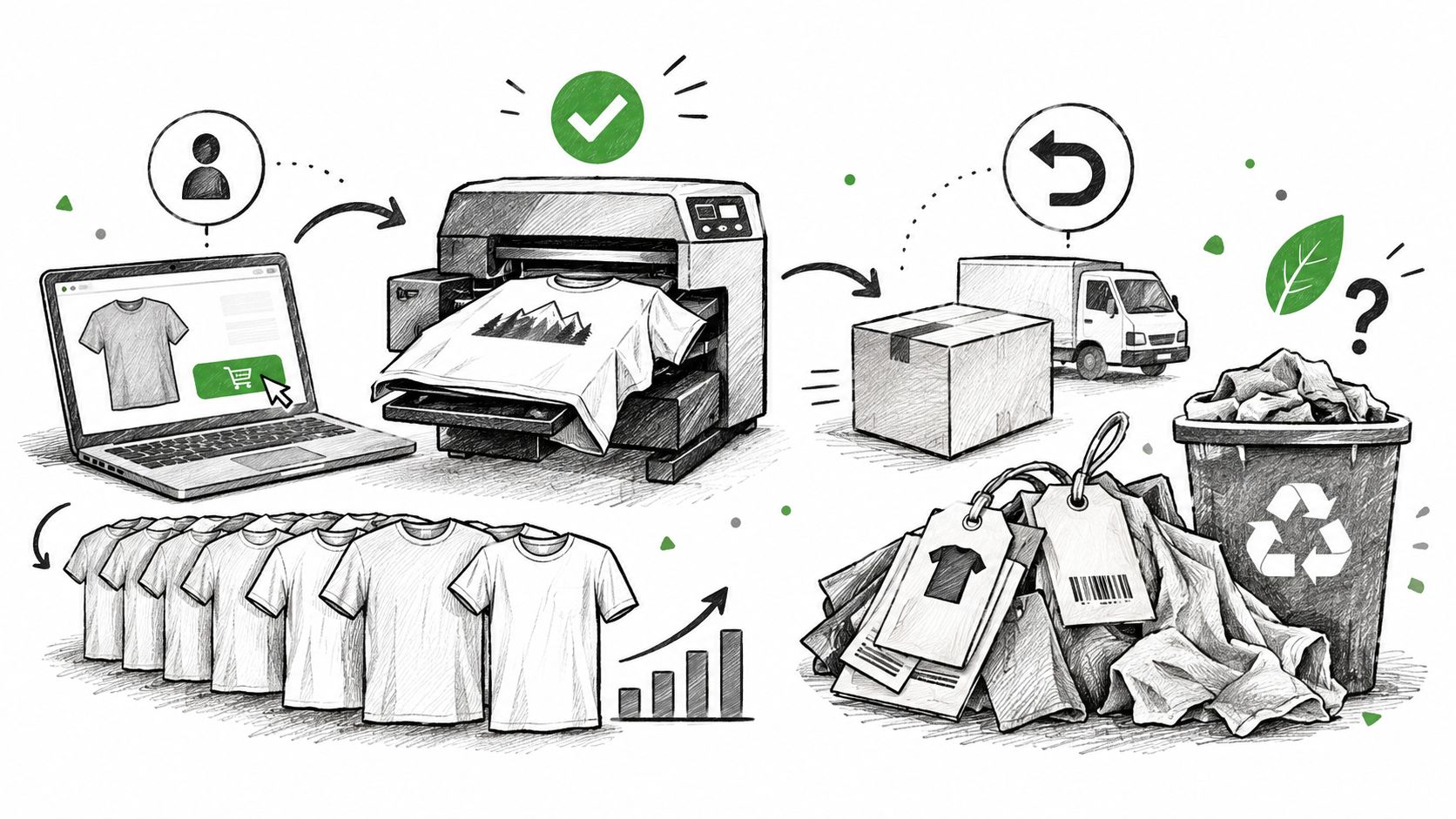
This process visual shows how those decisions connect to production and delivery.
The production handoffs
Supply the brand inputs. Send the logo, brand guide, product brief and placement restrictions, preferably with vector logo artwork in SVG, AI or PDF format. For raster artwork, supply a transparent PNG at the intended print dimensions and confirm the printer's resolution and colour-mode requirements; the common slip is enlarging a small web image until its edges soften.
The designer prepares a garment-specific proof showing artwork size, position and colour. Check it against the actual garment colour, because a floating logo on a white screen won't reveal poor contrast on the chosen hoodie.
Approve and lock the production file. Assign an approver and record the approved version before releasing the order to the queue. The common failure is treating a conversational comment as sign-off, leaving the operator unsure which file is final.
Select and prepare the blank. Check the garment code, fibre content, colour and size against the order, then pretreat where the method requires it. An unapproved substitute can change fit, print behaviour and the recipient's impression even when the artwork is correct.
The operator prints and cures or fixes the decoration using the appropriate process. The common slip is carrying the same production settings across materially different blanks without checking the result.
Inspect before packing. Check placement, spelling, visible defects and the ordered variant, then match the garment to its recipient record. A perfect print packed for the wrong person still creates a replacement shipment.
Ship and support the order. Record dispatch and tracking, and define who handles delivery problems, damage and print complaints. Don't leave the recipient to discover that the storefront and production partner each expect the other to resolve an issue.
Collect recipient choices before release
For event programmes, we have attendees confirm size, fit and style through a branded micro-portal that the customer pushes from its event platform. This collects recipient choices before printing rather than asking an events organiser to infer everyone's preferred fit.
At FLYP, we create the merch collection and store, then handle production, delivery and support. The customer still needs an internal owner who can approve designs and resolve missing recipient information.
When reviewing a storefront's production connection, Printful technology research on AdLibrarySpy offers a starting point for technology discovery. Treat that as a prompt for checking the actual integration, not proof of delivery performance.
The accompanying video provides another view of apparel production.
Lead time starts with usable inputs. An unfinished size list or unsigned proof can delay an otherwise production-ready order, so give those tasks deadlines alongside the event date.
Where Print Quality and Cost Trade Off
Cost drivers and their effect on quality
| Cost Driver | What Raises the Cost | Quality Effect | Control |
|---|---|---|---|
| Print area | Large graphics and additional placements | More coverage can create a heavier feel and harder-to-control curing | Use only the necessary area; wash-test dense graphics |
| Blank choice | Premium construction, fabric weight and special finishes | Changes fit, drape and print compatibility | Approve and standardise blanks |
| Pretreatment and cure | Preparation, handling and process verification | Poor control can produce weak adhesion or wash failure | Validate settings for each blank category |
| Ink film thickness | Heavy ink deposition | Can increase stiffness and complicate curing | Set an approved ink-load profile |
| Run size and setup | Screen preparation spread across a small order | Raises cost without necessarily improving suitability | Compare complete quotes at the intended quantity |
| Returns and resprints | Reproduction, support and additional shipping | Recipient receives a delayed or unwanted product | Use garment measurements and placement previews |
A high-resolution printer doesn't guarantee a durable garment. Screen Printing magazine's DTG durability guidance identifies fabric composition, pretreatment coverage, ink-film thickness and curing as interacting controls.
A thicker ink film can tolerate stretching better, but excessive deposition can cure unevenly. Different garment areas absorb and heat differently, so adding ink isn't a reliable fix for weak durability.
Test the garment, not just the artwork
Approve a sample made on the intended blank with representative artwork coverage. A small chest mark doesn't adequately test the feel or wash behaviour of a dense back graphic.
Record the pretreatment application and cure profile used for that sample. If the programme introduces a different fabric, garment colour or substantial change in coverage, review whether the approved production settings still apply.
Give recipients usable care instructions: wash inside out in cold water and avoid high-heat drying. Heat, detergent, water and agitation stress the print film, but care guidance can't compensate for an improperly cured print.
A replacement involves more than another blank. Someone must reproduce it, pack it, arrange delivery and answer the recipient.
For cost comparisons, use this working calculation:
Cost per kept garment = total programme expenditure ÷ garments recipients keep.
Include sampling, setup, production, packing, shipping, duties you pay, replacements and support costs where measurable. Keep the evaluation period consistent so a late return doesn't disappear from the calculation.
Pay for the right properties
A frequently worn staff hoodie may justify stronger construction, preferred fabric weight and a better fit. A lightweight event tee may be entirely appropriate for its intended use. Weight alone isn't proof of durability, and a premium label doesn't establish print compatibility.
Before committing, request the blank-specific cure procedure, wash-test evidence and the provider's definition of a defect. Ask how complaints are recorded and what evidence is needed to authorise a reprint. Those answers make the quality promise testable rather than subjective.
Enterprise and Creator Fit Compared
Programme fit by buyer type
| Factor | Enterprise Programmes | Creator Drops |
|---|---|---|
| Order pattern | Recurring kits, events and employee-choice stores | Launch drops and fan merchandise |
| Inventory risk | Less finished stock, more recipient-level exception handling | Less stock exposure, continued design and marketing risk |
| Size and fit control | Size information and fit guidance for each cohort | Usually a focused public-facing size guide |
| Brand safety | Approval trail, guardrails and curated catalogue | Creator controls the visual direction |
| Lead time | Must accommodate embellishment and a fixed event date | Must align production promises with the launch |
On-demand shifts risk rather than removing it. An enterprise may avoid leftover event shirts yet spend more time resolving address changes, regional substitutions and missed deliveries.
Fit deserves particular attention. Cart.com's discussion of apparel reverse logistics connects size, fit and product-quality uncertainty with purchasing friction and returns. For programme owners, that means garment selection is an operational decision, not just a design preference.
Enterprise control needs named owners
People Ops, HR and event teams should assign responsibility for country-specific blank substitutions, duplicate orders, customs charges and approval records. Finance also needs a consistent way to identify the programme, recipient cohort and authorised spend.
Rewards can raise questions about equal treatment and tax handling. Refer those questions to the organisation's finance or legal team rather than assuming every country should receive an identical item under identical rules.
An employee-choice arrangement suits programmes where personal preference matters. Centrally selected kits suit a tightly controlled presentation, but someone still needs reliable recipient information. Our company stores approach lets staff choose fit, size and style from the brand-safe catalogue the customer curates.
- Enterprise advantages: No finished-stock warehouse to manage, recipient-level fulfilment and a controlled route for repeat orders.
- Enterprise limitations: More attention to exceptions, local availability and recipient information.
- Creator advantages: Less cash committed to speculative stock, direct storefront ordering and easier design testing.
- Creator limitations: Individual fulfilment can leave less room for margin, while the creator remains responsible for whether fans want the design.
Measure whether the programme works
Track first-pass acceptance, meaning garments accepted without a quality or order-correction issue. Define the reporting window and the treatment of unresolved complaints so teams don't interpret the same measure differently.
Measure delivery reliability by region against the promised arrival date, not merely the dispatch date. Track cost per recipient and the elapsed time from approval to a wearable garment reaching that person.
For AI-generated artwork, retain the approved file and inspect lettering, logo fidelity, placement and production suitability. An attractive mock-up isn't an approval trail, and a generated design still needs human sign-off.
Sustainability and Scale Beyond the Print Run
Zero finished inventory isn't the same as zero waste. Printing after purchase can prevent speculative production, but failed samples, unwanted garments, packaging and replacement parcels still belong in the assessment.
Supply Chain Dive's examination of sustainable fashion puts online fashion returns at approximately 20–30% and excess production at an estimated 2.5–5 billion items in 2023. Those are broader fashion figures, not a forecast for an individual merchandise programme.
Count what reaches useful wear
Maintain separate counts for garments printed, delivered, kept and worn. Delivery tracking establishes arrival, but a short recipient survey is needed to understand whether the garment gets used.
Divide programme emissions, where you have credible inputs, by garments kept. Report cost using the same denominator, and keep wear information alongside it rather than claiming that retention proves repeated use.
- Compare production locations: A regional batch may suit a concentrated team better than separate international shipments.
- Consolidate thoughtfully: Employee kits can travel together to an office, but don't create an unnecessary onward journey for remote staff.
- Plan recovery: Assess repair, redistribution or resale before treating a returned garment as waste.
- Evaluate returnless refunds carefully: They can avoid an unproductive return journey, but they don't establish that the item remains in use.
Accurate garment measurements, fit guidance, placement previews and wash testing address preventable failures before production. Prioritise the causes of waste your own programme records reveal, rather than assuming a material change will solve every problem.
Keep material claims process-specific
Pigment printing can avoid wet-processing stages associated with reactive-dye workflows, as described in Textile World's technical report on digital printing. Its environmental results are process-specific, not a guarantee for every digitally printed garment.
For organic cotton T-shirts, assess fibre choice alongside print compatibility, garment lifespan and fulfilment geography. Ink chemistry, fabric preparation, curing and the test protocol all matter.
The same accounting applies to an individual order and a large programme, but larger volumes create more opportunities for shipment consolidation and controlled regional sourcing. Review return rate, replacement rate and shipping distance per delivered garment each quarter, with country and garment breakdowns where practical.
Choose Your Print Method and Merch Platform
Match fabric and method. Shortlist compatible processes, then compare complete quotes at the intended run size. Don't choose a process solely because its advertised starting price is lower.
Approve the evidence. Confirm the proof, recipient sizing process and physical sample before releasing production. Establish what changes require another approval.
Read the exception policy. Identify who pays when a garment is misprinted, damaged or ordered in the wrong size. Put those responsibilities into your cost model.
Work backwards from the date. Get embellished-piece turnaround and delivery assumptions in writing. At FLYP, SKOs and high-volume events with custom embellishment, such as embroidery or woven labels, typically need 4–6 weeks.
Confirm reporting access. Specify the country, garment and cohort breakdowns you need, plus a consistent way to record complaints and resolutions.
Judge cost per kept garment, not cost per printed garment.
Apply the same questions to every platform, including ours. We have no minimum order and produce only what's ordered, whether that's a single hoodie, a new-hire kit or a programme of 10,000 items, with no warehoused dead stock.
Get the policy and reporting answers in writing before signing. This week, request a sample on your chosen blank, wash-test the intended print method and compare providers using the full cost of delivering an accepted garment.
FLYP LTD creates merch collections and stores, then manages on-demand production, delivery and support for enterprise and creator programmes. Visit FLYP LTD with your garment brief, recipient locations and target date to discuss a sample-led plan before committing to production.