You're clearing space for the next onboarding shipment, and the cupboard is still full of last year's hoodies. The popular sizes disappeared early, the remaining colors aren't anyone's first choice, and the logo has since changed. You bought enough merchandise, just not the merchandise people wanted.
For a creator, the hesitation comes earlier: people engage with your content, but that doesn't tell you which design they'll buy or which size they'll choose. On demand merch changes when you commit money to production. Making that switch work, though, takes more than uploading artwork and connecting a checkout.
Table of Contents
- What On Demand Merch Really Means
- How the Production Flow Works
- On Demand Merch vs Traditional Bulk Production
- How Enterprise and Creator Programs Use It
- The Sustainability Question Most Coverage Skips
- Why Garment Accuracy and QA Are the Hard Problem
- Choosing a Platform and Getting Your First Drop Live
What On Demand Merch Really Means
On demand merch means apparel, accessories, and branded goods produced or decorated after a customer orders or an organization confirms demand. Instead of forecasting finished merchandise, buying a batch, and finding somewhere to store it, you maintain an approved digital catalog.
Think of it as cooking to order rather than preparing a buffet. You still need ingredients, equipment, and a reliable kitchen. What changes is whether you decide the finished mix before people choose.
The important distinction is the production trigger
The term overlaps with other models, but they answer different questions:
- On-demand production describes when an item is made or decorated. A confirmed order triggers the work.
- Mass customization describes how much a customer can personalize. It can use preproduced components, so personalization alone doesn't establish the production model.
- Dropshipping describes who ships the product. A supplier can ship generic stocked goods without producing anything specifically for that order.
For a beginner-friendly explanation of the commercial setup, Skup's POD business basics for beginners provides useful background.
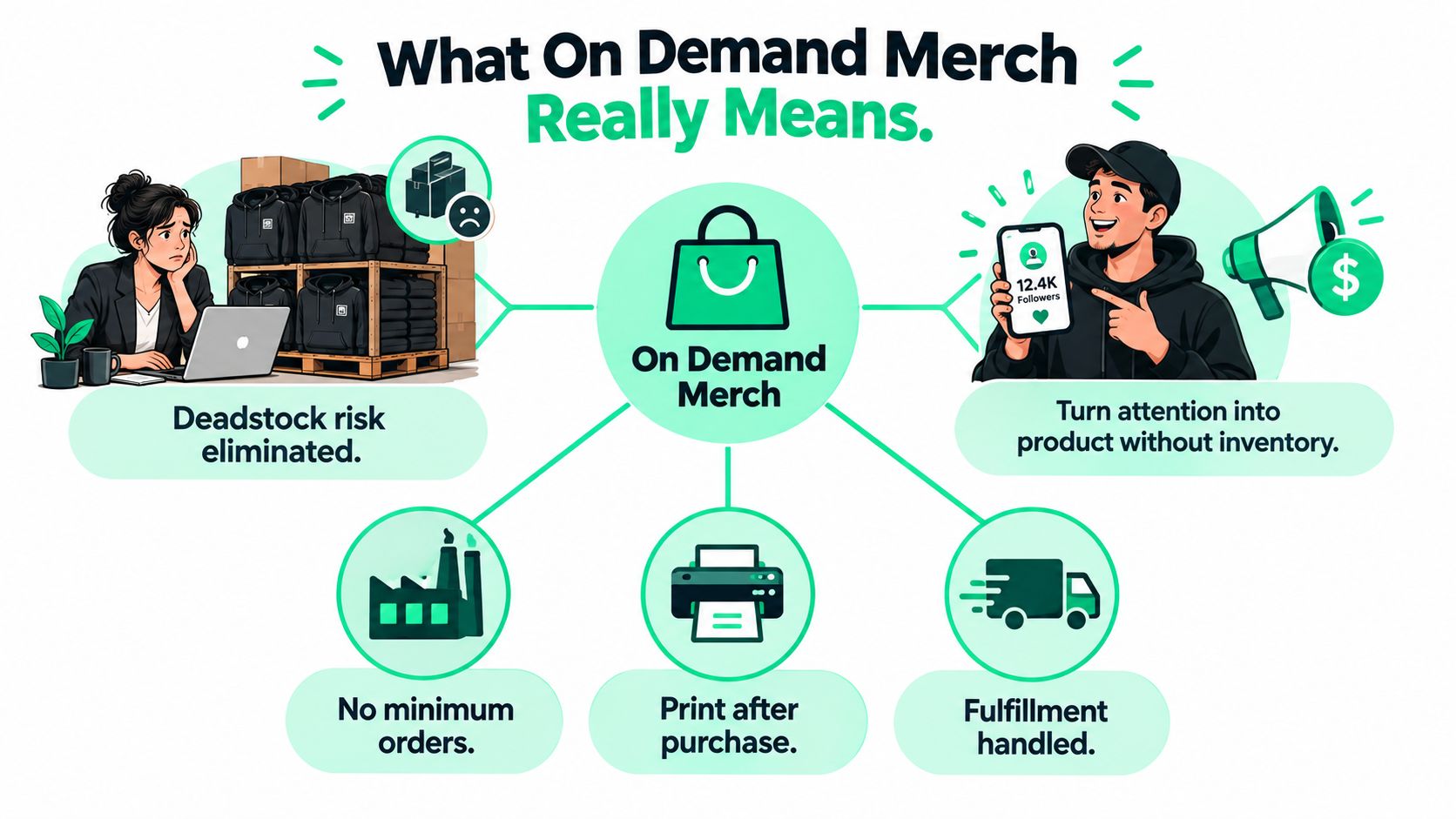
The concept map below illustrates the model, although supplier minimums and fulfillment arrangements still need checking.
Inventory risk matters more than the printing shortcut
The core benefit is controlling inventory risk, not generating designs faster. A team can validate interest before committing to a finished product mix, then retire an unpopular design without a cupboard full of branded leftovers.
That's distinct from eliminating inventory throughout the supply chain. Suppliers still need blank garments and materials, and your preferred size or color can become unavailable.
One industry estimate values global print-on-demand at USD 10.22 billion in 2024 and projects USD 39.42 billion by 2032, approximately 3.9-fold growth at an estimated 18.4% compound annual growth rate, according to Credence Research's print-on-demand market estimate. Treat that forecast as an industry estimate, not audited national statistics.
Practical rule: Use on demand merch when uncertainty about what people want is more expensive than paying extra to produce each confirmed order.
How the Production Flow Works
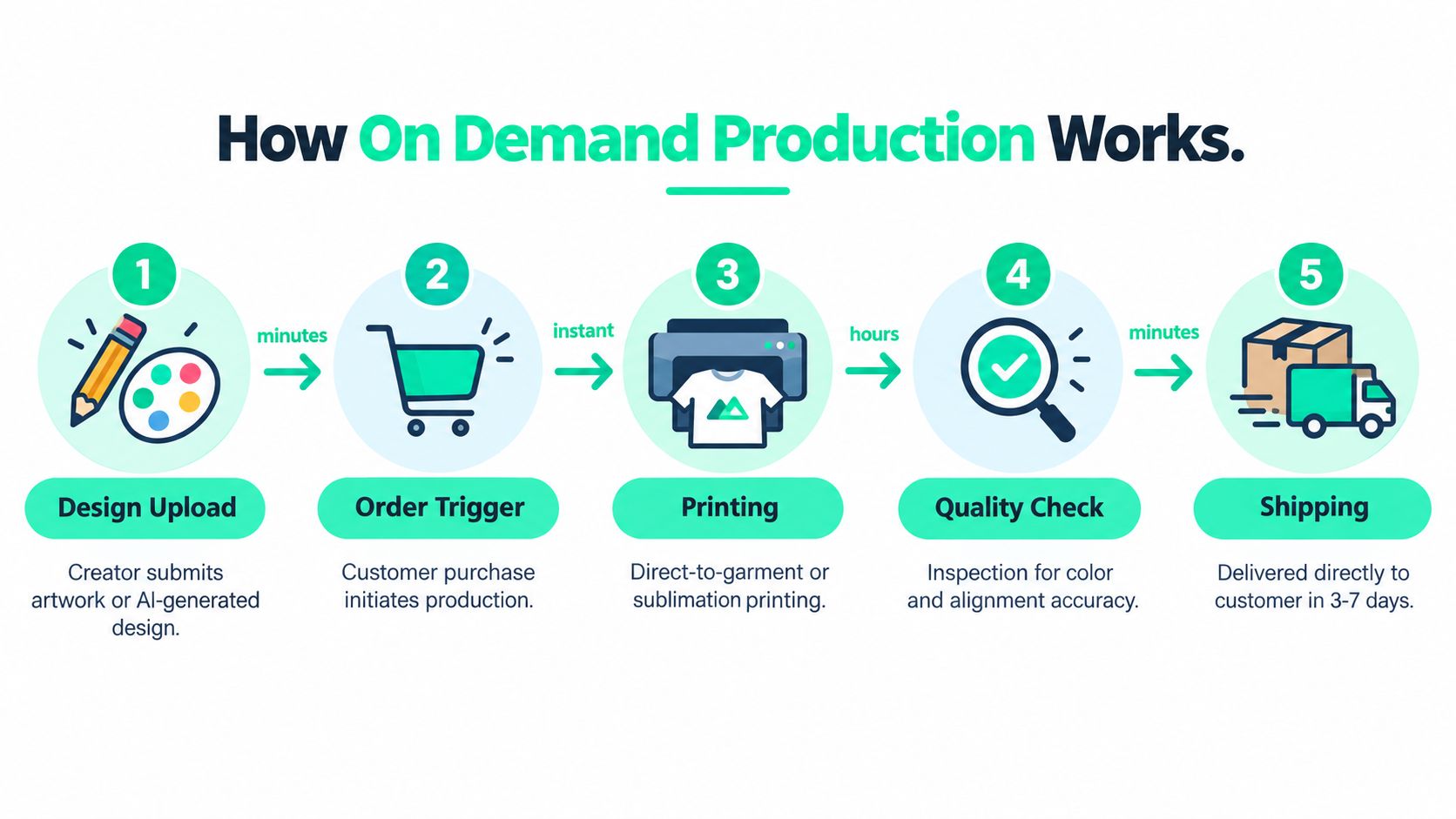
The production trigger, not the storefront, defines the model: a confirmed order starts the work. Everything before that moment is preparation, and everything after it is a chain of custody that either holds or breaks.
This diagram simplifies the flow. Its timing labels are illustrative rather than delivery commitments, since production capacity, destination, customs, and carrier service determine the schedule.
Before the order reaches production
Start with a brand brief, uploaded artwork, or a generated design. Translate that creative input into a production specification: approved colors, artwork files, placement, decoration method, and eligible garments.
Then select the blank, meaning the undecorated garment. Approval attaches to a specific garment, so a design signed off on a heavyweight hoodie still needs review on a lightweight shirt. Fabric, construction, available colors, and decoration areas all differ between the two.
For an enterprise program, the managed-service approach should turn a brief into a curated collection. Handing employees an unrestricted supplier catalog creates inconsistency, while an approved set of combinations keeps every order inside the specification.
Before opening orders:
- Approve the product representation. Check the selected garment, artwork position, size information, and description.
- Set the commercial rules. Define pricing or employee allowances, shipping eligibility, order windows, and cancellation terms.
- Validate order data. Confirm that the recipient's selection, address, and authorization can reach production without manual interpretation.
Industry reporting estimates that nearly 40% of clothing produced globally is never sold at full price and annual textile waste reaches approximately 92 million tonnes, with methodological uncertainty around both figures, as summarized in Rawshot's decorated-apparel industry reporting. That figure covers discounted and diverted stock too, yet it shows how far advance forecasts drift from real purchasing behavior.
After an order is confirmed
A confirmed order becomes a production job containing the exact garment variant and approved artwork. Printing or embroidery follows, then inspection, packing, dispatch, and tracking.
Quality assurance needs an owner before dispatch. A routing system can send a perfectly valid order to a facility that interprets placement or substitution rules differently, and nobody catches the variance without a named checker.
Regional fulfillment requires the same scrutiny. The question is whether each location can supply the approved garment and decoration method. Accepting an address is the easy part. Post-purchase support must also cover delays, defects, exchanges, and missing packages, because returns handling is where underprepared programs spend the most time.
For a visual introduction to the production workflow, use the accompanying video.
Traceability closes the loop. If someone can trace a delivered item back to its order, artwork version, garment specification, and production location, problems get fixed quickly. Without that record, every complaint becomes guesswork.
On Demand Merch vs Traditional Bulk Production
A lower factory price doesn't necessarily mean a cheaper merch program. Equally, avoiding a warehouse doesn't make on-demand production the right answer for every launch.
Compare both models against the same outcome: an acceptable item delivered when the recipient needs it. Comparing a bulk printing quote with an on-demand delivered price hides important costs.
On Demand Merch vs Bulk Production
| Dimension | On Demand Merch | Traditional Bulk Production |
|---|---|---|
| Unit cost | Can cost more per decorated item | Can offer production efficiencies on repeat runs |
| Speed to first delivery | Includes production after confirmation | Stock can dispatch quickly once the batch is ready |
| Minimum order size | Can support individual orders, depending on the supplier | Often requires a minimum commitment |
| Flexibility | Easier to change future listings and selections | Changes can leave existing stock obsolete |
| Inventory risk | Limits speculative finished merchandise | Requires a forecast before recipients choose |
| Brand control | Requires specifications across routed orders | Allows concentrated sampling and batch inspection |
| Fulfillment | May involve separate parcels and production sites | Can consolidate stock and destination shipments |
Minimum commitments deserve scrutiny beyond the headline promise. Check whether the garment, decoration technique, packaging, or branding treatment introduces a separate requirement, using this guide to minimum order quantities as a starting point.
Compare total program cost
For bulk production, include purchasing, inbound freight, storage, picking, outbound delivery, markdowns, and obsolete stock. For on demand merch, include decoration, individual fulfillment, shipping, platform charges, support, and replacements.
Don't assume that money not spent on inventory becomes profit. You may spend some of it on more expensive production and parcel handling.
A practical comparison should also include the cost of failure. For an event, a late shipment may be unusable even if the garments are excellent. For an ongoing employee store, waiting for production may be acceptable if the expectation is clear.
Buy predictable demand efficiently. Keep uncertain demand flexible.
Consider a recurring conference with a dependable attendance pattern and a firm distribution date. Bulk production may suit the main merchandise allocation because the team can inspect and receive it before the event. A speculative new design aimed at a dispersed audience has a different risk profile.
A hybrid model can separate those needs. Keep dependable baseline demand in stock while routing less predictable sizes, personalization, or locations through on-demand production.
The break-even question isn't whether on demand merch is cheaper in isolation. It's whether avoided storage, markdowns, obsolescence, and disposal outweigh additional production and fulfillment costs. Choose the model per program or product, rather than making a permanent company-wide commitment.
How Enterprise and Creator Programs Use It
A People team hiring across several countries does not need another logo file. It needs a welcome kit to reach each new hire without turning an office manager into a freight desk. The order works like a permission slip: once a hire, award, registration, or purchase is approved, production may start.
Use the model where demand is authorized, sporadic, or too uncertain to stock. The setup changes by program, but the control points repeat.
| Program | Trigger to produce | Recipient control | Failure to design for |
|---|---|---|---|
| Onboarding kit | Approved new-hire record or scheduled invitation | Employee picks size, item, and address | A start-date promise that ignores selection, production, and transport time |
| Recognition award | Manager nomination or approved award | Recipient chooses inside a funded collection | Letting choice change the budget or weaken the reason for the award |
| Employee-choice store | Standing eligibility and allowance rules | Catalog access with clear ownership | Outdated branding, address errors, unavailable garments, replacement requests |
| Conference or event | Selection collected during registration | Attendee confirms preference before cutoff | A deadline so tight that expedited shipping becomes the assumed fix |
| Creator drop | A video, community moment, or launch context | Audience buys through storefront or link-in-bio | Promoting before product approval, rights checks, and support rules are set |
For enterprise teams, the work is separation of duties. HR or finance owns authorization, the employee owns preference, and operations owns the audit trail. If a kit must arrive before day one, the workflow has to leave room for selection, decoration, and delivery. If arrival after day one is acceptable, say so plainly and make the invitation part of the welcome.
Creators start with a reason to buy, then protect trust. AI-generated artwork can help explore concepts, but channel fit and permission for every element still need a human decision before promotion. If YouTube Shopping is part of the plan, verify platform support, channel eligibility, and product tagging before the campaign depends on them. Judge revenue after production, payment costs, delivery subsidies, refunds, and customer support, not through an assumed advertising multiplier.
The shared risk sits in making the right garment reach the right person and owning the fix when it misses. Packing and dispatch can be outsourced; accountability stays with the employer name on the kit or the creator name on the channel.
The Sustainability Question Most Coverage Skips
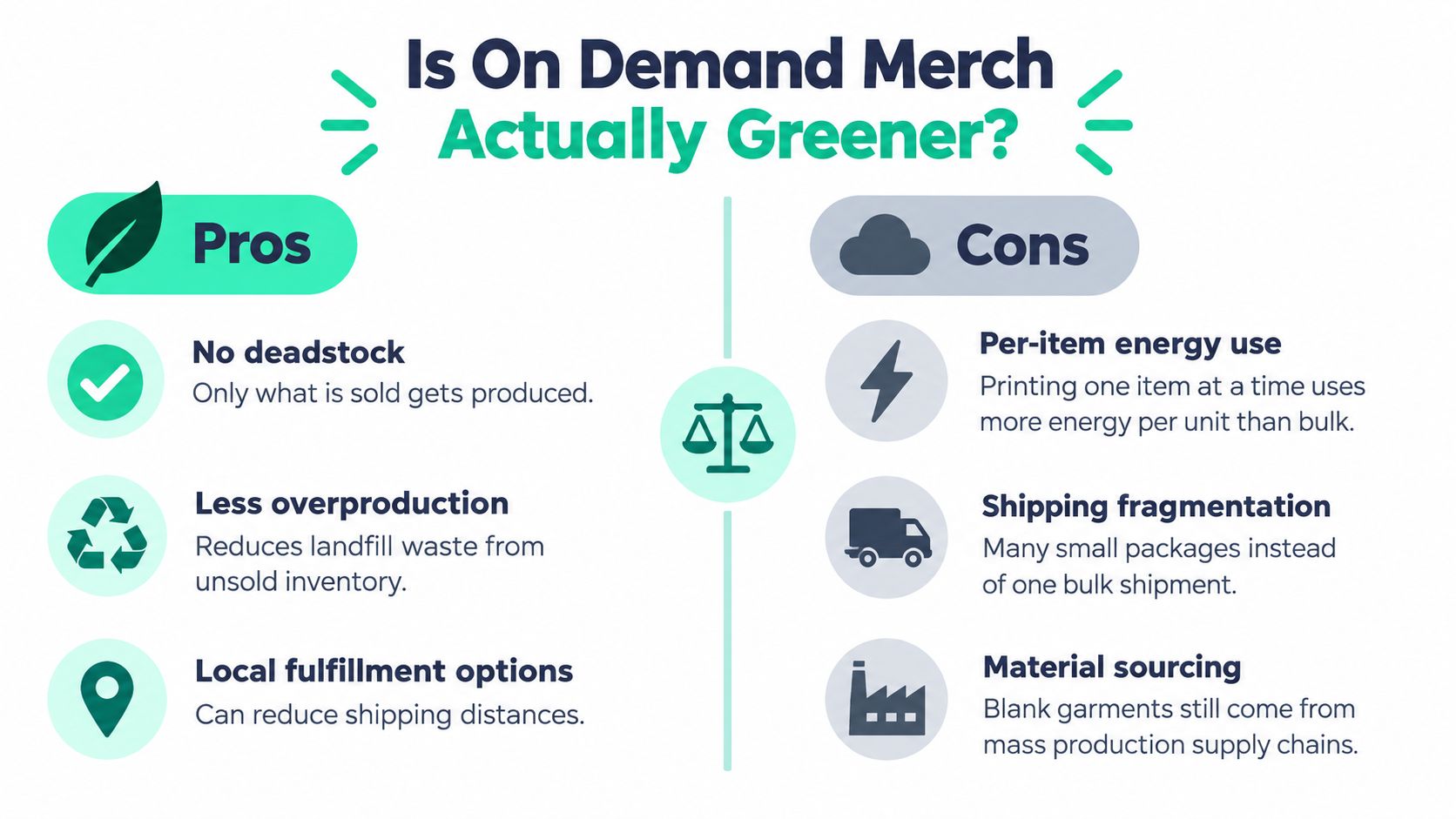
Producing after an order doesn't establish that a garment has a lower environmental impact. It addresses speculative finished stock, but it doesn't settle questions about materials, energy, transport, durability, or what happens after delivery.
The following comparison highlights those considerations. Treat its environmental benefits as possibilities to verify, not universal outcomes.
Measure what happens after production
Returns expose the weakness in counting only items manufactured. A garment made for a confirmed order can still arrive in the wrong size, disappoint its recipient, or require a replacement and another shipment.
A 2025 returns report found that 56% of apparel and footwear brands reported return rates of at least 30%; nearly 60% of consumers in the cited consumer research reported returning a product because its description was inaccurate or misleading, according to the Akeneo consumer returns report. Those findings aren't specific to corporate merchandise, but they make product information and post-purchase handling important evaluation criteria.
For program design, waste per useful wear is a more revealing question than waste per unit produced. Treat it as a practical evaluation lens, not a standardized metric: does the recipient use the item enough to justify the materials and activities involved?
Avoid manufacturing false precision. You may know shipping weight and packaging composition but have limited visibility into actual wear. Label recipient feedback and estimated use separately from measured supplier data.
Build an impact scorecard
Track environmental information alongside service performance:
- Product suitability includes size-guide accuracy, recipient satisfaction, and whether people keep using the garment.
- Delivery performance includes first-pass success, split shipments, packaging, and transport mode.
- Return handling distinguishes exchanges from refunds and records return distance, inspection, and final disposition.
- Supplier evidence covers material composition, manufacturing location, and the basis of environmental claims.
Consumer interest also extends beyond the purchase. Research cited in coverage of sustainable e-commerce development indicates that 60% of consumers are interested in clothing-return systems supporting recycling or donation. Interest isn't proof that a particular collection scheme works, so ask suppliers what happens to returned goods.
Use this approach when evaluating sustainable clothing production: request evidence of the actual product and route, not just a general sustainability statement.
A donated garment and a discarded garment shouldn't appear under the same vague label. Neither should a promised recycling pathway count as a completed outcome without confirmation.
Why Garment Accuracy and QA Are the Hard Problem
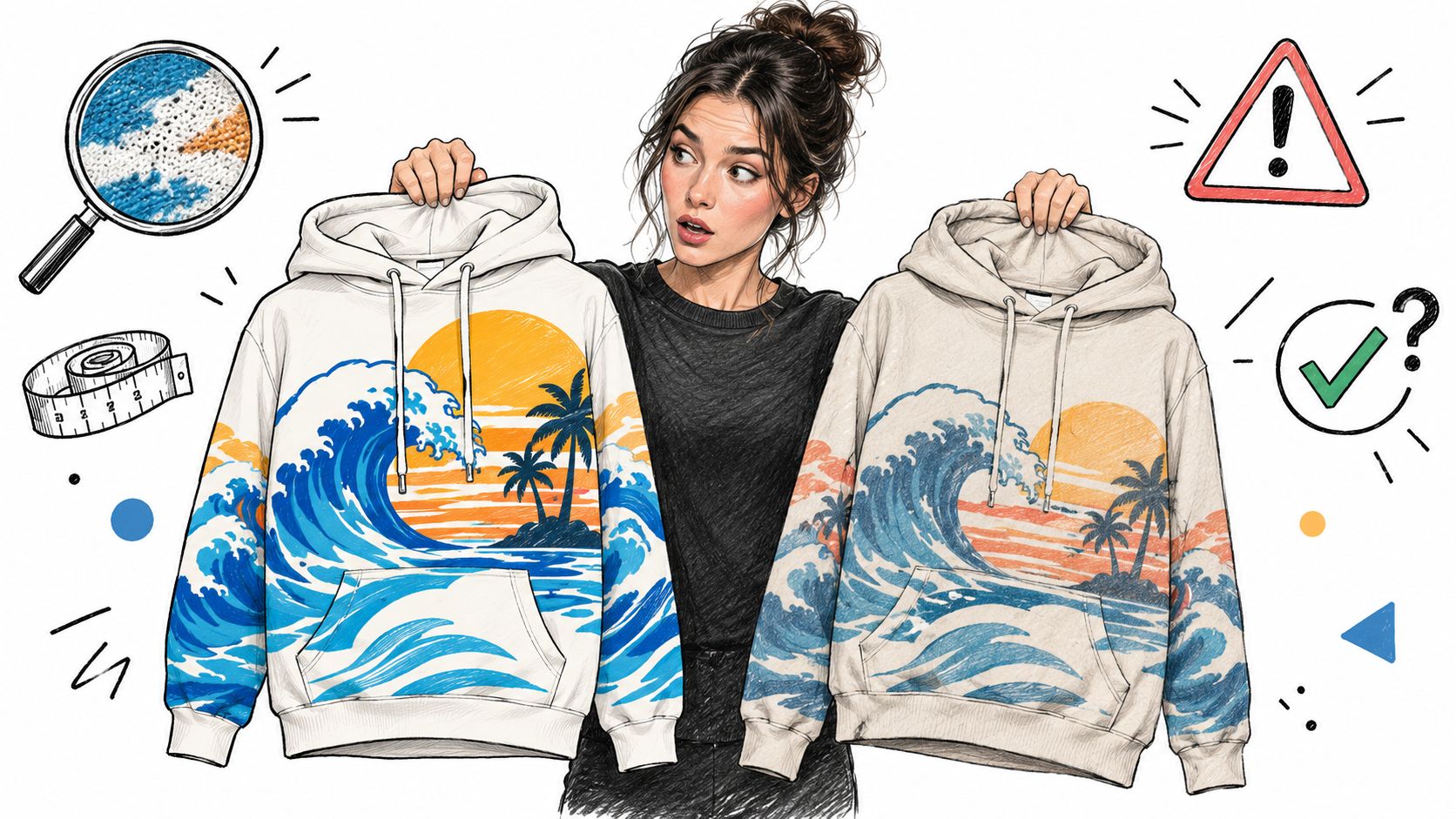
A preview that shows artwork at 300 dpi on a flat template cannot reveal that a chest pocket will clip the design on the actual heavyweight hoodie the recipient opens. That is the production question hiding inside every polished mockup: will this exact design look and feel right on the garment that arrives?
The product is the combination of artwork, garment, decoration process, placement, and production execution. For a program that can generate artwork quickly, approval quality becomes more important than design volume.
Approve a specification, not just a picture
Fabric color can change perceived contrast. Seams and pockets can restrict placement, while garment proportions change how large artwork appears. A regional substitution can introduce differences even when the product listing still says “hoodie.”
An approval package should cover four things:
| Element | What it confirms |
|---|---|
| Garment-specific mockups | The selected style and color, with realistic artwork placement |
| Production constraints | Printable areas, decoration compatibility, and artwork preparation |
| Fit information | Garment measurements, measuring instructions, fit descriptions, and regional size guidance |
| Physical evidence | Preproduction samples for consequential launches and photographs from the intended production setup |
A simulation helps people review a design, but it shouldn't be presented as proof of texture, fit, or finished color. Mark anything the preview can't reliably represent.
Lock the spec before it travels
Record the approved garment identifier, artwork version, decoration method, and placement specification. Define whether a supplier may substitute an item, who authorizes the change, and when a new sample is necessary.
Then monitor defects by supplier and location. Useful categories include incorrect garment, placement error, decoration defect, damage, and labeling mismatch. Shared apparel quality standards give everyone a consistent basis for accepting or rejecting work.
QA should also consider use, not just appearance on arrival. A peer-reviewed life-cycle assessment of a cycling jersey found that production and use generated the highest impacts, with manufacturing and laundering electricity identified as principal drivers. That finding is specific to the studied garment, but it supports asking about manufacturing conditions and care requirements.
Approval gate: Don't release a design globally until someone owns the garment specification, substitution policy, inspection criteria, and remedy for failure.
Fast design generation is useful only if teams can confidently approve what follows. Standardized gates keep creative speed from turning into uncontrolled production variation.
Choosing a Platform and Getting Your First Drop Live
Choose an on demand merch platform by testing the operating workflow, not by admiring its catalog. Ask vendors to demonstrate how they handle an unavailable garment, a failed inspection, an incorrect address, and a size exchange.
Score the service behind the storefront
Your shortlist should cover:
- Product control through curated garments, accurate previews, brand permissions, and approval gates.
- Delivery coverage through supported production regions, realistic estimates, tracking, and clear responsibility for customs.
- Program administration through budget controls, HRIS or ecommerce connections, and reporting on cost per delivered item.
- Aftercare through documented support ownership, defect remedies, exchanges, and returns.
Enterprise People and marketing teams should prioritize managed delivery and accountable approvals. Creators should test storefront setup, relevant shopping integrations, and whether production avoids speculative purchasing.
Evaluate transport separately from manufacturing. Resources that help you find reliable clothing delivery services can inform carrier discussions, but a courier service promise doesn't establish the full order-to-delivery timeline.
Launch a controlled pilot
Define the audience, budget, delivery requirement, and approved collection. Order samples, test checkout and support, then run a limited pilot before opening access more widely.
Measure order completion, delivery performance, defects, exchanges, returns, and actual delivered cost. For a creator drop, review contribution margin; for an employee program, review participation and recipient feedback.
Scale when the workflow produces acceptable garments and resolves exceptions reliably. More designs can wait until the operating model works.
FLYP LTD offers an AI-native merch operating system that combines design, production, fulfillment, and reporting for enterprise and creator programs. Visit FLYP LTD to discuss a pilot collection, your approval requirements, and how to manage delivery and returns before opening your first drop.