You know the message before you read it. A new hire starts Monday, the welcome kit shipped Thursday, and the tracking page hasn't moved since a scan two states away. Down the hall, an events lead is asking why 40 hoodies never reached the venue, and the carrier is the easiest thing to blame.
The carrier is rarely where the problem started. In a merch program, the decision that makes a parcel late was usually made weeks earlier, when someone chose how much stock to hold, where to hold it, and what happens when a return comes back. Store and logistics work is mostly a chain of those earlier decisions, and each one narrows what the later stages can do.
Table of Contents
- The Six Stages Between a Click and a Doorstep
- Storage Models That Keep Stock Lean
- How to Process a Merch Order Step by Step
- Fulfillment Metrics That Show Whether Orders Ship Right
- Choosing Between Home, Office and Pickup Delivery
- Carrier Handoff and Tracking
- Designing Returns as a Reverse Flow
- Worked Example and Launch Checklist
The Six Stages Between a Click and a Doorstep
A merch order behaves like a baton in a relay race. Six runners touch it, and every handoff has to land cleanly. Drop the baton at storage and the parcel still arrives late at the doorstep. Drop it at returns and the loss shows up as a write-off rather than a complaint, which is harder to see and easier to ignore.
That's why "shipping is slow" is usually a diagnosis made in the wrong place. Here are the six runners and what each one is responsible for.
| Stage | What Happens | Who Usually Runs It | Failure It Prevents |
|---|---|---|---|
| Storage | Stock is held or made ready before orders arrive | Brand or platform operator | Stockouts and dead inventory |
| Order intake | Checkout captures buyer, SKU, size and quantity | Platform | Wrong item or size entering production |
| Order processing | Address, allowance and release checks run | Platform with brand approval | Failed deliveries and budget overruns |
| Fulfillment | Picking, packing and quality checks | Warehouse or production partner | Picking errors and rework |
| Shipping | Carrier handoff, tracking and delivery | Carrier and regional partner | Late or missed deliveries |
| Returns | Authorization, grading and disposition | Platform and brand | Unrecorded losses and repeated faults |
The stages overlap more than the table suggests. A storage decision sets how fast picking can start, and a fulfillment choice sets which shipping options are even available.
A stage is only as strong as the one before it. Storage decides what can ship today, picking decides what ships correctly, and delivery choice decides what returns will cost you.
Geography rewrites the total cost of the same order. World Bank research on logistics costs puts logistics at roughly 8% of GDP in the United States, rising to 15 to 20% in many middle-income countries and reaching 30% in low-income, landlocked, or island states. The same hoodie, packed the same way, carries a very different landed cost depending on where it's stored and which borders it crosses.
A store can't judge fulfillment performance by product price alone, because border procedures, transport infrastructure, inventory policy and delivery reliability all sit inside that cost. For a program shipping into several regions, that's the argument for regional stock and consolidated shipments rather than one warehouse serving the world.
Keep the six stages as a map. When a parcel goes missing, walk the chain backward until you find the first stage that broke, rather than starting with the carrier.
Storage Models That Keep Stock Lean
Every merch operation faces the same question a kitchen does. Some ingredients you keep in the fridge because you use them weekly. Others you buy the day you need them, because they'd spoil on the shelf.
Three models and where each one breaks
A pre-stocked warehouse buys units in bulk and holds them on shelves. It suits stable best sellers with predictable weekly demand. The failure mode is dead stock: sizes that don't sell sit in a bay, paying storage cost, until someone writes them down.
On-demand production makes a unit only after an order is placed. It suits varied sizes, rotating designs, and long-tail items that would never justify a bulk buy. The failure mode is time: every order carries the production wait, so a last-minute event order can miss its date. On-demand production also removes the dead-stock problem entirely, because nothing is made until someone orders it.
A hybrid stocks core sizes and makes the rest to order. It suits most mid-size programs, and it carries the least obvious risk of the three: two systems to reconcile, which means two places where an order status can disagree.
The choice isn't permanent. It belongs per SKU, not per catalog.
The two numbers to set before you buy
The first is the reorder point, the stock level that triggers a new buy. Calculate it as weekly demand multiplied by your supplier's lead time. A store selling 40 hoodies a week with a 3-week supplier lead time reorders at 120 units. Below 120, it's already betting on a fast restock that may not arrive.
The second is a safety-stock buffer, and it matters most for event drops with fixed dates. A buffer absorbs a late supplier shipment without pushing the kit past the date it's meant to celebrate. Size it deliberately, based on how much a missed date costs, not on a round number that feels comfortable.
Run the arithmetic per SKU, and revisit it whenever lead times change. A detailed method for how buffers and reorder points interact sits in this guide to stock level optimization.
Before choosing a model, split the catalog. Core SKUs are steady sellers with real weekly demand. Long-tail SKUs are occasional sellers, seasonal designs, and sizes you'd otherwise warehouse for a year. Apply the model to the class, and the storage plan stops being a single decision that's wrong for half your catalog.
How to Process a Merch Order Step by Step
A clean order record makes every later check cheap. Once the order exists with the right buyer, SKU, size and quantity, the rest of processing is verification rather than correction.
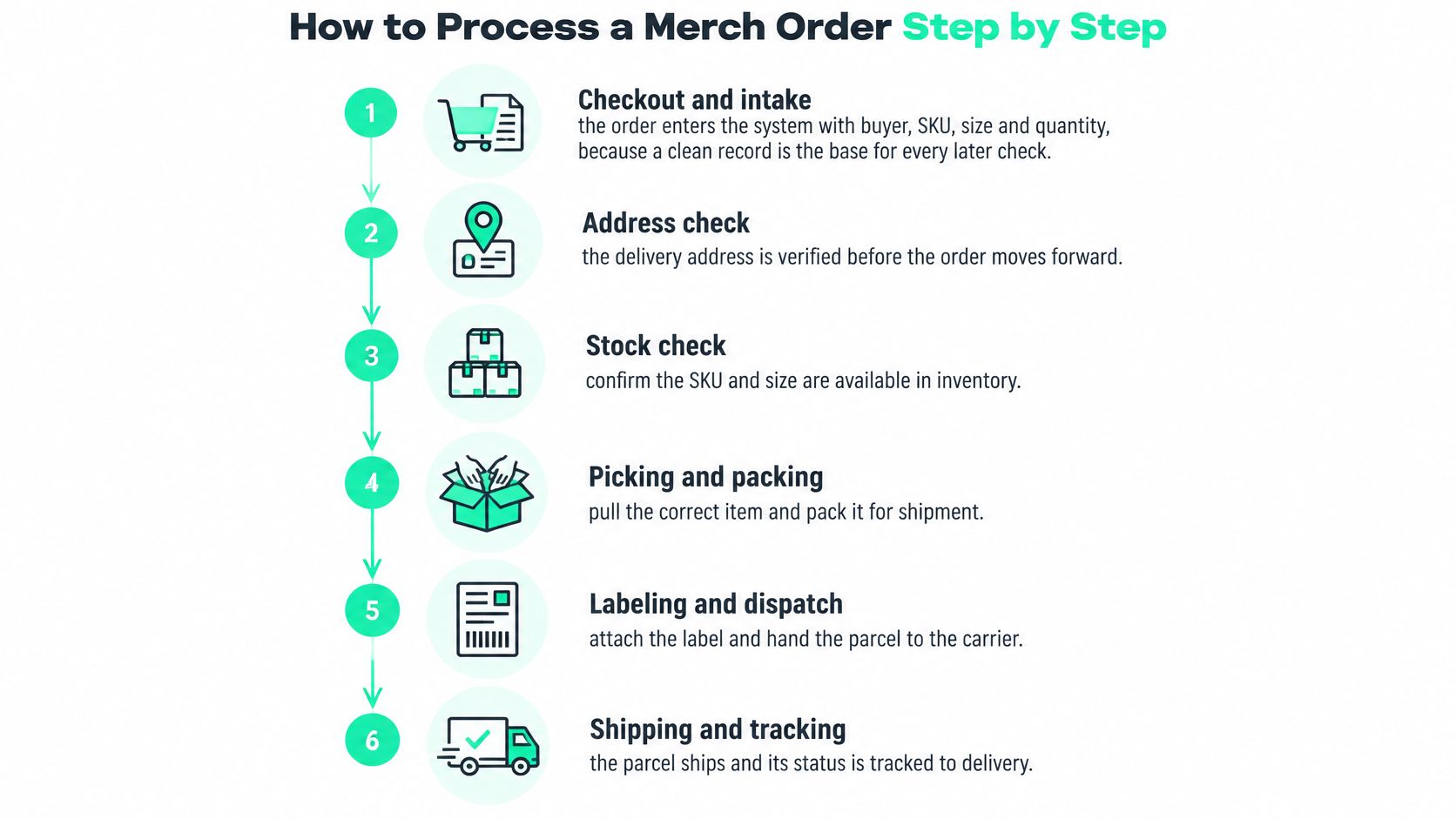
Checkout and intake. The order enters the system with the buyer, SKU, size and quantity. This record is the base for every check that follows. The common slip is a free-text size field, or a variant that maps to two SKUs, so the wrong garment enters production and nobody notices until the packing bench.
Address check. The delivery address is verified against the carrier database before the order moves forward. On a managed store, employees enter or confirm their delivery address at checkout and it's verified against that database before the order enters production, which catches a mistyped street while fixing it still costs nothing. Skip it and you pay for a failed attempt plus a reshipment.
Allowance check. Credits or budget limits are applied to the order, and any overage is handled by the policy agreed before launch. When employees redeem credits from a catalog, checkout, production and fulfillment run as one flow, so the budget check has to sit at the point of redemption rather than in a spreadsheet afterwards. An unchecked allowance produces a surprise invoice, not a surprise parcel.
Release. On-demand items go straight to production while stocked items go to picking, so the two paths split here. Getting this wrong is subtle: a stocked item sent to a production queue waits weeks for something that was already on a shelf.
Quality check. A sample or a scan confirms print and size accuracy before packing. A mislabelled size gets caught here, and it's the last cheap moment to catch one. After the parcel leaves, the same error becomes a return with freight attached.
Dispatch. The order moves to packing with a tracking reference attached to the order record, not just to a label.
What a clean order looks like at dispatch
One tracking reference, a verified address, and a size that matches what the buyer chose. If any of those three is missing, the order isn't ready, no matter what the warehouse management system says.
The steps look like administration. They're really the cheapest quality control in the whole chain, because each one converts a problem into a correction while the order is still in your hands.
Fulfillment Metrics That Show Whether Orders Ship Right
An average is a comfort, not a control. A single global number hides the difference between a steady best seller and a personalized item that ships to a country with a difficult last mile. Segment the numbers by product type, destination and order channel, then compare each segment against a real benchmark.
Benchmark data from the Aberdeen and Infor warehouse productivity study separates ordinary operations from strong ones on three measures. The same benchmark records sustained productivity gains of roughly 5 to 10% in warehouse departments after labor-management software went in, which is the useful part: measurement often pays for itself before anyone adds headcount.
| Metric | Typical Operation | High-Performing Operation | What a Miss Signals |
|---|---|---|---|
| Order-picking accuracy | 90-96% | 99%+ | Picking errors and replacement freight |
| On-time-and-complete shipment rate | 90-96% | 97%+ | Late kits missing onboarding dates |
| Order-to-ship cycle time | About 2-3 days | Same day or faster | Release queue or packing bottleneck |
The chain between a miss and a cost is direct. Every picking error creates rework, replacement freight and a customer-service contact, and it spends brand goodwill on an apology. A slow release-to-ship time carries a different cost: onboarding kits, event merchandise and recognition gifts arrive after the date that gave them meaning, which turns a gift into an awkward question.
Controls that move the numbers
- Scan confirmation at four points. Barcode scans at receiving, storage, picking and packing mean an item can't move without a record. The scan is what turns a discrepancy into a traceable event.
- Exception queues for SKU and quantity mismatches. Route them to a named owner with a decision, not into a general inbox.
- Accuracy reported by order type. Single-item, multi-item and personalized orders fail differently, and a blended number hides the one that's struggling.
Set a monthly routine: pull each segment, compare it against the typical and high-performing ranges in the table, and pick the one segment with the widest gap. Fix that before widening the dashboard.
Choosing Between Home, Office and Pickup Delivery
A parcel can be scanned, sorted and delivered, then still fail the person who needed it. A kit sent to a home where nobody can receive it may close as a successful shipment and still miss onboarding. Delivery choice works like the last baton change in a relay race. The earlier legs can be fast, but the handover has to land with someone who can take it.
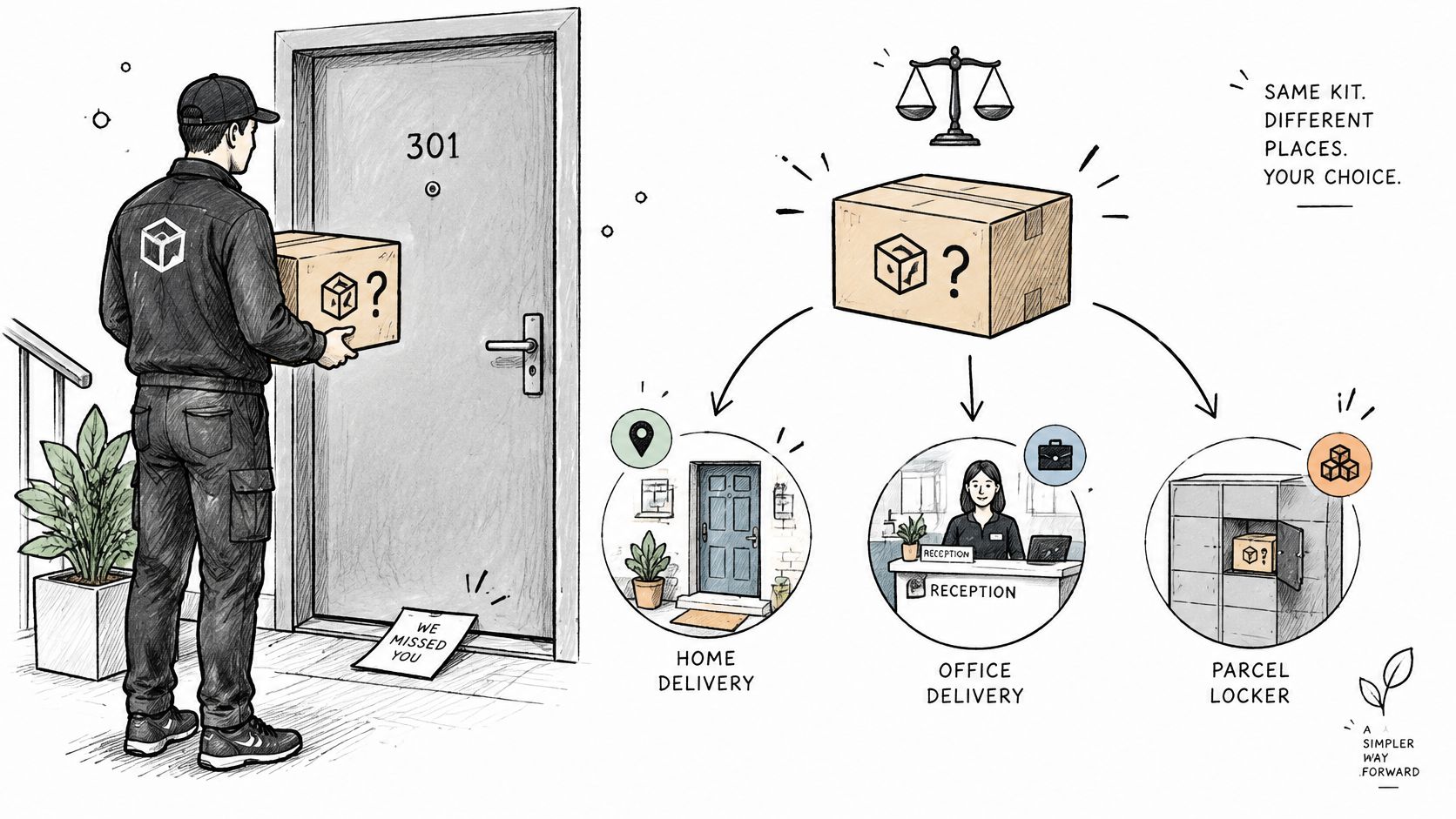
The option matters because it decides whether a recipient can receive the parcel privately and conveniently. DHL's global e-commerce trends research puts numbers around that preference: 81% of consumers abandon a purchase when their preferred delivery option is unavailable, 66% prefer returning items through parcel lockers or shops, and 72% consider sustainability when shopping. A merch program uses the same logic. If the delivery route does not fit the recipient, the order has a problem before anyone opens the box.
| Delivery Method | Best For | Trade-off | Measure First |
|---|---|---|---|
| Home delivery | Remote staff with secure reception | Fails for people who move or lack secure reception | First-attempt success |
| Workplace consolidation | Office-based teams | Needs a receiving contact on site | Receipt confirmation rate |
| Pickup point or locker | Dense cities and frequent movers | May exclude rural or mobility-limited recipients | Pickup accessibility |
| Scheduled event delivery | Attendees with known dates | Address may change after ordering | Missed-delivery rate |
| Regional bulk shipment | Multi-region offsites | Requires regional production or fulfillment | Carbon per delivered order |
Read the table as a set of trade-offs, not a ranking. Lockers can cut failed deliveries and emissions, while a rural recipient or someone with mobility constraints may have no locker within reach. A workplace drop works well when a receiving contact is present and informed. It breaks down when the office moves floors and nobody updates that contact. Home delivery feels simple for remote staff with secure reception, then struggles when address details are stale or no one can accept the parcel.
Address changes deserve a general rule: a recipient who relocates mid-program will not receive the parcel if the confirmation email still points at the old address. In a managed store, the clean pattern is to have employees enter or confirm their delivery address at checkout, then verify it against the carrier database before the order enters production. That puts the address decision before production, where changes are cheaper and easier to handle.
Storage choices also travel into delivery. A program that produces on demand and makes only what is ordered avoids warehoused dead stock. For multi-region offsites, FLYP produces regionally rather than routing every kit through one warehouse, avoiding the bulk-shipping carbon cost and duties that routing adds. Delivery method, production location and returns path are one chain, not three separate choices.
Measure the result with first-attempt success, missed-delivery rate, pickup accessibility, carbon per delivered order, and participation by geography. A method that wins on average transit time can still lose on every one of those. Pair that measurement with planned reverse flow, since interstate moving advice for Sydney families can inform relocation planning around address changes, while a merch program still needs its own returns route for parcels that cannot be delivered.
Carrier Handoff and Tracking
The packed order leaving the warehouse is a handover, not an ending. Four checks keep it traceable from that moment onward.
Handoff scan. Confirm the tracking reference is linked to the order record before the carrier collects, so a lost parcel can be traced to a stage. A parcel scanned onto a truck without an order link can be located by the carrier and still be unlocatable for you.
Tracking to the buyer. Send the reference at dispatch so the recipient can follow progress without opening a support ticket. This one email prevents most "where is my order" contacts, and it costs nothing to automate.
Delivery attempt. Record each attempt, its outcome and any recipient response. A missed attempt isn't bad luck, it's a signal that the delivery method doesn't suit that recipient, which is exactly the data the delivery decision needs.
Exception queue. Route parcels with no scan for a set period, failed attempts or address errors to a named owner who decides whether to reroute, reship or refund. Without an owner, exceptions age until the recipient complains.
A parcel without a tracked handoff can't be found, only replaced. Replacement means rebuilding the order from scratch, and for a personalized item that means reprinting it.
Carrier cost deserves the same discipline as tracking. Before comparing quotes, a Dirt Cheap Headwear shipping guide that walks through weight, zone and packaging assumptions is a useful sanity check, and the same variables drive the levers in this guide to shipping cost optimization.
Skipping these checks produces a specific kind of failure. A lost parcel without a delivery record forces the team to rebuild the whole order, and a damaged delivery becomes a return. That's the next stage, and it deserves its own design.
Designing Returns as a Reverse Flow
Returns enter the logistics chain at the doorstep. Treat them like the return leg of a relay race: the parcel still needs a handoff, a scan, a route and a final owner. DHL's research on returns trends reports that 92% of shoppers return up to 30% of their online purchases, so the reverse route affects the order experience as directly as the outbound one. Easy returns shape buying behavior, and inconvenient instructions can stop someone before they place an order.
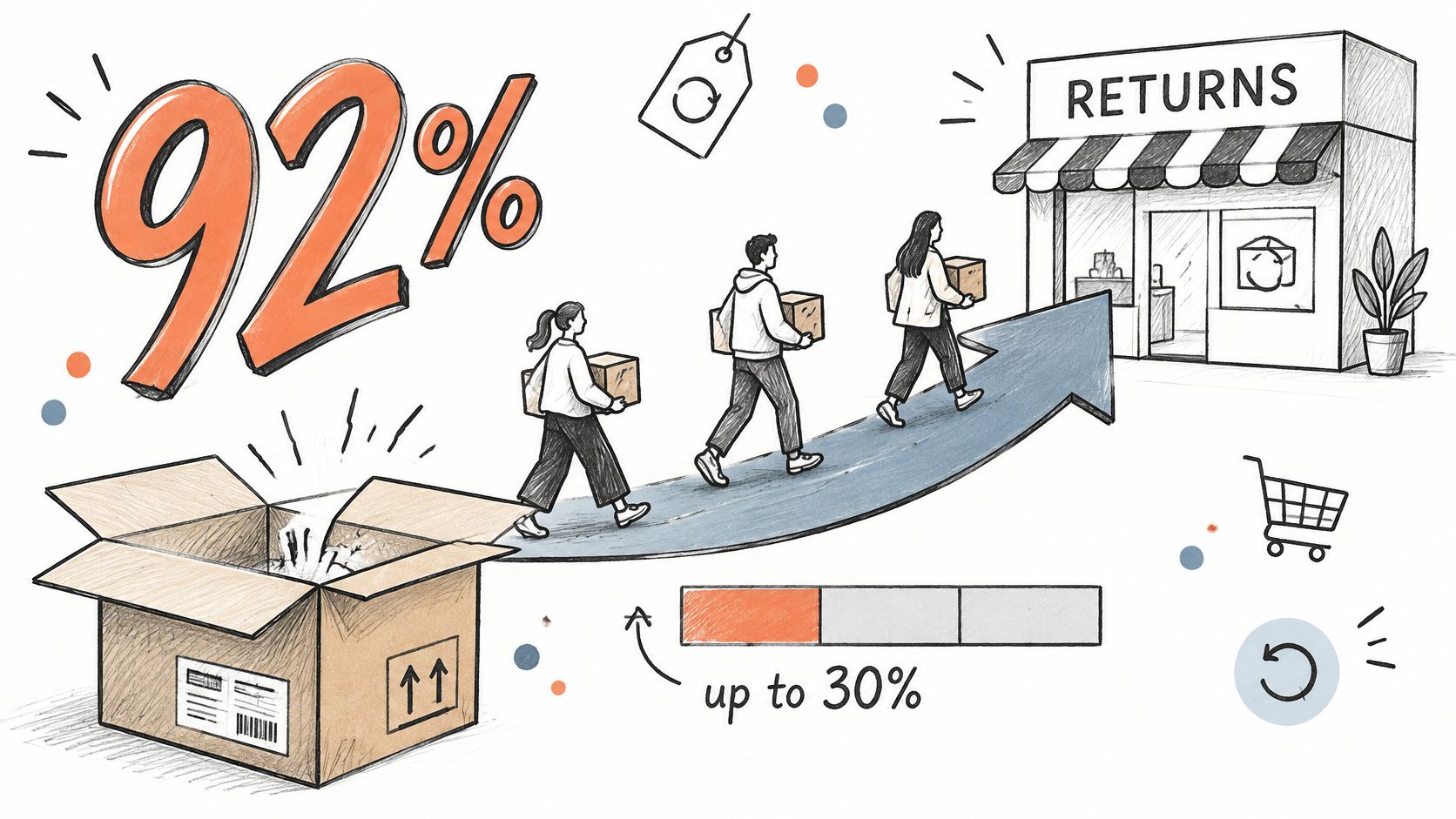
For apparel and merch, each returned unit needs authorization, transport, receipt scanning, condition grading, disposition, an inventory adjustment and often refund reconciliation. Miss one stage and value leaks. The unit either disappears from stock, or it reappears as a phantom that someone picks against even though no usable item is on the shelf.
The control that holds the chain together is a return-merchandise authorization linked to the original order and SKU. Capture reason codes for size, defect, damage or preference, then record every outcome against that authorization. The return then has a history, not just a status. That matters when the same SKU returns for different reasons in different regions, because the team can see which decision was made and why.
Disposition is the point where the reverse flow either recovers value or turns the item into cost. A practical rule should exist for each outcome, so no one has to invent a decision while a returned parcel sits on a desk.
| Return Outcome | Use When | What to Record |
|---|---|---|
| Resale | Item is undamaged and in sellable condition | Condition grade and SKU |
| Refurbishment | Minor defect can be fixed at reasonable cost | Repair cost and reason code |
| Donation | Resale is not viable but the item is usable | Partner name and quantity |
| Recycling | Material can be recovered | Material type and weight |
| Disposal | Item is unsafe or unusable after grading | Grading reason |
Reason codes turn returns into feedback for the forward flow. A cluster of size-related returns points at an inaccurate size chart rather than at the recipient. A cluster of defect returns points at print or supplier quality. Fix the chart or the production issue and the same fault stops repeating every drop.
Localize the instructions, not just the labels
Return instructions should be written per market, in the recipient's own language, and connected to the pickup or locker options recipients already use. A return route that requires a printer and a post office queue will lose people. Merchandise with a clear reverse path is easier to accept, especially when size or fit is uncertain.
A managed service has a role here because returns touch the same operational chain as the original order. FLYP handles production, fulfillment, tracking, support, returns and reprints, so a defective run can move to a reprint path instead of becoming a long email negotiation. That works like passing the baton to a named runner: the item, reason and next action stay connected.
Customers compare policies across categories. Someone reading a kilt returns and exchange policy for clarity expects the same plainness from an employer swag store. The same expectation applies to internal merch, where an overseas address or unclear window can make the process feel not worth starting. Write the return steps per market, in the recipient's own language, with the route and next action stated plainly.
Set country-specific tax, carrier and refund rules before launch. Rules decided after the first international return become manual exceptions, and manual exceptions erode both margin and trust. A fuller set of controls sits in this guide to returns management best practices.
Worked Example and Launch Checklist
Take an illustrative company of 600 people, shipping onboarding kits to new hires across three regions plus a summer event. Nothing here is a case study, and the numbers are chosen to make the chain visible.
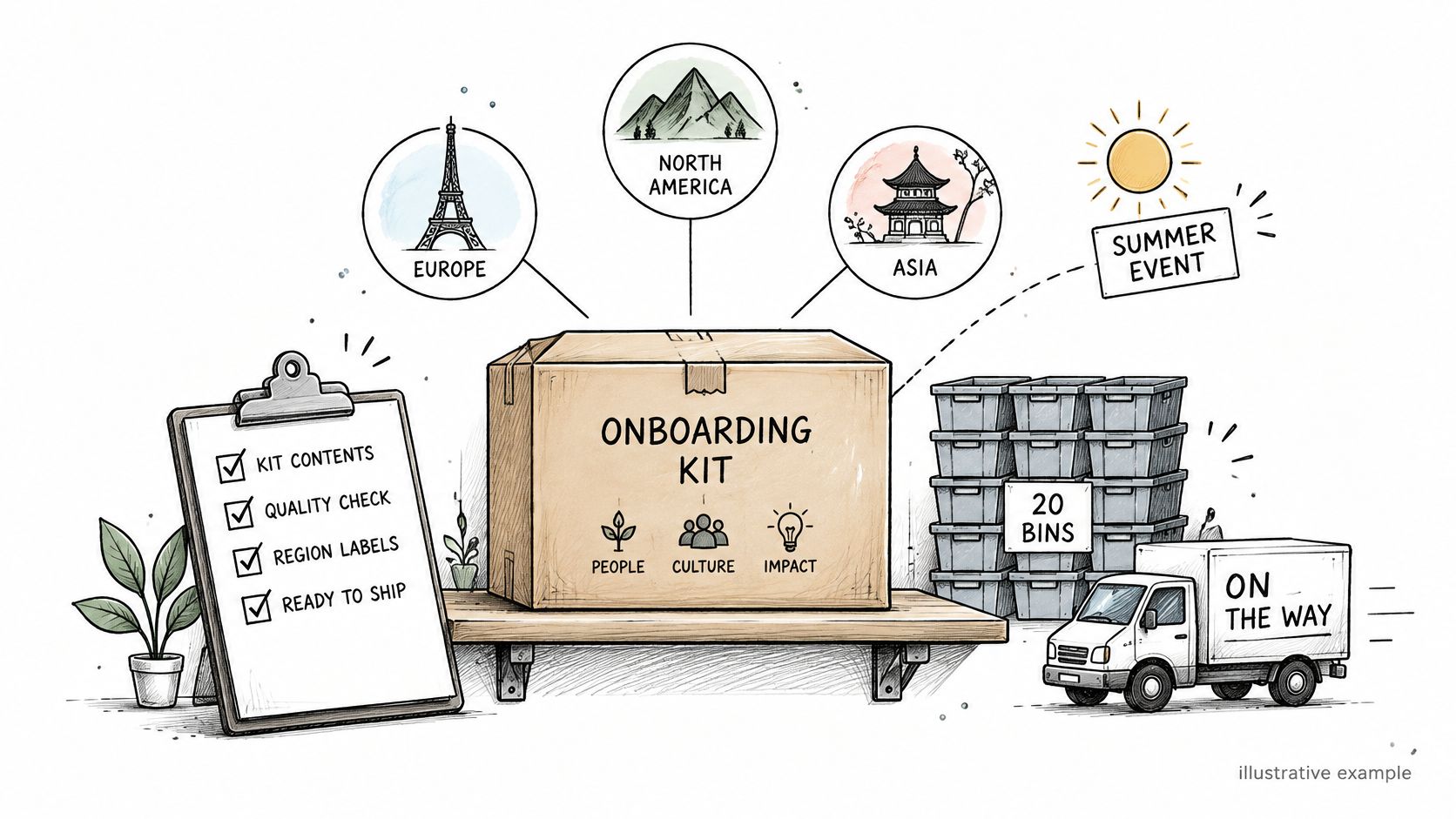
Storage. Twenty core SKUs are held in stock because new hires order them every week. Everything else, seasonal designs, extended sizes and one-off event art, is made on demand so nothing sits unsold after the season ends. That split is the hybrid model, and it works because the catalog was classified before the warehouse was booked.
Processing. Each new-hire order passes address verification, then the allowance check, then release. Orders for stocked items go to picking; on-demand items go to production. Because verification happens before release, a wrong postcode gets caught while the kit is still a record rather than a parcel.
Fulfillment. Picking and packing aim for the top band rather than the typical one, with scan confirmation at receiving, storage, picking and packing. Personalized items are measured separately, because a printed name fails differently from a blank tee.
Two cases show the chain working. An event attendee moved cities after ordering, so the scheduled delivery was rerouted to a pickup point near the new address instead of bouncing. Separately, 40 returned hoodies cited size, which pointed at the size chart rather than at the garments, and the chart was corrected before the next drop.
Event leftovers then take one of three routes: shipped forward to the next event, donated through a partner network, or listed on the internal company store for employee redemption. Deciding which route before the event ends prevents a pallet of stock from becoming an unowned problem.
Five decisions before launch
- The storage model for each SKU class. Core to stock, long-tail to order, and a reorder point plus buffer written down for each.
- The delivery method for each recipient group. Home, workplace, pickup point, scheduled event delivery or regional bulk, chosen by recipient rather than by habit.
- The metrics and benchmark ranges reviewed monthly. Picking accuracy, on-time-and-complete rate and cycle time, segmented by product, destination and channel.
- The return outcomes and reason codes. Five dispositions with a rule for each, and a named owner for grading.
- The country rules for tax, carrier and refunds. Written before the first international order, not after the first international return.
The next step is a scoping call that models the catalog, the allowance and the program budget against headcount, which is how a pilot store can be running in a brand inside three weeks. We ask for no upfront commitment and charge no warehousing fees, because the storage model is meant to be chosen on fit rather than on sunk cost.
The readiness test. If you can't say where each order goes after dispatch, and who owns it when it doesn't arrive, the setup isn't ready to launch.
FLYP LTD runs the store and logistics chain for enterprise merch programs, covering production, regional fulfillment, global shipping, tracking, support, returns and reprints under one managed service, so your team chooses the storage and delivery model instead of building it in every market. If you're planning onboarding kits, recognition drops or an event program and want the six stages mapped against your headcount before you commit, visit FLYP LTD to start a scoping conversation with our enterprise team.