Your People Ops team has approved the concept for an employee-choice store. The visual direction is clear: natural kraft packaging, restrained printing, and a tactile unboxing experience that feels more thoughtful than a standard poly mailer. Then the practical questions arrive. Which kraft format should you use? Can the same specification work for onboarding kits, event drops, and international delivery? What happens when moisture, compression, or regional production changes the finished result?
That's the challenge behind store kraft manufacturing. Kraft isn't one universal product. It's a material family used across retail packaging, shipping cartons, display components, wraps, bags, and branded merchandise programs. Each application has a different job, and a mistake in format selection can create damaged products, inconsistent branding, avoidable rework, or sustainability claims that don't hold up in use.
Table of Contents
- Introduction to Store Kraft Manufacturing for Modern Merch Programs
- What Store Kraft Manufacturing Really Means
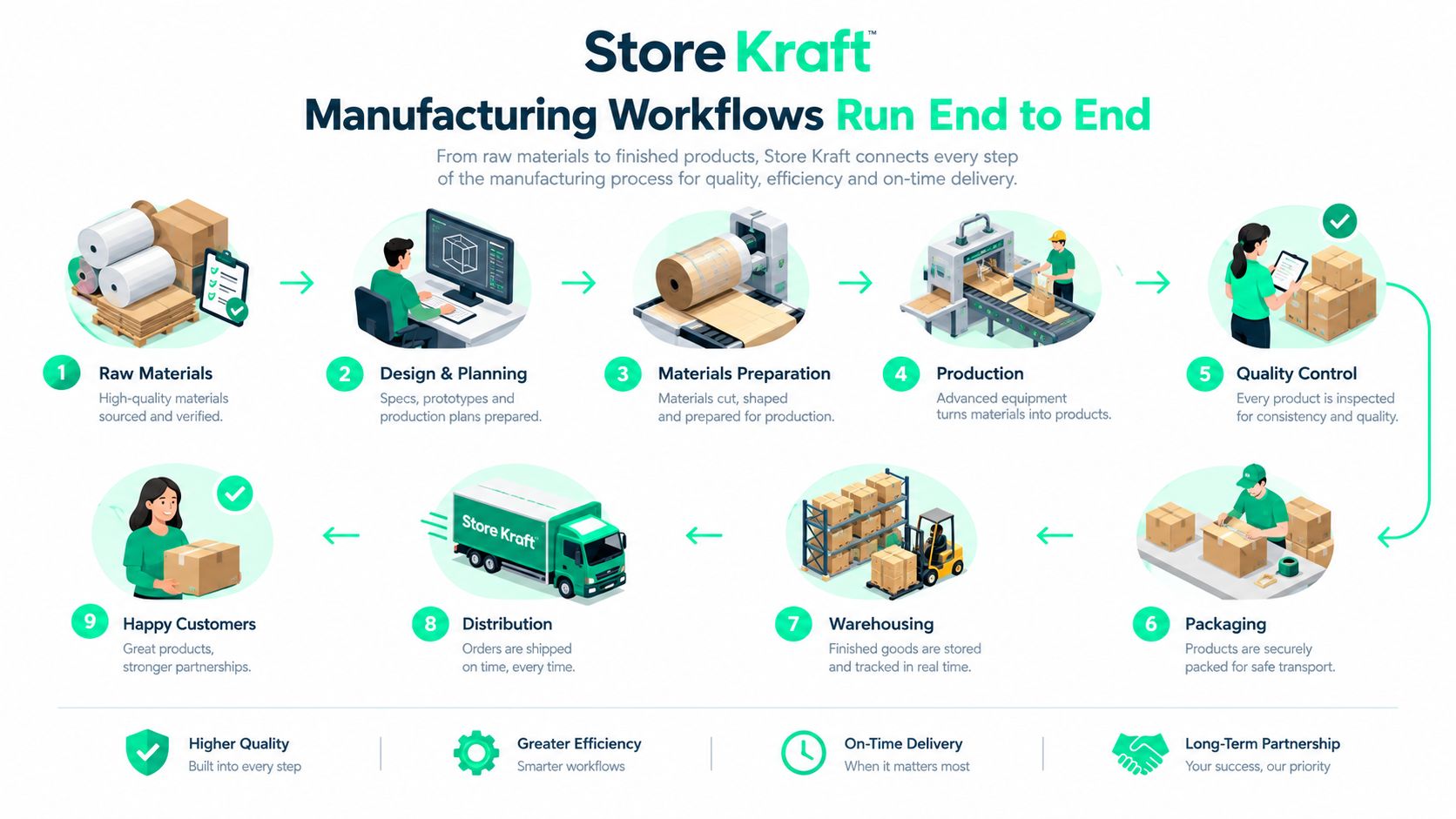
- How Store Kraft Manufacturing Workflows Run End to End
- Choosing the Right Kraft Format for Your Store Use Case
- How to Evaluate Suppliers for Enterprise Merch Programs
- Quality Control and Brand Safety Essentials That Protect Your Store
- Bringing Your Store Kraft Manufacturing Program Together
Introduction to Store Kraft Manufacturing for Modern Merch Programs
A People Ops team may approve kraft mailers for a new-hire kit, printed bags for an event, and kraft display pieces for a temporary activation. The visual language looks consistent. The production requirements are not. Each output may need a different paper grade, converting method, print control, and fulfillment plan.
That distinction matters because store kraft manufacturing draws on overlapping supply chains, not one universal kraft market. Corrugated liners prioritize structural performance, while lightweight wraps and branded bags prioritize handling, appearance, and finishing. Display components need stable dimensions and clean cuts. E-commerce shippers need compression resistance, dependable closures, and protection during delivery. Calling all of these “kraft packaging” conceals choices that affect cost, consistency, and brand risk.
Kraft can strengthen a store experience when the format matches the job. It can also create failure risk when a natural-paper look is treated as the specification. Moisture, compression, ink coverage, folds, handles, and storage conditions can change how the finished item performs.
The surrounding apparel and merchandising industries show why supplier discipline matters. One market summary estimates apparel manufacturing at about $507.9 billion in 2025, while broader apparel retail is estimated at roughly $1.9 trillion in 2026. The gap reflects value created after production through merchandising, branding, distribution, and customer experience. These market estimates and manufacturing figures also identify China, Bangladesh, and Vietnam as major production hubs within a supplier base concentrated in Asia.
Practical rule: Treat the kraft aesthetic as a brand direction, then specify the material, format, performance requirements, and inspection standards separately.
A reliable store program must serve People Ops, marketing, events, procurement, and merch operators beyond a single print job. The work ahead examines the material, production workflow, format choices, supplier evaluation, and quality controls. The goal is practical: use kraft where it improves the store experience, and flag applications where it may compromise delivery, presentation, or brand consistency.
What Store Kraft Manufacturing Really Means
Start with a useful distinction. Kraft is a material choice. Store kraft manufacturing is the coordinated process of turning that material into branded products and store assets.
Think of kraft as an ingredient rather than a finished recipe. Flour can become bread, pastry, or noodles, but the ingredient alone doesn't tell you the final use. Kraft paper can become a shopping bag, wrap, carton liner, display panel, mailer, product insert, or fixture component. The fiber may be related, but the manufacturing route and performance expectations differ.
From paper to store experience
The first step is identifying the job the finished item must perform.
A branded onboarding box may need clean print, a premium hand feel, and enough stiffness to present a shirt, notebook, or bottle attractively. A shipping carton needs stronger resistance to compression and scuffing. A retail bag needs dependable seams and handles. A display element may need accurate cutting, fold memory, and stable dimensions under store lighting and handling.
Natural kraft paper commonly uses a high proportion of softwood fiber because longer fibers support tensile and tear resistance through stronger inter-fiber bonding. One technical profile specifies 50 to 80% softwood kraft pulp blended with 20 to 50% hardwood kraft pulp, with different freeness ranges used to balance strength, drainage, and formation quality. The technical profile for natural kraft paper manufacturing also places common packaging grades in the 60 to 120 g/m² basis-weight range.
The paper mill controls furnish and sheet formation. The converter then cuts, folds, glues, prints, laminates, scores, or otherwise transforms the sheet. The merch operator still has to define the artwork, pack-out, destination, inspection standard, and replenishment model.
Why the store context changes the decision
A store program creates value beyond the paper itself. The enterprise selects products, applies its identity, manages assortment, fulfills orders, and creates a consistent experience across locations and employee groups. That's why manufacturing rarely sits inside a single plant. It usually depends on a network of mills, converters, printers, apparel suppliers, agents, fulfillment partners, and carriers.
The broader apparel ecosystem shows the same pattern. Reporting on the sector describes more than 100 billion garments produced annually by the early 2020s, a global market valued at around $1.5 trillion in 2022, and a fashion and textile sector employing about 430 million people worldwide. The apparel and merchandise industry overview connects that scale with specialized factories, standardized blanks, repeatable specifications, and international logistics.
For a People Ops lead, the practical takeaway is that kraft shouldn't be purchased as a visual shortcut. Define the store use case first, then select the paper, construction, print method, and supplier network that can deliver it consistently.
How Store Kraft Manufacturing Workflows Run End to End
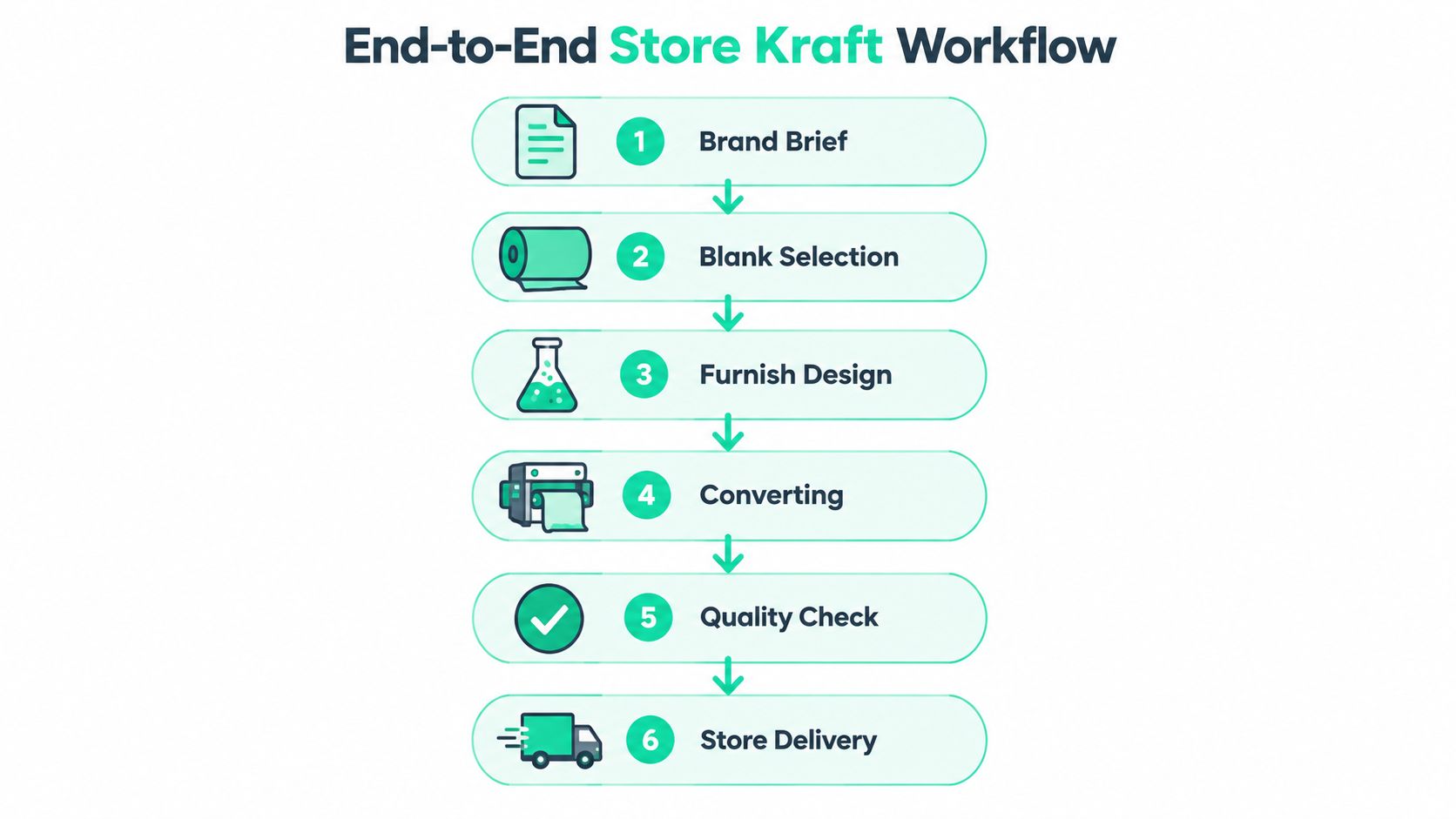
A dependable workflow starts before anyone orders paper. The brand team defines the purpose, audience, dimensions, artwork, delivery locations, expected handling conditions, and acceptable variation. A supplier should be able to turn that brief into a controlled specification, not just a visual sample.
The connected production chain
Brand brief: Record the logo treatment, color references, pack contents, opening experience, dimensions, and intended environment. An event bag and a shipped onboarding kit shouldn't share assumptions merely because both use kraft.
Blank or sheet selection: The manufacturer selects a paper grade or board construction suitable for the load, print process, folding pattern, and destination. The cheapest sheet can become expensive if it causes tearing, crushing, or slow manual packing.
Furnish design: The mill or paper supplier manages the fiber blend, refining, drainage, formation, and moisture profile. This stage affects how the sheet behaves later, including its strength, surface, porosity, and print response.
Converting: A converter cuts, scores, folds, glues, forms handles, or assembles the component. Tolerances matter here because a small dimensional difference can affect carton closure, insert fit, or display alignment.
Printing and finishing: The supplier applies brand artwork using a compatible process. Uncoated kraft can produce a different color appearance from coated stock, so your approval process should judge the printed result on the actual material, not only on a digital proof.
Quality inspection: Incoming material, in-process construction, print output, and finished pack-out each need defined checks. A final visual glance cannot replace a measurable acceptance standard.
Packing and kitting: The manufacturer or fulfillment partner groups the right items, inserts, labels, and instructions. Pack-out errors can undermine an otherwise successful manufacturing run.
Freight and regional handoff: The program moves through carriers, warehouses, customs processes, or regional partners. A global store needs clear ownership at every handoff.
Store delivery: The finished item reaches an employee, event team, office, or customer. Feedback from actual use should inform the next production cycle.
Where programs lose control
Delays often appear at handoffs. Artwork changes after cutting begins. A regional supplier substitutes a board grade. A fulfillment partner receives cartons without clear pack-out instructions. A carrier exposes unprotected kraft packaging to damp conditions. Each issue may look minor, but the employee sees one finished brand experience.
Managed merch programs reduce this risk by keeping the specification, artwork, product data, inspection rules, and fulfillment instructions in one operating system. Teams reviewing their broader merch process may also benefit from documenting how a merchandise management system handles product data, approvals, inventory, and order routing.
The same principle applies to product standards. If your store includes bottles, bags, apparel, or other physical goods, a resource on how gear standards protect users can help frame the difference between a design preference and a functional requirement. Your supplier should explain not only what it will make, but how it will verify that the item performs in its intended setting.
Choosing the Right Kraft Format for Your Store Use Case
The right kraft format depends on the load, journey, handling environment, and visual role. A thin wrap that looks excellent around an item in an office may fail after international shipping. A heavy liner that protects a carton may be unnecessary for a hand-delivered event kit and may reduce print flexibility.
Match the format to the job
Lightweight grades suit bags, wraps, tissue-like inserts, and simple presentation layers when the contents don't place high stress on the material. Heavier grades and liner constructions make more sense for shipping cartons, load-bearing packaging, and structural display components. Basis weight is only one input. Burst strength, tensile strength, porosity, moisture, thickness, and converting behavior all shape the result.
A technical specification for kraft paper lists 60 to 100 g/m² grades with thickness around 85 to 130 µm, while burst strength and tensile strength rise across the stated grade range. The same source specifies moisture at 6±1%, a control that matters because moisture can change stiffness, dimensional stability, and print behavior. The kraft paper specification also describes heavier grades up to 300 g/m², with higher compression-related performance for more demanding packaging uses.
| Kraft Format | Typical Use in Store Program | Key Property Focus | Trade-off to Discuss With Supplier |
|---|---|---|---|
| Lightweight natural kraft | Event bags, wraps, inserts, simple onboarding presentation | Tear resistance, print clarity, fold behavior | Lower material use can mean less protection and lower resistance to rough handling |
| Midweight converted kraft | Branded bags, sleeves, small kits, retail presentation | Tensile strength, seam integrity, moisture control | Stronger construction may add cost and affect folding or handle design |
| Corrugated kraft liner | E-commerce shippers, replenishment cartons, warehouse distribution | Compression resistance, burst performance, ply bonding | Better protection can increase shipping volume and reduce the tactile simplicity of the pack |
| Heavy board or structural kraft | Display panels, fixtures, rigid inserts, signage | Flatness, scoring, dimensional stability, scuff resistance | Structural formats need more complex cutting, assembly, and storage planning |
Use examples to expose hidden requirements
An onboarding kit delivered by hand can prioritize presentation, easy opening, and clean branding. The same kit sent through a parcel network needs edge protection, closure strength, and a design that stays intact when stacked or handled repeatedly.
For practical reference, a supplier or buyer can also review guidance on where to get cardboard boxes for posting, particularly when comparing postal carton construction and closure expectations. The point isn't to copy a consumer box specification. It's to ask better questions about the journey the package must survive.
Ask suppliers to recommend a format against a written use case. Require them to explain the failure mode they're preventing, the test or inspection that supports the recommendation, and the compromise they're making on printability, weight, storage, or cost. Kraft formats aren't interchangeable just because they share a brown surface.
How to Evaluate Suppliers for Enterprise Merch Programs
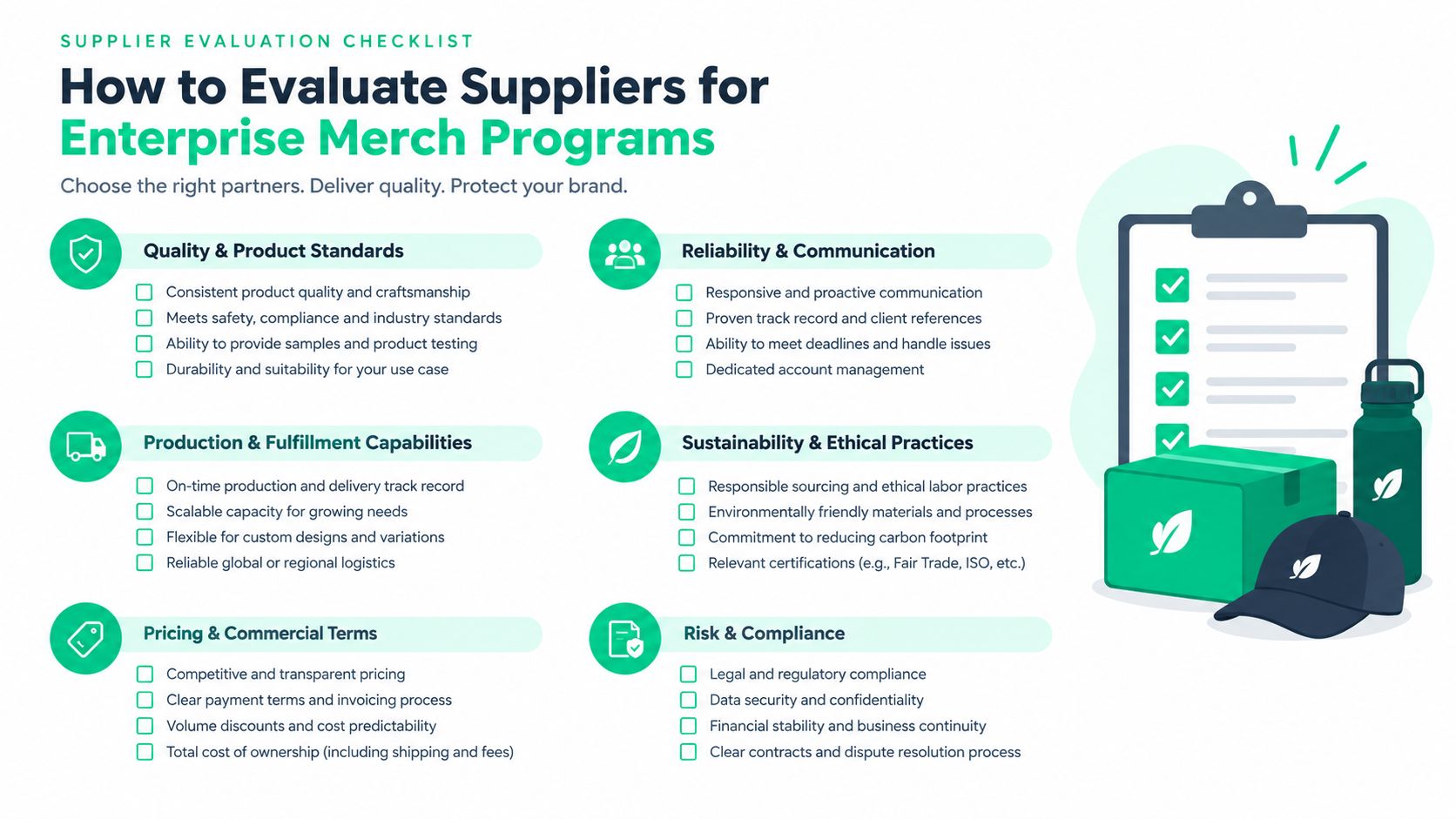
A polished sample can hide operational weaknesses. An enterprise store may need retail packaging, display pieces, and branded merch from overlapping supply chains, so supplier evaluation must cover more than paper appearance. Review sourcing geography, documentation, production ownership, quality systems, fulfillment, and communication. A supplier that produces an attractive prototype may still struggle with regional consistency or replenishment.
Apparel and merch production often depends on distributed networks rather than one vertically integrated facility. That structure can provide capacity and regional options, but it also creates handoff risk. Each supplier should show who controls specifications, approves substitutions, and owns the finished experience.
A practical supplier matrix
| Evaluation Area | What to Verify | Brand Risk if Missing |
|---|---|---|
| Geographic strategy | Primary and backup production locations, transit assumptions, regional fulfillment options | A local disruption can interrupt the store or create uneven delivery experiences |
| Specification control | Master files, approved samples, revision history, tolerance rules | Different regions may produce visibly different bags, cartons, or inserts |
| Fiber handling | Recycled and virgin material sources, blend documentation, substitution rules | Sustainability language may not match the material actually delivered |
| Compliance | Factory documentation, labor expectations, restricted-material controls, audit access | Procurement or legal review may stop the program after launch |
| Quality assurance | Incoming checks, in-process inspections, final sampling, defect escalation | Scuffing, color drift, weak seams, or crushed cartons reach employees |
| Logistics resilience | Warehousing, pack-out ownership, customs support, returns, carrier handoffs | The manufacturing partner may blame the carrier while your team manages complaints |
| Reporting | Orders, defects, stock position, regional performance, sustainability records | Program owners cannot identify recurring failures or budget leakage |
Questions that belong in the RFP
Ask who owns the specification after approval and how the supplier handles a paper substitution, revised logo, or changed kit component. Request physical samples made through the proposed production process, not only a digitally printed mockup. The sample should reveal how the selected kraft format behaves through cutting, folding, assembly, packing, and delivery.
Require the partner to separate creative approval from manufacturing approval. A design can match brand guidelines while remaining unsuitable for the stock, fold pattern, print surface, or delivery route. A supplier that serves retail packaging may not have the same controls for display construction or branded apparel, so ask for evidence tied to each supply chain.
Teams defining responsibilities among brand owners, factories, and service providers can consult manufacturing partnerships as a complementary reference.
Decision test: Choose the supplier that can show how it prevents variation, not only the supplier that offers the lowest quote.
Score resilience alongside price. A clear substitute-material policy, documented inspection plan, and regional contingency may protect the program more effectively than a small unit-cost reduction. Also confirm who owns inventory decisions, exception handling, and communication when a shipment or component falls outside the approved specification.
Quality Control and Brand Safety Essentials That Protect Your Store
Quality control translates technical paper behavior into a visible employee or customer experience. Grammage affects sheet mass and handling. Tensile strength influences whether a bag or seam survives pulling. Burst strength matters when contents press outward. Porosity affects how the sheet interacts with ink, coatings, adhesives, and moisture.
A supplier should define which properties it checks at incoming inspection and which it verifies on the finished item. The goal isn't to collect laboratory data for its own sake. The goal is to connect each measurement with a failure your team wants to prevent.
Connect the specification to the failure
A useful control plan might include:
- Material identity: Confirm the approved grade, basis weight, fiber declaration, and moisture condition before converting starts.
- Construction: Inspect dimensions, fold lines, glue coverage, handles, seams, closures, and fit against the approved sample.
- Print appearance: Compare color, registration, logo placement, contrast, and surface response under the lighting used by employees or customers.
- Handling simulation: Test stacking, opening, carrying, packing, and ordinary exposure to the environment where the item will be used.
- Pack-out accuracy: Verify that each kit contains the right products, inserts, labels, and regional information.
Recycled and virgin kraft can serve different program goals, but neither should be selected through a slogan alone. The supplier needs to explain how the chosen fiber affects strength, surface appearance, print consistency, odor, moisture response, and availability. If your sustainability claim says an item uses recycled content, retain documentation that supports the claim and define what happens if the approved source becomes unavailable.
Protect claims in real conditions
Kraft packaging can look sustainable at the design stage and still fail in a warehouse, food-service environment, retail stockroom, or parcel network. Moisture can soften material. Friction can scuff printed surfaces. Compression can deform cartons. A coating or barrier can improve durability but may affect recyclability or complicate disposal instructions.
The operational answer is to approve the complete product, not just the raw sheet. A quality assurance workflow should assign owners, record defects, preserve approved samples, and set escalation rules. Teams that want a broader process reference can review quality assurance processes while building their own inspection and release controls.
Brand safety depends on the finished experience. A sustainability message remains credible only when the package performs as promised and the material description matches what the supplier delivered.
Bringing Your Store Kraft Manufacturing Program Together
A successful store kraft program follows a clear sequence:
- Define the store moment, whether it's onboarding, recognition, an event, retail presentation, or e-commerce delivery.
- Separate the visual brief from the performance specification.
- Match each use case with a kraft format, construction, and finishing method.
- Require suppliers to document materials, substitutions, production ownership, inspection, and logistics.
- Approve physical production samples and pack-out instructions before wider release.
- Pilot with a limited assortment or region, then use defect and user feedback to refine the specification.
- Scale through controlled artwork, consistent product data, and clear regional responsibilities.
Kraft packaging is evolving alongside interest in biodegradable materials, moisture-resistant treatments, and AI-assisted packaging optimization. Recent kraft packaging coverage frames those developments alongside raw-material volatility and standardization challenges. For enterprise merch teams, the important question isn't whether kraft is fashionable. It's whether the selected format improves the experience without creating hidden failure points.
A managed merch backbone can help keep brand inputs, product selection, manufacturing, fulfillment, and reporting connected. FLYP LTD offers made-to-order branded merchandise with production, worldwide fulfillment, customer service, and returns managed as part of the platform, which can support programs that need controlled execution without holding every item in inventory.
FLYP LTD helps enterprise teams run branded onboarding kits, recognition moments, event drops, and employee-choice stores with design, manufacturing, fulfillment, logistics, QA, and reporting coordinated in one service. Visit FLYP LTD to discuss how a managed merch program can turn your kraft packaging direction into a consistent store experience.