“Just choose organic cotton” is bad procurement advice. A preferred fiber doesn't rescue an unwanted hoodie, an inaccurate size curve, or a warehouse full of event shirts nobody requested. Sustainable company swag starts with proving demand and verifying claims, not browsing a supplier's green collection.
Buy garments you can defend with evidence, distribute them to people who want them, and decide what happens when they come back. Anything less is a branding exercise with a waste problem attached.
Table of Contents
- Why Most Sustainable Swag Programs Are Built on Sand
- Writing the LCA-Style Brief Before You Talk to Suppliers
- Fiber and Material Choices That Actually Hold Up
- Vetting Suppliers Beyond the Green Badge
- Demand Accuracy Is the Hidden Sustainability Lever
- Closing the Loop on Returns, Leftovers, and End of Life
- A 90-Day Rollout Plan for Your First Sustainable Swag Program
Why Most Sustainable Swag Programs Are Built on Sand
The wrong starting question is, “Which fabric is sustainable?” Ask instead, “What evidence would justify producing this item at all?” That forces the budget owner to confront speculative quantities, unsuitable fits, and designs employees won't wear outside work.
The scale of textile waste makes that distinction important. Approximately 92 million tonnes of textile waste are generated annually; clothing production doubled between 2000 and 2015, while average garment use duration fell by 36%, according to the Geneva Environment Network's sustainable fashion overview. Buying a preferred material without addressing useful life misses the central procurement problem.
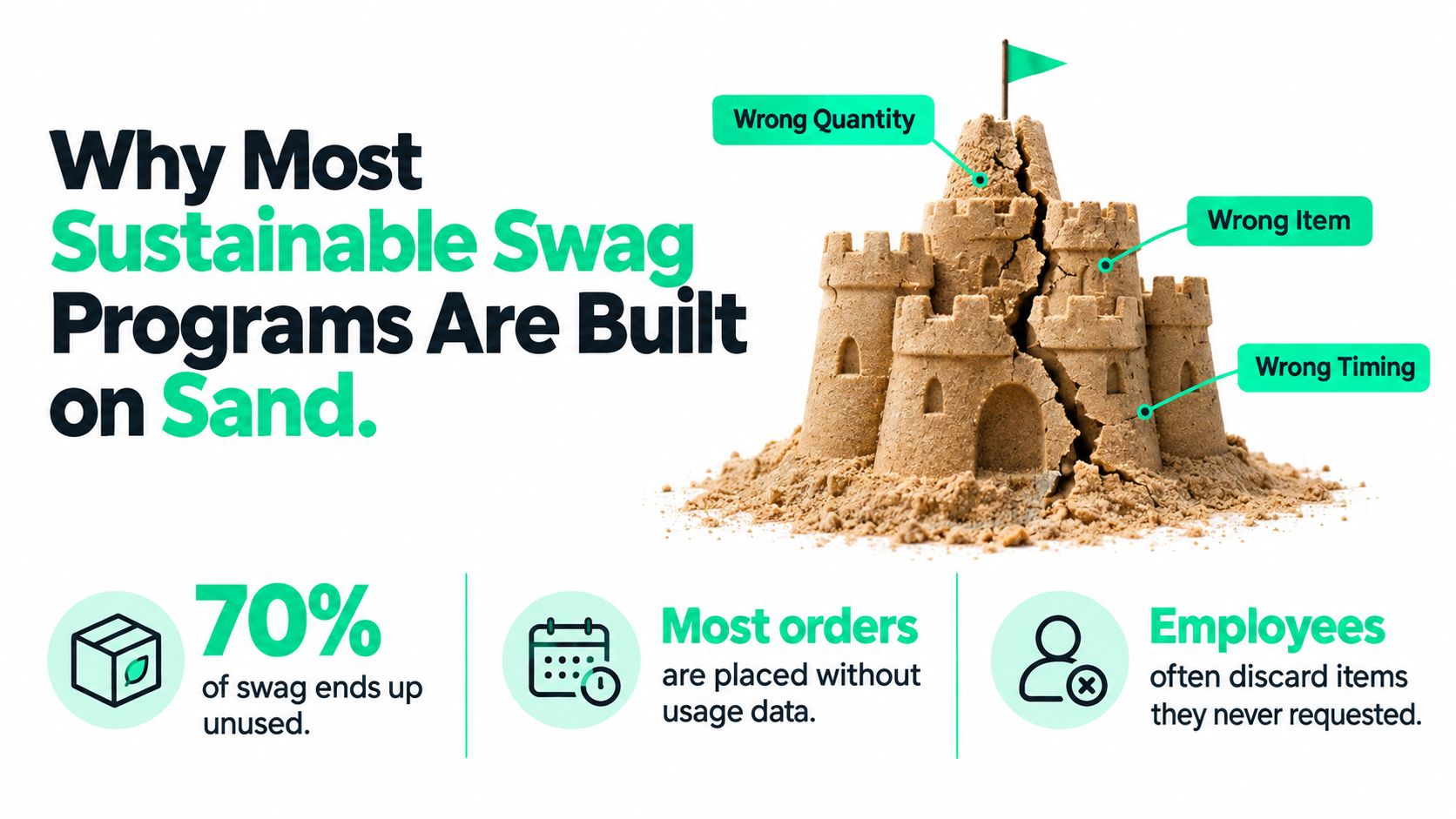
Treat the graphic's logistical themes as a checklist, not its unused-swag percentage as an established benchmark. Your own distribution records should determine whether your program works.
Make evidence a purchasing requirement
In June 2025, the European Commission endorsed Product Environmental Footprint Category Rules for apparel and footwear, covering raw materials, production, logistics, use, and end of life without favoring a particular fiber, as explained in its announcement on measuring clothing and footwear impacts. That's a useful procurement lens, not permission to claim every garment must already carry a particular footprint label.
Separate textile collection is another operational signal, addressed below. Together, these developments make vague environmental language a poor foundation for a global purchasing policy.
Your next approval form should ask for:
- Demand evidence: Who requested the product, and what recipient need does it meet?
- Product evidence: Which claims apply to the finished, decorated item?
- Operating ownership: Who manages exchanges, dormant stock, and final disposition?
- Measurement: What will you record after distribution, rather than at purchase?
Buying rule: A sustainability claim should change what procurement can verify, not merely what marketing can print.
Don't turn this into an impossible requirement for perfect information. Allow documented assumptions where primary data isn't available, but make the uncertainty visible. A supplier who identifies a data gap is more useful than one who fills it with an unexplained eco badge.
Writing the LCA-Style Brief Before You Talk to Suppliers
Send the evidence request with the quotation request. If you wait until samples arrive, your team may already be attached to a garment whose environmental claims can't be compared with anything else.
A functional unit defines the service you're buying. For apparel, use an item worn a specified number of times, rather than an item sitting in a delivery box. Define the system boundary alongside it, covering the processes included in the assessment.
Build a usable evidence sheet
The International Labour Organization's apparel life-cycle assessment guidance identifies functional units and system boundaries as starting points and discusses inventory, impact assessment, interpretation, and use-phase assumptions. Its illustrative functional unit of one T-shirt worn 30 times gives procurement a practical basis for comparison.
Require the following fields for every shortlisted SKU:
| Evidence field | What the supplier should provide |
|---|---|
| Product identity | Exact style, size basis, garment weight, and fiber composition |
| Manufacturing | Production facilities, energy consumption, and energy mix |
| Processing and decoration | Dyeing, finishing, printing, or embroidery assumptions |
| Packaging | Material types and packaging mass |
| Transport | Shipment origin, destination, distance assumptions, and mode |
| Employee use | Expected wears, washing, drying, ironing, and care instructions |
| Final treatment | Reuse, recycling, or disposal assumptions |
| Methodology | Data sources, emission factors, exclusions, and uncertainty |
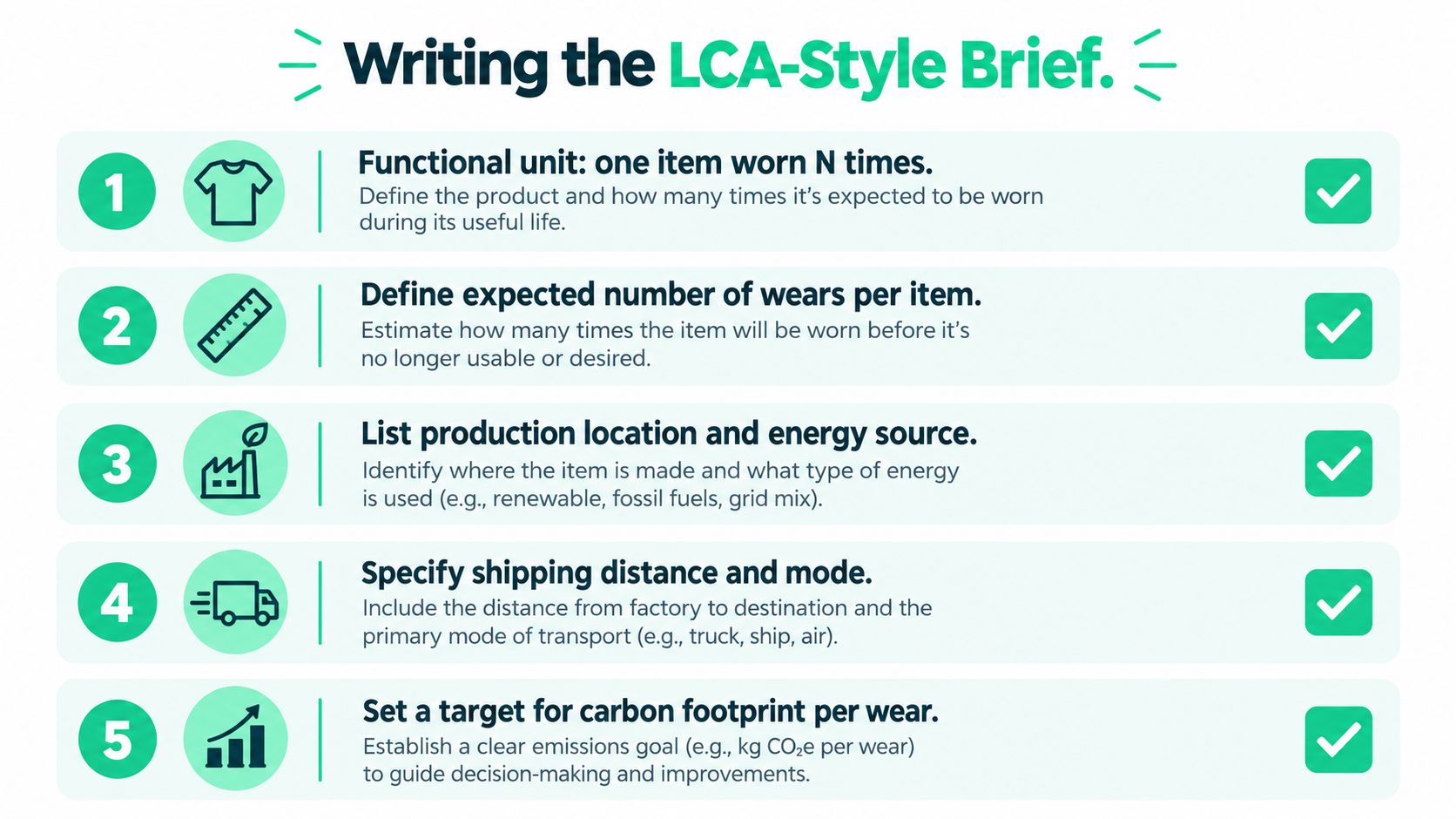
Compare the service, not just the garment
For the T-shirt example, calculate each included activity's impact by multiplying measured activity by the appropriate factor. Sum production, decoration, packaging, transport, care, and final treatment, then divide by the defined wears. Keep the same boundary and assumptions when assessing the alternative shirt.
Impact per wear = total assessed life-cycle impact ÷ expected useful wears.
Don't insert an invented factory footprint just to complete the spreadsheet. Mark missing data, distinguish estimates from measurements, and ask whether the purchasing decision changes under different lifetime or care assumptions.
Keep environmental indicators separate, too. A carbon figure doesn't answer a water-impact question, and neither replaces a durability assessment.
This is an LCA-style procurement brief, not automatically a complete or independently verified LCA. Use it to establish comparable evidence and identify where specialist assessment is necessary. Reject an apparently precise ranking if suppliers have excluded different processes or assumed different garment lifetimes.
Fiber and Material Choices That Actually Hold Up
There's no defensible universal winner among cotton, polyester, hemp, linen, and regenerated cellulose. Rank finished garments for a defined job, not fibers in isolation.
Published textile LCAs show that results depend on farming, processing, energy mix, garment weight, use behavior, and end-of-life assumptions, as discussed in this review of textile life-cycle assessment variables. That variability is precisely why a blanket water, energy, or durability ranking would mislead buyers.
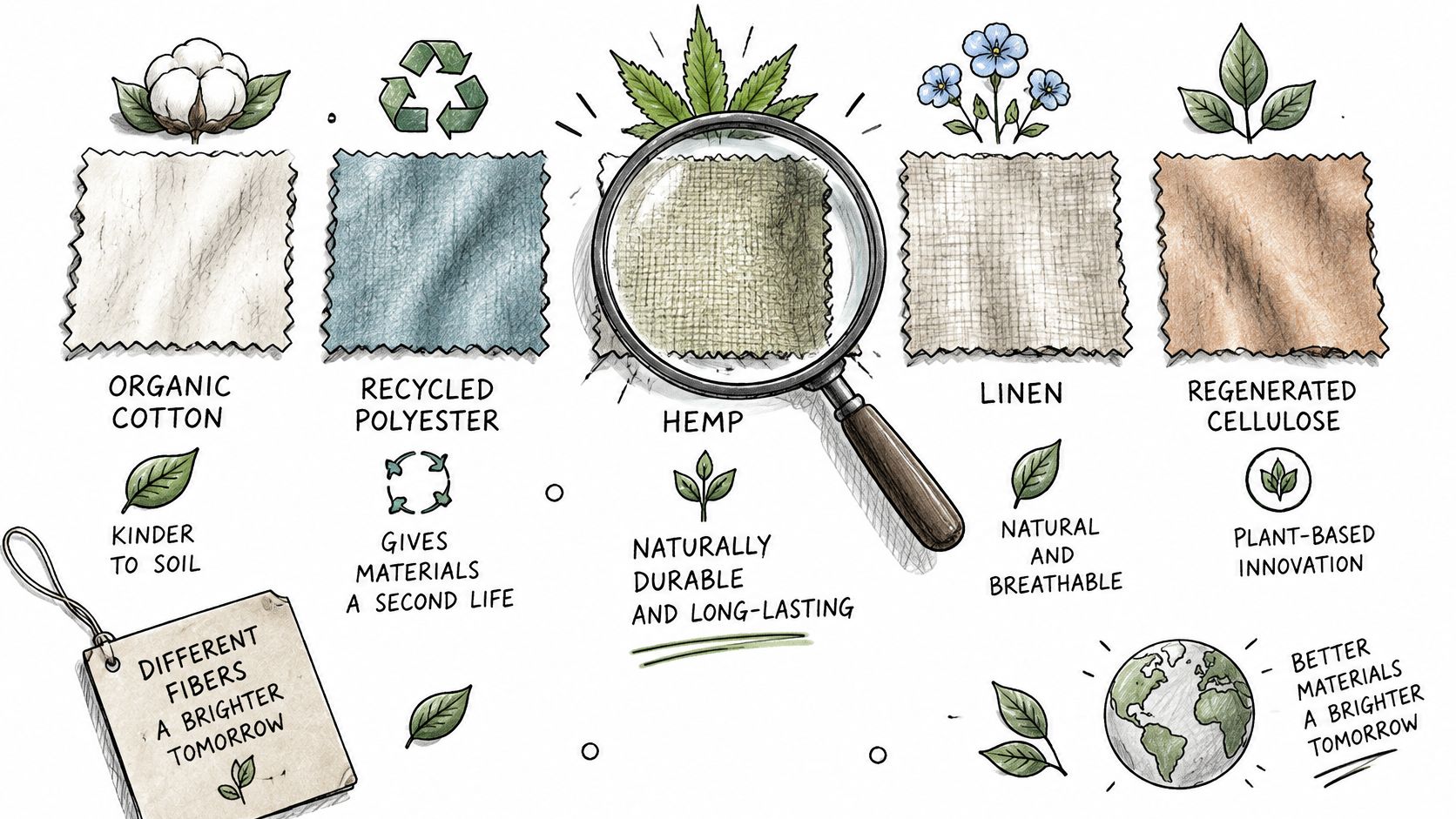
Common swag fibers at a glance
Use this as a comparison request, not a set of predetermined environmental scores.
| Fiber | Water intensity | Durability indicator | Recycled input available | Best-fit swag use case |
|---|---|---|---|---|
| Cotton, including organic | Require location-specific evidence | Wash-test results and shape retention | Verify recycled cotton options by SKU | Everyday tees where recipients approve fit and feel |
| Polyester, virgin or recycled | Compare complete processing and care | Performance after repeated wear and washing | Verify claimed recycled content | Apparel with a defined technical requirement |
| Hemp and linen | Require cultivation and processing evidence | Construction and repeated-care testing | Ask for documented availability | Optional lifestyle garments after sample approval |
| Regenerated cellulose | Assess the named production route | Finished-garment testing | Require evidence for any recycled claim | Drape-led styles chosen by recipients |
| Blends and other alternatives | Assess the complete composition | Test the blend, not its headline fiber | Verify each claimed input | Products with a specific, tested functional benefit |
For organic cotton, request evidence for the organic claim and compare the finished product. For recycled cotton, ask the supplier to demonstrate that the selected construction meets your wear requirements. Don't assume either label settles the product's overall impact.
For polyester, make the technical requirement explicit before comparing virgin and recycled options. For hemp, linen, and regenerated cellulose, insist on the same manufacturing and care evidence you'd demand for more familiar materials.
Match the garment to its actual job
An event tee shouldn't be designed for obsolescence because the event is short. Keep dates and oversized campaign graphics off the garment where possible. For a recognition hoodie, prioritize recipient preference, construction testing, and continued wear over novelty.
Compare landed cost, expected service, and documented recovery options alongside environmental indicators. Never assume a lower quoted price or a natural-fiber description answers those questions.
Use sustainable clothing production considerations to structure supplier conversations. If your shortlist includes bags, Urban Totes' guide to planet-friendly carryalls can help frame product questions, but require SKU-specific evidence before approving any claim.
Vetting Suppliers Beyond the Green Badge
A certificate in a sales deck isn't a supplier assessment. Ask which entity it covers, which facility performed the work, which product the claim applies to, and whether the supporting documents match your order.
Keep social conditions, environmental management, material traceability, and product performance as separate review categories. Don't let evidence in one category substitute for missing evidence elsewhere.
Request documents that answer specific questions
Build a supplier file with clearly named owners and review status:
- Facility mapping: Request the garment maker, dyeing and finishing facilities, decorator, and subcontractors. Require notification before substitutions.
- Social documentation: Ask for applicable BSCI, SA8000, or FWF-related records, their scope, findings, and corrective-action evidence. Don't treat the names as interchangeable guarantees.
- Environmental management: Request ISO 14001 documentation where offered, or evidence of facility energy, water, and chemical-management programs.
- Material traceability: Where suppliers claim GRS, GOTS, RCS, or OCS coverage, request the applicable documents and a clear connection to the quoted SKU.
- Product testing: Require reports relevant to your use case, such as dimensional stability, seam performance, color retention, and decoration durability.
These are purchasing requests, not a claim that every supplier must hold every named credential. Match the evidence to the risk and claim under review.
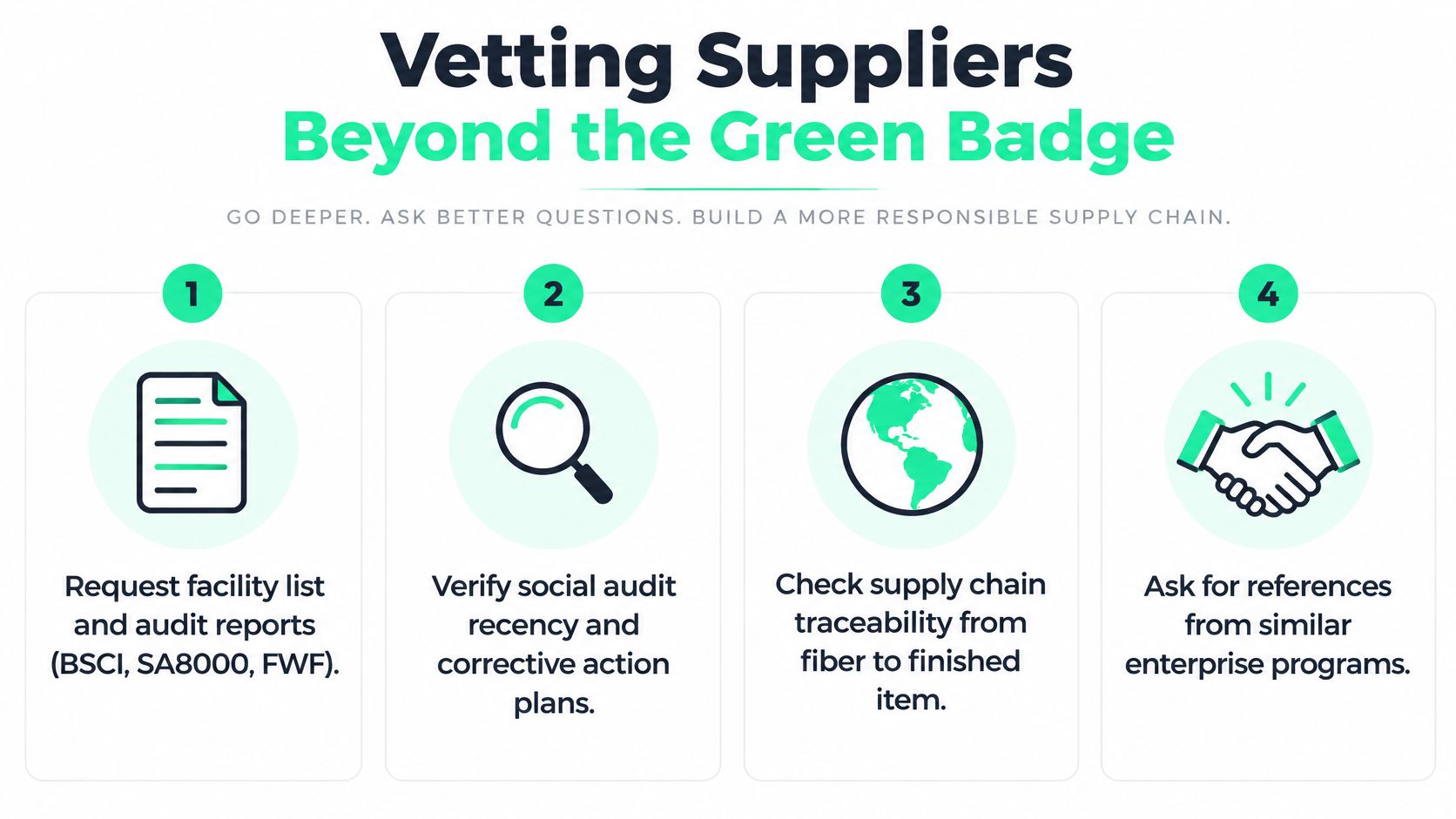
Use approval gates instead of a flattering average
A weighted score can hide a serious failure behind strong delivery performance. Apply a simple rubric that prevents that trade-off:
| Status | Evidence condition | Purchasing response |
|---|---|---|
| Accept | Current, relevant documents connect to the proposed product | Proceed to commercial review |
| Conditional | A defined gap has an owner and resolution deadline | Hold approval pending closure |
| Reject | Unsupported claims, unexplained substitutions, or missing traceability | Remove the claim or supplier |
Watch for unspecified recycled percentages, documents covering only an unrelated supplier, and catalogue photographs offered instead of current product evidence. None should pass because the account manager is responsive.
Use a supply-chain transparency framework to organize the handoffs between procurement, legal, and operations. Retain the actual documents, not just a checkbox saying somebody reviewed them.
A supplier's willingness to show limitations belongs in the assessment. Confidence without supporting records doesn't.
Demand Accuracy Is the Hidden Sustainability Lever
Approve the demand process before approving the production quantity. A perfectly documented garment still fails your program if it stays in a carton.
Treat demand accuracy as the primary operating control and material verification as a separate product control. You need both, but the order matters: first establish that recipients want the item, then evaluate how to supply it responsibly.
Replace assumptions with recipient decisions
Begin with eligible recipients by geography, intended delivery date, and available sizing. Don't copy last year's order mix without checking whether the audience, garment cut, or distribution method has changed.
Give employees an opt-in window with product photographs, garment measurements, fit guidance, and an explicit option to decline. Ask for the size of the selected garment, not someone's supposed universal clothing size. Keep preference collection proportionate and limit access to personal information.
Then define your purchasing rules:
- Production threshold: Decide when confirmed demand justifies ordering and when to offer an alternative.
- Shipping plan: Consolidate where practical, while checking whether storage or later reshipment undermines the benefit.
- Onboarding reserve: Maintain a deliberately limited safety stock, with replenishment tied to expected starts.
- Exception route: Establish who can authorize urgent purchases and how those orders enter the inventory record.
Use inventory forecasting methods to distinguish predictable onboarding requirements from uncertain event demand. They shouldn't share an undifferentiated stock allowance.
Measure what happens after delivery
A courier delivery confirmation doesn't establish that an employee wanted or used a garment. Separate delivered, claimed, and used in your reporting.
| KPI | Working definition |
|---|---|
| Claim rate | Claimed units divided by units offered for distribution |
| Unclaimed inventory | Available stock without a recipient, separated by age |
| Return rate | Returned units divided by distributed units |
| Repeat-wear rate | Recipient-reported repeated use, with the survey method disclosed |
| Impact per wear | Assessed life-cycle impact divided by useful wears |
Set your reporting cadence and retention check before launch. Don't describe self-reported wear as direct observation, and record nonresponse rather than assuming satisfaction.
Review these measures by SKU and geography. A popular garment in one office doesn't justify automatic replenishment everywhere.
Budget discipline: Don't spend the remaining allocation simply because it exists. Unspent swag budget is preferable to unsupported production.
The commercial question isn't whether a premium garment costs more at checkout. It's whether the evidence supports sufficient useful service to justify that purchase. Make that case with your own program records, not a vendor's generic promise of longer retention.
Closing the Loop on Returns, Leftovers, and End of Life
Put an owner's name next to every possible destination before placing the order. “We'll donate leftovers” isn't a plan unless a partner has agreed to accept those particular items.
Separate textile collection became mandatory across EU member states on January 1, 2025, and policy measures increasingly assign producers responsibility for collection, sorting, reuse, and recycling, according to UN-Habitat's textile-waste and circularity briefing. Don't translate that into a blanket claim that every employer has identical producer obligations. Ask legal counsel to establish the relevant role, jurisdiction, and requirements.
Give returned products a decision path
Start with inspection, not disposal. Record condition, reason for return, size, decoration status, and whether the item can safely re-enter circulation.
- Reissue: Create an internal channel for suitable exchanges and returned items. Disclose condition and apply an appropriate cleaning policy.
- Repair or redecorate: Request a quote when a repair or branding change could restore useful service. Compare the complete intervention with the likely result.
- Donation: Confirm acceptance criteria, destination, branding restrictions, and collection arrangements before shipment.
- Material recovery: Obtain written confirmation that the provider accepts the actual composition and decoration.
- Disposal: Record the treatment when reuse or recovery isn't feasible. Don't rename disposal as circularity.
For departing employees, offer a voluntary return route where appropriate. Avoid creating an expensive reverse-logistics requirement for a garment the person still wants to wear.
Report endpoints without double counting
Maintain both an inventory movement record and a disposition record. A unit sent for repair is still in process until the repair succeeds or another endpoint is confirmed.
| Disposition field | Required record |
|---|---|
| Product | SKU, composition, and relevant batch |
| Quantity | Units and measured kilograms |
| Condition | Reusable, repairable, defective, or unsuitable |
| Endpoint | Reissue, repair, donation, recycling, or disposal |
| Evidence | Recipient acknowledgment or treatment documentation |
| Financial record | Handling, transport, repair, and treatment costs |
| Ownership | Responsible employee and closure status |
Finance should be able to reconcile those movements with write-offs and recovery costs. The Gegan waste finance reporting guide is a useful starting point for organizing the accounting discussion, not proof that a disposal route meets local requirements.
Keep operational claims narrow. “Transferred to a collection partner” is supportable with a receipt; “recycled” requires evidence of that outcome. Your reporting should describe what happened, not what everyone hoped would happen.
A 90-Day Rollout Plan for Your First Sustainable Swag Program
Consider a hypothetical People Ops team relaunching onboarding and recognition merchandise across several countries. Finance wants a defensible budget, marketing wants consistent branding, and HR wants fewer delivery and sizing complaints.
The proposed 90-day rollout below is an implementation schedule, not a reported case study. Its purpose is to give each decision an owner before the first purchase commitment.
Days 1 to 30
The People Ops lead begins with the existing cupboard and purchasing records, not a fresh catalogue. They identify dormant products, unresolved returns, and the programs that require merchandise.
Procurement drafts the evidence sheet. Marketing agrees on wearable branding, while HR establishes the recipient-choice and sizing process. Finance approves the KPI definitions and the treatment of unused stock.
By the end of this phase, the team has a shortlist and approval criteria. It hasn't selected a supplier because samples arrived quickly.
Days 31 to 60
Suppliers return evidence against the same product requirements. Procurement records missing information, obtains relevant samples and test reports, and resolves differences in assessment boundaries before presenting a recommendation.
Meanwhile, operations prepares the exchange and reissue workflow. Regional stakeholders confirm delivery constraints, and the program owner explains what employees can choose, decline, or return.
If client gifting shares the budget, keep it as a separate demand category. Shivora Candles' gift ideas for business clients can support the recipient-fit conversation, but a gift idea still needs its own evidence and acceptance criteria.
Days 61 to 90
The team releases the initial order only after approval conditions are closed. It launches the employee-choice flow or onboarding kit, records exceptions, and checks that delivered products match the approved specification.
The final handover should leave named owners for:
- Purchasing: Claim verification, supplier changes, and replenishment authorization.
- Operations: Fulfillment, exchanges, reissue, and disposition records.
- Reporting: Quarterly review, data quality, and corrective decisions.
Don't declare success at launch. Use the first operating review to decide what to stop, what to change, and what deserves replenishment. A defensible program gives the budget owner a reason for every order and a record of what happened afterward.
FLYP LTD offers managed enterprise merchandise programs covering onboarding kits, recognition, events, and employee-choice stores, with curation, quality assurance, logistics, budgeting, and reporting. Visit with your recipient requirements and evidence checklist, and ask how those controls can be built into your next swag program before production begins.