Merchandise management is the end-to-end coordination of design, sourcing, production, fulfillment, QA, budgeting, and reporting so branded goods reach the right recipient on time, on brand, and on budget. In modern enterprise programs, that means turning a messy pile of approvals, vendors, and deadlines into one operating system.
If you've ever had to ship onboarding boxes across several countries while brand rejects the mockup for the third time, you've already felt the problem. The issue isn't just logistics, it's that People Ops, marketing, finance, and procurement are all making pieces of the same decision without one shared control layer.
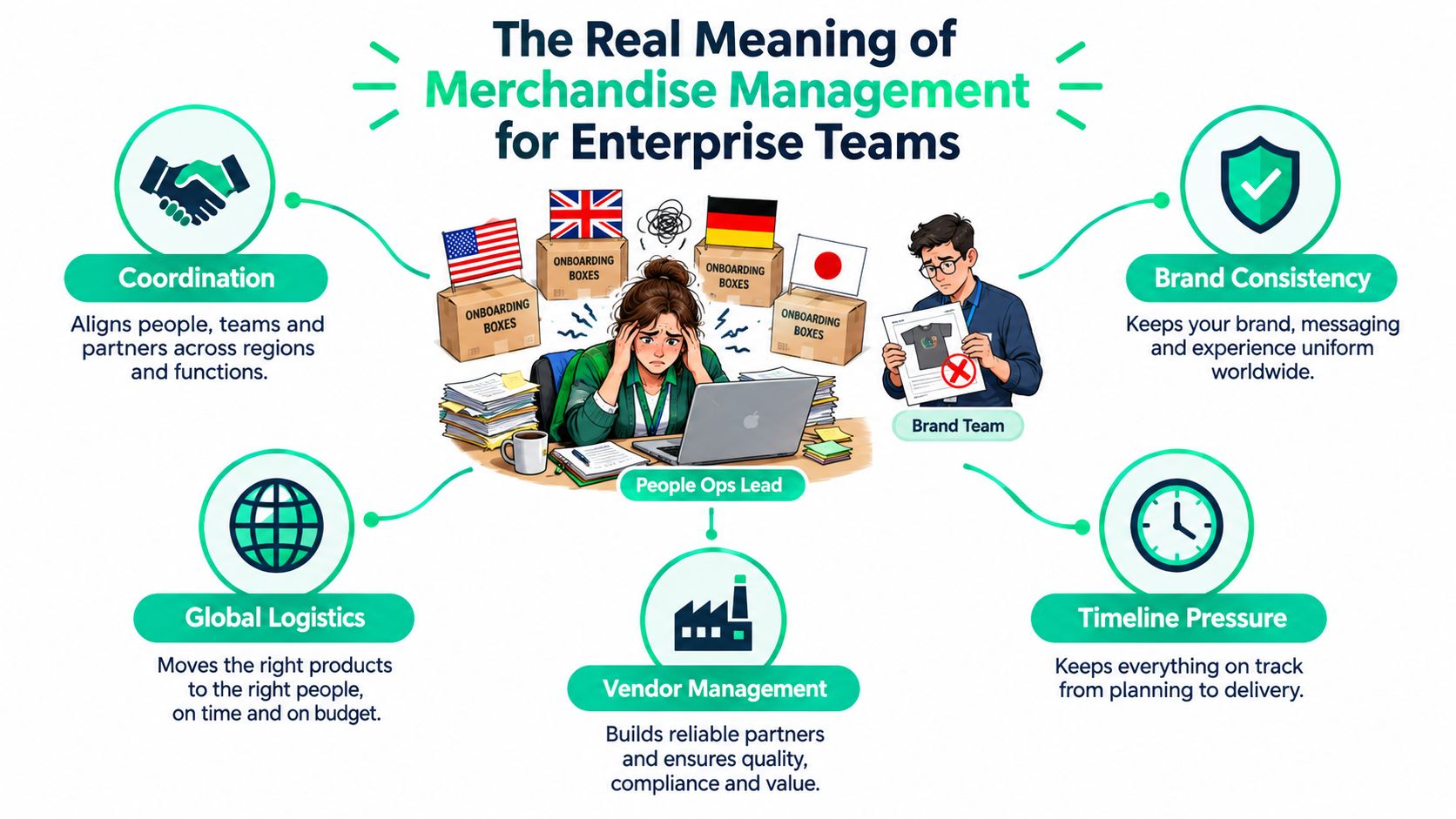
Table of Contents
- What Merchandise Management Means for Enterprise Teams
- Where Merchandise Management Came From
- The Planning and Inventory Core That Holds Everything Together
- How an AI-Native Merch OS Runs the Lifecycle End to End
- Choosing Between Bulk Purchasing and Recipient Choice
- Why Cheapest Unit Price Is Usually the Most Expensive Choice
- The KPIs That Prove a Corporate Merch Program Actually Worked
- Putting It All Together with an AI-Native Merch Operating System
What Merchandise Management Means for Enterprise Teams
A People Ops lead may be trying to get onboarding kits to Germany while marketing reviews a hoodie color and finance questions a rush shipment. Those decisions look separate, but they all shape one employee experience. Merchandise management gives the team a way to coordinate them.
A working definition for corporate merch
In an enterprise setting, merchandise management is the process of choosing, presenting, pricing, allocating, replenishing, and evaluating products so the right assortment reaches the right recipient at the right time. The same logic applies to onboarding kits, recognition gifts, event drops, and creator storefronts.
The scope extends beyond inventory records. It includes design governance, sourcing, production, QA, fulfillment, returns, and reporting. A team is managing merchandise whenever it approves branded goods, coordinates production, ships across regions, or operates a store where recipients choose their items.
Product selection also affects how a gift is perceived. Teams considering premium options can browse luxury corporate gifts to see how materials, presentation, and assortment contribute to the recipient experience.
Why the enterprise version is different
Retail merchants often measure success through sales and conversion. Enterprise programs measure whether people participate, receive something relevant, recognize the brand, get deliveries reliably, and use what they receive. The operating question changes from "Will this sell?" to "Will people wear it, keep it, and value it?"
That difference creates a wider set of decisions. A marketing team may protect brand standards, People Ops may define the employee moment, procurement may compare suppliers, and finance may control spend. Without shared rules, each group can optimize its own task while the program becomes slower and harder to measure.
A useful test is simple: if a program requires coordinated decisions about what to make, how much to produce, where to send it, and how to assess the result, it is already merchandise management. The work may still sit across inboxes and spreadsheets, but the operating need is the same.
For enterprise teams, an AI-native merch operating system puts those decisions into one layer. It can connect requests, approvals, product data, supplier coordination, recipient details, and reporting, replacing a workflow spread across separate vendors with a process the team can oversee from one place.
Where Merchandise Management Came From
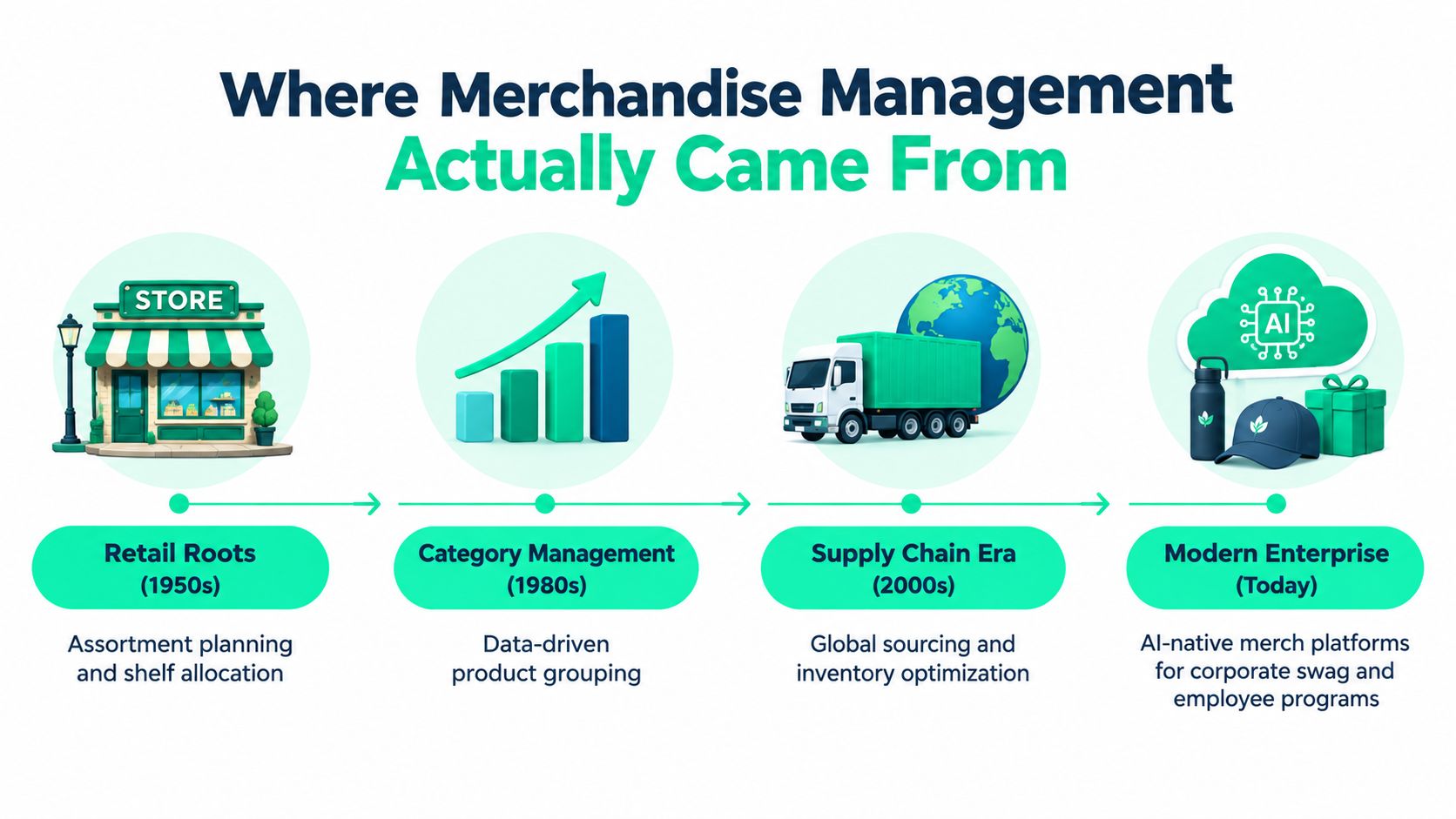
Enterprise merchandise programs inherit their operating logic from department stores. In the nineteenth century, retailers had to coordinate many categories under one roof, deciding how products should be grouped, displayed, promoted, and replenished. Le Bon Marché opened in Paris in 1852, Macy's in New York in 1858, Marshall Field's in Chicago in 1865, Bloomingdale's in New York in 1872, and Wanamaker's in Philadelphia in 1876, as documented in the merchandising history reference.
Retail made presentation measurable
Department stores turned product presentation into an operating function, not decoration alone. Marshall Field's display department grew from 7 employees in 1895 to 20 by 1900, as documented in the merchandising history reference. The growth reflects how seriously retailers treated customer attention and the arrangement of merchandise.
That history explains why modern teams still use terms such as assortment, allocation, replenishment, and presentation. The setting has changed, but the decisions remain familiar: which products belong in the program, who should receive them, when they should ship, and how the team will judge the result.
For an enterprise, the store may be an employee portal, an onboarding kit, a recognition moment, or a creator drop. A People Ops team may need apparel by size, a marketing team may need consistent branding, and procurement may need supplier and delivery control. Each use case creates the same coordination problem that retailers faced, even though the recipient is not a shopper.
Why the old vocabulary still fits
Retail language persists because it describes recurring operational choices. Large assortments create complexity. Presentation can influence uptake. Replenishment matters when demand differs by group, region, or event.
An AI-native merch operating system applies that logic across the enterprise. Instead of forcing teams to coordinate separate product, sourcing, fulfillment, and reporting tools, it connects the workflow in one operating layer. The interface is modern, but the underlying task remains practical: match the right product to the right person at the right time, then learn from what happened.
The Planning and Inventory Core That Holds Everything Together
Merchandise management becomes practical when it connects money, forecast, and inventory. A merchandise plan translates projected sales and margin into inventory and purchase budgets across product hierarchies, selling channels, locations, and time periods as SAP's planning documentation lays out. In plain English, that means you don't buy first and hope later. You plan first, then buy with guardrails.
The basic control loop
A simple open-to-buy logic looks like this:
Planned purchases = projected sales + desired ending inventory - expected on-hand - expected on-order
That formula matters because enterprise merch is rarely one-size-fits-all. Sizes vary, regions ship differently, and lead times change by vendor and country. If you only look at revenue, you miss the operational picture.
Useful habit: Track inventory as a decision system, not as a pile of boxes. The right number tells you whether to buy, hold, move, or stop.
For teams that want a deeper operational lens, how to reduce inventory costs is a helpful companion resource because it focuses on the trade-offs that sit behind every buying decision.
Four metrics that belong on the dashboard
| Metric | What it measures | Healthy signal |
|---|---|---|
| SKU-level sell-through | How quickly each item moves after receipt | Demand is matching the assortment |
| Inventory turns | How efficiently stock moves through the program | Inventory isn't sitting idle |
| Weeks of supply | How long current stock should last | Stock is neither thin nor bloated |
| Forecast error | How far planned demand differs from actual demand | Forecasts are becoming more reliable |
These four numbers tell a better story than order volume alone. A high order count can still hide weak planning if one region is overstocked while another runs dry. That's common in global onboarding, where a 1,000-person cohort may need different sizes, different delivery timing, and different language or brand constraints across regions.
When planning is weak, one country gets excess inventory and another gets a stockout. When planning is strong, procurement, fulfillment, and finance all see the same control logic.
A merch budget only works if the inventory plan underneath it is real. Without that, “budget” is just a ceiling with no steering wheel.
How an AI-Native Merch OS Runs the Lifecycle End to End
A global onboarding kit for a 500-person engineering hire wave shows how enterprise merchandise management works in practice. The People Ops lead must coordinate brand approval, size coverage, regional shipping, and reporting. In a traditional workflow, that can mean five vendors and two internal spreadsheets. An AI-native merch operating system brings those activities into one operating layer.
From brief to approved design
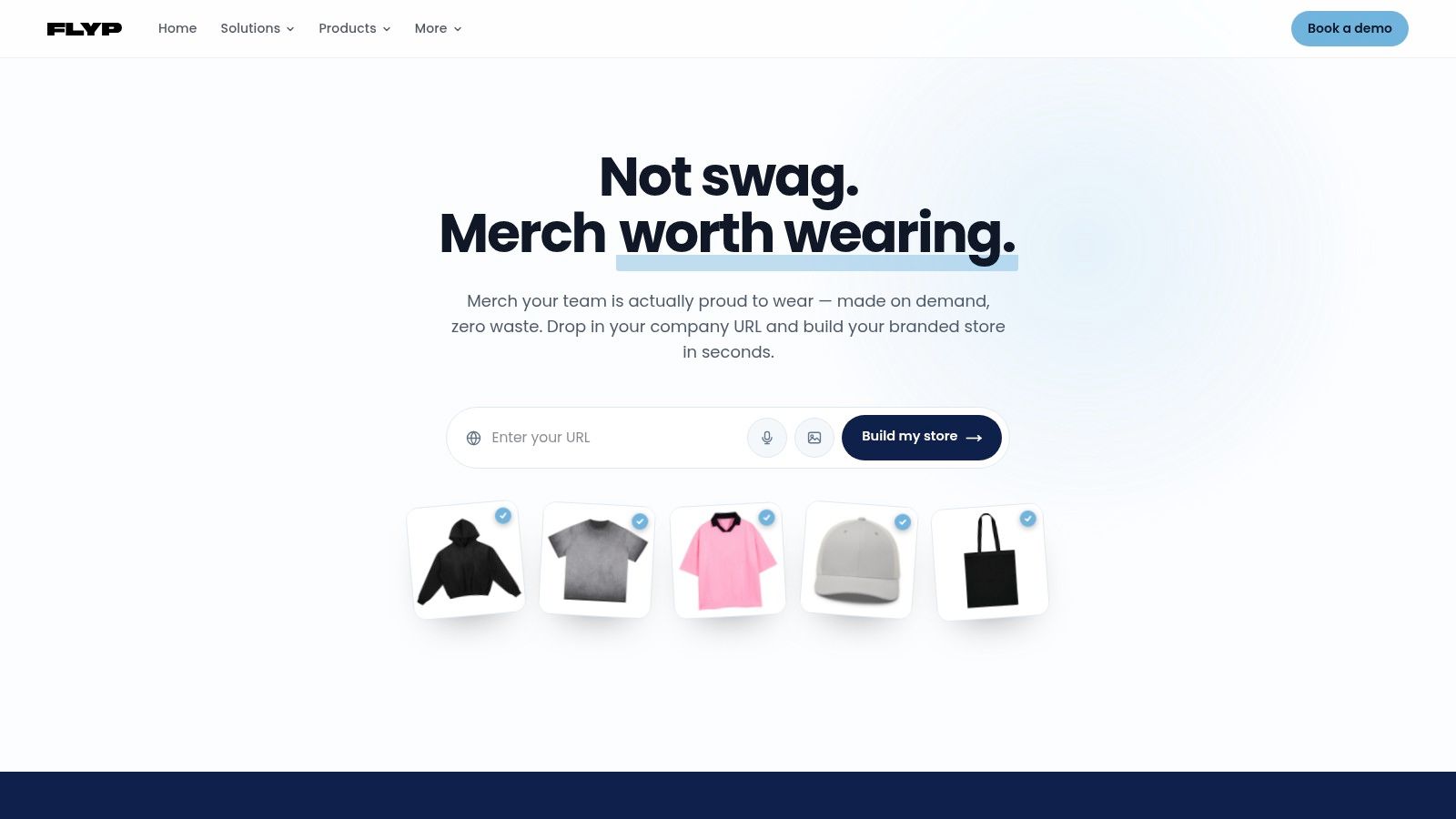
The process begins with the available brand input. It may be a text prompt, URL, video, image, or written brief. FLYP converts those inputs into on-brand, garment-accurate designs across 600+ premium blanks in minutes. It also runs global merch as a managed service covering curation, quality assurance, logistics, budgeting, brand safety, and reporting according to the product overview.
Early visibility prevents later rework. A misplaced logo sends the mockup back for correction. The wrong garment blank weakens consistency across the kit. A budget impact discovered late can create an avoidable finance issue.
Where the workflow usually breaks
Traditional programs divide responsibility among separate providers. One handles sourcing, another design, a third fulfillment, and an internal spreadsheet may hold reporting. Every handoff creates another place for status, specifications, or ownership to become unclear.
An AI-native OS connects the workflow in one layer:
- Brief intake preserves brand intent from the beginning.
- Design QA identifies problems before production.
- Production routing connects approved artwork with the correct blanks.
- Fulfillment and shipping turn approved orders into deliveries.
- Returns and reporting keep the program measurable after shipment.
What changes for the People Ops lead
The lead can assign the program to one operating layer instead of chasing separate updates. Brand stakeholders can review what will ship, finance can monitor budget status, and operations can track delivery progress. Recipients receive merchandise selected for practical use, rather than items distributed without enough attention to fit or relevance.
The operational gain is traceability. Each stage, from brief through delivery, has a visible status and an accountable workflow. The next section compares bulk purchasing with recipient choice, two fulfillment approaches that affect how this lifecycle is configured.
That distinction separates buying swag from operating a merch program.
Choosing Between Bulk Purchasing and Recipient Choice
Enterprise teams typically face this decision at two moments: the annual kit refresh and the ad-hoc event drop. The choice is between standardized bulk purchasing, where merchandise is ordered in advance and distributed from stock, and recipient choice, where employees select from a curated collection or store.
The trade-off in plain language
Bulk purchasing can reduce unit cost and simplify distribution, but storage, redistribution, waste, and unused sizes can erode that advantage as the management literature notes.pdf). Recipient choice can improve fit and relevance. It also requires catalog rules, service-level oversight, and reporting that show what people selected and whether orders arrived as expected.
The lower quote is not automatically the lower program cost. The more flexible model is not automatically easier to operate. The right configuration depends on the outcome the program must prove, such as consistent brand presentation, participation, or useful distribution.
A simple decision matrix
| Decision factor | Bulk purchasing | Recipient choice |
|---|---|---|
| Cost per active recipient | Often lower upfront | May cost more upfront, with clearer use |
| Participation rate | Depends on distribution | Easier to measure directly |
| Return rate | Can rise when fit is poor | Often lower when recipients choose |
| Brand consistency | Strong with standardized items | Depends on catalog controls |
| Sustainability | Exposed to deadstock risk | Better fit, with governance required |
A hybrid model combines control with personal relevance. A team might order a standard welcome card and core item in bulk, then let each recipient choose an approved shirt, size, or color. Clear limits on artwork, products, and budget keep the catalog manageable. Made-to-order options can also reduce stored inventory when timing and production capacity support them, as explained in what is print on demand.
A 400-person onboarding cohort across three regions is a typical hybrid case: bulk core kit, choice-based apparel add-on.
Why Cheapest Unit Price Is Usually the Most Expensive Choice
The lowest quote on paper can become the costliest decision in practice. That happens when a team over-orders before the logo is finalized, the campaign changes, the headcount shifts, or the event date moves. Deadstock is what's left when the forecast was more confident than reality.
Unit price hides lifecycle cost
The global textile picture makes that risk harder to ignore. Global textile waste is estimated at 92 million tonnes annually, garment production doubled between 2000 and 2015, the duration of garment use fell by 36%, and only 8% of textile fibres in 2023 came from recycled sources according to the UN-Habitat release. Those figures push merch teams to think beyond purchase price and into lifecycle impact.
For enterprise programs, the central question is not “What's the cheapest unit?” It's “What's the total impact per useful wear or use?” That includes forecast accuracy, minimum order quantities, inventory age, utilization, return and replacement rates, material composition, production geography, shipment consolidation, and disposal or donation outcomes.
The real operational risk
A bulk order can look efficient until a campaign changes halfway through, or an onboarding class lands smaller than expected. Then the program pays for storage, redistribution, and waste on top of the original purchase.
A more disciplined approach asks a harder question before approval: how much of this stock is likely to be used by actual recipients, and how much is just going to sit there? That's the metric that matters.
Cheap inventory is only cheap if it moves into real use before the program changes.
Sustainability in merch isn't a slogan. It's a forecasting, sizing, and disposition problem. Teams that treat it that way make better buying decisions and waste less.
The KPIs That Prove a Corporate Merch Program Actually Worked
Units ordered don't prove much. A dashboard full of shipment counts can still hide poor fit, late delivery, or low recipient use. What matters is whether the program reached the right people, on time, with acceptable waste and useful outcomes.
The measurement stack that actually helps
The practical KPIs are cost per active recipient, redemption or participation rate, delivery accuracy, return rate, time to fulfill, utilization, employee satisfaction, and incremental employer-brand outcomes. Those metrics tell you whether merch created value or just activity.
A forecasting pilot in retail helps explain why this matters. In an applied retail program covering all SKUs across stores, improved forecasting procedures reduced mean squared error by 43%, with the firm estimating a 21% inventory reduction and a 22-percentage-point reduction in customer-service variability per the pilot report. The enterprise lesson is straightforward, better segmentation by region, role, and event type usually improves planning quality.
For teams designing a dashboard, how to measure team building CSR is a useful companion because it reinforces the idea that program value needs measurement, not assumptions.
What each metric proves
- Cost per active recipient: Shows whether the program created value for the people who used it.
- Participation rate: Tells you whether recipients engaged with the store or drop.
- Delivery accuracy: Confirms the right items arrived in the right place.
- Return rate: Exposes fit problems, damage, or mismatch.
- Time to fulfill: Shows whether operations matched the promise date.
- Utilization: Helps distinguish real use from warehoused inventory.
- Employee satisfaction: Captures the recipient side of the experience.
- Incremental employer-brand outcomes: Shows whether the program supported broader brand goals.
A merch function earns budget when it proves service and utilization. That's also why a KPI dashboard should sit at the center of the operating model, not as an afterthought.
Putting It All Together with an AI-Native Merch Operating System
A People Ops team preparing an onboarding drop may begin with a list of shirts, notebooks, and welcome cards. The work starts earlier: identifying recipients, defining the intended outcome, setting the budget, confirming deadlines, and applying brand requirements. Once those decisions are recorded, production and fulfillment become easier to coordinate.
A simple operating checklist
- Define the program goal. Onboarding, recognition, event distribution, and employee choice require different workflows.
- Set the brand rules. Confirm approvals, logos, garment standards, packaging, and any regional requirements before production.
- Assign planning ownership. One owner should manage budget, timing, inventory posture, and local constraints.
- Choose the fulfillment model. Bulk shipment, recipient choice, or a hybrid approach should match the program's purpose.
- Track service and usage. Measure recipient activity, delivery accuracy, returns, fulfillment time, and utilization rather than order volume alone.
- Feed results into the next cycle. Returns, feedback, and usage patterns should shape future purchasing and assortment decisions.
A managed merch platform gives those decisions one operating layer. Instead of coordinating separate design, sourcing, production, fulfillment, and reporting partners through scattered messages, the team can keep approvals, orders, recipient details, and program status in one workflow.
The first month should produce visible operating evidence. The team submits the brief, reviews product and design options, approves the selected direction, ships the first drop, and receives an initial utilization report. That sequence exposes practical issues early, such as unclear approval ownership, regional shipping limits, or products recipients do not use. The value comes from making those issues visible while the program is still easy to adjust.
Two questions teams usually ask
What does a merch OS replace? It replaces much of the manual coordination between design, sourcing, production, fulfillment, and reporting vendors. It does not replace judgment about recipients, goals, budget, or brand standards. It reduces the repeated data entry and follow-up required to connect those decisions.
How fast can a pilot move? Timing depends on approvals, product selection, and shipping scope. A single workflow can shorten the process because the brief, approved designs, order details, and delivery information do not need to be recreated across separate systems.
Merchandise management is the operating layer connecting brand decisions, supply, budget, and recipient experience. Teams ready to replace one-off coordination with a repeatable workflow can visit FLYP LTD to explore an AI-native merch operating system.