In 2025, Capital One Shopping Research on online clothing sales put global online apparel sales at $880.9 billion. That scale changes what you should demand from the best custom T shirt design website. You're not choosing a novelty editor. You're choosing a workflow that has to produce the right garment, in the right size, with artwork that survives the move from screen to fabric, for people who may never meet you if it arrives wrong.
Table of Contents
- Scorecard Criteria and Benchmarks for Choosing a Platform
- Matching a Platform to Your Buyer Type
- How Design Editors and Mockups Hold Up Under Real Use
- How to Test a Platform Before You Commit
- Fit, Print Accuracy and Post-Purchase Risk
- Total Cost, Minimums and Hidden Waste
- Shortlist Providers and Run a Paid Sample Order
Scorecard Criteria and Benchmarks for Choosing a Platform
The global custom T-shirt printing market was valued at approximately USD 5.2 billion in 2024 and commercial customers accounted for 56% of industry revenue in 2024, according to Shopify's ecommerce fashion industry analysis. Online sales were identified as the fastest-growing channel in that analysis, so a platform has to serve a person ordering one shirt and an organization reordering the same artwork for onboarding, conferences, brand activations and campaigns.
Don't start by ranking editors. Start by scoring the full workflow. A polished canvas means little if the configurator loses work, the size chart is vague, or nobody can tell you who pays when a print lands off-center. The scorecard below gives you eight checks you can run before you commit budget.
Platform Scorecard Criteria Benchmarks and Common Gaps
| Criterion | What to Check | Benchmark or Signal | Common Gap |
|---|---|---|---|
| Design completion | First-attempt completion of a standard design task | Product-customization sites average 66% completion; a repeated T-shirt design task drops to 44% | Lost work between design sessions |
| Time to approved design | Minutes from brief to approved artwork | Configuration sessions average 15 minutes 10 seconds in a peer-reviewed study | Long option lists with no guided defaults |
| Mockup fidelity | Front and back views, print-area boundaries, color preview | Realistic garment view and placement guides on the same screen | Preview that ignores the chosen blank |
| Page speed | LCP, INP and CLS during asset-heavy actions | LCP at or below 2.5 seconds, INP at or below 200 milliseconds, CLS at or below 0.1 | Fast landing page with a slow configurator |
| Sizing | Measurement charts for each garment | Measurements in centimeters and inches, plus shrinkage data | S/M/L labels only |
| Print accuracy | Print method, placement tolerance, proof policy | Stated tolerance in millimeters and a physical proof option | Mockup presented as the final product |
| Pricing | Full landed cost per delivered unit | Written setup, minimum and shipping terms | Low unit price with fees added later |
| Fulfillment and returns | Regions served, consolidation, replacement policy | Written wrong-size and misprint policy with return shipping terms | Policy only on an FAQ page |
Treat this as a starting score sheet, not a verdict. A gap in private size selection can break an HR program and barely matter to a creator selling to fans who choose their own size at checkout. A slow configurator hurts an events team working on phones more than it hurts a designer on office Wi-Fi.
I would rate every candidate 1 to 3 on each row before you look at pricing pages. A 1 means you couldn't verify it, a 2 means it's stated but untested, and a 3 means you've seen it work on your own artwork, device and delivery region. That discipline stops a strong template library from masking weak sizing, vague proofing or an expensive returns process.
Practical rule: If a vendor can't put a benchmark, tolerance or policy in writing, score it 1. Verbal reassurance won't help when 200 shirts are already printed.
Weight the rows once you know your buyer type. The criteria don't change, but their order should.
Matching a Platform to Your Buyer Type
North America held 33.60% of custom T-shirt printing revenue in 2025, and online direct-to-consumer sales represented 61.40% of revenue in the same year in estimates cited by the Mordor Intelligence custom T-shirt printing market report. You're buying in a digitally mature market, but a digitally mature buyer still fails when the operating model doesn't match the job.
Read your row first, then set your weights.
| Buyer Type | Top Priorities | Can Weigh Less |
|---|---|---|
| People Ops and HR | Sizing accuracy, private size choice, repeat ordering | Editor sophistication |
| Global marketing and events | Mobile speed, proof approval, multi-region shipping | Template count |
| Startups and scaleups | Low minimums, fast approvals, simple onboarding | Depth of managed services |
| Creators | Storefront tools, shipping to fans, sales reporting | Bulk-order discounts |
The buyer types below show why weighting matters more than a feature checklist.
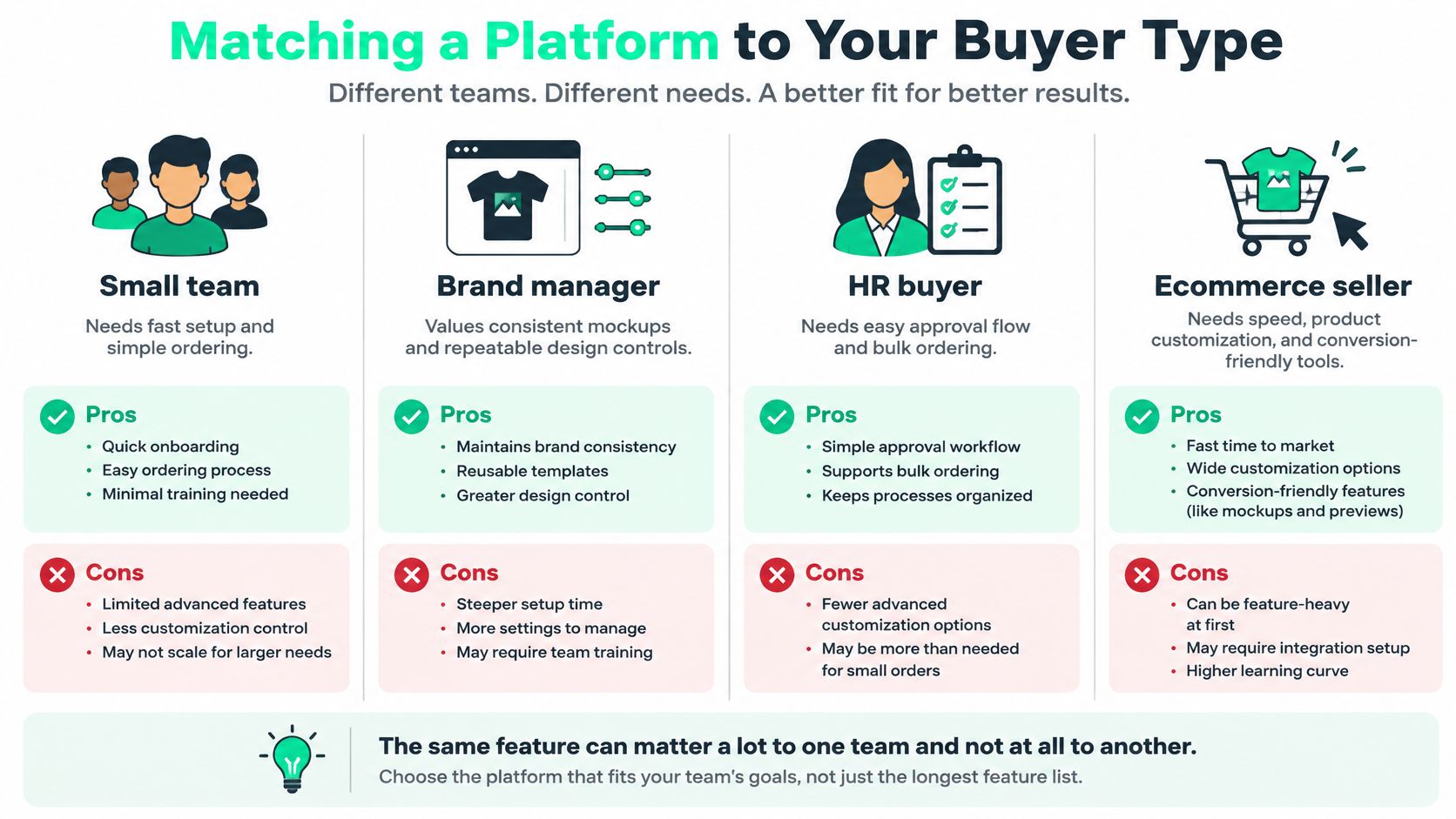
A managed service fits programs where curation, quality control, logistics, budget control and reporting need one accountable owner. That's onboarding kits, employee-choice stores and event drops with several approvers and regions. A self-serve editor fits one buyer placing a small, repeatable order with clear artwork and a clear budget.
Use a simple test. If one person can brief, approve, pay and distribute the whole order in a week, self-serve is probably enough. If approvals, budgets, sizes and countries multiply, managed support earns its cost because someone owns the exceptions instead of your team absorbing them in chat threads and spreadsheets.
How Design Editors and Mockups Hold Up Under Real Use
Customization is harder to use than ordinary ecommerce, and the gap is measurable. Nielsen Norman Group testing found that product-customization sites achieved only 66% average task completion, compared with 83% for sites without product customization, in research summarized in a peer-reviewed garment-customization study. A repeated T-shirt-design task in that research fell to 44% completion and produced moderate-to-major user difficulty.
That isn't a cosmetic problem. It shows up as lost state between designs, edits overwriting an earlier version, and people hunting for undo or reset controls after one bad click. In an enterprise program, those failures become support tickets, delayed approvals and artwork nobody wants to sign off.
The contrast between a simple store and a complex configurator is where most buyers overestimate their teams.
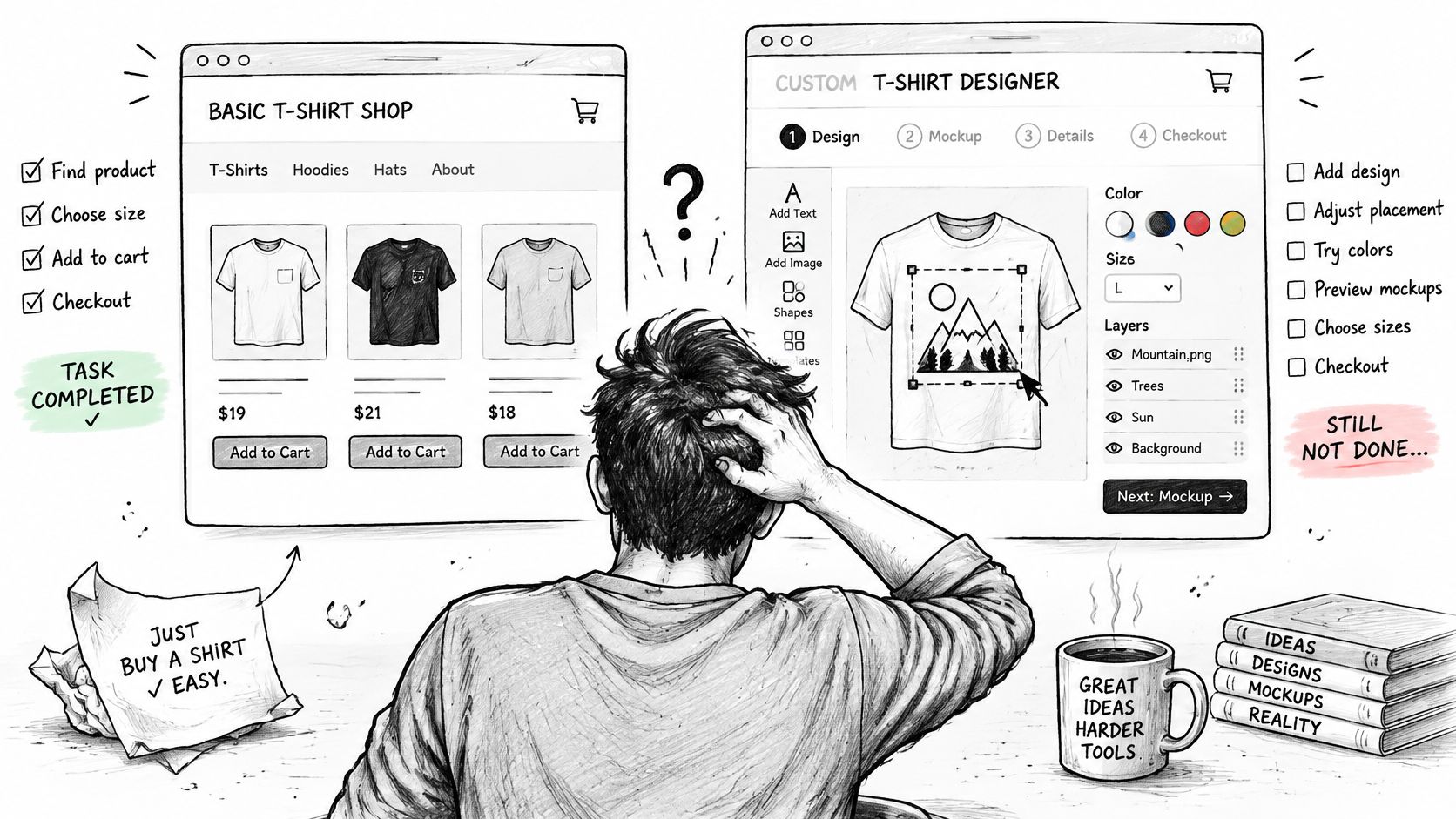
Option Overload Slows Approval
More choice doesn't always help the buyer finish. The same study reported an average configuration session of 15 minutes 10 seconds and found users valued flexibility but struggled with decision-making and visualizing the garment on their own bodies. If your approver needs training to place a chest logo, the tool has shifted design labor onto the busiest person in the chain.
Run these checks with a real brief, not a demo file.
- Preserve editable versions: Save, duplicate and reopen the design without flattening text, logos or placement into one image.
- Show both sides: Confirm front and back views stay linked to the same garment, color and size selection.
- Expose print boundaries: Look for placement guides on the garment itself, with a warning when artwork crosses the printable area.
- Change the blank safely: Switch color and style and confirm the artwork keeps its size, position and legibility.
- End with one review screen: Check garment, size run, placement, colors and quantity in one place before checkout or approval.
A curated set of blanks with guided defaults often beats a long template library. Fewer, better choices reduce the chance that a remote manager pairs a low-contrast logo with the wrong fabric or approves artwork scaled for an XL on every size. For teams building previews before production, an apparel mockup generator workflow is useful only when it reflects the actual blank, print area and garment color you'll ship.
What a Mockup Can and Cannot Prove
A mockup proves composition. It doesn't prove ink behavior, fabric drape, shrinkage or how a print sits on a moving body. Treat a realistic preview as an approval aid, then validate the physical result before you scale the order.
The walkthrough below is useful for seeing editor actions in sequence, especially saving, switching views and reviewing before approval.
I would distrust any editor that makes design feel easy by hiding constraints. You want the opposite. The platform should surface print limits, low-resolution artwork and contrast problems early, while fixing them costs minutes instead of a reprint.
How to Test a Platform Before You Commit
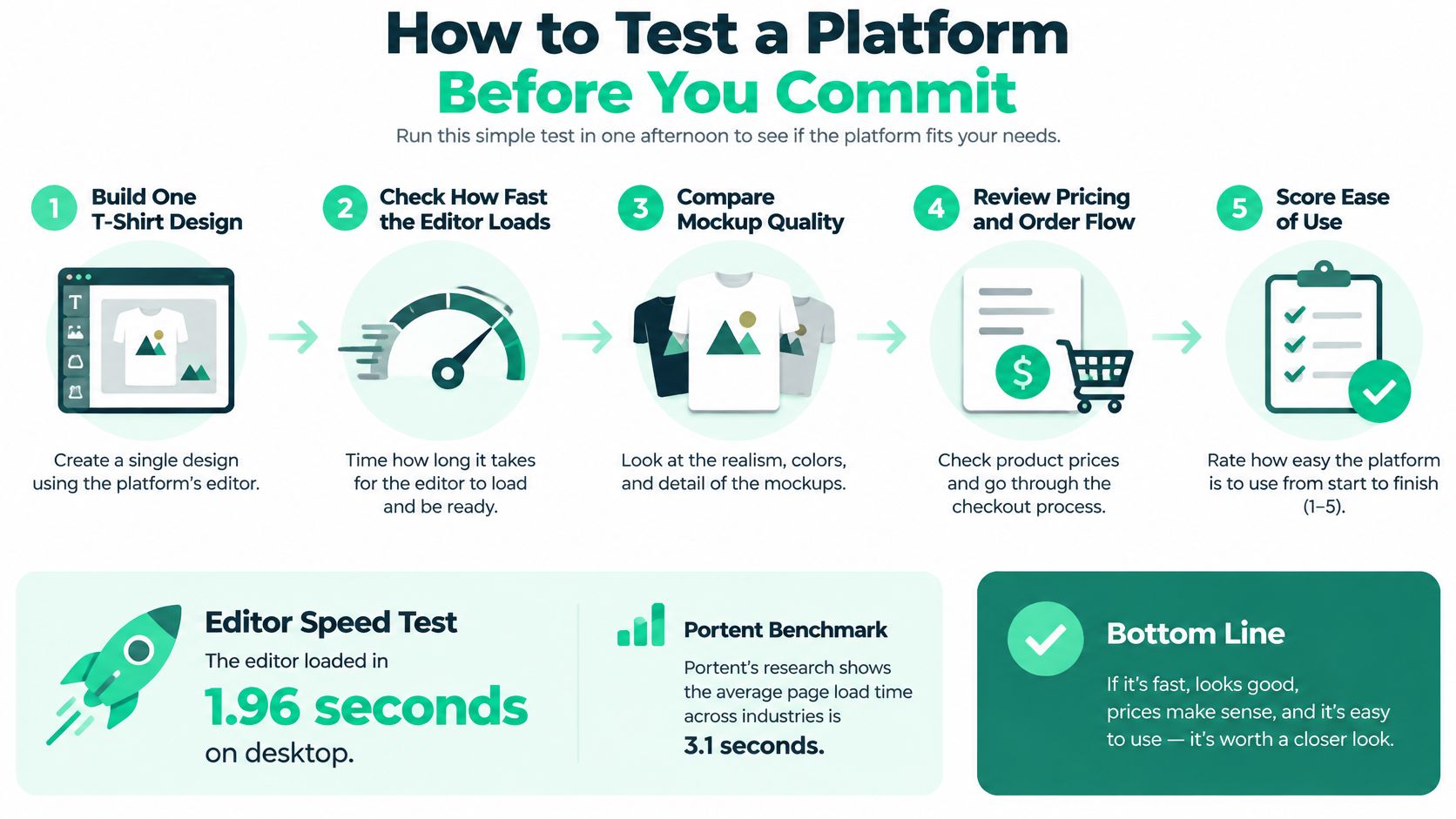
You can expose most platform weaknesses in one afternoon if you test the configurator under real conditions. Speed belongs in that test because people approve merch on phones at events, in airports and from home networks, not only on a designer's wired connection. Ecommerce benchmarks summarized by SEO Sherpa's ecommerce statistics report leading sites averaged 1.96 seconds on desktop, while Portent's analysis found conversion around 3.05% at one second versus 0.67% at four seconds.
The five-step flow below gives you the order of work before you start timing anything.
Run the Same Brief Six Ways
Build one test brief. Use a logo, a photo and one line of text, then time the full design on a phone. A clean vector logo alone won't reveal upload, scaling or text-editing friction.
Repeat it on weaker hardware. Use a mid-range Android device on a slow mobile connection. Testing only on fast office Wi-Fi hides the experience your distributed employees will get.
Change color and style five times. Watch for lag, layout jumps and artwork that resets or resizes itself. State loss usually appears here, and it's the failure least likely to show up in a vendor demo.
Save and reopen on a second device. Confirm every element is still editable, including font, spacing and placement. If reopening gives you a flat image, your team can't safely hand work between approver and designer.
Measure during heavy actions. Use a browser performance panel while loading mockups, applying a logo and generating a preview, and log LCP, INP and CLS. Measuring only the landing page tells you almost nothing about the tool people must finish in.
Score against fixed targets. Compare results with LCP at or below 2.5 seconds, INP at or below 200 milliseconds, and CLS at or below 0.1, the practical acceptance targets set out with those benchmarks. Record the device and connection beside each result so vendors can't dismiss a failure as your setup.
For a broader method you can reuse across internal tools, usability testing for product teams from Uxia is a sensible companion resource to adapt for task scripts and participant notes.
Don't let a vendor watch over your shoulder and rescue the test. The point is to see what your least technical approver can complete alone.
Only 42% of sites passing all Core Web Vitals were reported in the 2025 ecommerce benchmark cited with those speed figures, so a clean pass is a meaningful signal rather than table stakes. A platform that stays stable while rendering garment previews on ordinary hardware will create fewer abandoned designs and fewer approval delays when you roll it out.
I would also time human completion, not just page loads. Ask three people who've never used the tool to finish the same brief, count first-attempt completions, and note every point where someone asks what to click next. Those hesitations predict your support load better than any feature matrix.
Fit, Print Accuracy and Post-Purchase Risk
US online apparel returns were estimated at 24.4% in 2025, compared with 19.3% across online retail, and 53% of apparel sellers identified size and fit as the leading return cause, according to Size.ly's ecommerce return statistics. A separate 2025 survey in that summary found 61% of consumers cited poor fit as the main reason for returning clothing or footwear. That's the risk your platform choice has to manage after the design looks good on screen.
Most comparisons stop at editor features, templates and base price. They don't answer the operational question. How closely will the finished garment match the approved design, fit the recipient, and get handled if it arrives wrong?
Fit and Print Risk Checks to Request From a Vendor
| Risk Area | What to Ask For | Red Flag |
|---|---|---|
| Sizing | Measurement charts in centimeters and inches for each blank, with shrinkage data | Only S/M/L labels |
| Print placement | Printable area and placement tolerance in millimeters | No stated tolerance |
| Color | Digital-versus-physical color policy and a proof option | Promise of an exact on-screen match |
| Samples | Paid or free sample before bulk production | No sample offered |
| Wrong size or misprint | Written exchange policy and who pays return shipping | Policy described only in general terms |
| Recipient sizing | Option for recipients to choose their own size privately | Sizes collected on a shared spreadsheet |
Copy that table into a vendor email. You're not being difficult. You're asking for the information that prevents waste, rework and a new hire receiving a shirt they'll never wear.
Start with measurements, not labels. One brand's medium isn't another brand's medium, and a size run built on labels alone will misfit part of every team. Ask for chest width, body length and sleeve measurements for each blank, plus expected shrinkage and fabric weight. If you're comparing blanks, guidance on choosing premium blank T-shirts helps you separate garment quality from print quality before you judge a sample.
Then pin down print placement. A logo that sits a few millimeters high can look fine in isolation and wrong across a group photo. Ask where placement is measured from, what tolerance production works to, and whether the same artwork scales across sizes or stays one fixed width. A vendor who can't state a tolerance is asking you to accept whatever the press produces.
Color needs the same honesty. Screen color and fabric color differ with the blank, ink, print method and lighting, so a promise of an exact match is a warning sign. Ask how brand colors are referenced, whether physical proofing is available, and what happens when the delivered color falls outside the approved proof.
The strongest quality-control workflow can be worth a simpler editor and a higher base price. Nobody remembers your template library when the fit is wrong.
Private size choice also matters. Employees shouldn't have to publish their size in a shared sheet, and managers shouldn't guess on their behalf. A recipient-choice flow reduces exchanges and removes an awkward step from onboarding.
I would make a physical sample a requirement for any bulk order. Wash it once, check print edges, measure it against the chart, and compare color against your brand reference in daylight. A mockup can't give you that evidence.
Total Cost, Minimums and Hidden Waste
Comparing unit prices while ignoring what happens after ordering is the most common budgeting mistake in custom merch. US retail returns overall were projected at $849.9 billion in 2025, with online sales returning at a 19.3% rate, according to an IEOM Society conference paper on merch sustainability and cost. A lower inventory commitment can shift cost into parcels, replacements and reverse logistics instead of removing it.
Build a landed cost per delivered garment from every line below.
| Cost Line | Where It Hides | How to Compare |
|---|---|---|
| Blank garment | Price varies by brand, weight and fabric | Compare cost per finished unit, not per blank |
| Print setup | Per-design, per-color or per-placement fees | Ask for total setup cost per order |
| Minimum order | Minimums can apply per size, per color or per design | Divide the minimum by real headcount in each size |
| Packaging and parcels | Per-parcel charges on split shipments | Compare consolidated shipping with per-recipient shipping |
| Replacements and reverse shipping | Replacement garments and return labels | Ask for a written replacement and return-cost policy |
| International duties | Import duties and taxes on cross-border orders | Calculate landed cost for each destination country |
Use bulk T-shirt pricing by order size from Dirt Cheap Product, Inc. as a reference point when you sanity-check how quantity changes a quote, then rebuild the number with your own setup, shipping and replacement terms. Check whether minimums apply per design or per size, a detail covered in this guide to minimum order quantities for merch, because a harmless-looking minimum can force you to over-order unpopular sizes.
Print-on-demand isn't automatically the responsible choice either. Ask which workflow stops unwanted garments from being produced or shipped at all. Request disclosure on blank provenance and certifications, packaging materials, production location, consolidation options, carbon accounting boundaries, and what happens to returned stock.
Recipient-choice stores, accurate sizing and approval gates usually prevent more waste than a sustainability badge on a product page. The cheapest garment environmentally and financially is the one you never had to make twice.
Shortlist Providers and Run a Paid Sample Order
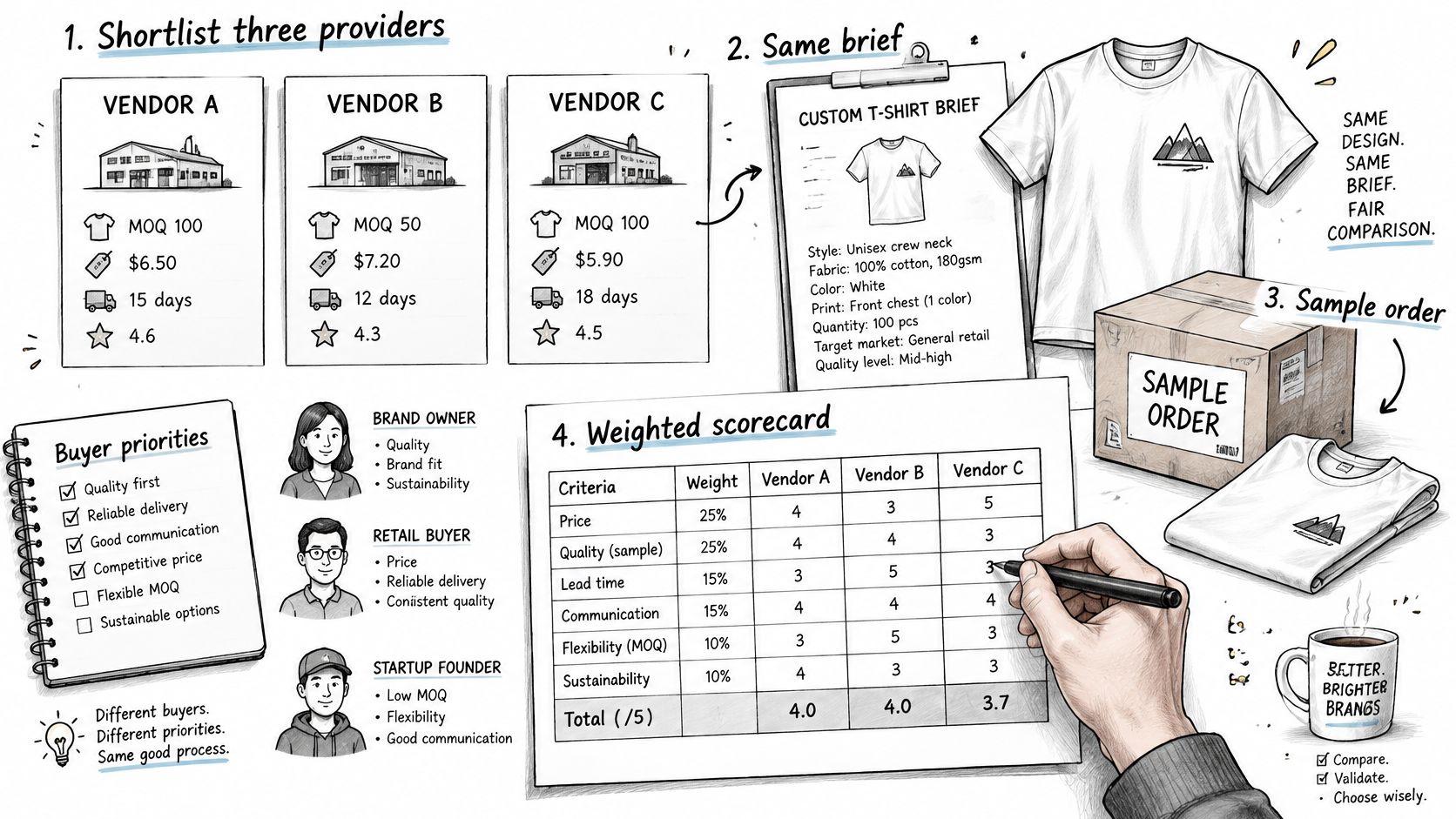
Shortlist three providers and put all three through the same brief. Don't give one vendor your finished vector logo and another a rough screenshot, then compare the experience as if the inputs were equal. Same artwork, same blank category, same sizes, same delivery regions and same deadline.
Turn your scorecard into a weighted sheet before samples arrive. An HR team shipping onboarding kits may double-weight sizing accuracy and private size choice, while a creator weights storefront tools and shipping to fans more heavily. Weighting first stops the nicest sample box from overruling a weak returns policy.
The selection flow below shows the sequence from weighted scoring to a paid sample decision.
What to Compare on the Sample
Order the same blank in the same sizes from each provider and inspect them side by side. Measure chest width and length against each vendor's chart, check placement against the approved position, and compare color with your brand reference under the same light. Look closely at print edges, fine lines and any cracking or heavy hand feel after one wash.
Send one deliberately difficult file as part of the test, such as a low-resolution logo. You're checking whether the platform warns you, whether a human flags it, and how quickly the vendor proposes a fix. Silence at this stage is expensive later, because production will faithfully reproduce a bad file at full quantity.
Include FLYP in that process only if its managed enterprise workflow or creator storefront model fits your buyer type, and score it on the same rows as every other candidate. No provider earns an exemption from sample, sizing or performance checks because its editor looks modern.
Terms to Confirm Before You Pay
Get these answers in writing before bulk production:
- Approval gate: Who approves artwork, and can production start without that approval?
- Wrong-size handling: What happens to the garment, who pays return shipping, and how fast is a replacement sent?
- Recipient sizing: How do recipients choose sizes privately, and what data can your team see?
- Landed cost: What's the full cost per delivered unit for each destination, including duties where they apply?
- Lead time: How many days run from final approval to delivered garment, and what does a rush option cost?
That last answer matters more than teams expect. A late onboarding kit misses the start date it was ordered for, and event shirts delivered after the event become storage, not marketing.
Use one decision rule. Choose the platform with the highest weighted score, provided it passes your performance targets and sizing checks, and drop any option that can't produce a physical sample. I would rather pay more per unit for measured garments, stated tolerances and a clear replacement policy than save money on shirts people won't wear.
If you're ready to put your shortlist to work, FLYP LTD offers managed global merch for enterprise onboarding, recognition and events, plus creator storefronts with production, fulfillment and returns handled after approval. Bring your weighted scorecard, your test brief and your sample requirements, and judge the workflow on fit, print accuracy and delivered cost before you scale your next order.