You've inherited a cupboard of unwanted hoodies, a spreadsheet of missing deliveries, and a new-hire welcome process that depends on someone remembering to send a parcel. Finance wants a predictable budget. Employees want something they'll use. A company merch store can help, but only if you fix the operating model behind it, not just the checkout page.
Table of Contents
- When a Company Merch Store Becomes the Right Move
- Foundational Decisions Before You Pick a Platform
- Choosing Between Platforms, Marketplaces, and Managed Service
- Designing Catalogs and Budgets Employees Can Trust
- Running the Operational Workflow From Invite to Delivery
- Sustainability Beyond the Fabric Label
- Measuring Adoption and Building a 30-Day Launch Plan
When a Company Merch Store Becomes the Right Move
Consider a familiar handover: Marketing owns the artwork, People Ops owns onboarding, and an office coordinator knows where the stock is. Nobody owns the complete experience. When a remote employee asks for a different size, the request passes between teams until someone buys a replacement outside the original budget.
That's an illustrative situation, not a case study. It captures the decision that matters: do you need another merchandise order, or a repeatable employee service? A store becomes useful when recurring requests, distributed recipients, and inconsistent access make manual coordination difficult to govern.
Look for an operating problem
A one-off event purchase can remain a straightforward procurement project. An ongoing program needs eligibility rules, accountable owners, support, and reporting.
Look for these signals before committing:
- Recurring occasions: Onboarding, recognition, and events require repeated access rather than occasional bulk orders.
- Uneven employee experiences: Office-based employees can browse stock, while remote colleagues receive whatever remains.
- Unclear accountability: Nobody can explain who approves replacements, handles complaints, or pays unexpected delivery charges.
- Persistent mismatch: Recipients receive items that don't fit their work, preferences, or circumstances.
Understanding what company swag includes helps define the product category. The store decision goes further: it determines how employees access that category and how the organization manages it.
Separate category demand from employee value
The U.S. promotional-products industry reached $26.78 billion in 2024, with apparel accounting for 26.6% of sales, according to PPAI's sales-volume estimate. Branded clothing is a substantial category, but those figures don't tell you whether your employees want your particular hoodie.
Practical rule: Launch a store to solve a recurring employee-service problem, not to make existing stock look more attractive.
People Ops should own the employee purpose and access policy. Procurement should own commercial terms, while Brand owns approved design standards. That division makes merch a managed service rather than an informal favor.
A store won't repair weak management or replace meaningful recognition. It can make a well-designed welcome or appreciation moment easier to deliver consistently.
Foundational Decisions Before You Pick a Platform
Write the policy before booking demos. Otherwise, you'll compare attractive storefronts without knowing whether they support your actual requirements.
The recognition context matters: 36% of employees received no recognition in the prior year, and only 47% felt recognition was provided fairly, according to SHRM's employee-recognition survey. Treat those findings as a reason to examine access and fairness, not as evidence that a store alone will resolve either problem.
Use this checklist to make the initial decisions explicit.
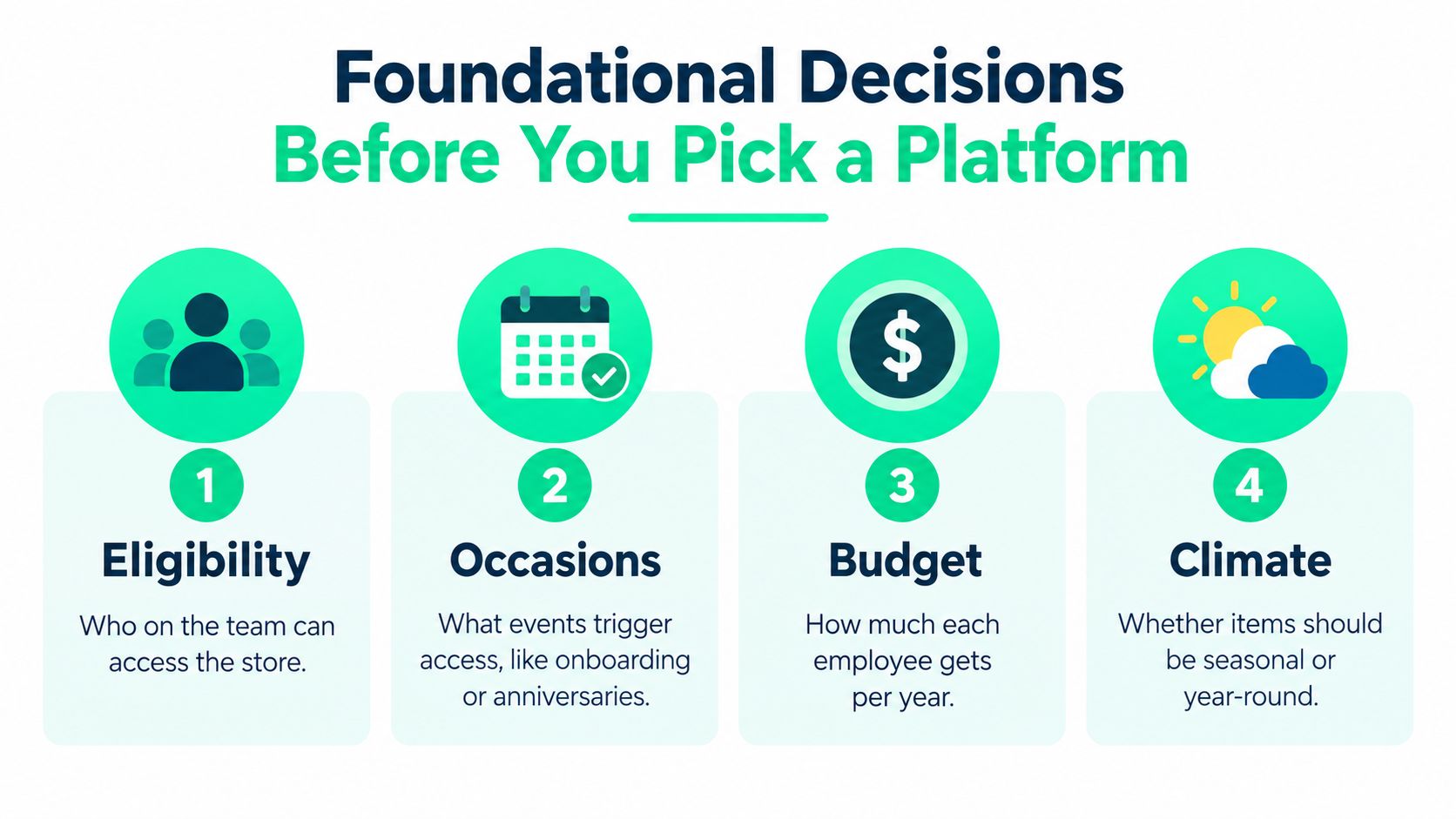
Define access and occasions
Audience comes first. Decide whether employees, contractors, interns, customers, or event attendees can participate. An employee-only store and a public retail store need different access, payment, support, and privacy arrangements.
Specify which occasions create access. A new-hire allowance, manager-nominated recognition award, and event allocation shouldn't become interchangeable because they share a checkout.
Then set eligibility windows. Document when access begins, when unused allowances expire, and what happens during leave, internal transfers, or departure. Employees should be able to understand the rules without asking their manager to interpret them.
Assign governance before automation
Keep the decision brief short enough that stakeholders will review it:
- People Ops: Defines program purpose, eligible groups, occasion rules, and the escalation owner.
- Finance and Payroll: Approve funding boundaries and review how different award types should be treated.
- Legal and Privacy: Review recipient-data collection, processing locations, retention, and vendor responsibilities.
- Brand and Procurement: Establish approval rights, product standards, purchasing authority, and contractual remedies.
Choose whether recipients select products or receive a fixed allocation. Also decide whether catalogs are unified or localized, and who can approve an exception. These are policy decisions, not settings to leave with an implementation consultant.
With that brief in hand, ECORN's guide to find the right ecommerce platform provides a broader platform-selection resource. Use it alongside your employee-service requirements, rather than treating retail functionality as the complete checklist.
The brief should end with acceptance criteria: approved employees can access the right assortment, spend within authorized limits, and obtain support without exposing unnecessary personal data. If a vendor can't demonstrate that workflow, an impressive demo isn't enough.
Choosing Between Platforms, Marketplaces, and Managed Service
The central question isn't which storefront looks most polished. It's which responsibilities your team can realistically retain.
A self-serve platform gives you configuration control, but someone still needs to manage suppliers, product approvals, shipping arrangements, and support. A marketplace can simplify product discovery and ordering, although you'll need to test consistency across suppliers. A managed service shifts more execution to a partner, with less direct control and a service cost to evaluate.
Merch Store Operating Models Compared
| Model | Control | Cost Model | Brand QA | Global Reach | Time to Launch |
|---|---|---|---|---|---|
| Self-serve platform | Extensive configuration control | Software, products, integrations, and operations | Your team defines and enforces checks | Depends on connected suppliers and logistics | Depends on setup and internal capacity |
| Marketplace | Limited to available seller and store options | Item, decoration, delivery, and applicable fees | Requires checks across sellers | Varies by product and destination | Can be quick for a narrow assortment |
| Managed service | Shared through an agreed brief and approvals | Service scope plus merchandise and logistics | Partner executes agreed standards | Must be validated country by country | Depends on sampling, approvals, and rollout scope |
For storefront architecture, WebinOne's guide to choosing an ecommerce CMS for clients is a useful companion. Keep CMS requirements separate from fulfillment requirements: editing a product page and replacing a damaged parcel are different capabilities.
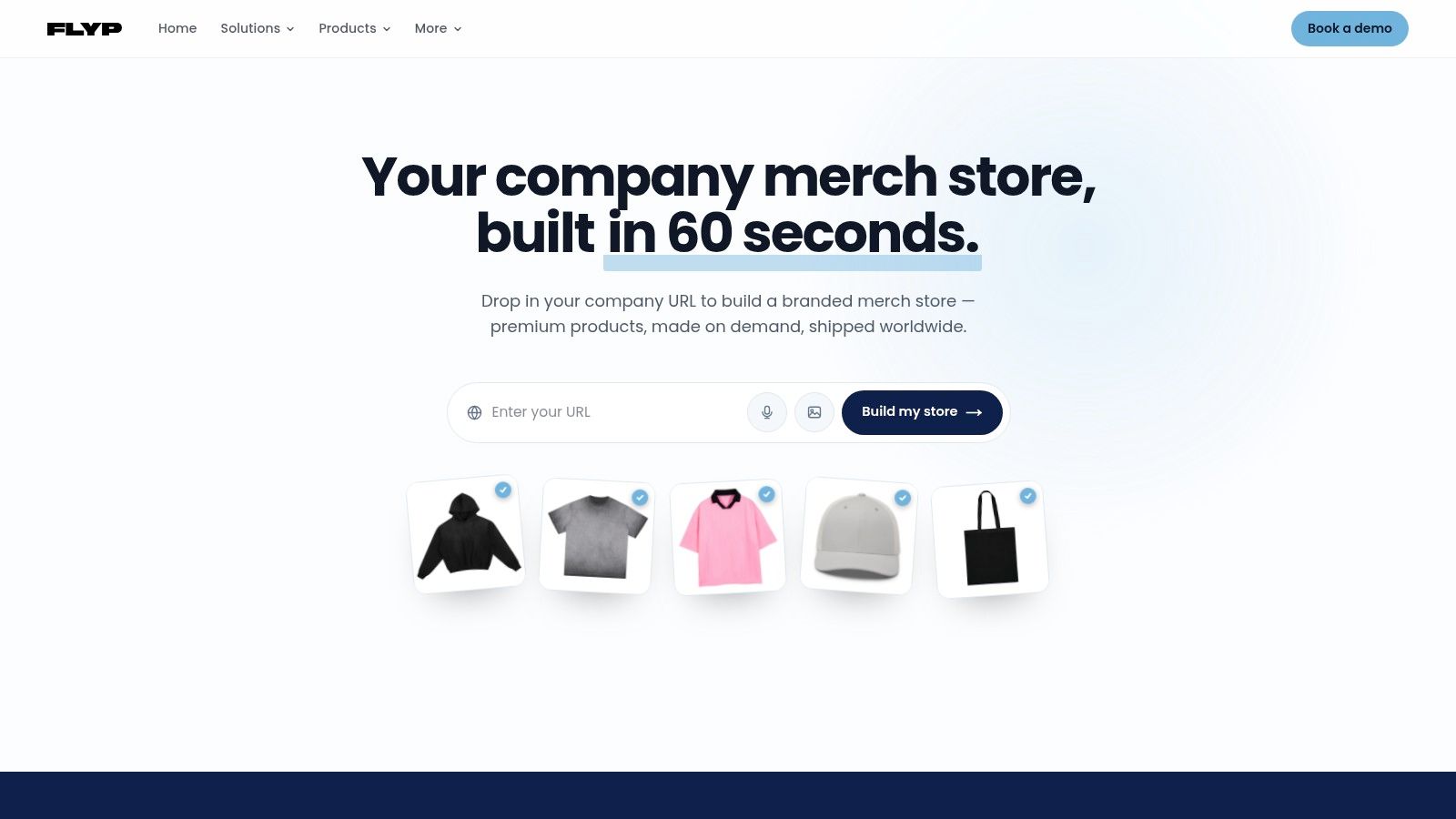
A merch-builder interface can help stakeholders review designs, but it doesn't demonstrate the whole service.
Make the production decision separately
Inventory versus on-demand is a separate choice from platform versus service. You can operate either production model through different storefront arrangements.
Batch production may suit predictable event demand and tightly controlled decoration. The trade-off is committing money before recipients choose, then managing storage and leftover stock. On-demand production reduces that commitment, but requires careful testing of production timing, product availability, and repeat-order consistency.
A small startup with a narrow domestic program may reasonably retain supplier coordination. A distributed enterprise should evaluate regional administration, reporting exports, and exception handling more heavily. Headcount alone shouldn't decide the model; operational complexity matters more.
Ask the vendor to demonstrate a difficult order, not just a successful checkout.
Use a scenario involving an unavailable size, a changed address, and a delivery exception. Ask who contacts the employee, who authorizes the remedy, and which costs appear on the invoice. Request samples and destination-specific service terms before signing.
Designing Catalogs and Budgets Employees Can Trust
A catalog isn't equitable because every employee sees the same products. If one recipient can choose a useful garment while another can only redeem an unsuitable item, identical access hasn't produced a comparable benefit.
Employee preference supports a curated-choice approach: 52% of U.S. employees preferred several gift options, compared with 31% preferring the same item for everyone; 82% valued personalization, and 77% valued premium or trusted brands more highly, according to Custom Ink's holiday-gifting survey. Those are U.S. gifting preferences, not universal instructions for every workforce.
Budget uncertainty shouldn't become the employee's problem.

Design a usable assortment
Segment by geography, climate, employment status, sizing needs, and use case. Ask regional colleagues to review the actual assortment rather than merely approving translated product descriptions.
Pair approved logo treatments with selectable products. Include non-wearable alternatives for employees who don't want branded clothing, and avoid making the most useful options available only through personal top-ups.
- Sizing: Publish garment measurements and fit notes, not just generic size labels. Show local conversions and explain how employees should measure.
- Accessibility: Check selection, checkout, product information, and support for barriers. Offer an alternative route when someone can't use the storefront.
- Availability: Hide products that can't be supplied to a destination, rather than revealing restrictions after selection.
A smaller, dependable catalog is easier to defend than a broad assortment full of unavailable variants.
Budget for comparable value
Define equitable budgets as comparable usable value, not identical nominal currency amounts. Model the merchandise allowance separately from decoration, shipping, duties, support, and replacements. Then have Finance approve the full program cost.
For a points-based store, assign redemption values to products and test whether employees in each region can select a meaningful assortment within their allowance. Keep point values understandable. Don't disguise expensive shipping by charging employees more points for the same item without explaining why.
Store credits don't automatically determine tax treatment. Separate employee-choice budgets from cash-equivalent awards, and ask local Payroll or Legal to review the relevant treatment. Explain any employee liability before redemption, with an approved route for resolving questions.
Budget boundary: The employee should know what their allowance covers before choosing, not after receiving a charge.
Record who approves regional adjustments and when values are reviewed. That gives Finance a defensible policy and employees a predictable experience.
Running the Operational Workflow From Invite to Delivery
Run the company merch store through explicit checkpoints. Automation should move approved decisions between systems, not invent policy when an order becomes complicated.
Timing deserves attention. Work Institute's onboarding summary reports that 83% of high-performing companies begin onboarding before day one, 69% of employees exposed to structured onboarding are more likely to stay three or more years, and 70% decide whether to stay or leave within the first six months, as described in its onboarding research summary. These findings concern onboarding, not a causal effect of merchandise on retention.
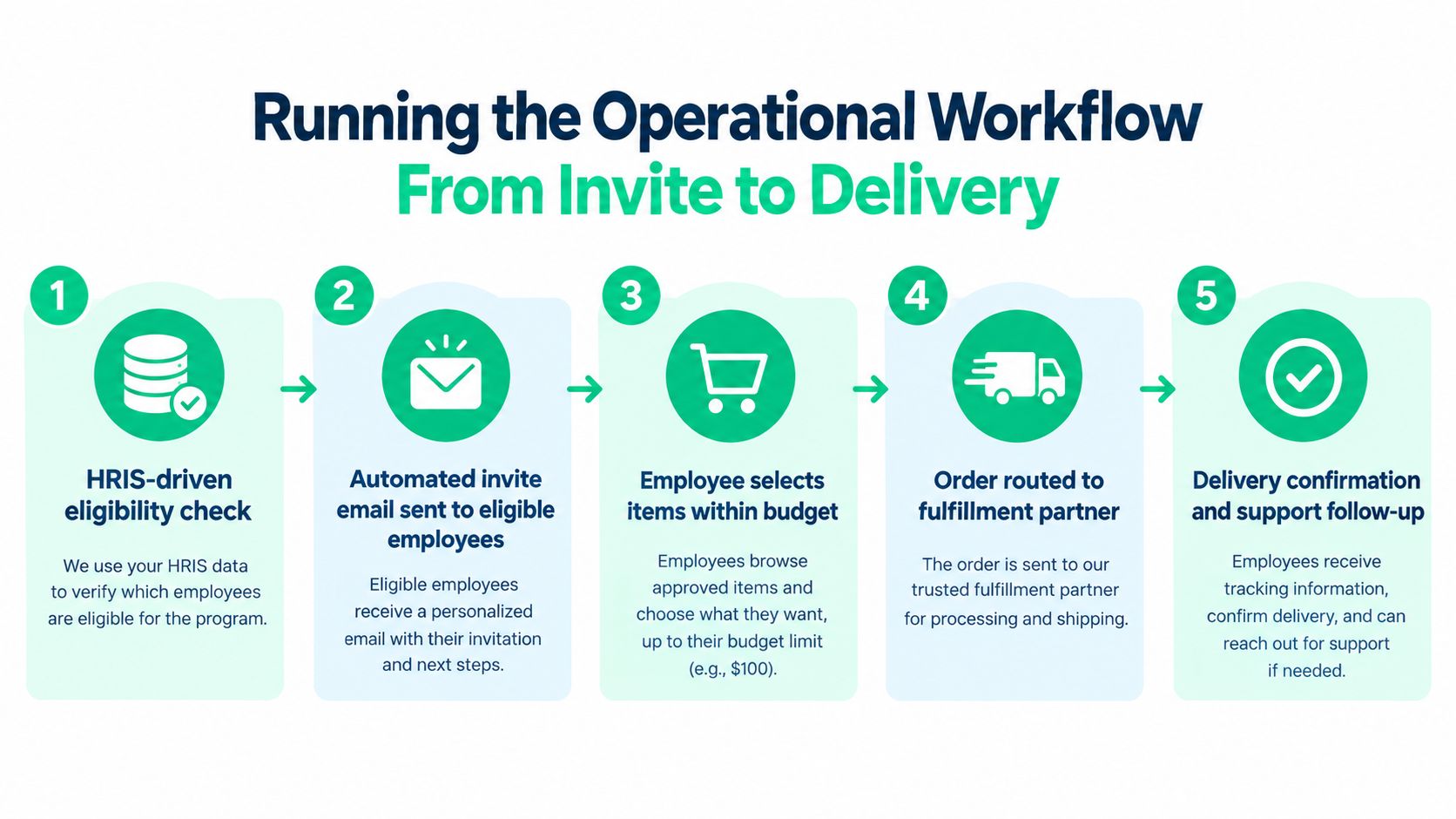
Use this workflow as the operational skeleton.
Put checks at each handoff
- Eligibility and invitation: Use the HRIS as the eligibility reference, with an approved integration or controlled import. Check start-date changes, duplicate records, and withdrawn invitations before release.
- Recipient selection: Capture the selected variant, delivery address, required tax information, and appropriate consent or privacy acknowledgment. Collect only what the workflow needs.
- Production release: Validate budget authorization, destination availability, approved artwork, and address completeness before routing the order.
- Dispatch: Apply agreed packaging standards and verify tracking information. Determine who handles customs documentation and importer responsibilities.
- Delivery and support: Record delivery confirmation separately from dispatch. Keep an exception queue for missing, damaged, refused, or incorrectly supplied orders.
For onboarding, plan pre-start store access, first-week delivery confirmation, and manager follow-up at the established onboarding milestones. If production won't meet the intended welcome date, communicate that before the employee starts.
The embedded video offers a separate viewing resource.
Keep exceptions off one coordinator's desk
Put service expectations in writing: acknowledgment deadlines, production windows, tracking updates, escalation ownership, and replacement authorization. Distinguish production time from transit time, and request destination-specific commitments rather than a blanket global promise.
Vendor support should handle package-status queries where contracted. Brand should resolve artwork questions; People Ops should handle eligibility disputes. An internal program owner remains accountable when those teams disagree.
For exchanges, distinguish employee fit changes from supplier mistakes and damage. Explain return eligibility before checkout, including restrictions on personalized products. Require a reason code and final resolution for every exception, so unresolved requests don't disappear into email.
Before opening broadly, test the whole path with internal recipients. Include an address correction and an exchange request. A successful purchase proves the checkout works; a resolved exception proves someone can operate the service.
Sustainability Beyond the Fabric Label
A recycled garment that nobody wants still creates an unwanted-item problem. Materials matter, but procurement also needs to examine production decisions, packaging, transport, and what happens after delivery.
European e-commerce research found that 73% of internet users pay attention to packaging, 52% are willing to pay extra for eco-friendly packaging, and 63% recognize the environmental consequences of returns, with the latter figure twice the previous year's level, according to the Sustainable E-commerce 2025 report announcement. This is consumer e-commerce evidence, not a measurement of your employee-merch footprint.
Ask for lifecycle evidence
Use a scorecard that records evidence, gaps, and responsible owners rather than awarding products an unexplained green badge.
| Lifecycle area | Evidence to request |
|---|---|
| Demand planning | Redemption forecasts, unused stock records, and purchasing assumptions |
| Production | Batch or on-demand rationale, production locations, and material documentation |
| Packaging | Material composition, packaging weight, and destination-relevant disposal guidance |
| Transport | Origin, destination, shipping mode, and consolidation options |
| Fit and returns | Sizing-related reasons, replacement shipments, and final item disposition |
| End of use | Feasible repair, donation, or resale routes and applicable brand restrictions |
| Emissions reporting | Calculation method, reporting boundaries, and missing-data disclosures |
Neither on-demand nor regional inventory is automatically the lower-impact option. On-demand can avoid speculative stock, while batch production may support consolidated shipments. Regional stock may shorten delivery routes but introduces forecasting and surplus risk.
The appropriate decision depends on actual demand and supplier evidence. Don't claim an environmental improvement unless the reporting supports it.
Connect the storefront to procurement
Grumspot's eco-friendly ecommerce design advice offers a storefront-focused resource. Pair interface choices with supplier questions about sustainable clothing production, rather than treating website messaging as proof of product impact.
Employee choice may help avoid unwanted purchases, but that remains a hypothesis to evaluate in your program. Examine which items employees retain, why they exchange garments, and whether replacements require additional shipments.
- Avoid vague labels: Replace “eco-friendly” with specific, documented material or process descriptions.
- Plan disposition: Confirm whether recipients can realistically repair, donate, or resell items before presenting those routes as solutions.
- Expose uncertainty: Mark missing supplier data and require follow-up instead of filling gaps with optimistic assumptions.
Give ESG colleagues a traceable record of decisions. A qualified claim backed by evidence is more useful than a confident claim nobody can audit.
Measuring Adoption and Building a 30-Day Launch Plan
Units shipped measure activity, not appreciation. Build reporting around invite-to-redemption, selection completion, redemption time, opt-outs, exchanges, returns, and employee-rated usefulness at 30 and 90 days. Calculate cost per engaged recipient using a documented definition of engagement and fully loaded program costs.
Compare adoption and usable value across eligible regional cohorts. An engagement-tracking approach should distinguish browsing from selection and delivery from satisfaction.
Evaluate outcomes without overstating causality
Connect store records to permitted HRIS data to examine first-90-day attrition, onboarding-task completion, time-to-productivity, and recognition participation. Compare a merch-supported cohort with a matched standard-onboarding cohort, accounting for location, role, manager, hiring wave, and employment type. Report associations with transparency; a difference does not establish that merch caused it.
Use the launch month deliberately
- Align stakeholders: Approve purpose, ownership, eligibility, privacy requirements, and spending boundaries.
- Design the catalog: Obtain regional feedback, confirm usable allowances, and approve samples.
- Select the operating model: Test vendor workflows and agree on service and reporting obligations.
- Pilot before expansion: Choose recipients across relevant locations and working arrangements, then inspect exceptions.
- Run the first reporting cycle: Review participation, costs, support cases, and employee feedback. Assign fixes before expanding access.
A 30-day launch plan can produce a governed pilot, not necessarily a complete global rollout. Start Monday by drafting the decision brief and assigning an accountable owner.
FLYP LTD offers managed company merch stores with curation, design QA, budgeting, production, global logistics, and reporting. Visit FLYP LTD with your eligibility rules, regional requirements, and pilot scope to discuss which responsibilities your team wants to retain and which it needs a partner to handle.