A new hire needs a welcome kit, an event lead wants branded jackets, and finance wants to know which budget paid for last month's orders. Meanwhile, People Ops is collecting sizes in a spreadsheet and chasing delivery updates. Company store software should replace that coordination work, but a storefront alone won't solve it. You need a system that connects employee choice to purchasing rules, recognition moments, fulfillment and a usable financial record.
Table of Contents
- What Company Store Software Does and Which Model Fits
- Core Features Enterprise Teams Rely On
- Vendor Selection Criteria for Enterprise Stores
- Governance Controls Finance and Security Will Ask For
- How to Launch a Company Store in Seven Steps
- Measuring Recognition, Participation and Spend
- Common Pitfalls and How to Avoid Them
- Confirm Your Pilot Scope Before You Commit
What Company Store Software Does and Which Model Fits
Company store software manages a branded catalog, employee credits or allowances, checkout, spending records and the handoff to production and fulfillment. A company swag store is the employee-facing part: an internal storefront where people choose merchandise using allowances allocated by People Ops.
In our managed service at FLYP LTD, we run production, fulfillment and reporting while the company runs the brand. The funding model determines how that service should work.
Store models by funding and choice
| Model | Who funds it | Who chooses | Best for |
|---|---|---|---|
| Direct-send kit | Company | Company, no employee choice | Welcome kits and executive gifting |
| Employer-paid credit store | Company, recurring or one-time credits | Employee | Everyday recognition and self-service |
| Payroll-deduct store | Employee | Employee | Optional premium merch |
| Hybrid store | Company credit plus employee co-pay above the allowance | Employee | Programs with a budget ceiling |
| One-time event grant | Company | Employee or event lead | Conferences, offsites and team events |
These models address different operational needs. Our primary store goals are replacing manual swag operations, giving employees self-service choice, creating an employer-brand surface and consolidating regional swag spending. Our guide to on-demand merch explains the production approach that can support a store without treating every catalog item as a bulk inventory commitment.
Central distribution without dependence
Historically, a company store supplied workers with necessities, often in isolated industrial communities; some accepted employer-issued scrip that restricted purchasing choice, as the historical account of company stores describes. A modern workplace store should preserve centralized convenience, not employer control over household spending. Participation should be optional, prices transparent and employee payment clearly distinguished from employer funding.
Say a People team wants consistent onboarding but flexible milestone recognition. It can send a standard welcome kit directly, then offer employee-choice credits for anniversaries and promotions. Choose the model for the moment, rather than forcing every gift through checkout.
Core Features Enterprise Teams Rely On
A useful platform connects the catalog employees see to the rules administrators set and the orders a fulfillment team delivers. Evaluate those layers together, not as isolated feature checkboxes.
The employee-facing layers
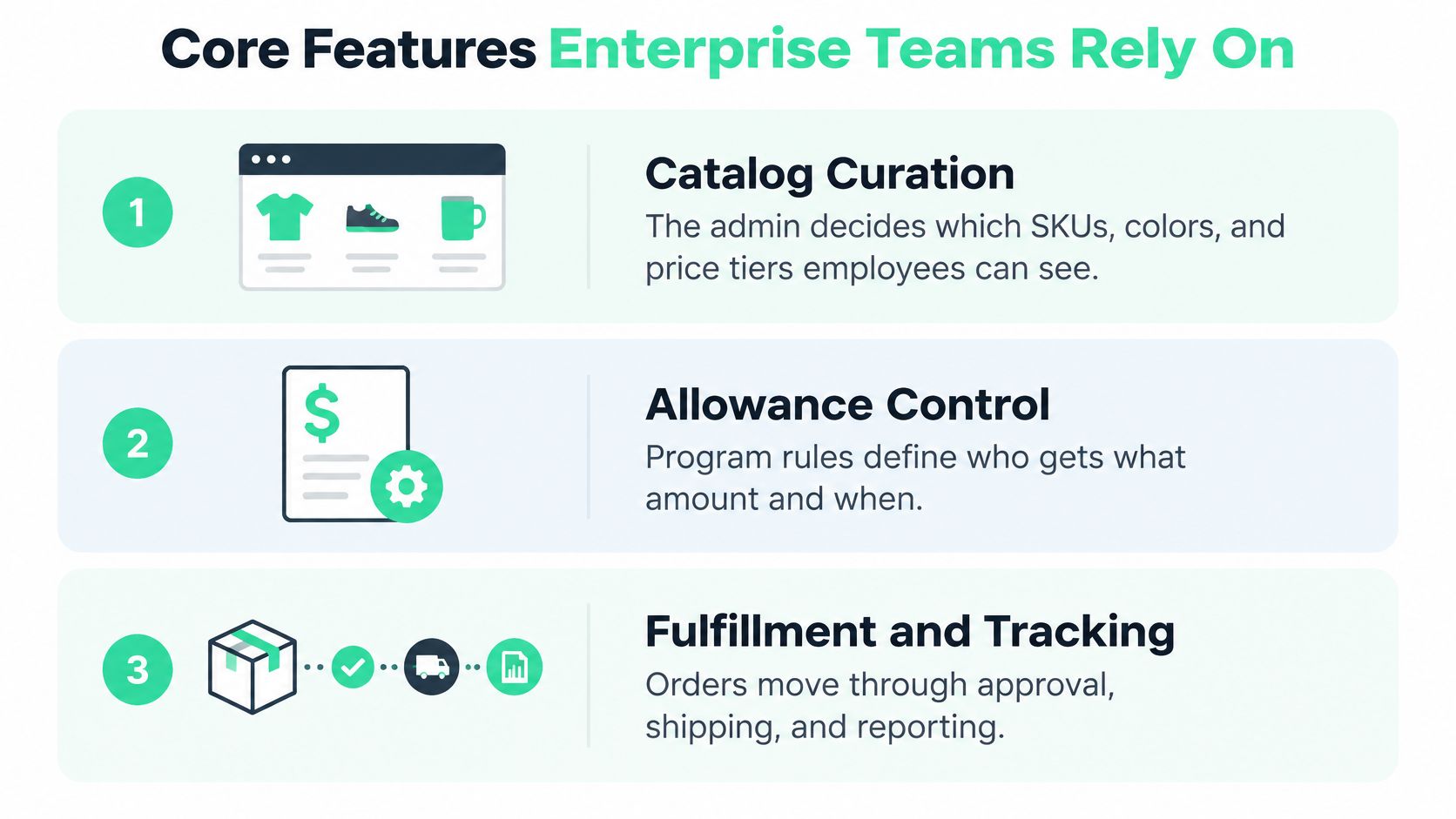
Catalog curation comes first. The program administrator selects the SKUs, colors and price tiers employees can access. A useful assortment offers relevant choices across climates, sizing needs and everyday uses, rather than an unrestricted promotional-products directory.
Allowance control determines purchasing power. Our stores support recurring monthly, quarterly or annual balances and one-time credits for onboarding, anniversaries or bonuses. Employees should understand what their balance covers, whether unused credit remains available and how any employee-funded overage works before checking out.
Identity and personalization connect the right balance to the right person. Our identity layer uses single sign-on so credits, milestones and allowances appear within each employee's own account. This follows the same self-service principle behind self-service payslips and personal data updates, explained by HR Management 365: employees should handle routine tasks without asking HR to act as an intermediary.
From sign-in to delivery
An employee signs in, sees their balance, selects an eligible item and checks out. We then handle production and fulfillment, while the employee needs clear order-status information rather than an email thread with People Ops.
Behind that journey, administrators need ordering, approvals, budget visibility, spending reports and controlled team access. People teams benefit from HRIS-triggered onboarding and milestone workflows; marketing needs consistent logos, colors and tone, plus campaign-level budget visibility.
Use this launch-readiness checklist to separate essentials from later refinements:
- Day-one essentials: A curated catalog, accurate balances, clear overage rules, reliable checkout, order tracking and administrator access.
- Operational readiness: Tested employee eligibility, usable transaction exports and a named owner for delivery questions.
- Later additions: Broader catalog segments, more milestone workflows and campaign-specific storefront experiences once the initial process is stable.
Don't confuse a larger feature list with a better launch. A small catalog with dependable balances and delivery information is more useful than extensive personalization built on unreliable employee records.
Vendor Selection Criteria for Enterprise Stores
Vendor evaluation criteria
| Criterion | What to verify | Red flag |
|---|---|---|
| Store branding | Custom domain, logo, colors, type and tone for each store | Shared platform branding only |
| HRIS integration | Onboarding and milestone triggers from your HR system | Manual uploads for every hire |
| Funding models | Employer credits, payroll deduct and hybrid co-pay | Only one funding model offered |
| Reconciliation | Order totals matched to payments, refunds and invoices | No transaction export |
| Access control | SSO, role permissions and stronger sign-in for admin actions | Shared logins for staff |
| Fulfillment ownership | Who handles production, shipping, returns and support | Returns and shipping left to your team |
| Scoping support | Headcount-based budget model and catalog plan before launch | Catalog chosen without a budget model |
Give funding and reconciliation the most weight
Funding compatibility is a purchasing requirement, not a cosmetic preference. Test whether a vendor can apply your actual allowance and co-pay rules, including what happens when an order is canceled or refunded. For payroll deduction, have payroll and legal reviewers approve the intended process before enabling it.
Reconciliation deserves equal scrutiny. GAO purchase-card audit guidance recommends reconciling transaction-database totals against an independent source; apply that discipline by requesting an order export and matching it against payments, refunds, carrier charges and invoices.
Your proposed ledger should include requester, cost center, SKU, quantity, unit price, destination, approver, allowance consumed, fulfillment status, return status and final invoice value. Test a returned order, not just a clean purchase.
Verify the complete operating service
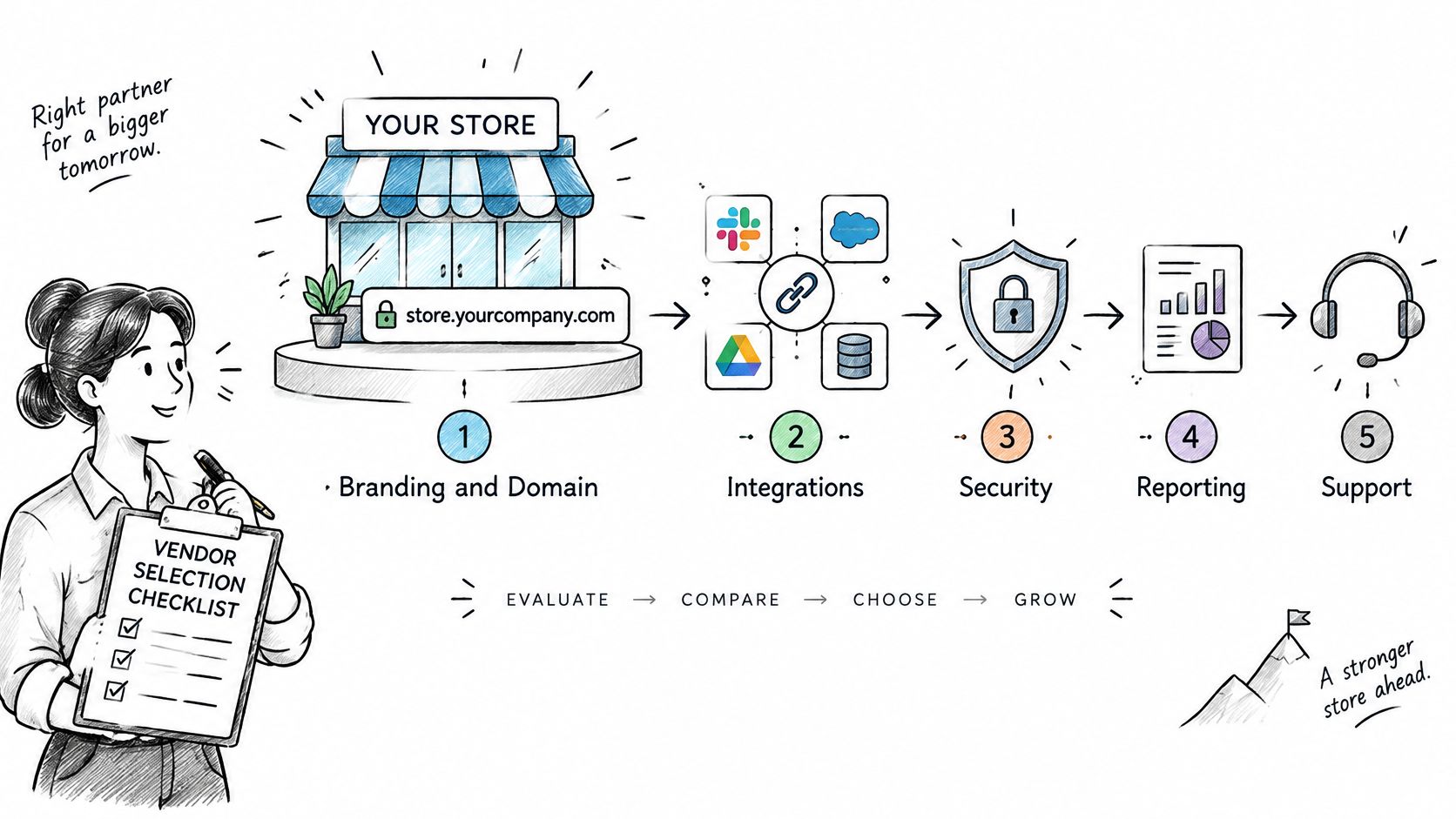
Branding affects whether employees recognize the store as an official company service. Integrations determine whether HR must maintain another employee list. CIQRA's guide to what to consider before selecting ecommerce software offers useful broader platform-selection context, but enterprise buyers also need to establish who owns production, international shipping, customer support and returns.
For our offering, we support employer-paid credits, payroll-deduct stores, hybrid co-pay and one-time employer-paid event grants. Custom domains are available on enterprise plans, and we integrate with major HRIS providers for onboarding-triggered kits. Use the scoping call to confirm your specific HR system, plan entitlement and workflow in writing, rather than treating a general capability as proof of configuration fit.
For a practical scoring method, rate each criterion as unsupported, workable or demonstrated. Give funding models and reconciliation double weight, and require a demonstration or sample document before awarding the strongest rating.
Buying rule: A polished storefront shouldn't compensate for an order ledger that finance can't reconcile.
Build the cost comparison around the full service: merchandise, decoration, platform or management charges, storage, shipping, duties, returns and support. Require vendors to distinguish included services from separately charged work.
Governance Controls Finance and Security Will Ask For
Shopping access and administrative authority shouldn't be equivalent. An employee may need permission to redeem an allowance, but not to increase it, export colleagues' addresses or approve a catalog change.
Access matched to consequences
NIST's digital-identity framework distinguishes identity, authentication and federation assurance so organizations can match controls to risk. For a company store, use employer SSO for workforce access, role-based permissions for HR, procurement and finance, and stronger authentication for sensitive administrative actions.
A security reviewer should first test whether a shopper account can reach privileged functions. For subsidiaries with separate identity providers, document the federation arrangement and required assurance rather than assuming one configuration fits every workforce.
Our customer information security guidance provides context for that discussion. Request a store-specific access matrix before approving the deployment.
Spend authority and audit evidence
We handle checkout, allowance tracking and overage policy for per-employee credits; the customer keeps control of finance. Every enterprise program includes an admin portal for ordering, approvals, budget visibility, spend reporting and team access.
Finance should first inspect who can approve exceptions. The requester shouldn't also be the sole approver and reconciler of an exceptional purchase.
For distributed programs, NanoPIM explains how teams can streamline multichannel orders with an OMS. Centralized order handling can improve operational visibility, but it doesn't replace financial approval rules.
Keep operational responsibility with the service provider and spending authority with named company owners.
Require access-controlled audit records for sign-ins, permission changes, approvals, refunds and exports, plus automatic removal of leavers through the identity lifecycle. Close the governance review with explicit answers:
- Order approval: Who approves routine purchases and exceptions?
- Data exports: Which roles can download employee information?
- Reconciliation: Who runs it, on what schedule, and where are discrepancies recorded?
- Audit review: Who examines privileged activity and confirms access removal?
How to Launch a Company Store in Seven Steps
Launch around an operating process, not a product assortment. Assign a company owner who can coordinate People Ops, marketing, finance and identity administrators, then work through the configuration with the provider.
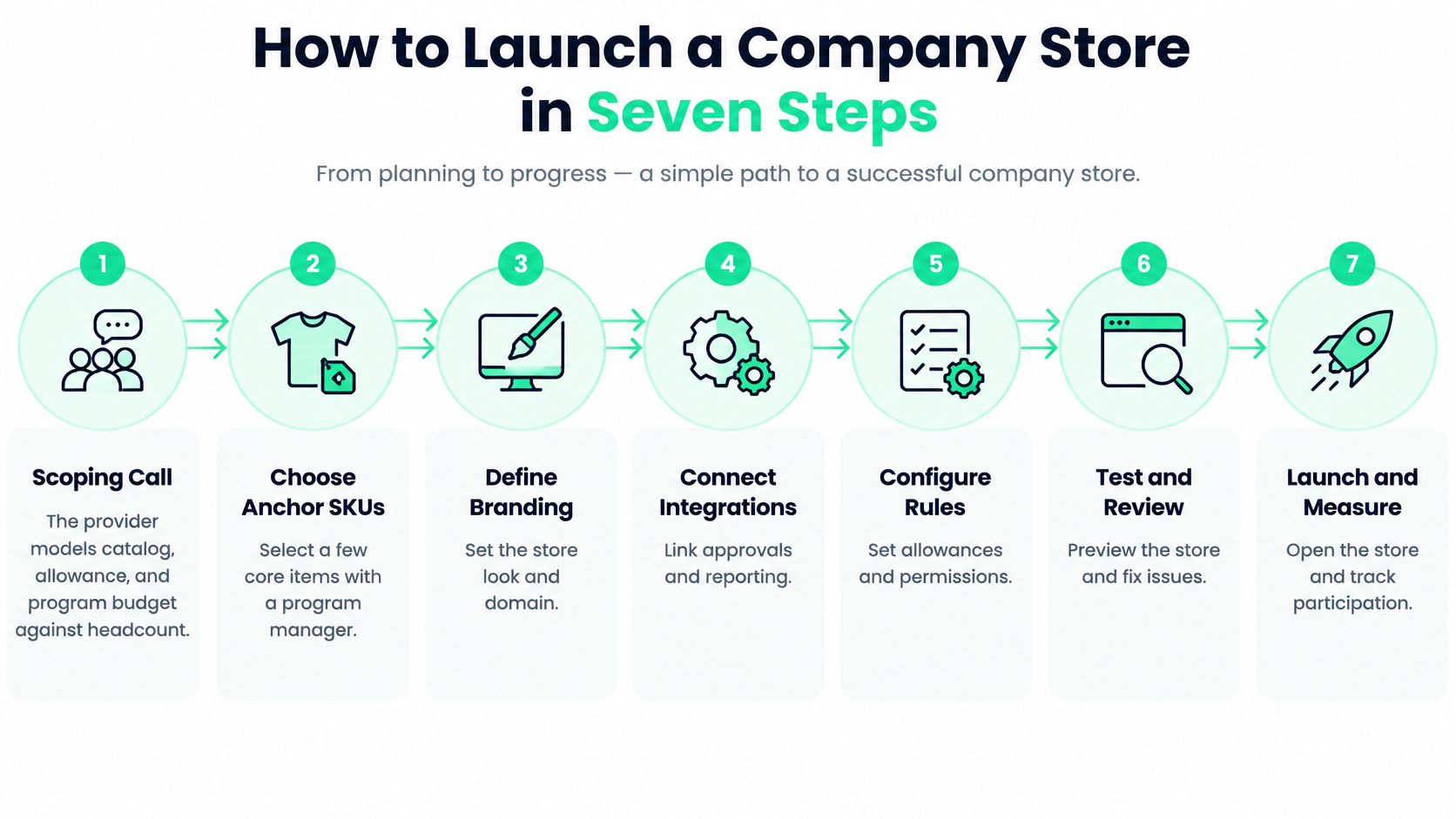
Scope the program against headcount. We begin with a scoping call that models the catalog, allowance and program budget together. Include expected participation and delivery destinations so the merchandise allowance isn't mistaken for the total operating cost.
Choose the anchor products. Our program manager helps select the core SKUs that make the store useful from launch. Review samples, size information and production expectations before approving the collection.
Define the credit rules. Select recurring or one-time funding and the appropriate employer-paid, employee-paid or hybrid arrangement. Record overage handling, cancellation treatment and refund allocation in the configuration document.
Map the employee events. Connect the relevant HRIS fields for new hires, anniversaries and promotions, then test eligibility and credit issuance using test records. Confirm how corrections to employee records affect pending grants.
Configure access and approvals. Have identity and finance owners approve roles and thresholds before employees enter the store. Test a permitted purchase, a blocked purchase and an exception requiring approval.
Apply and review the brand. Approve the logo, colors, typography, tone and domain arrangement. Preview product pages and transactional messages as an employee, including on a phone.
Pilot before opening broadly. Use a defined team or region and test the complete journey through delivery, support and a return. We create the collection and store, then handle production, delivery and support.
Define the opening review
During the pilot, reconcile orders weekly, monitor redemption and record support issues by cause. Make a deliberate catalog adjustment after reviewing those signals, rather than changing products whenever someone requests another option.
A successful launch is a closed operating loop: an eligible employee receives the right allowance, places an authorized order, receives the item and leaves a transaction finance can verify.
Measuring Recognition, Participation and Spend
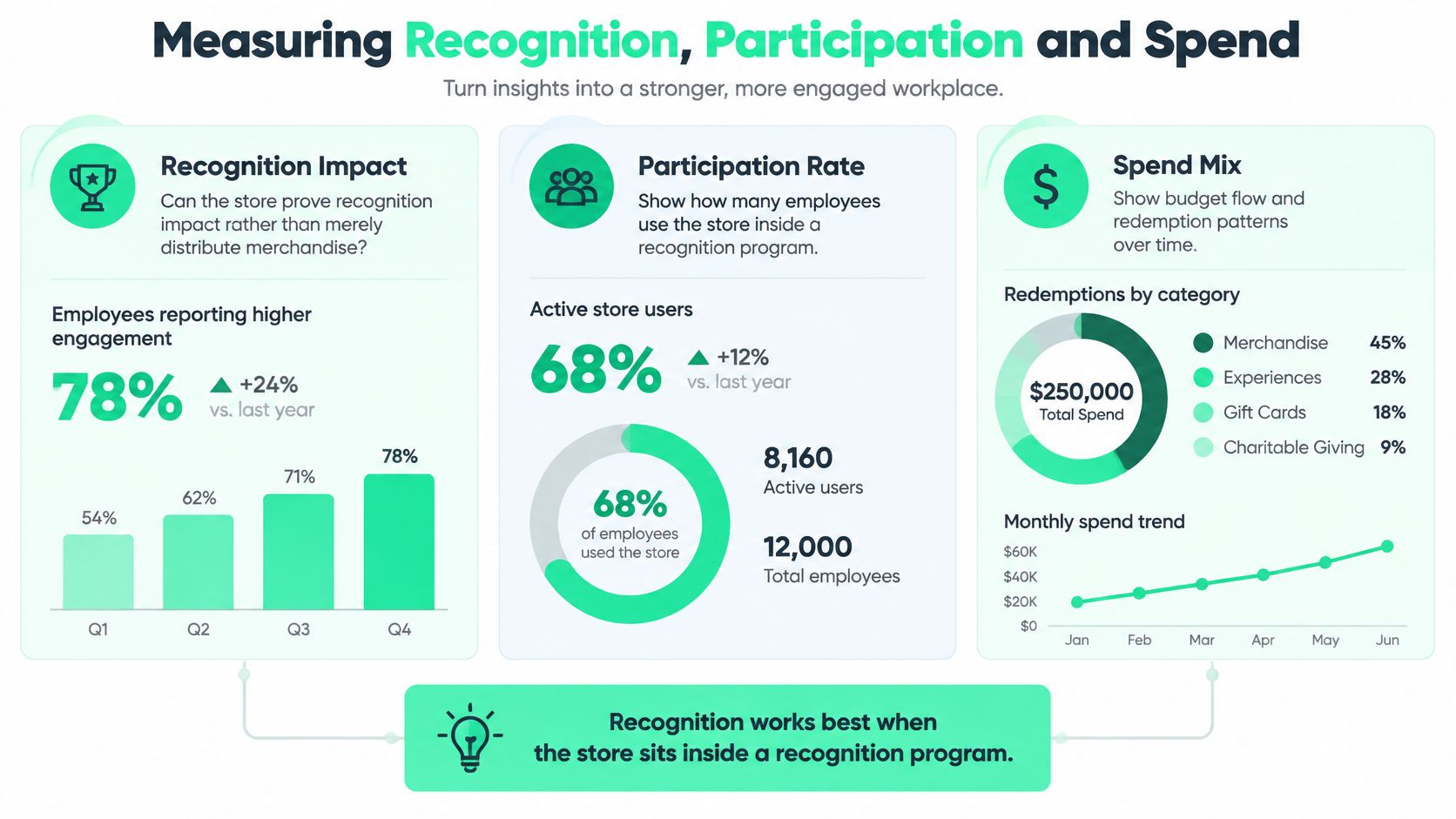
Start with measures your People lead can calculate: participation, credit redemption, program spend and cost per redeeming employee. Then ask the harder question: did the recognition experience improve how employees feel, or did the store distribute merchandise?
JLL's 2025 survey of 8,700 office workers across 31 countries found that younger workers place greater emphasis on visibility, rewards, recognition, wellbeing and belonging. That supports designing a thoughtful recognition experience, not assuming merchandise alone produces retention.
Separate activity from outcomes
Our reporting layer covers spend, redemption rates, sizing data, regional split and environmental footprint. Define each denominator: participation can mean employees redeeming divided by eligible employees, while credit redemption can mean credit value spent divided by credit value issued.
Calculate cost per engaged employee as total program spend divided by employees who redeemed. This is an operational definition of engagement, not evidence of emotional commitment. Our guide to engagement tracking provides additional context for interpreting program activity.
Benchmark evidence and what it shows
| Source | Figure | What it does and does not show |
|---|---|---|
| Custom Ink 2024 Employee Swag Survey, surveying 1,064 U.S. adults | 94% of employees receiving workplace swag at least monthly reported being very satisfied with their employer | Association with satisfaction, not proof that swag causes retention |
| Snappy 2025 Holiday Gifting Survey, surveying 1,500 employed U.S. adults | 67% said a meaningful employer gift increased their job satisfaction | Self-reported gift effect, not a program-level result |
| 2024 Employee Swag Survey reported by The Economic Times | 33% of employees receiving branded gifts less than once a year were very satisfied with their employer | Suggests frequency may matter; check the method before relying on it |
| Dataintelo 2025 corporate gifting analysis | Organizations allocate $50 to $400 per employee annually for gifting | Market estimate for budgeting, not a benchmark for your program |
Test recognition rather than assume it
Embed the store within manager-nominated awards, onboarding completion or milestone recognition. Collect a short pulse survey before and after launch, and compare an eligible recognized cohort with a comparable holdout receiving no store credit during the test period.
Where feasible, randomize the timing of access without withholding an established entitlement. Report aggregate results, suppress small groups and account for differences in manager behavior or employee tenure.
Measurement caution: Report financial ROI only when the test supports a defensible monetary value.
Use (measured value minus program cost) divided by program cost for ROI. Otherwise, report satisfaction changes alongside cost and participation; marketing can separately compare campaign spend with redeemed items verifiably shared in campaigns.
Common Pitfalls and How to Avoid Them
Premium sustainable swag can still create waste. Overproduction, avoidable size exchanges, individual international shipments and retired logos can undermine an otherwise thoughtful material choice.
VF Corporation reported tracing 61% of key materials volume across five supply-chain tiers in FY2025. Even major apparel businesses can have incomplete upstream visibility, so don't treat a sustainability badge as a substitute for product-specific evidence.
Pitfall symptoms, causes and fixes
| Symptom | Likely cause | Fix |
|---|---|---|
| Unused credits and low redemption | Catalog too wide or items not relevant to employees | Keep fewer anchor SKUs and refresh the catalog quarterly |
| Duplicate or unapproved orders | No per-user budgets or approval thresholds | Set limits, eligibility rules and approvals before launch |
| Shared admin logins | No SSO or role permissions | Configure SSO, roles and approvals before anyone shops |
| Milestone credits not dropping | Unmapped HRIS fields | Map new-hire, anniversary and promotion fields before launch |
| No overage policy | Credit rules set without limits | Define overage and co-pay rules before the first credit |
| Leftover stock and deadstock | Overproduction without a demand forecast | Use made-to-order or small-batch runs for core items |
| Obsolete logos still on sale | Retired brand assets never removed | Set a brand-asset review date and remove retired designs |
| Returns missing from the ledger | Returns handled outside the order record | Reconcile returns against refunds and carrier charges |
| Store used for every gift | Hybrid program not designed | Send welcome and executive gifts through direct-send kits |
| Sustainability claims unsupported | No supply-chain documentation | Require evidence for recycled content and materials before publishing |
Match inventory to the delivery promise
Made-to-order can reduce speculative stock, but production must fit the promised delivery window. Small-batch or regional inventory can suit date-sensitive event kits, provided an event owner approves the demand forecast and surplus plan.
For returned or surplus goods, establish routes for repair, resale, donation, recycling or end-of-program take-back. Confirm recipient acceptance and processing arrangements before presenting any route as an assured outcome.
Before publishing environmental or labor claims, request:
- Materials evidence: Product-level composition records and documentation supporting recycled-content or preferred-material claims.
- Packaging records: Specifications describing what ships with the product, not just the garment.
- Emissions methodology: Calculation boundaries, assumptions and the activities included.
- Worker-condition evidence: Supplier coverage, assessment scope and documented corrective-action processes.
Keep claims as narrow as the evidence. A documented material attribute doesn't establish that the entire order, delivery process or supply chain is sustainable.
Confirm Your Pilot Scope Before You Commit
Commit to a bounded pilot, not an unrestricted rollout. Choose a single team, region or recognition moment so you can distinguish product relevance from configuration and delivery problems.
Before the scoping call, prepare a short decision pack:
- Budget boundaries: The employer allowance, total program ceiling and per-user purchasing limit.
- Named owners: The approver, reconciler, identity administrator and employee-support contact.
- Success measures: Redemption, cost per redeeming employee, pulse-survey responses and return reasons.
- Written evidence: A sample transaction export, access-control summary, HRIS integration plan and verified scope of service.
Our enterprise team can have a branded pilot store running inside three weeks. We also offer AI-designed company swag with no minimums, which can support a narrowly scoped assortment without requiring a speculative bulk commitment.
Request relevant references and written confirmation of the capabilities that determined your shortlist. Set a post-launch review date before opening access, then use the results to decide whether to expand, change the assortment or stop.
Make the funding-model decision first. Whether the employer, employee or both pay determines the budget structure, approval workflow and reconciliation requirements your pilot must prove.
FLYP LTD offers managed company stores that connect curated merchandise, employee allowances, production, fulfillment and reporting. Visit FLYP LTD to scope a pilot around your headcount, funding model and recognition moment, with clear budget and operational responsibilities before launch.