Well-recognized employees were 45% less likely to have left their organization after two years, according to Gallup and Workhuman's study tracking nearly 3,500 employees from 2022 to 2024. That's a substantial association, but it isn't a promise that buying gifts will prevent departures. The useful question is what an organization must do to make recognition meaningful, credible, and reachable across its workforce.
Table of Contents
- Employee Recognition Benefits in the Numbers
- What Employee Recognition Actually Means
- How Recognition Changes Retention and Engagement
- What Recognition Does to Performance and Profit
- Recognition Moments That Make Benefits Real
- How to Scale Recognition Without Making It Generic
- Rolling Out a Recognition Program in 90 Days
- Pick a Recognition Mix You Can Measure
Employee Recognition Benefits in the Numbers
The strongest case for recognition combines retention, engagement, and employees' experience of being valued. Those outcomes aren't interchangeable. Staying with an employer is a behavior; feeling appreciated is a perception; engagement describes a broader relationship with work.
People teams should therefore resist combining every positive finding into a single return-on-investment claim. Employee recognition benefits have different evidence bases, and each requires a different operational response.
Employee recognition benefits and the evidence behind them
The Gallup and Workhuman findings below distinguish the experience of being well recognized from having a recognition program.
| Benefit | Evidence | Practical read |
|---|---|---|
| Two-year retention | Well-recognized employees were 45% less likely to have left after two years, in the longitudinal study identified above. | Consistent recognition is associated with workforce stability, not guaranteed retention. |
| Engagement | Earlier Gallup findings reported in that study linked strongly agreeing that recognition was sufficient with being four times more likely to be engaged. | Ask whether recognition meets employees' needs, not just whether managers send praise. |
| Coverage gap | Gallup reported that 22% received the right amount; 55% of U.S. employees received none or recognition meeting none of its strategic criteria. | Program availability doesn't establish that employees experience meaningful recognition. |
| Feeling valued | In Fiserv's August 2024 Gift Card Gauge survey, 89% said an employer reward or incentive made them feel like a valued team member, according to Fiserv. | A tangible reward can communicate membership, although the survey doesn't establish a retention effect. |
| Personal meaning | 84% felt more appreciated as a person when receiving customized recognition for performance, according to Reward Gateway's 2024 employee research. | Personalization deserves a place in program design; this finding isn't a direct comparison of gift catalogs. |
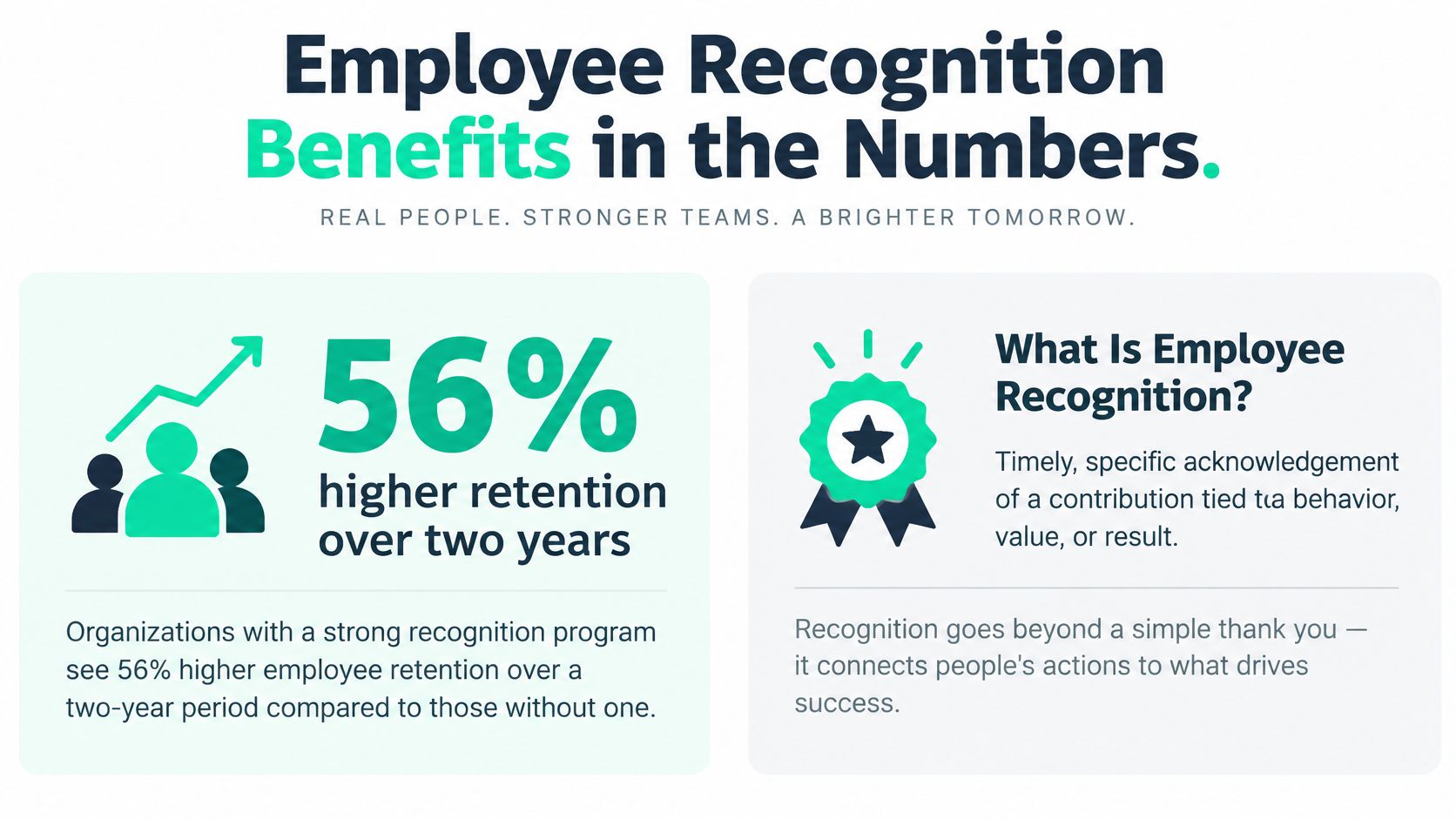
The supplied visual accompanies the retention evidence. Use the longitudinal finding stated above for decision-making, rather than interpreting the illustration as a separate retention estimate.
What the numbers require from People teams
Employee recognition means timely, specific acknowledgment of a contribution tied to a behavior, value, or result. It's distinct from salary and standing perks because it identifies something the employee did.
That distinction changes the implementation question. A rewards budget establishes spending capacity, but it doesn't establish whether a night-shift supervisor notices good work, whether a remote employee receives a personal message, or whether an international recipient can use the reward.
Treat these findings as reasons to build a delivery capability, not just purchase more items. Leaders need a reliable way to identify contributions, communicate their significance, and check whether employees experienced the acknowledgment as intended.
The operating gap: Intentions are easy to announce. Consistent, meaningful delivery requires ownership, access, and follow-through.
What Employee Recognition Actually Means
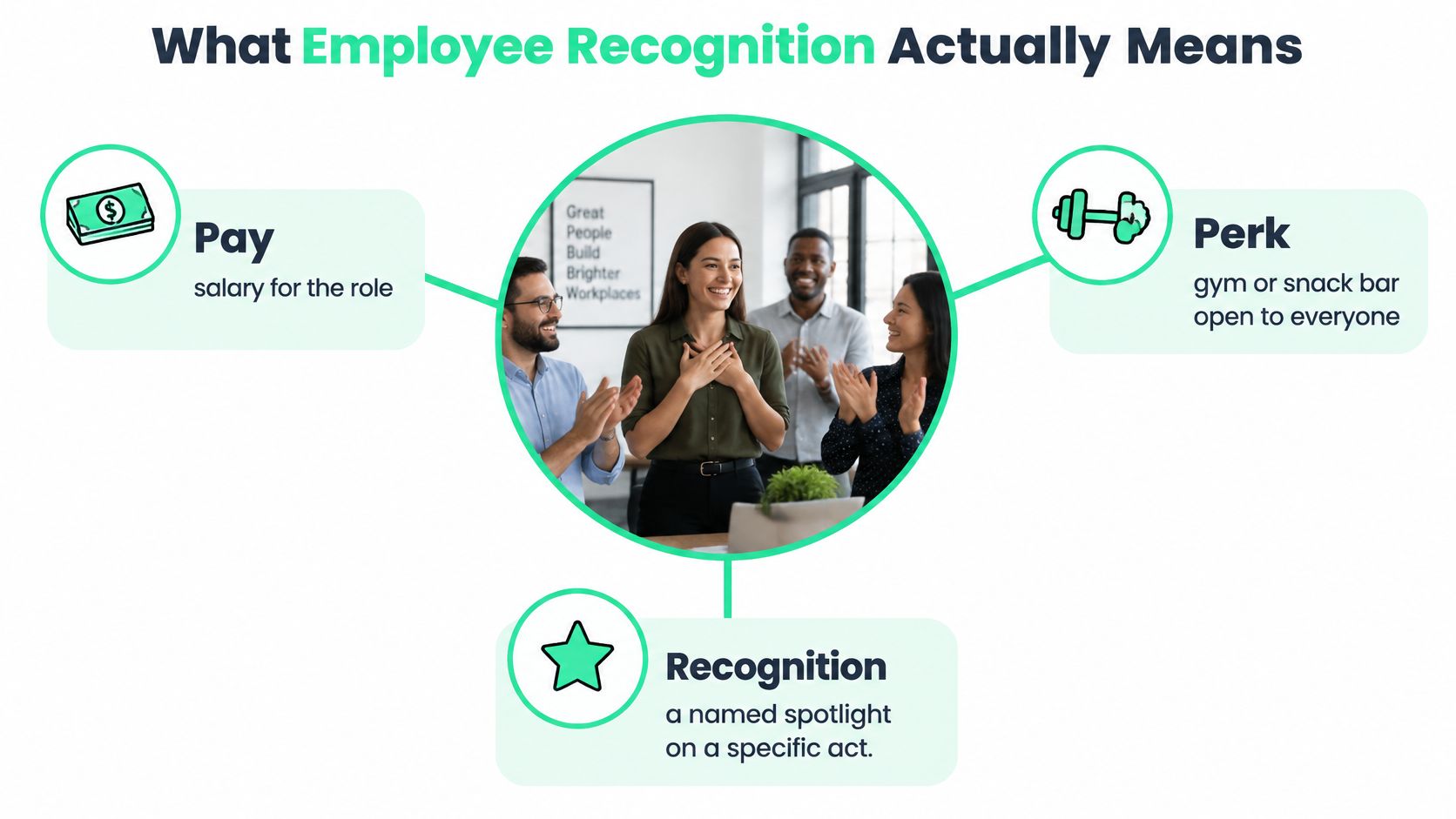
Pay compensates someone for a role. A perk, such as a gym membership or snack bar, is available because they work there. Recognition puts a named spotlight on a specific act.
This distinction is useful when deciding whether a proposed benefit is acknowledgment or another employment offering.
The same contribution handled differently
Say a support lead stays late to resolve a launch-blocking customer issue. A generic thank-you at the team meeting acknowledges effort but leaves colleagues guessing about what mattered.
A better note names the action: the lead coordinated engineering and support, explained the workaround clearly, and protected the customer's launch. Be careful not to celebrate late working itself. Recognize the judgment and collaboration, while separately addressing workload.
A tangible milestone can accompany that message, with the employee choosing how to mark it. The item doesn't replace the explanation.
Test the moment before sending it
Use these practical criteria rather than treating every positive message as equivalent:
- Specific: Name the contribution instead of using interchangeable praise.
- Timely: Deliver acknowledgment while the event remains clear.
- Behavior-linked: Explain the value or result the action served.
- Credible: Check that colleagues could understand the basis for recognition.
- Fair to earn: Make the opportunity available through comparable work, not proximity to leadership.
Social recognition describes visibility. Manager and peer recognition describe who gives it. Tangible recognition describes an accompanying reward, which needn't be cash. These categories overlap: a peer nomination might lead to a public acknowledgment and an employee-chosen item.
For a complementary discussion of recognition, use the video alongside these practical tests.
Recognition works when the employee can tell what they did, why it mattered, and that people like them can earn it too.
How Recognition Changes Retention and Engagement
Employees who don't feel adequately recognized are twice as likely to say they'll leave their organization within the next year, according to Gallup's analysis of engagement and operating outcomes. That measures stated intention, not observed departures, and it doesn't isolate recognition as the cause.
Gallup's broader engagement comparisons also associate top-quartile teams with 18% higher sales productivity, 14% higher production-based productivity, 23% higher profitability, 78% lower absenteeism, and 32% fewer quality defects than bottom-quartile teams. Recognition is part of that employee experience, not a standalone explanation for those differences.
Instrument the relationship without overstating it
People teams can act on an association without presenting it as experimental proof. Regrettable departures, absence, and defects are operating problems worth investigating, and recognition is a practice the organization can observe and change.
Start by defining meaningful recognition through a short recipient check. Ask whether the acknowledgment described their contribution accurately and whether they felt it was deserved. A platform event alone records activity, not the employee's experience.
Recognition measurement set
| Measure | How to calculate | Compare against |
|---|---|---|
| Meaningful recognition coverage | Employees receiving recognition they consider meaningful, divided by eligible employees in the defined period | Regrettable attrition |
| Segment split | Calculate coverage by geography, manager, tenure, work arrangement, and demographic group | Regrettable attrition and absence within the same segments |
| Manager concentration | Manager-issued recognitions divided by all recognition events; distinguish peer and organization-issued events | Coverage gaps by team |
| Absence and quality | Apply consistent absence-rate and defect definitions to teams with and without full coverage | Recognition frequency by team |
Look for manager deserts
A company-wide average can conceal teams whose employees rarely receive acknowledgment. Inspect the distribution before celebrating the total, and protect confidentiality when demographic groups are small.
Compare equivalent periods and account for changes such as pay adjustments, restructuring, workload, and manager turnover. Otherwise, an improving retention trend might receive an explanation that belongs elsewhere.
Use recognition alongside broader efforts to improve employee satisfaction, rather than asking praise to compensate for unresolved working conditions. Employees can appreciate acknowledgment and still need better scheduling, equipment, or progression.
The benchmark to watch is whether higher meaningful coverage predicts lower regrettable attrition within comparable groups. Preserve specificity and credibility while testing that relationship. If managers raise coverage by sending identical messages, the event count may improve without the employee experience improving.
What Recognition Does to Performance and Profit
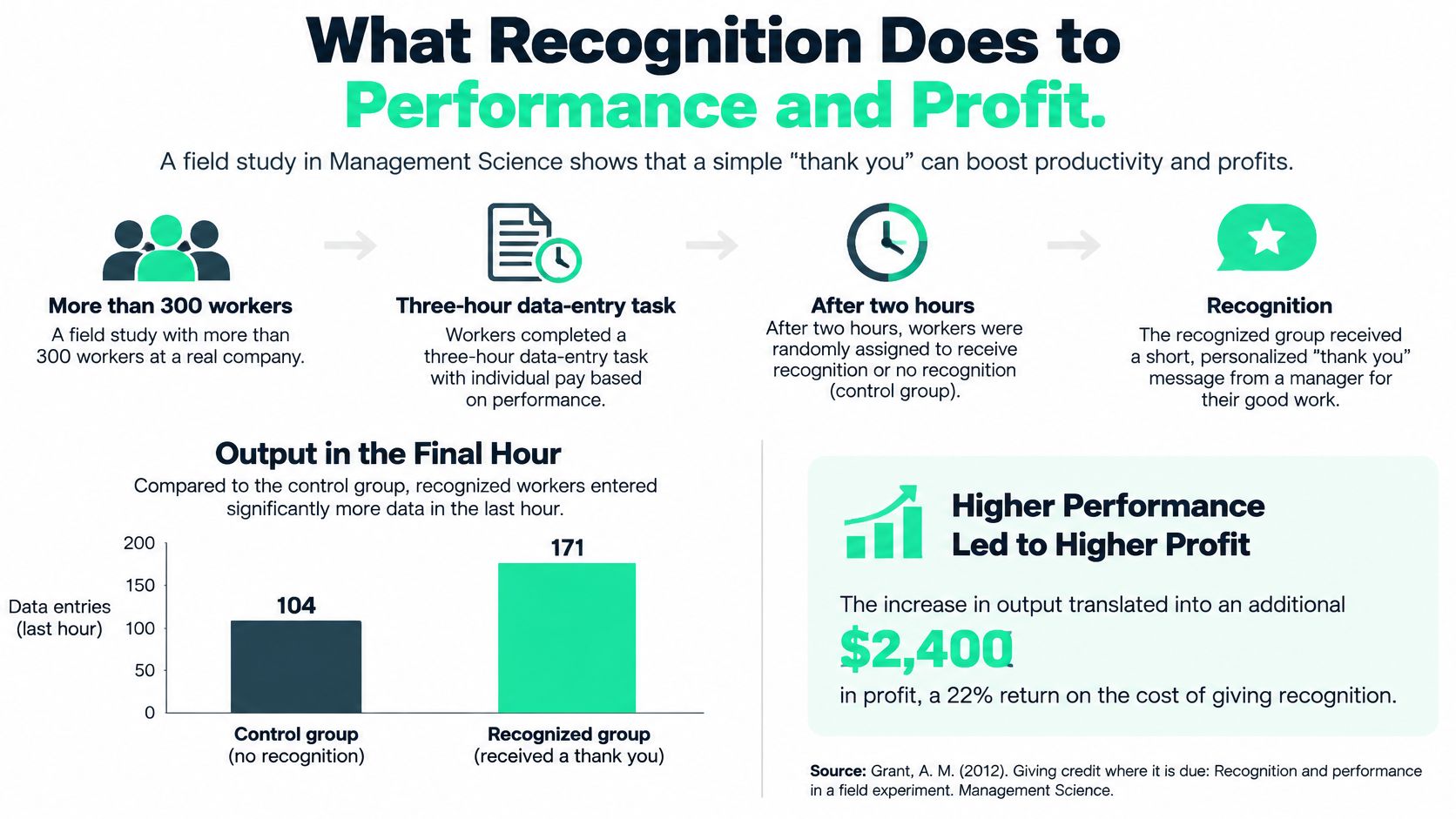
A randomized field experiment published in Management Science assigned more than 300 workers to a three-hour data-entry task, then gave unexpected recognition to randomly selected work groups after two hours. Unlike an employee survey, this treatment-and-control design supports a causal interpretation within the study setting.
When every worker received a thank-you card, subsequent output increased by approximately 5.2%, equivalent to 0.27 standard deviations or about 0.8 additional correct entries per minute. The strongest effect occurred when recognition went to the three highest performers, while workers who weren't recognized accounted for much of the broader performance increase.
The visual summarizes the experiment. Its productivity result shouldn't be interpreted as a measured increase in company profit.
Account for the coworkers watching
The design implication isn't to create a permanent winner-takes-all contest. It's to make an award understandable: publish the accomplishment, acknowledge it promptly, and explain the achievement threshold.
Peer spillovers deserve attention because recognition may affect people beyond the recipient. But don't assume colleagues will respond positively to any public award. Ask whether they regard the selection as legitimate and whether their own roles offer a comparable route to acknowledgment.
A gathering can provide a setting for a team acknowledgment. Chronos One Escape Rooms Eltham's guide to the business benefits of corporate gatherings offers event-planning context, but an event itself isn't evidence of a recognition effect.
Build a finance-ready calculation
Use a conventional net-return calculation:
Recognition ROI = (attributable financial benefit minus total program cost) divided by total program cost.
Include administration, manager time, reward costs, shipping, and event costs where relevant. Value avoided replacement costs, absence, or defects only when your evaluation supports attributing those changes to the intervention. Don't count overlapping benefits twice.
Report distinct measures rather than collapsing everything into redemption:
- Recipient output proxies: Role-appropriate throughput, accuracy, or service outcomes.
- Peer-team movement: Changes among colleagues who weren't recipients.
- Reward use: Whether employees redeemed or used the tangible element.
- Perceived fairness: Whether employees understood and accepted the selection.
The task-level effect isn't a company-profit forecast. The experiment tested a particular combination of visibility, timing, selectivity, and work setting, not a generic morale gesture.
Recognition Moments That Make Benefits Real
Choose recognition moments by the behavior you want to acknowledge, not by whichever products remain in storage. Each moment needs a clear trigger and an equivalent version outside headquarters.
An onboarding milestone is a useful place to start because managers can identify observable learning rather than waiting for a tenure anniversary.

Match the moment to its intended benefit
| Moment | Office scenario | Frontline scenario | Intended benefit |
|---|---|---|---|
| Onboarding achievement | A new analyst independently completes a reviewed reporting task | A warehouse starter demonstrates the safe picking workflow | Early belonging through acknowledgment of learning |
| Values in action | A colleague documents a handover that helps another team | A retail closer coaches a new starter through a difficult return | Reinforcement of observable cultural behavior |
| Customer or production win | A support specialist resolves a documented launch blocker | A field technician diagnoses a recurring equipment fault | Visibility for a credible result |
| Tenure or life milestone | A remote colleague chooses how to mark an anniversary | A manufacturing employee receives a shift-compatible acknowledgment | Personal appreciation without requiring public exposure |
Make the message travel
For values-based nominations, require the nominator to describe the behavior rather than selecting a value label alone. Use employee recognition messages as drafting prompts, but replace reusable wording with the actual contribution.
When a tangible item accompanies the moment, let the employee choose something useful in their size and region. Keep personal milestones optional, and don't let calendar celebrations displace acknowledgment of work.
If an anniversary includes a hosted event, practical planning matters too. BeeHive Mobile Bar's corporate bar compliance and branding tips can inform the hospitality component; provide an equally considered option for employees who don't drink or attend.
Pick a pair of moments your organization already celebrates unevenly. Rewrite their triggers so a night-shift employee can receive acknowledgment of the same quality as a headquarters manager.
How to Scale Recognition Without Making It Generic
Among the workforce examined in O.C. Tanner's global report on the 80% experience, fewer than half received recognition from leaders, peers, or their organization in the previous month, and only 26% considered recognition meaningful. Just 46% said leaders understood how they wanted to be recognized, while 39% believed their work was valued less than office work.
That gap changes the scaling problem. Sending more praise through an office-only channel doesn't address whether a warehouse worker can access it, understand it, or receive an appropriate reward. Increasing volume may even reinforce exclusion when the same visible employees keep receiving attention.
Build access into the operating rules
Remove the laptop requirement. Support phone-accessible nominations and redemption, shared-device access with secure sign-out, and a supervisor-assisted route for employees who can't use personal devices at work.
Assign manager responsibility for coverage. Give managers a clear expectation to notice contributions across their teams. Use coverage targets to investigate omissions, not to require invented achievements or identical awards.
Localize delivery. Provide local-language guidance and schedule announcements during recipients' working hours. Don't make employees accommodate headquarters' calendar to receive acknowledgment.
Offer appropriate choice. For earned tangible moments, include regionally relevant merchandise, inclusive sizing, accessible alternatives, and realistic delivery options. Check the recipient's experience, not just catalog availability.
Calibrate eligibility to observable work. Publish role-adjusted examples. A field technician shouldn't need to attend an office presentation to become eligible, and contractor eligibility should be explicitly defined rather than assumed.
Which recognition format fits the moment
This isn't a ranking. Choose the format that suits the achievement and the employee's preferences.
| Format | Use when | Failure mode | Fairness check |
|---|---|---|---|
| Private personal note | The contribution is specific and the person prefers low visibility | Others don't learn the standard | The employee can explain what was noticed |
| Public recognition | The achievement can appropriately be shared and connects to a value or result | Embarrassment, politics, or repeated selection of familiar names | Nominations include every site and shift |
| Monetary award | A published threshold marks a rare, high-impact result | It becomes expected pay or favors headquarters roles | Eligibility is published and role-adjusted |
| Shared experience | A team win merits a shared celebration | Logistics exclude remote or shift staff | Every location can join or receive an equivalent |
| Employee-choice item | The recipient should select something useful | A narrow catalog or uneven shipping undermines the gesture | Sizing, culture, language, and delivery suit the region |
Audit the last mile
Ask employees to test the entire journey before launch: finding eligibility rules, submitting a nomination, receiving the message, selecting an item, and resolving a delivery problem. Include people who don't routinely interact with HR.
Equal access isn't automatic distribution. Everyone should have a credible opportunity to earn recognition, while meaningful awards still require a real contribution.
The design passes when a warehouse, retail, manufacturing, field, contractor, or international employee can see the criteria and receive an experience of comparable quality to someone at headquarters.
Rolling Out a Recognition Program in 90 Days
Use the following as a proposed implementation schedule, not an evidence-based guarantee of results. The aim is to establish accountable delivery and a usable baseline before making claims about business impact.
Establish ownership and test delivery
Name an accountable owner. Give recognition its own budget line, separate from the annual party. Assign responsibility for approvals, employee questions, and fulfillment exceptions.
Audit the previous quarter. Review recognition events by site, shift, and manager. Distinguish missing records from confirmed lack of recognition.
Publish the rules. Set manager coverage expectations and contribution thresholds for each recognition type. Agree who resolves disputed nominations.
Choose default formats. Start with onboarding achievements and values-in-action nominations. Use an employee recognition gift program only where a tangible element suits the moment.
Configure access. Build nomination and approval triggers in a phone-accessible workflow. Test shared-device privacy, local-language prompts, and announcement timing.
Run a contrasting pilot. As a practical trial design, use a frontline site and a remote team for a proposed 60-day pilot. Record process failures as well as successful moments.
Review at the proposed day-90 checkpoint. Examine coverage, recipient feedback, delivery failures, and fairness. Revise or retire moments that repeatedly exclude eligible employees.
Make the review a decision meeting
Don't treat an early absence of measurable retention change as proof of failure. A short rollout is more useful for assessing whether the process works than for establishing long-term effects.
Leave the review with named fixes, owners, and a decision on whether the program is ready to expand.
Pick a Recognition Mix You Can Measure
Use a human-written, contribution-specific message for every recognition moment. Reserve public acknowledgment for achievements that can appropriately be shared, money for defined exceptional thresholds, and employee choice for tangible rewards.
The authenticity evidence supports caution about automating the employee-facing words. A 2026 survey of 1,021 U.S. professionals, summarized in Matter's employee engagement statistics, found that 63% said recognition would feel less meaningful if they knew AI had written it; weekly-recognized employees were five times more likely to call recognition heartfelt, while money was most meaningful to 10% of weekly-recognized employees versus 30% of rarely recognized employees.
Keep automation behind the message
Those survey differences don't prove that increasing frequency causes sincerity or reduces the importance of cash. They support testing the quality of an established recognition habit rather than assuming the reward's financial value explains everything.
Use AI for routing, reporting, and translation support with human review. Keep authorship of the appreciation with someone who knows the contribution.
Score the program on more than activity:
- Repeat recognition: Check whether the same recipients dominate.
- Sincerity: Ask whether the message felt personal and accurate.
- Fairness: Test whether comparable contributions receive comparable consideration.
- Use: Confirm whether recipients wanted and used the reward.
Start with an omission audit
Audit a quarter of recognition events for who was left out, then investigate why. Pilot employee-choice tangible rewards where recipient feedback identifies unsuitable items or poor access, rather than assuming every gap needs merchandise.
Keep the People team accountable for the message and eligibility decisions. Operational support should make those decisions deliverable, not substitute for them.
FLYP LTD offers a managed merch system for employee-choice stores, onboarding kits, and recognition moments, with curation, brand controls, quality assurance, and global fulfillment handled end-to-end. Visit FLYP LTD to discuss a recognition pilot that gives distributed employees appropriate choices while your People team retains ownership of the message.