Your team needs a new-hire kit by next month, an event drop for several regions, and a recognition gift that feels intentional rather than disposable. The design brief is sitting in a document, but nobody has resolved the harder questions: who should receive what, which products can be fulfilled reliably, how the brand will be protected, and what happens when an employee in another country needs a replacement.
That's the operational reality behind how to create merch online at scale. A storefront is only the visible layer. A dependable program also needs audience decisions, controlled SKU selection, garment-accurate design, zero-inventory production, regional fulfillment, quality monitoring, legal review, and reporting. The goal isn't to publish the largest catalog. It's to create a focused system that people want to use and that your team can operate without constant exceptions.
Table of Contents
- Defining Goals and Audience for Your Merch Program
- Choosing SKUs and Zero-Inventory Production Models
- Generating On-Brand Designs with AI Workflows
- Managing Global Fulfillment and Quality Assurance
- Navigating Legal Compliance and Launch Strategies
- Measuring Success and Iterating on Merch KPIs
Defining Goals and Audience for Your Merch Program
Most merch programs stall before production starts because the team chooses products before defining the job those products need to perform. A hoodie gets added because hoodies are popular, a mug gets added because mugs are familiar, and a generic catalog grows without giving employees, customers, or event attendees a reason to choose anything.
Start with the moment you're trying to support. An onboarding kit should help a new employee feel expected and equipped. An event drop should make a specific gathering recognizable while remaining practical after the event. A recognition item should communicate status or appreciation without creating awkward sizing, shipping, or tax problems.
Turn the brief into an audience decision
Write one short program brief before opening a product catalog. It should identify:
- Primary recipient: Decide whether the audience is new hires, existing employees, customers, event attendees, creators' fans, or a mixed group.
- Desired action: Define whether recipients should wear the item, use it at work, share it publicly, keep it as a collectible, or select it from an employee-choice store.
- Distribution context: Record whether items will ship automatically, be claimed through a link, be handed out at an event, or be allocated by a People or marketing team.
- Brand tolerance: Establish whether the design should be highly visible, understated, seasonal, regional, or tied to a particular campaign.
- Success signal: Choose a useful observation, such as selection behavior, repeat orders, event participation, employee feedback, or reduced support requests.
Audience segmentation helps prevent one design from carrying incompatible expectations. Use the audience segmentation framework to separate groups by role, location, occasion, and likely product preference rather than treating “the company” as one buyer.
A global engineering team may appreciate a restrained logo treatment on a premium overshirt, while an event audience may respond better to a bold graphic that identifies the community. The same artwork can be technically correct and strategically wrong if it ignores the recipient's context.
Validate demand before expanding the range
A useful validation sequence is deliberately narrow:
- Choose one audience and one occasion.
- Present a small, coherent product set.
- Ask recipients to select or rank products before production.
- Sample the leading options physically.
- Review feedback, sizing questions, and fulfillment constraints.
- Expand only after the first launch produces evidence.
Independent coverage of merch operations emphasizes starting with a tight niche and 10–25 SKUs, not a sprawling catalog, because fewer decisions make demand testing and execution easier. Automateed's print-on-demand trends coverage also frames the central challenge as validating demand quickly enough to avoid overbuilding.
Operational rule: Every SKU should have a named audience, a use case, an owner, and a reason it belongs in the program.
This discipline also protects budget. If the launch is for onboarding, you may need a reliable size-inclusive apparel option, a practical desk item, and a welcome note. You probably don't need a dozen colorways, several untested accessories, and products that require separate regional sourcing. Merch works better when the product set reflects the moment instead of trying to represent every possible preference.
Choosing SKUs and Zero-Inventory Production Models
Once the audience and occasion are clear, production becomes a risk decision. Traditional bulk manufacturing can offer unit economics and control for predictable demand, but it also requires forecasting, storage, handling, and a plan for leftover stock. Zero-inventory print-on-demand shifts the commitment closer to the order, which reduces waste and makes testing easier, while placing more importance on supplier consistency, shipping coverage, and product-level quality checks.
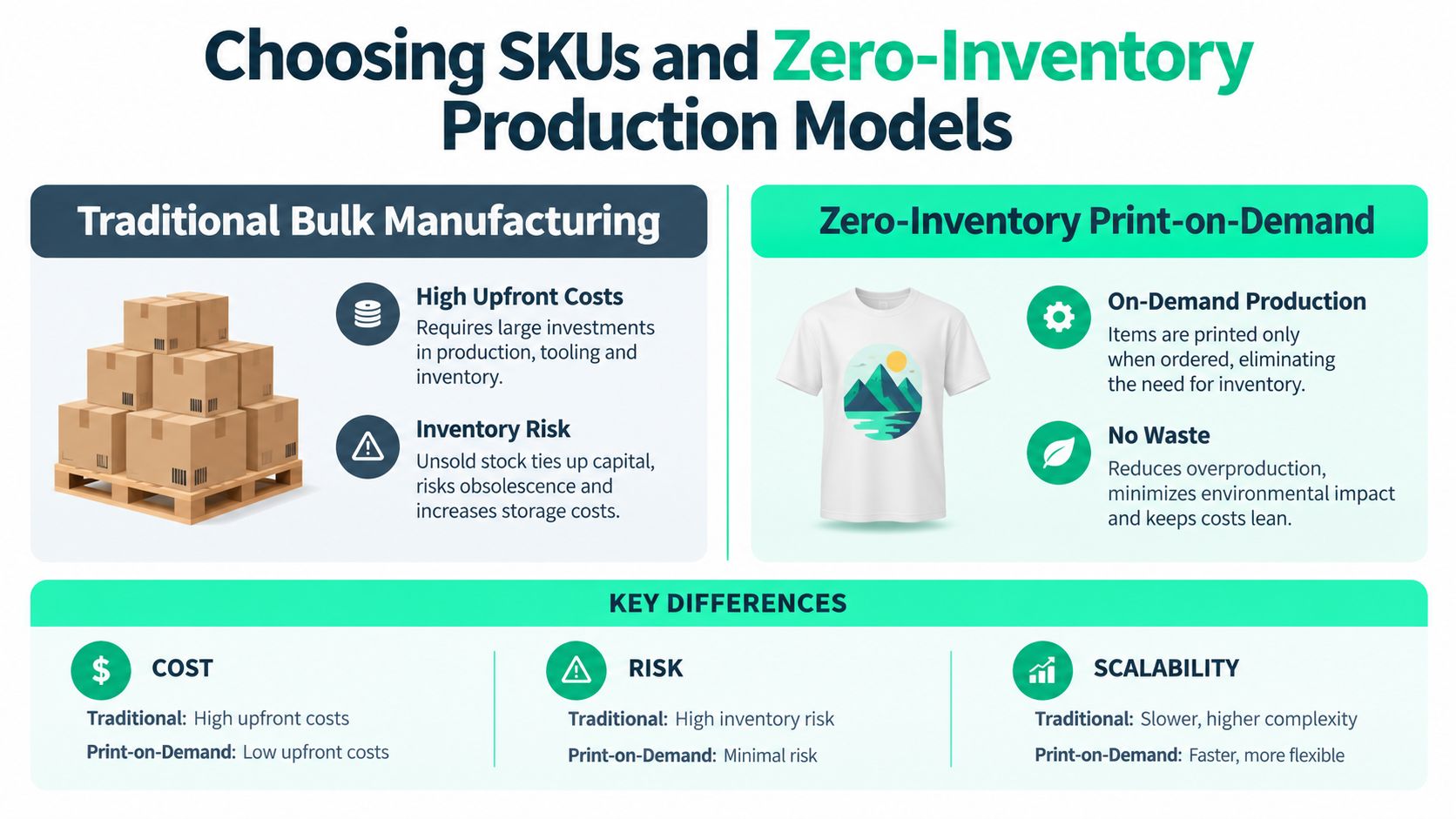
The broader market context supports this shift. One estimate places the global print-on-demand market at USD 11.38 billion in 2025, with a projection of USD 61.79 billion by 2034 and a 20.06% CAGR during 2026–2034. The same print-on-demand market estimate reports that apparel represented 46.9% of the market, North America held 37.8% of regional share, and software platforms accounted for 58.7%. Those figures point to a commerce model built around apparel, digital workflows, and major English-language markets, but they don't remove the need for operational judgment.
Compare the two production models
| Decision area | Traditional bulk manufacturing | Zero-inventory print-on-demand |
|---|---|---|
| Commitment | Stock is purchased before individual demand is known | Production starts after an order is placed |
| Main exposure | Unsold inventory, storage, and size or color imbalance | Per-order production cost, supplier variation, and delivery dependencies |
| Best fit | Predictable demand, planned physical distribution, and repeatable volumes | Testing, employee choice, distributed teams, and changing designs |
| Operational burden | Forecasting, warehousing, packing, and stock reconciliation | Product configuration, supplier selection, QA, routing, and support |
| Scaling pattern | Efficient when the forecast is reliable | Flexible when demand is uncertain or geographically dispersed |
The right answer may be hybrid. Bulk production can make sense for a planned conference where quantities and delivery dates are known. On-demand production is safer for an employee-choice store, an evergreen onboarding program, or a creator drop where demand is difficult to forecast.
Choose products by physical constraints
Don't start with the design. Start with the blank and its limitations. Check fabric composition, garment weight, available sizes, fit, color availability, print area, decoration method, wash expectations, and regional substitutions. A design that works on a flat front print may fail on a sleeve, embroidery zone, dark garment, or textured fabric.
Apparel remains the primary merch category in the cited market estimate, but accessories and home goods can create useful bundles when they serve the same audience and occasion. A recognition drop might combine one wearable item with a practical desk product. The bundle should still be easy to explain, fulfill, and replace.
The recommended workflow is to validate audience and product fit, select products according to print method and garment specifications, optimize the artwork, create mockups, connect the store to a fulfillment partner, and enable automated order routing. Wix's practical merch-creation guidance also stresses sampling before launch because the physical result can differ from an on-screen mockup.
Zero inventory doesn't mean zero responsibility. Teams still need clear ownership for supplier approval, product substitutions, returns, customer support, and regional exceptions. For a concise explanation of the commercial mechanics and responsibilities involved, review the LA Law Group guidance on dropshipping law. Then document the specific obligations that apply to your business and selling markets.
A zero-inventory program is easiest to govern when the system records every product, design version, region, supplier, price, and approval status. That is the practical value of a zero-inventory operating model, not merely the absence of boxes in a warehouse.
Generating On-Brand Designs with AI Workflows
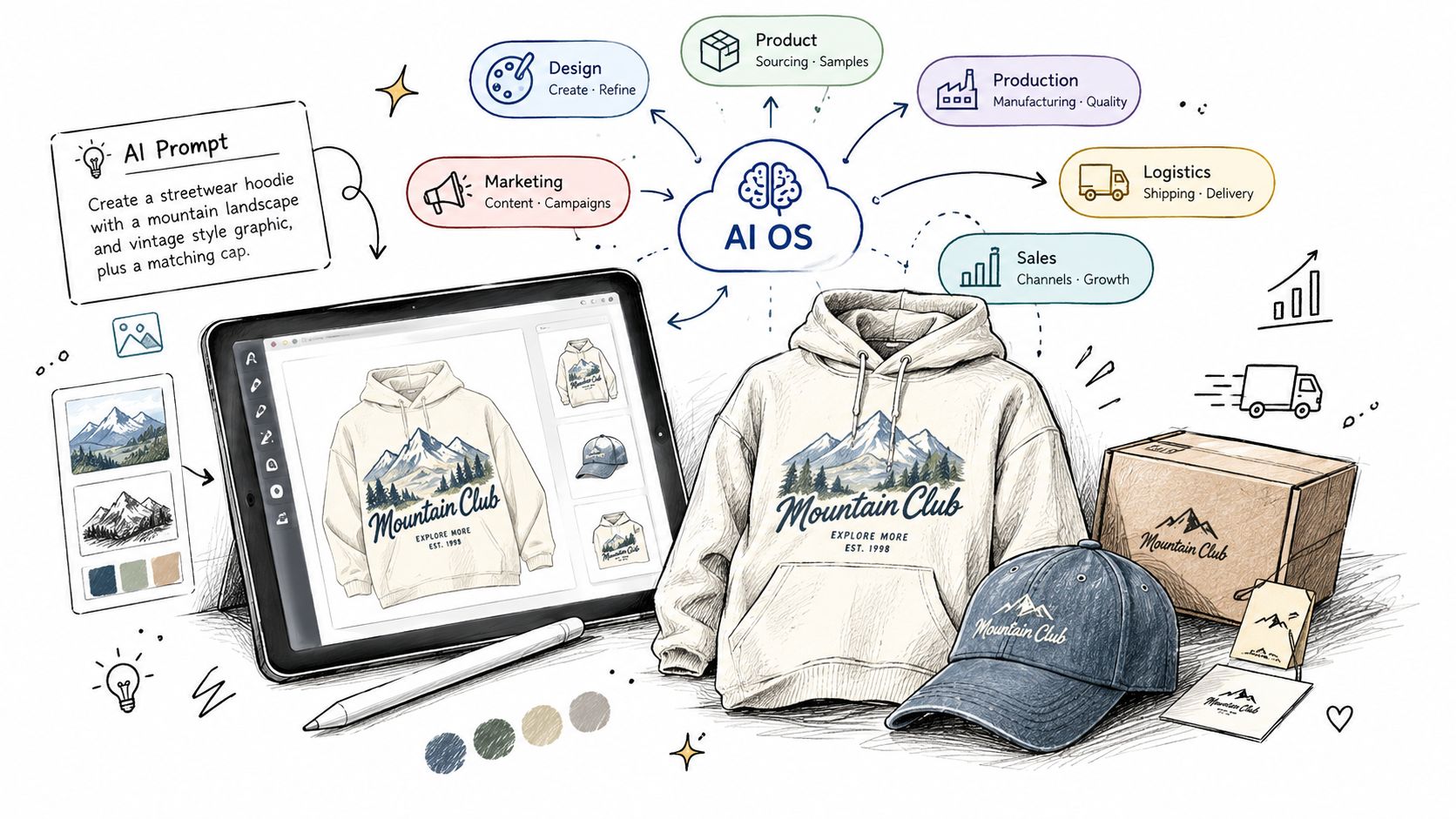
AI can reduce the time between a brief and a design candidate, but speed creates a new control problem. A model can produce visually attractive artwork that uses an outdated logo, invents a brand element, places text incorrectly, or creates a composition that looks good in a prompt window but fails on the selected garment.
Treat AI as a controlled production assistant, not an unsupervised art director. The workflow should begin with approved brand inputs and end with a human review against the actual product configuration.
Build a brief the system can enforce
A useful merch brief contains more than a slogan. Include the audience, occasion, approved logo files, brand colors, prohibited uses, tone, garment type, decoration method, placement zone, and any regional or legal restrictions. Add references for the visual direction, but distinguish inspiration from assets the team is authorized to use.
A strong prompt or structured input might specify a restrained left-chest mark for an onboarding overshirt, a large back graphic for an event hoodie, or a small embroidered symbol for recognition apparel. It should also state what the design must avoid, such as unapproved partner marks, political interpretations, protected characters, misleading product claims, or text that becomes unreadable at the chosen size.
AI-generated copy needs the same scrutiny as artwork. Review spelling, trademark usage, cultural references, language versions, and claims. A design that passes a visual review can still create brand or legal exposure if the wording implies an endorsement or uses a protected phrase.
Judge the design on the garment
Mockups are useful for direction, not approval. Review the art on the exact blank, color, size range, and print method. Check how the composition behaves on smaller garments, how a dark base changes contrast, whether a curved surface distorts the message, and whether embroidery simplifies fine detail.
Resolution and placement should be handled as production requirements. Export artwork at the resolution requested by the fulfillment partner, confirm the intended DPI, keep important elements inside the safe placement area, and separate transparent artwork from background fills when the print method requires it. Don't approve a generic image and expect production to solve garment-specific decisions later.
Brand safety check: Approve the artwork, the wording, the placement, the garment, and the region as one package. A green light on the design alone isn't enough.
A practical approval chain can be short:
- Design review: Confirm visual quality, readability, and adherence to the current identity system.
- Brand review: Check logo rules, color use, tone, partner references, and prohibited content.
- Product review: Verify the blank, decoration method, placement, sizing, and care expectations.
- Regional review: Check language, cultural interpretation, shipping limitations, and local requirements.
- Production review: Confirm file format, routing, mockup, sample status, and version control.
Use version names that a fulfillment team can understand. “Final hoodie” is not a useful identifier. A record should distinguish the campaign, audience, product, color, region, and revision so customer support can identify exactly what was ordered.
AI is most valuable when it removes repetitive layout and concept work while preserving human approval at the points where errors become expensive. The following walkthrough shows the kind of efficient design-to-production flow teams now expect from AI-native merch systems.
For enterprise teams, FLYP LTD is one option that turns prompts, URLs, videos, images, or briefs into on-brand designs across premium blanks, then supports managed production and fulfillment. The important evaluation criteria remain the same regardless of platform: approved inputs, garment-accurate previews, human review, reliable versioning, and an audit trail from brief to order.
Managing Global Fulfillment and Quality Assurance
A merch program earns trust at the delivery point. Employees don't experience your design workflow or vendor dashboard. They experience the package that arrives, the fit of the garment, the accuracy of the print, and the support response when something goes wrong.
Global fulfillment creates competing priorities. A centralized supplier may simplify governance but produce longer delivery routes for some regions. A distributed network may improve local delivery performance but create differences in blanks, print quality, packaging, and return handling. The right choice depends on the audience, service expectation, destination, and degree of consistency required.
Sample before you promise
Order physical samples before launching to a broad audience. Inspect the garment, seams, hand feel, color, print edges, placement, label, packaging, and care instructions. Wash or wear-test apparel when the program is intended for repeated use, and compare the result with the approved mockup rather than relying on memory.
Keep a sample record containing the product identifier, supplier, decoration method, artwork version, destination region, reviewer, and approval date. If a supplier later proposes a substitution, require a new review. A replacement blank can change fit, color, print scale, or perceived quality even when the product title looks unchanged.
The operating model described in global fulfillment services guidance should be judged by its exception handling as much as its standard flow. Ask who owns address corrections, customs questions, damaged parcels, failed deliveries, replacement orders, and regional escalations.
Use return data to find causes
POD return-rate benchmarks are commonly treated as 1–2% for well-run stores, while sustained returns above roughly 2–3% should trigger investigation. Defect rates should remain under 2%, and a spike in one defect category warrants root-cause analysis. These benchmarks and failure modes are summarized in print-on-demand quality-control guidance.
| Signal | What to inspect first | Appropriate response |
|---|---|---|
| Misprint concentration | Artwork file, placement rules, supplier production record | Pause the affected design if the issue repeats |
| Sizing complaints | Size chart, blank fit, regional expectations, product page copy | Review the garment and clarify fit information |
| Photo-versus-reality complaints | Mockup accuracy, color rendering, fabric, print finish | Replace the mockup or reconsider the product |
| Delivery failures | Address capture, carrier route, customs process, regional partner | Segment by destination and correct the handoff |
| One supplier or product spike | Supplier batch, blank substitution, production method | Compare against approved samples and alternatives |
Segment every return by design, product type, size, region, supplier, and reason. A blended return rate can hide a problem affecting only one hoodie color or one size range. Customer support should capture structured reasons rather than relying on free-text notes alone.
Distributed teams may need local support for language, time zones, and recipient coordination. If you use contractors for customer operations, a resource such as LatHire's Latin American virtual assistants can help you evaluate regional support coverage, but retain clear internal ownership for policy, refunds, brand decisions, and escalations.
Quality principle: Don't normalize defects because the overall program is profitable. A recurring failure tied to one design or supplier will keep generating support work until someone isolates its cause.
Navigating Legal Compliance and Launch Strategies
A global merch launch joins several systems that teams often manage separately. Brand protection, product claims, tax treatment, import rules, budget ownership, employee communications, and storefront promotion all affect the same order. A design can be approved by marketing and still fail legal review, or a launch can generate demand without a clear owner for duties and returns.
Build the launch around a documented release checklist rather than an informal approval thread.
Connect compliance to the operating plan
Trademark review should cover the company name, campaign name, slogans, logos, collaborator marks, and any third-party visual references. Confirm that the business has permission to use supplied artwork, employee-created work, creator assets, music-related references, and photographs. Keep approval records with the design version, not in a separate folder that future operators may not find.
Shipping apparel internationally can involve import rules, duties, taxes, restricted materials, labeling requirements, and consumer-protection obligations. Your fulfillment partner should explain how charges are presented, who pays them, what happens when a recipient refuses a parcel, and which party handles a return across borders.
Budgeting needs its own ledger. Assign product, decoration, packaging, shipping, taxes, duties, platform fees, refunds, replacements, and support costs to a department or campaign owner. Employee-choice stores should also define whether the business funds the full order, applies a regional allowance, or charges an employee for optional upgrades.
Teams operating through an entity or cross-border structure can use resources such as this EU Inc taxes and banking guide as a prompt for questions about registration, banking, and tax administration. It isn't a substitute for advice in the countries where you sell or distribute.
Choose the launch path deliberately
An internal employee-choice store offers control over recipient data, budgets, and approved products. A link-in-bio store prioritizes public discovery and simple conversion for creators. Native integrations such as YouTube Shopping can reduce friction by allowing products to appear alongside creator content, but they still require accurate product data, customer support, and a policy for refunds and regional availability.
Before publishing, confirm:
- Approved catalog: Remove unapproved designs, expired campaigns, and regionally unavailable products.
- Price ownership: Record who can change prices and how departments see their allocated spend.
- Recipient data: Collect only the shipping and contact information needed to fulfill and support the order.
- Promotion rights: Verify permissions for logos, people, music, images, and partner references used in launch assets.
- Regional readiness: Check translations, delivery promises, taxes, duties, returns, and support coverage.
- Incident plan: Define who pauses a product, communicates a correction, issues replacements, and reports the resolution.
A launch is ready when the operational answers are as clear as the marketing message. “Available worldwide” should mean the team has tested the relevant routes and knows what happens when an order falls outside the normal path.
Measuring Success and Iterating on Merch KPIs
A merch program can look successful because orders are moving while creating sizing complaints, unused inventory, budget disputes, or low adoption. Sales alone won't tell you whether the program strengthened onboarding, helped an event, supported recognition, or gave a creator a durable revenue channel.
Track the journey from selection to experience. For an employee store, review which groups open the offer, which products they choose, whether certain regions need more support, and whether recipients report fit or quality problems. For an event drop, compare participation with the campaign audience and examine which products remain selected after the event ends. For a creator store, distinguish a design that attracts clicks from one that produces completed, supported orders.
Use a product-level scorecard with qualitative and operational fields:
- Adoption: Who selected or purchased the item, and which audience segments ignored it?
- Experience: What did recipients say about fit, quality, packaging, and delivery?
- Reliability: Which designs, products, regions, or suppliers generated exceptions?
- Financial control: Did actual landed costs match the budget assigned to the campaign?
- Lifecycle decision: Should the item be retained, revised, paused, or retired?
A design with strong initial interest may need a better blank, clearer sizing information, or a regional alternative. A quiet product may be useful for a small audience and shouldn't be judged only by aggregate demand. The operator's job is to connect behavior with context, then make a deliberate catalog decision.
The best merch programs behave like products. They launch with a clear use case, collect feedback, and improve through controlled releases.
Create a review cadence that matches the program. New-hire stores may need regular operational checks, while event drops require a post-launch review while delivery and support details are still fresh. Keep the approved sample, design version, order data, return reasons, and final decision together so the next launch starts with evidence instead of assumptions.
FLYP LTD helps enterprise and creator teams turn approved brand inputs into on-brand merch, manage zero-inventory production, coordinate global fulfillment, and monitor quality across launches. Visit FLYP LTD to build a merch program that connects design, logistics, brand safety, and reporting in one operating workflow.