An estimated 40% of garments are sold at a markdown because of overproduction, according to McKinsey's fashion-on-climate report. That number is the honest starting point for any print on demand vs inventory decision, because most merch programs aren't really choosing between two production methods. They're choosing who absorbs the cost of being wrong about demand.
The usual comparison, a bulk quote against a per-item quote, answers the wrong question. A $14 shirt and a $22 shirt aren't competing until you know how many sell at full price, how long the rest sits, and what it costs to hold them. What follows is the comparison procurement teams need: risk-adjusted total cost across low, base and high demand, with break-even arithmetic you can run on your own volumes.
Table of Contents
- Print on Demand vs Inventory at a Glance
- What Each Model Really Costs Once Risk Is Counted
- Fulfillment Speed and Stockout Trade-offs
- Quality Control and Decoration Methods Compared
- Which Model Fits Your Merch Program
- Confirm the Model and Terms Before You Order
Print on Demand vs Inventory at a Glance
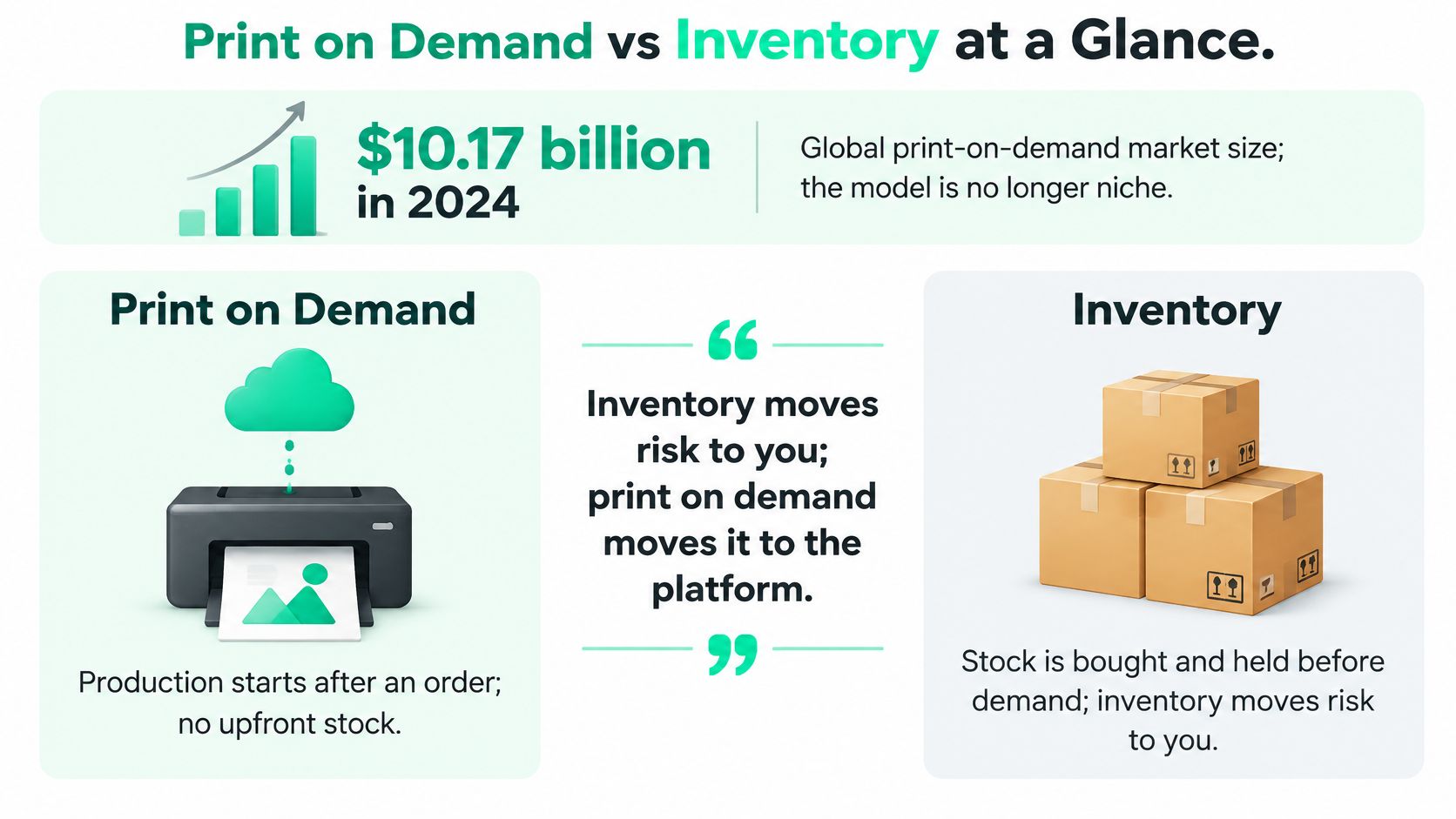
On-demand production usually carries less financial risk when demand is uncertain, spread across many variants, or tied to a design nobody has tested yet. Inventory usually costs less per unit, but only when demand is proven and repeatable.
The model isn't niche any more. The global print-on-demand market reached approximately $10.17 billion in 2024, according to Blinkstore's compilation of print-on-demand market statistics. That scale matters: the per-unit premium that once made on-demand a boutique choice now sits inside a mature supply base with real capacity behind it.
The trade in one line: Inventory moves demand risk onto your balance sheet before the sale. Print on demand moves it onto the unit price and the production queue.
| Criterion | Inventory-based | Print on demand |
|---|---|---|
| Upfront cash | Paid for stock before demand is proven | Paid per order, after the sale |
| Unit cost | Lower at high volume | Higher per unit |
| Unsold stock risk | Held by the brand | No stock held in advance |
| Minimum order | Set by supplier and stock plan | Usually none for single orders |
| Speed to customer | Fast from stock on hand | Queue time plus transit |
| Size and colour variants | Each variant stocked in advance | Each variant produced when ordered |
| Best fit | Repeatable, high-volume staples | Varied, uncertain or new designs |
The table isn't a scorecard. No single row decides the question, and the two rows people reach for first, unit cost and speed, are the two that mislead most often. A cheaper unit price only pays off if the units sell, and faster dispatch only pays off if the right size is on the shelf when someone asks for it.
Test your own volumes before trusting any headline comparison. Some widely circulated print-on-demand and inventory cost figures are vendor-published or methodologically unclear, and a per-unit price quoted by a supplier who profits from one model isn't a benchmark. Three questions matter most: what each model costs once risk is counted, how fulfillment and stockouts differ, and which program types fit each model.
What Each Model Really Costs Once Risk Is Counted
Both models print the same shirt. Only one of them charges you before anyone has asked for it, and that gap is where the cost sits.
A bulk quote of $14 next to an on-demand quote of $22 looks like a settled argument. It isn't, because the $14 shirt arrives with an entourage: storage, insurance, handling, shrinkage, obsolescence, and the cash you can't spend on anything else. Inventory carrying cost typically absorbs 20 to 30 percent of average stock value annually, per AisleStock's breakdown of carrying costs. That percentage is why a volume discount can evaporate before the first markdown.
What overproduction costs beyond the write-off
McKinsey estimated the fashion industry produced approximately 2.5 billion to 5 billion excess items in 2023, representing roughly $70 billion to $140 billion in potential sales value, as reported in Business of Fashion's inventory analysis. The same analysis found about one-third of brands still struggling with inventory positions in 2024, even with overall industry inventory levels broadly flat.
Those figures measure the industry-wide problem, not your program. Your exposure comes down to one narrower question: how wrong your size and design mix turns out to be.
| Cost line | Inventory-based | Print on demand |
|---|---|---|
| Unit production price | Lower, improves with volume | Higher per unit, few volume savings |
| Storage and carrying cost | About 20 to 30% of average stock value a year | None held in advance |
| Unsold stock and markdowns | Borne by the brand | Minimal, limited to unfulfilled designs |
| Minimum order quantities | Set by supplier and stock plan | Usually none |
| Shipping and returns | Bulk freight, then per-order shipping | Per-order shipping, returns handled per item |
| Working capital tied up | High, paid before demand | Low, paid after the sale |
The break-even rule in plain terms
A forecast batch wins only if the units you sell at full margin inside your holding period cover four things: the unit cost, the carrying cost, the expected markdowns and write-offs, and the cost of the cash tied up before demand was known. Everything else is arithmetic in service of that sentence.
Run the rule with your own numbers in three passes. Take your realistic low, base and high demand for a given design, and for each one count full-price sales, what the leftovers recover at markdown, what gets written off entirely, and how long the cash sat in a box. The pass where the two models flip positions is your break-even point, and it moves with batch size, holding period and how confidently you can forecast the size curve. If cutting the carrying line is the priority, how to reduce inventory costs works through the levers in order of impact.
On-demand production pays a per-unit premium and gives up most volume efficiencies, but it carries almost no fixed-stock exposure. We produce on demand and make only what's ordered, so there's no warehoused dead stock to mark down later.
The same design under two demand scenarios
Take a typical scenario with illustrative assumptions: selling price $32, landed inventory cost $14, on-demand cost $22, batch size 800, markdown price $18, write-off value $0.
- Low demand, 200 units at full price. You still paid 800 × $14 = $11,200. Full-price revenue is $6,400. Move 300 leftovers at $18 for $5,400, write off 300, and carry roughly $1,400 in holding cost on the stock you sat on. That's $12,600 of cost against $11,800 of revenue, a loss before any disposal fee. On demand, 200 units at $22 cost $4,400 against the same $6,400, leaving $2,000.
- High demand, 800 units at full price. Inventory turns $11,200 into $25,600 of revenue, so $14,400. On demand, the same revenue against 800 × $22 = $17,600 leaves $8,000. Inventory wins by $6,400.
Same design, same retail price, opposite verdicts. The cheaper unit price produced the worse outcome in the scenario that decides whether the program can absorb its own mistakes. That is the point of running the low case first: the high case rewards you for being right, but the low case is the one you have to survive.
Fulfillment Speed and Stockout Trade-offs
A merch stockout rarely looks like an empty shelf. It looks like a size run that fails: mediums gone, extra larges still boxed in the corner, and half the team asking for a swap.
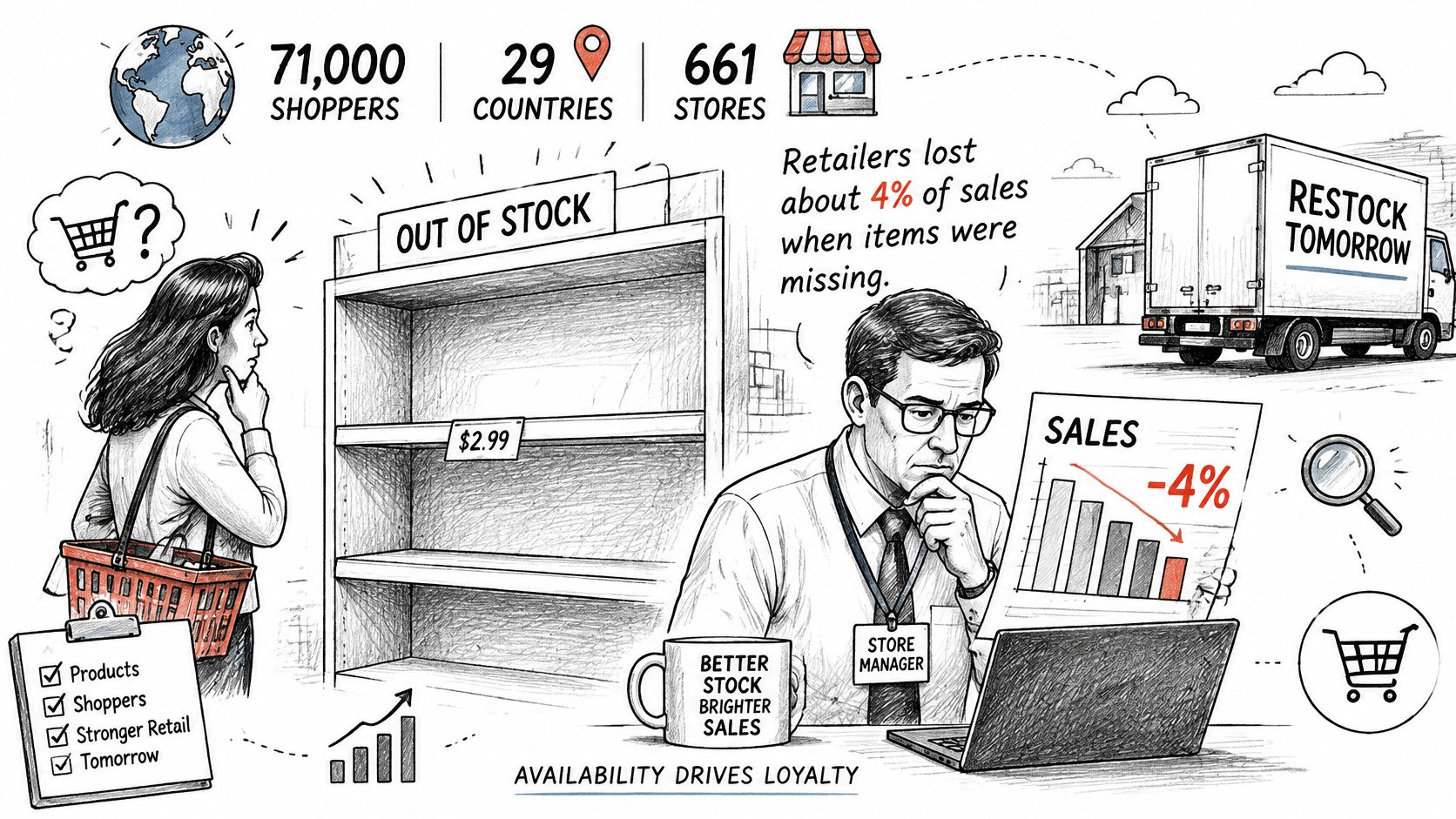
Here's the visual version of what that costs a retailer.
Apparel makes this worse than most categories because every design multiplies across a size-colour matrix. Forecast error splits in two directions at once, a shortage in one variant sitting beside dead stock in another, and both come out of the same budget line.
Where on-demand time actually goes
Print on demand removes the pre-positioned stockout. It replaces it with a queue, where production capacity and embellishment time set the dispatch date instead of a shelf. Custom embellishment such as embroidery or woven labels typically needs 4 to 6 weeks for SKOs and high-volume events, so the calendar, not the cash, becomes the constraint you plan around.
Two programs show the difference in shape. A new-hire kit ordered one unit at a time has no minimum and nothing sitting in advance, so a few days of production is a fair price for zero dead stock. A 500-person event on a fixed date is the opposite problem: the date can't move, so production has to be locked early enough to absorb the embellishment window.
Practical rule: If the date is fixed and the headcount is confirmed, schedule production against that headcount. If the date is fixed and the headcount is a guess, you're buying inventory with a deadline attached.
Every kit we ship is retail-grade and produced against the customer's event date, and we produce only the quantities attendees confirm through the sizing portal. That removes the over-order, but it puts the discipline on the order date rather than on the warehouse.
A timeline check to run before you commit
- Work backwards from the delivery date. Start with when the boxes must arrive, subtract transit, subtract production, subtract proofing and artwork approval.
- Count the queue, not just the shipping. A two-day courier is irrelevant next to a three-week production backlog in peak season.
- Close the size list early. Late size changes in a made-to-order run are reprints, not edits.
- Order one unit first. A single live order on the exact garment tells you more than a sample request handled as a special case.
Run this before you choose a model rather than after. If the numbers don't fit, the fix is a different date or a different garment, not a rush fee. Lead time management covers the sequencing in more detail.
Quality Control and Decoration Methods Compared
A decoration method that doesn't match the garment produces a finished item nobody can sell. On-demand has one advantage here: the error shows up on the first order for that design, not after a pallet has been printed and paid for.
| Method | Best use | Suited garments | Limit |
|---|---|---|---|
| DTG print | Full-colour designs | Cotton tees | Best on cotton, less suited to other fabrics |
| Embroidery | Logos | Caps, polos, totes | Limited for complex full-colour artwork |
| DTF transfer | Designs on mixed fabrics, smaller runs | Mixed-fabric garments | Adds a transfer layer to the garment |
| Sublimation | All-over print | Polyester or poly-blend hoodies | Bonds into polyester fabric only |
| Heat-transfer vinyl | One-off prototypes, very small runs | Prototypes only | Not recommended for production company apparel |
Two rules sit behind that table. Sublimation bonds into polyester, so an all-over print piece needs a polyester or poly-blend body, which is the construction we use for all-over hoodies. Heat-transfer vinyl holds up well enough for a prototype and belongs nowhere near production company apparel, where it will fail on the garments people wash most.
If you're mapping methods across a wider range of products, these branding methods for branded merchandise lay out the same choices across apparel, bags and drinkware. Read the garment's fibre content before you pick the method, not after.
The two failure modes are different
Inventory lets you approve one sample and reorder the identical blank from the same lot, which is a genuine quality advantage for a stable core item. The catch is timing: defects in a bulk batch surface after you've paid for the whole batch, and by then the reprint comes out of your own budget. On-demand spreads the check across individual orders instead, so a bad method or blank gets caught on order one rather than order five hundred.
A QC routine that catches the cheap mistakes
- Request a physical proof on the exact blank you'll ship. Not a digital mock, and not the same design on a different tee.
- Check placement on a real garment in each size range. A chest print that sits correctly on a medium can sit visibly low on a 3XL.
- Wash it before you approve volume. Two or three domestic washes tell you more about durability, cracking and shrinkage than any spec sheet.
- Match the fabric to the method. Cotton for DTG, structured fabrics for embroidery, polyester for sublimation.
Once the method and the blank agree, quality control becomes a process rather than a gamble. Each order runs through on-demand apparel printing as it's placed, so the proof and the first real order are never far apart.
Which Model Fits Your Merch Program
Start with the rule, before the programs.
Decision rule: Inventory is justified only when forecast confidence, sell-through speed and replenishment reliability are all high. When any of those three is soft, print on demand is the safer default, and the per-unit premium is what you pay for the option to be wrong.
Stockouts have a measured cost. A large international consumer study covering 71,000 shoppers in 29 countries and 661 stores found retailers lost approximately 4% of sales when shoppers couldn't find the requested product, per AisleStock's stockout cost analysis. Apparel forecasting research cited in the same analysis reports that even a 5 to 10 percent improvement in forecast accuracy can materially reduce finished-goods carrying costs, back orders, returns and service-level problems. Note what that implies: the gain is real but bounded, which is why inventory protects service levels only where demand is predictable.
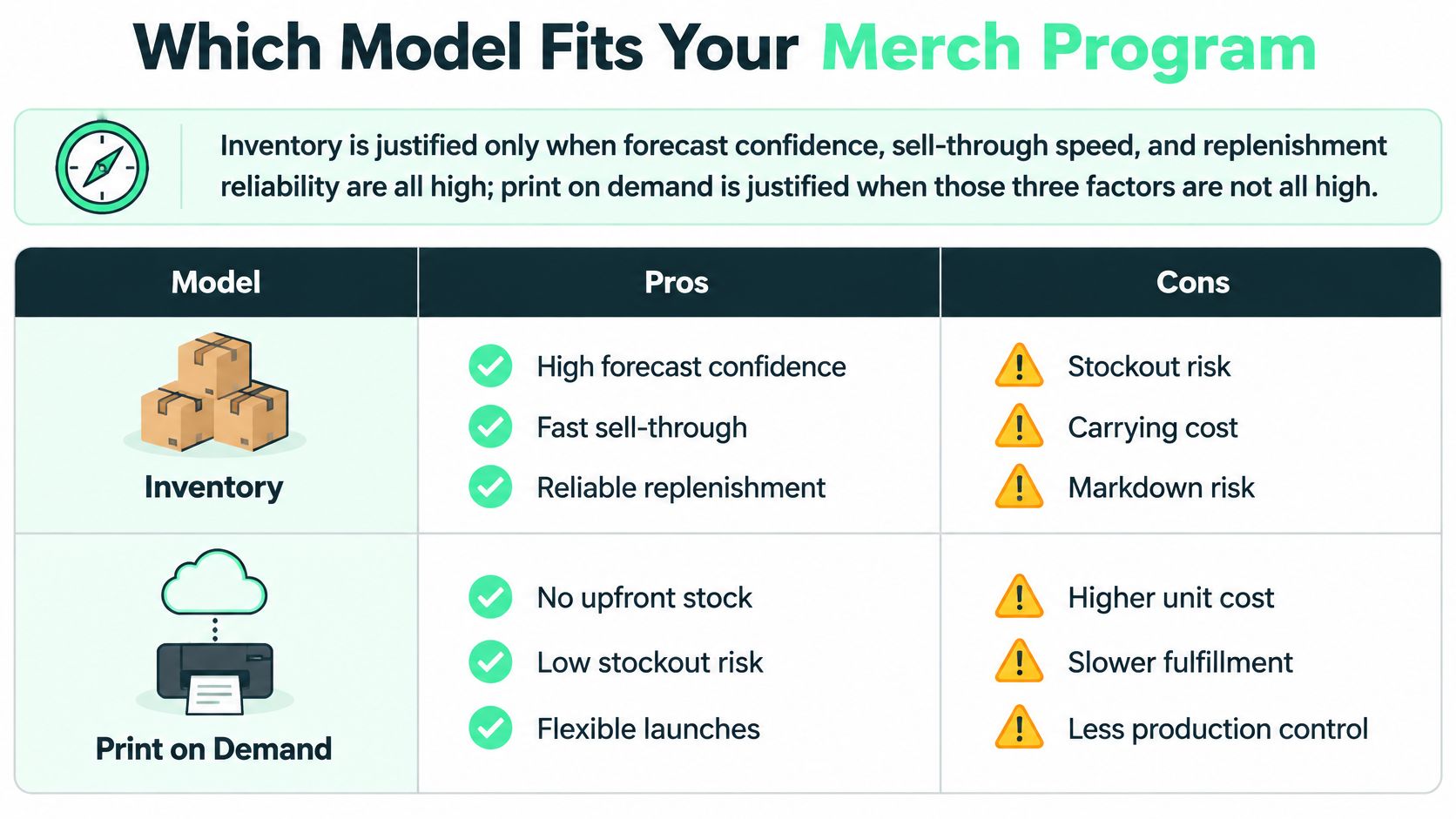
Where a stocked core pays for itself
An onboarding program is the clearest case for a hybrid. The core is stable: a hoodie, a tee, a tote, the same three colours, year round. The long tail is sizes and geography, and that's where forecasts break. Stock the core in the two or three sizes carrying most of the volume, and route everything else through made-to-order production so a new hire in a small or a 3XL isn't waiting on a replenishment decision. The deciding factor is forecast confidence on the core, and it's testable. If you can predict the size mix within a narrow band across three consecutive cohorts, the core has earned its shelf.
Repeatable event staples behave the same way. Lanyards, the same tee for a recurring annual conference, the same tote every quarter: known unit count, known date. That's inventory's home turf.
Everything else in the program usually isn't. Here, the per-unit premium gets cheap.
Where on-demand wins without much argument
Employee-choice catalogues are the hardest thing to forecast in company merch, because the demand isn't a quantity, it's a distribution across dozens of designs, colours and price tiers. Every additional option splits the forecast thinner. Stocking the catalogue means stocking the least popular choice in every size, which is the definition of dead stock.
Recognition gifts share that shape for a different reason: the timing is unknown and the quantities are small. Nobody issues a purchase order for a birthday. When the moment arrives, a made-to-order item that ships in days beats a stocked item you stopped carrying two quarters ago.
Creator drops and experimental designs are the third case, and the risk there is obsolescence rather than stockouts. A design that doesn't land leaves you holding a hundred units of a joke nobody wants. FLYP offers AI-designed company swag with no minimums, so a new idea can go live as a one-unit test instead of a batch decision.
Fixed-date event merch sits between the two. The headcount is confirmed and the date is fixed, so scheduled on-demand production matches the shape of the demand: produce what the attendee list says, against a date you control.
| Program | Better model | Deciding factor |
|---|---|---|
| Onboarding kit with a stable core | Inventory for core items, on demand for the long tail | Forecast confidence on the core |
| Employee-choice catalogue | Print on demand | Demand spread across many choices |
| Recognition gifts | Print on demand | Timing unknown, quantities small |
| Fixed-date event merch | Scheduled on-demand production | Confirmed headcount, lead time |
| Creator drops and new designs | Print on demand | Unknown sell-through, obsolescence risk |
The low-demand test that settles most arguments
Most model comparisons die in the spreadsheet because they model the base case. Nobody buys inventory for the base case. They buy it because they believe the base case.
Run the comparison three times for the same program: low, base and high. Low demand means the pessimistic unit count you'd defend in a budget meeting, not a disaster scenario. High demand means the number that would make the batch look brilliant. Then look at which model still wins at the low end, because that scenario dictates how much risk the program can absorb.
If inventory only wins at high demand, the batch isn't a cost saving. It's a risky bet on your own forecast. That can be a fine decision for a proven design in a proven size mix, and a poor one for a first-time design, a new region, or a catalogue with forty options.
Write the three unit counts down before you request any quote. A supplier quotes a price per unit; only you know the range of outcomes that price has to survive. If the batch only works at base and above, shrink it until it works at low, or move the design to made-to-order and keep the cash.
Confirm the Model and Terms Before You Order
The decision isn't finished until it's written down. Six items belong in the pre-order file, and each one closes a gap that otherwise reappears as a surprise invoice.
- Your own break-even comparison. Run the carrying-cost and liquidation arithmetic on your volumes, not on someone else's case study.
- The scenario that makes the choice wrong. Name the demand level at which inventory would have been the worse decision, and decide now what you'll do if it arrives.
- The lead time against the actual date. Production plus embellishment plus transit, measured against the event or the start date rather than the date on the purchase request.
- The decoration method checked against the garment. Fibre content first, method second.
- The returns and reprint policy. Who pays for a misprint, a damaged shipment or a size exchange, and how fast it gets replaced.
- The plan for leftover stock. Ship it forward to the next event, donate it through a partner network, or list it on an internal store for employee redemption. Decide before the boxes arrive.
What to get in writing
Two things cause most of the friction in merch programs, and neither is the unit price. The first is the production service level: the date, the replacement window, and who is accountable for missing either. We lock production SLAs in writing before a customer commits to an order, which turns a promise into a term.
The second is who pays for what on credit redemptions. Most companies cover production and shipping, and employees pay out of pocket only when they buy above their allowance. Have that stated explicitly. A surprise shipping charge on someone's first redemption is the kind of detail that kills adoption.
The next practical step
Write down three numbers: expected units, the low-demand case, and the lead time you need. Then request a physical proof on the exact blank before approving a full program. A proof costs a week. A wrong blank costs a season.
Choose inventory only for proven, repeatable core items, and default to on-demand for everything uncertain.
FLYP LTD runs merch as a made-to-order program, from AI-generated designs on premium blanks through production, delivery and support, so you can test a design on one unit before committing to a batch. If you're weighing print on demand vs inventory for an onboarding kit, an event drop or an employee-choice store, the team can put your own volumes through the same low, base and high demand comparison. Visit FLYP LTD to see how a program runs end to end.