A People Ops team can approve a thoughtful gift, check the brand artwork, and still discover that the box is late, a recipient's address is missing, or the item falls foul of local tax rules. By the time the package arrives, the milestone may have passed, and the gift can feel like a fulfillment problem rather than recognition.
That's why corporate gifts for employees need to be managed as an operating system, not just a product order. The work begins with the reason for the gift, then runs through classification, budget, local rules, employee choice, delivery, and the message that connects the package to someone's contribution.
Table of Contents
- Why Employee Gifting Goes Wrong at Scale
- Mapping Milestones to Gift Categories
- Building a Budget That Survives Finance
- Choosing Between Fixed Gifts, Choice Menus, and Flexible Budgets
- Compliance and Fulfillment Controls Before You Click Buy
- Procurement, Personalization, and Last-Mile Distribution
- Measuring Impact Beyond Packages Shipped
Why Employee Gifting Goes Wrong at Scale
A welcome kit ships on time to fifty hires in one city. Send the same kit to five hundred people across a dozen countries and it hits missing addresses, wrong sizes, customs paperwork, and local rules nobody checked. The informal process that worked at small scale breaks, then all at once. A spreadsheet can track names and items, but it cannot decide whether a gift is taxable, whether a product suits a recipient's market, or who owns a failed shipment.
Employee gifting is also unevenly used in the United States. A 2025 survey of 1,000 employed U.S. adults found that 49% had received a corporate gift from their employer during the previous year, while 51% had received none (2025 survey on corporate gifts). The gap held across company sizes and work arrangements: 65% of employees at small companies and 54% at large companies said they received no gift, as did 54% of remote workers and 58% of on-site workers (same 2025 survey). Reach is a program-design problem. Attractive merchandise does not fix it.
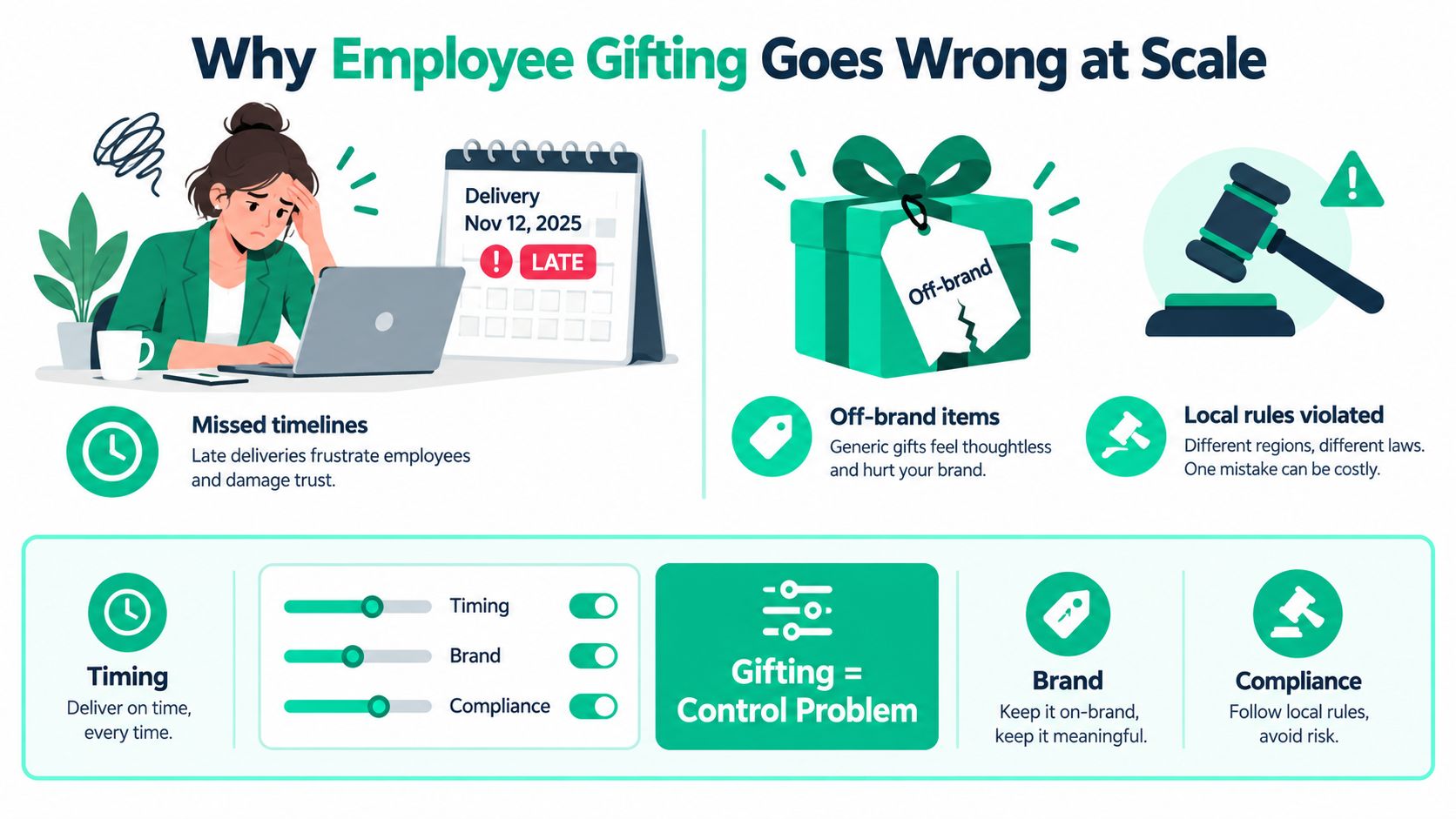
Treat each failure as a control gap
Missed dates, poor fit, customs holds, and tax exposure each have a different root cause. Timing drift often starts with late address collection. Off-brand products trace back to a skipped sample or approval. Customs delays come from incomplete documentation, while tax problems begin when a team applies one rule to every country and gift type.
| Failure Mode | Typical Root Cause | Where This Is Solved |
|---|---|---|
| Late or missing delivery | Address collection starts too late, or no one owns delivery exceptions | Fulfillment calendar and delivery QA |
| Wrong size or unsuitable item | No sizing, dietary, or regional preference check | Choice design and recipient data |
| Product feels generic | Item selection isn't tied to a milestone or message | Recognition policy and gift brief |
| Customs hold or return | Local shipping requirements weren't checked | Country-specific fulfillment plan |
| Tax or approval problem | Gift type, value, and business purpose weren't classified | Finance, payroll, and approval controls |
The deliverable is not the box. It is the handoff from receipt to recognition: a package arriving on the milestone, carrying a message that ties it to the person's contribution. A practical system will not make every shipment effortless. It makes ownership clear, catches predictable problems before dispatch, and keeps a logistics miss from erasing the recognition moment.
Mapping Milestones to Gift Categories
Before choosing a product, decide what the employer is giving and why. A gift for a personal milestone, a performance reward, a benefit available under policy, and something that substitutes for compensation can look similar to an employee, but those categories may have different tax treatment, approvals, and fulfillment rules.
Start with the purpose
Use four working classifications, then confirm them with payroll or tax advisers for each relevant market:
- Gift: A discretionary expression of appreciation tied to a personal or work milestone, such as a welcome package or a note and item for a retirement.
- Reward: Recognition linked to a specific contribution or result. A spot award for exceptional work belongs here, not in a generic gifting bucket.
- Benefit: An item or allowance offered under a broader employee policy, such as a recurring wellbeing or home-office benefit.
- Compensation substitute: Cash or a cash-like payment presented as a “gift” but effectively used to reward performance or replace pay. Don't assume a different label changes its treatment.
Next, map the event to a category and a trigger. Promotions and work anniversaries are clear moments for personal recognition; a retirement may call for a lasting keepsake or a message from colleagues. Parental leave can be marked with a practical, optional gift that respects household preferences. Onboarding works best as a welcome, while a recognition spot should explain the contribution being acknowledged.
The timing matters too. In a 2025 survey, employees most often considered gifts meaningful when they were connected to promotions (59%), followed by work anniversaries (54%), retirements (48%), and personal events such as weddings or new babies (43%) (employee gifting survey findings). Those moments give a program a more understandable trigger than an undifferentiated annual drop.
Run the classification test before approving value
Suppose a manager wants to recognize an employee with a gift valued at $75. If it's a discretionary thank-you for a life or service milestone, the team needs to check the rules for that gift category and location. If it's tied to a sales target or exceptional performance, it may be treated as a reward or compensation-related item instead. The amount alone doesn't settle the question.
For service milestones, a policy can define which anniversaries trigger recognition and how managers add a personal note. Teams planning that cadence can use this guide to employee recognition for years of service as a reference for thinking through the recognition moment. For a specific experience-based option, an employer might consider golf lesson vouchers, provided the item suits the recipient and meets local policy.
Practical rule: Put the occasion, purpose, category, and approval owner in the request. If the requester can't explain why the employee is receiving the item, don't send it yet.
Building a Budget That Survives Finance
Finance needs more than a unit price and a recipient count. A defensible budget shows what each milestone tier covers, how regional costs are handled, and what happens when shipping, duties, returns, or replacement items push the landed cost above the catalog price.
Start with the annual gifting calendar and the eligible recipient groups. Separate planned events, such as onboarding and service anniversaries, from manager-requested recognition. Set a per-recipient envelope for each category, then model it by region using a defined exchange-rate approach. Don't let teams convert currencies using whichever rate happens to appear on a vendor invoice.
Model landed cost, not shelf price
Build each regional estimate from the components that can change the final cost:
- Product and packaging: Include personalization, assembly, and any note or insert.
- Delivery and import costs: Account for shipping, customs, duties, and applicable taxes.
- Operational handling: Include storage, kitting, address correction, returns, and replacement units.
- Contingency: Reserve headroom for localized alternatives and failed deliveries without drawing from another milestone tier.
A sample budget structure can separate onboarding kits, anniversary gifts, recognition spots, and major milestones. The amounts should come from internal policy and actual vendor quotes, not a made-up industry benchmark. If a team expects substitutions for sizing or local suitability, model that as an explicit planning assumption and validate it against past program records rather than treating it as a universal rate.
Give Finance a concise approval view
A useful one-pager names the program owner, recipient eligibility, milestone triggers, proposed categories, regional cost assumptions, tax review owner, and the process for exceptions. Attach vendor quotes and call out costs that aren't included in the advertised item price. Procurement can then compare offers on the same basis instead of picking the lowest unit price and discovering later that packaging or international delivery wasn't included.
Keep a record of approved budget against actual landed cost. That lets the team see whether an overspend came from a vendor, a shipping issue, or a policy choice. It also gives Finance something concrete to review when the program changes, rather than asking them to approve a fresh estimate built from memory.
Choosing Between Fixed Gifts, Choice Menus, and Flexible Budgets
A fixed gift is easy to order and hard to personalize. A flexible budget gives employees broad control but can create more work for Finance and People Ops. A curated menu sits between them, offering choice without asking employees to search an enormous catalog or the program owner to manage unlimited exceptions.
The right model depends on geography, recipient needs, and the capacity to administer the program. In a survey on employee gifting, 52% of employees said they'd rather choose from several gift options, 82% valued personalized gifts more than generic ones, and only 10% identified company-logo merchandise as an important feature of an enjoyable reward selection experience (employee choice and gifting preferences). Choice can help, but only if the options are relevant and fair.
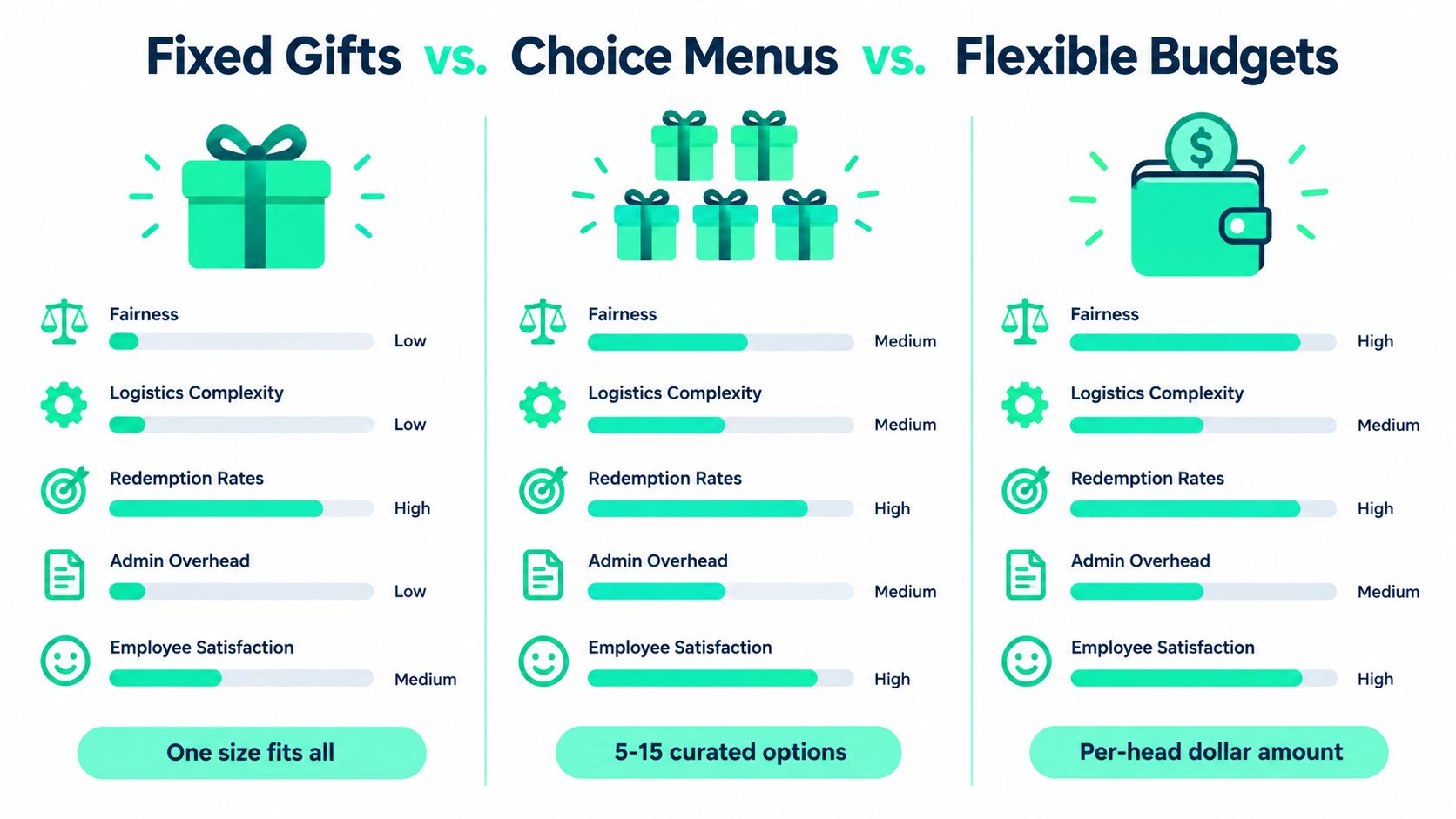
| Model | Fairness and recipient fit | Fulfillment and administration | Works well when |
|---|---|---|---|
| Fixed gift | Everyone receives the same item, which can feel consistent but may not suit every employee | Simplest to procure; greater risk of unwanted or unusable items | The event is shared, the item travels well, and local needs are similar |
| Curated choice menu | Employees choose from a limited set designed around comparable value and local suitability | Requires clear deadlines, inventory planning, and a process for non-response | Teams are distributed and can maintain regionally appropriate options |
| Flexible budget | Can accommodate individual preferences, but the experience may vary and feel uneven | Requires spending rules, reimbursement or platform administration, and tax review | Employees have strong local preferences and the organization can support the administration |
Design choice, don't outsource the problem
A huge catalog isn't automatically more personal. It may move the work of evaluating fit, delivery, and availability from the employer to the employee. A smaller set of locally appropriate options can be easier to use, while still allowing employees to select for size, style, dietary needs, or household preference.
For each option, define eligibility, a common value basis, any regional substitutions, and an opt-out or donation path. Don't create a menu in which one region gets a practical item and another gets a visibly lower-value substitute without explaining the difference. Ask employees what they would use; a set of employee benefits questionnaire ideas can help shape those questions without turning the gift selection into a cumbersome survey.
Use the model that your team can deliver reliably. A simple fixed gift with careful localization can outperform a poorly managed choice program. Conversely, if recipients have different climates, sizes, dietary needs, or delivery constraints, offering no choice may create avoidable waste. Track redemption, satisfaction, delivery success, and unused stock so the next cycle reflects what employees chose.
The video below offers another perspective on employee gifting and recognition in practice.
Compliance and Fulfillment Controls Before You Click Buy
Global employee gifting needs a control system before anyone selects products. A useful sequence is to classify the item, define country rules, set approval gates, preserve an audit trail, and monitor exceptions. If a program skips classification and jumps to a vendor catalog, the team may discover too late that its preferred item doesn't fit local policy.
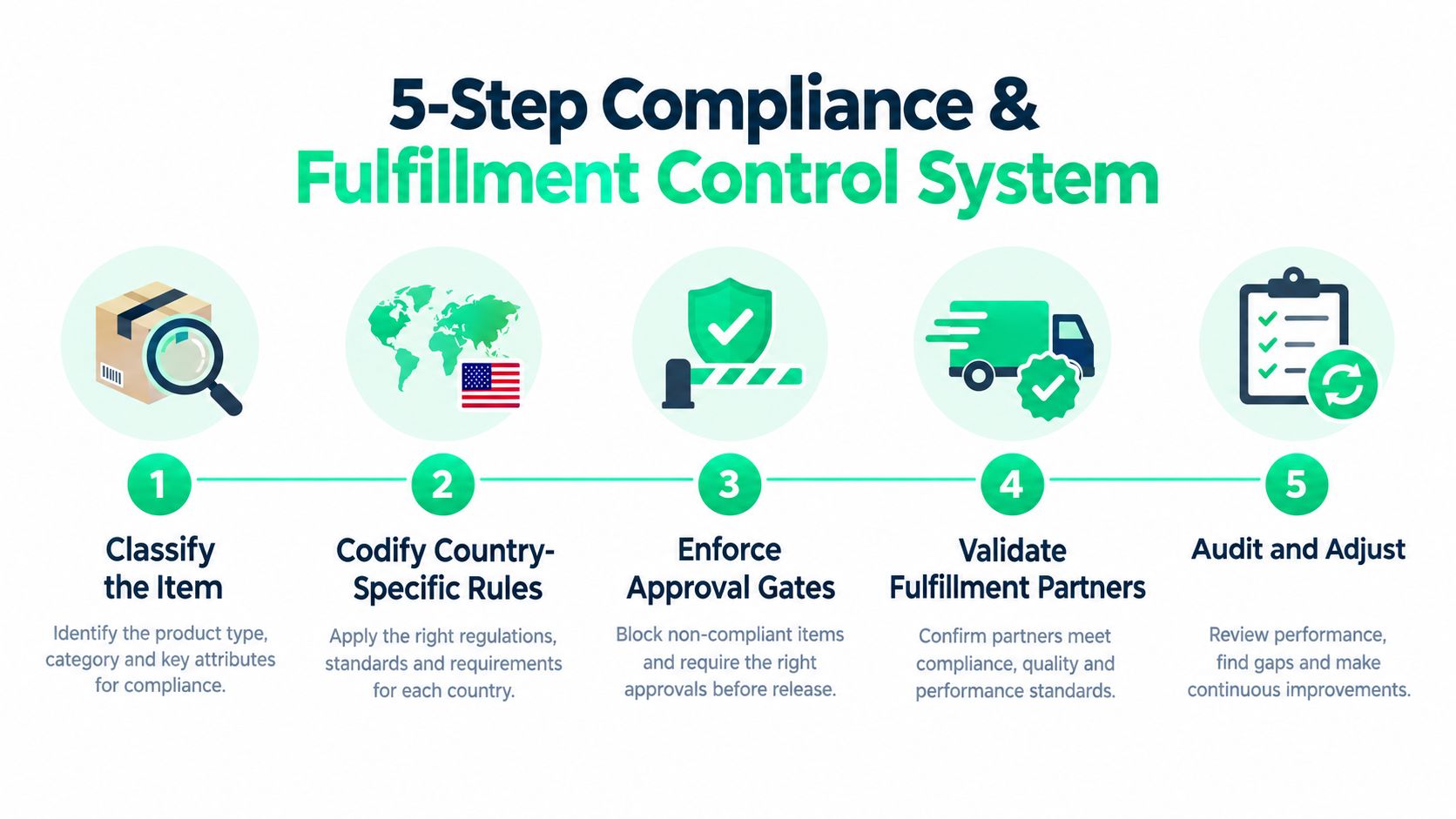
Make the rules operational
- Classify the item. Decide whether it's a gift, reward, benefit, or compensation substitute. Record the business purpose as well as the category.
- Codify country-specific requirements. Document monetary limits, cash-equivalent restrictions, payroll reporting, VAT or sales tax, and customs paperwork for each market. Assign an owner to validate changes with local payroll or tax professionals.
- Set approval gates. Define who can approve recipient eligibility, item value, frequency, and business purpose. Route exceptions to a named approver rather than relying on informal messages.
- Maintain an auditable record. Capture recipient, country, item value, currency conversion, delivery date, and the tax decision. Store the approval and fulfillment details where Finance can retrieve them.
- Monitor exceptions. Review returned shipments, failed deliveries, missing addresses, and substitutions by market. Use the review to update the policy and vendor instructions.
The UK illustrates why one worldwide gift-card rule doesn't work. Under HMRC's trivial-benefits framework, a gift card can generally be tax-free only when it isn't cash or a cash voucher, isn't a performance reward, isn't contractual, and costs no more than £50 including VAT (UK trivial-benefits guidance for gift cards). A restricted retailer card may meet different conditions from a prepaid Visa or Mastercard. Don't treat the two as interchangeable.
A compliant gift that can't be used or delivered locally still wastes budget and weakens the gesture.
The recurring pitfalls are straightforward: exceeding a per-item threshold, using a gift as performance compensation, assuming a taxable benefit is exempt everywhere, and overlooking cross-border logistics. A policy should spell out what happens when an item is unavailable, a recipient declines, or customs returns a package. Validate country guidance with local professionals before launch; a checklist is an operating aid, not a substitute for tax advice.
Procurement, Personalization, and Last-Mile Distribution
Consider a recognition program for teams in the United States, Germany, and India. The request may start as a single brief, but procurement still needs to check supplier coverage, product quality, local availability, address collection, recipient preferences, packaging, and delivery timing. The easiest mistake is to treat one approved mockup as proof that every country can receive the same finished item.
Start by asking vendors for samples and checking the actual product, print placement, materials, and packaging. For apparel, collect sizing or offer a choice that lets employees select a suitable fit. For food or fragrance, confirm whether the product can ship to each destination and whether the recipient can use it; an international perfume shipping guide can help identify the types of transport and customs questions to raise with a supplier.
Keep the runbook short enough to use
The program owner should keep a single runbook with the steps, owners, deadlines, and decisions that matter:
- Brief and approval: State the milestone, audience, item category, brand requirements, and approved regional alternatives.
- Recipient data: Set a secure method for collecting addresses and preferences, and limit access to the people handling fulfillment.
- Sample and QA: Approve a physical sample where practical. Check names, sizes, packaging, and personalization before the full order.
- Dispatch and tracking: Confirm who monitors delivery status and who contacts recipients when an address or shipment needs attention.
- Exceptions and rollback: Define how the team will replace, refund, or reroute an item, and who can approve a substitute.
Digital design workflows can help teams develop brand-consistent concepts, localized variants, and production specifications faster, but speed doesn't remove the need for human review. People Ops or brand owners should approve the final design. Someone responsible for privacy should review how recipient data is collected and shared, and an assigned coordinator should handle delivery exceptions.
When a package fails to arrive, send a personal note close to the milestone and explain the next step. Offer a replacement, local alternative, or choice where appropriate. The recognition isn't the parcel alone; it's the recipient understanding why the employer reached out.
For teams that need a coordinated delivery process, corporate gift delivery operations can be considered alongside internal ownership and vendor coverage. FLYP LTD is one option for enterprise merch operations, with design, curation, QA, budgeting, logistics, and reporting handled as a managed service. Whichever provider the team chooses, keep the runbook and decision rights with the program owner.
Measuring Impact Beyond Packages Shipped
Shipment counts show whether a vendor dispatched orders. They don't tell People Ops whether employees were included, whether the gift arrived in usable condition, or whether the recognition felt personal. Measure the experience in a sequence that links each signal to a decision.
A 2025 survey of 1,500 employed U.S. adults reported that 67% believed a meaningful employer gift increased job satisfaction, 43% associated it with a stronger connection to their team and workplace culture, and 29% said it made them more likely to remain with their company (survey on why corporate holiday gifts matter). These are reported attitudes, not proof that a gift alone causes retention. Recognition works best as part of a broader practice that is timely, specific, and connected to contribution or belonging.
Connect each metric to a program decision
- Participation: Check whether eligible employees could take part. Low participation may point to inaccessible choice, missed communications, or a difficult ordering process.
- Milestone coverage: Compare recognized moments with the events your policy says should trigger a gift. Gaps call for a calendar or eligibility audit.
- Satisfaction and perceived personalization: Ask whether the item felt useful and appropriate. Weak results may mean it's time to revise the gift or choice model.
- Engagement and retention signals: Review these as longer-term indicators alongside broader recognition practices, not as outcomes a gift can claim on its own.
Set the measures before the next program cycle, then review exceptions and feedback after delivery and revisit the policy on a regular operating cadence. Teams building a broader measurement approach can use this guide to engagement tracking to consider how gifting fits with other employee signals.
Build your next gifting cycle around a clear milestone, an approved local policy, and a delivery owner before selecting products. FLYP LTD supports enterprise merch programs with design, curation, quality checks, budgeting, fulfillment, and reporting; visit FLYP LTD to see whether its managed-service approach fits your team.