54% of corporate gift recipients said they'd thrown away at least one gift without using it, according to a 2022 Business.com survey of 1,547 professionals. The same survey found a $30 median company spend per gift, compared with recipients' expectations of approximately $100, while nearly half said vendor holiday gifts influenced them to continue working with the sender. For teams buying corporate gifts for executives, that combination calls for more than a bigger budget. It calls for a defensible way to select, approve, deliver, and evaluate gifts.
Table of Contents
- Why Executive Gifts Are Harder Than They Look
- Luxury Gift Categories Compared Side by Side
- Tax and Policy Limits Behind Every Executive Gift
- Etiquette and Ethics Across Recipient Types
- Personalization and Budget Tiers for Executive Use Cases
- Procurement, Logistics, and Choosing a Managed Model
- Your Next Step for an Executive Gifting Program
Why Executive Gifts Are Harder Than They Look
The survey's disposal finding concerns recipients who discarded at least one gift, not the proportion of all gifts discarded. That distinction matters. It identifies a relevance problem without establishing how much material entered the waste stream, whether expensive gifts performed better, or whether executive recipients behaved differently.
The spending gap also needs careful interpretation. It doesn't prove that raising every budget would improve relationships. My procurement recommendation is to treat recipient choice as the default to test, then approve a premium physical gift when the team can explain why that specific person would want it.

Different Teams Need Different Evidence
People Ops and HR teams should connect executive gifts to a defined recognition purpose. Global marketing and events teams should assess whether an invitation or object suits the relationship. Startups outsourcing company swag and new-hire kits should establish who owns approvals and recipient communication before delegating fulfillment.
Use a shared decision record:
- Relevance: What evidence supports the recipient's likely interest or use?
- Choice: Can the recipient select an alternative or decline comfortably?
- Compliance: Has an accountable person checked permission to give and receive?
- Acceptance: Can the team distinguish delivery from actual acceptance and use?
An experience can be appropriate when preferences are known. For a team considering regional hospitality, the winery event insights from McLaren Vale Cellars provide planning context. Procurement should still verify interest, accessibility, scheduling, and alcohol suitability rather than assume a prestigious venue fits everyone.
Buying principle: Approve the reason for the gift before approving the object.
The defensible question isn't whether an item looks executive-grade. It's whether the team has enough recipient knowledge to justify committing money and materials to it.
Luxury Gift Categories Compared Side by Side
Luxury gift categories compared for executive programs
| Category | Best fit | Main risk |
|---|---|---|
| Premium physical objects | A known recipient and a milestone with a clear commemorative purpose | An unwanted permanent object, especially after irreversible personalization |
| Premium food and beverage | Confirmed tastes and an appropriate delivery occasion | Dietary mismatch, alcohol restrictions, spoilage, or unsuccessful delivery |
| Experiences | A recipient who welcomes the activity and can choose when to participate | Scheduling, accessibility, travel, or redemption barriers |
| Digital gift cards and eGifts | Uncertain preferences or geographically dispersed recipients | Merchant restrictions, redemption friction, or policy incompatibility |
| Donation-based gifts | A recipient who has expressed a charitable preference | An unwanted cause association or a donation presented as personal recognition |
These are procurement judgments, not measured performance rankings. Compare proposals against personalization depth, recipient choice, perceived value, fulfillment complexity, and the possibility of refusal. No category wins across every criterion.
Where Physical Gifts Earn Their Place
A premium notebook with a restrained inscription can suit a service milestone when the recipient uses paper and values a keepsake. Its strength is the connection between the object and the occasion. Its weakness is commitment: once engraved, it may be difficult to reassign if the recipient declines.
Food and beverage call for a different test. Confirm dietary preferences, alcohol acceptance, and delivery availability before selecting a hamper. Don't interpret polished packaging as evidence that the contents are appropriate.
Experiences shift personalization away from ownership toward participation. Offer scheduling flexibility and check whether the recipient would need to arrange travel or incur additional costs. An invitation that creates work for the recipient may not feel generous.
Where Choice Deserves Priority
Digital options deserve consideration when the team lacks reliable preference information. Before selection, review how digital gift cards work from Approved Experiences Traveler, then obtain the proposed provider's actual redemption terms. Verify eligible locations, merchants, expiry conditions, and support arrangements rather than treating all digital products as interchangeable.
Donation-based gifts should be an affirmative selection, not an assumed substitute. Ask whether the recipient wants a donation and whether they wish to choose the organization.
For category comparison, request a sample recipient journey alongside the product quotation:
- Selection: What does the recipient see, and can they decline?
- Personalization: Which details can change after acceptance?
- Completion: What confirms delivery, redemption, or participation?
- Recovery: What happens if the recipient never responds?
A physical gift fits when recipient knowledge is strong. A choice-led offer fits when uncertainty is the central buying risk.
Tax and Policy Limits Behind Every Executive Gift
Consider the IRS's worked example: a business buys $80 gift baskets for three executives, spending $240, but its deduction is limited to $75, calculated at $25 per recipient, under the IRS business-gift guidance. That guidance also explains that sending a gift to a company for the personal benefit of particular executives doesn't avoid individual treatment.
The operational lesson is simple: the invoice recipient isn't necessarily the tax recipient. Finance needs to know who benefits, not just which company or office accepted the shipment.
Separate Spending Authority From Deductibility
For U.S. business gifts, the general annual deduction boundary applies to gifts made directly or indirectly. As IRS Publication 463 explains, certain incidental packing, shipping, and engraving expenses are excluded when they don't add substantial value; qualifying branded items costing $4 or less can also fall outside the limit when permanently imprinted with the business name and widely and regularly distributed.
The same IRS guidance requires supporting records covering the business purpose, description, cost, date, and recipient. Don't assume a branded premium item qualifies for the low-cost exception because it carries a logo.
The deduction limit governs tax treatment. It doesn't, by itself, authorize spending or establish that a gift is ethically permissible.
A premium gift can therefore exceed the deductible amount without making the purchase automatically impermissible. Finance should assess the treatment, while the budget owner and compliance reviewer separately assess commercial purpose and permission.
Build the Ledger Around the Beneficiary
Use recipient-level records by tax year, with product value separated from fulfillment charges. A single bundled invoice may be convenient for purchasing, but it shouldn't prevent Finance from identifying the underlying costs.
A useful control record includes:
- Beneficiary: The individual receiving the personal benefit, with employer and role.
- Gift description: The item, occasion, and documented business purpose.
- Cost components: Product, decoration, packaging, freight, and other separately identified charges.
- Supporting evidence: Invoice, approval, dispatch information, and recipient correspondence.
Ask Finance to review the cost classification before the campaign launches. Reconstructing it afterward leaves the team dependent on supplier invoices that may not contain the information needed.
These are U.S. business-gift considerations, not a universal treatment for employee awards or international recipients. Route those cases for appropriate tax review rather than applying the business-contact rule across the entire executive population.
Etiquette and Ethics Across Recipient Types
An expensive personalized object can communicate attention. It can also make refusal awkward. My recommendation is to assess recipient role and decision timing before personalization, because a thoughtful design doesn't resolve a conflict of interest.
The distinction between recipients is substantive. A customer executive may influence a renewal; a supplier executive may participate in negotiations; a board member may hold an oversight role. An employee recognition gift has a different purpose and approval context from an external relationship gift.
Test Permission Before Preference
Create a country-and-recipient review that identifies the applicable employer policy, internal rules, and required legal or compliance input. Don't use a single global spending allowance as a substitute for this assessment.
Procurement should propose restrictions around tenders, negotiations, contract renewals, and audits. The organization's compliance owner should determine when those restrictions apply and whether gifts should be prohibited altogether.
- Customer executives: Check pending commercial decisions and the recipient organization's acceptance policy.
- Supplier executives: Establish why recognition is appropriate independently of purchasing decisions.
- Employees: Use a consistent recognition framework, with the relevant payroll or tax review.
- Board members: Obtain governance approval appropriate to the occasion and relationship.
- Public officials: Require specialist screening rather than treating them as ordinary business contacts.
For internal programs, the related guide to corporate gifts for employees provides a separate planning context. Keep that workflow distinct from gifts to external decision-makers.
When Less Is More Respectful
A lower-value choice offer may be preferable when the recipient's tastes are uncertain or a permanent personalized item could create discomfort. That's a risk-based recommendation, not evidence that cheaper gifts always perform better.
Choice still needs boundaries. A selectable gift can be inappropriate during a restricted decision window, and an apparently modest option can conflict with the recipient's employer policy.
Approval test: Would the sender be comfortable explaining the recipient, timing, value, and business purpose to an independent reviewer?
Give recipients a discreet way to decline without having to justify themselves. Record the refusal without treating it as a relationship failure, and prevent well-meaning colleagues from sending a replacement automatically.
The strongest etiquette is operational: no surprise dispatch before permission is established, no pressure to accept, and no exception based solely on an executive's commercial importance.
Personalization and Budget Tiers for Executive Use Cases
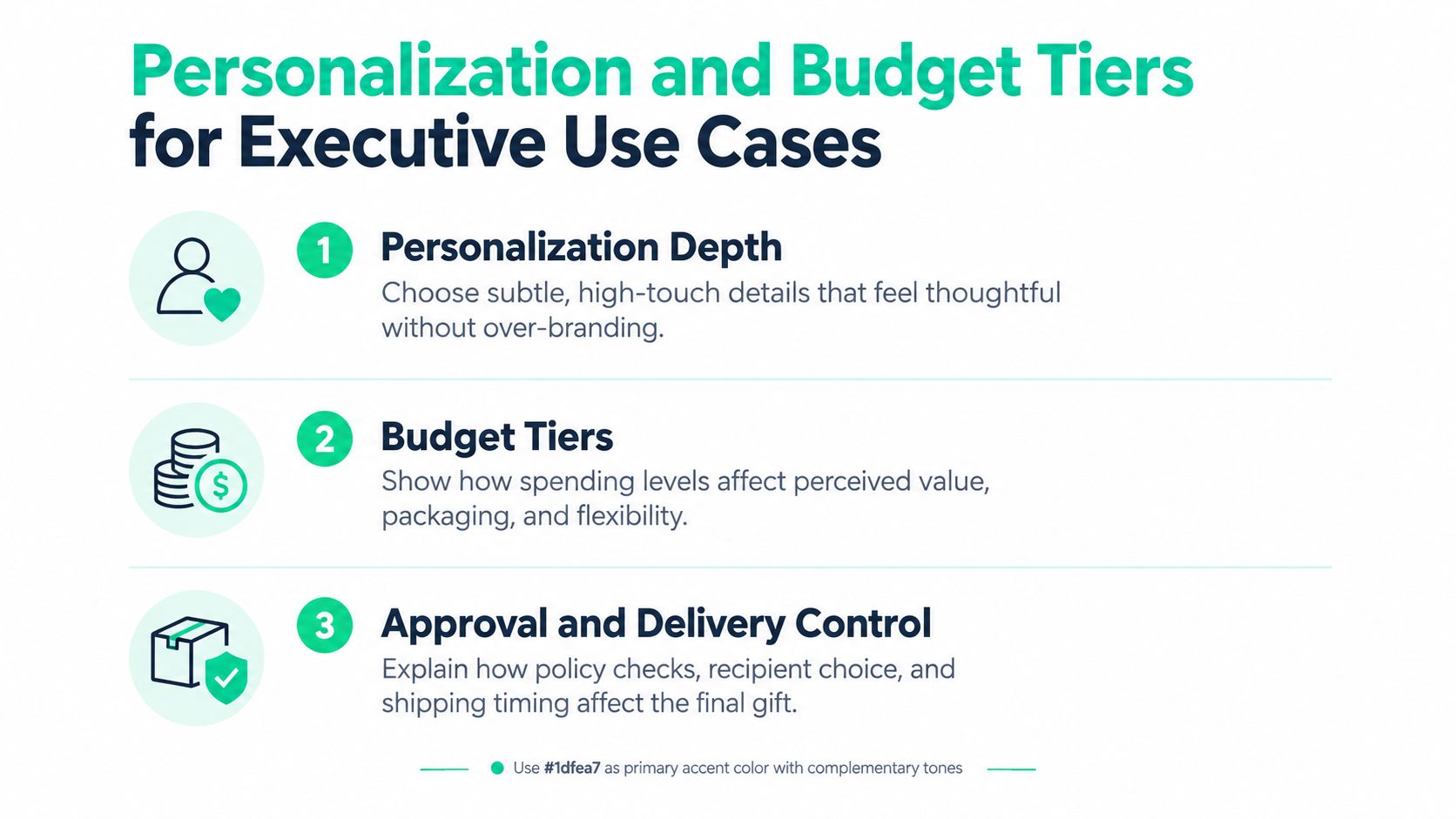
Set budget bands by purpose and risk, not seniority alone. A senior hire's welcome gift, a director's service milestone, and an external executive's thank-you should not automatically receive the same treatment because the recipients hold comparable titles.
Use descriptive bands rather than importing arbitrary market prices. A policy-constrained band, a standard recognition band, and an exceptional milestone band can each have distinct approval requirements. Finance should set the actual allowances using internal policy and the recipient assessment.
Match the Band to the Situation
| Executive use case | Suggested band | Selection approach |
|---|---|---|
| Senior-hire onboarding | Standard recognition | Offer useful items, confirm sizing, and align delivery with the start date |
| Service milestone | Exceptional milestone when approved | Consider a commemorative physical gift after confirming interest |
| Board recognition | Governance-approved band | Document the occasion and use restrained personalization |
| Public-sector or regulated-industry contact | Policy-constrained | Establish eligibility before showing a catalog |
| Key-client appreciation | Relationship-specific approved band | Match the selection to known preferences and cleared timing |
For U.S. federal executive-branch employees, general unsolicited-gift exceptions include limits of $20 per occasion and $50 annually from one source, as summarized in this corporate-gift etiquette and policy guide. These aren't blanket permissions: recipient classification, circumstances, other restrictions, and agency guidance still require review.
A regulated-industry executive shouldn't be assigned those federal thresholds merely because their employer operates in a regulated sector. Identify the actual rule that applies.
Evaluate Features Alongside Cost
Within each approved band, score proposals against personalization depth, visible branding, recipient choice, delivery control, policy compatibility, and auditability. A supplier's ability to add a name is only one feature, not a complete personalization strategy.
For onboarding, functional choices and accurate sizing may matter more than permanent engraving. For a service milestone, a personal note explaining the contribution can establish the connection without customizing every component.
Use the principles in personalization at scale to frame repeatable workflows, then specify which details require individual confirmation.
Before releasing a personalized order, check:
- Identity: Has the recipient confirmed their preferred name and relevant details?
- Branding: Does the proposed placement suit the occasion?
- Reversibility: Can production wait until the recipient accepts?
- Approval: Is the selected configuration within the cleared band?
A higher band should buy an appropriate level of service, flexibility, or craftsmanship. It shouldn't automatically buy more objects, heavier packaging, or a larger logo.
Procurement, Logistics, and Choosing a Managed Model
Choose between in-house sourcing and a managed program by comparing control, internal workload, exception handling, and reporting. Don't compare a product-only quotation with an end-to-end service fee and call the difference a markup.
In-house sourcing is a reasonable candidate when the catalog is narrow, destinations are familiar, and an internal owner can manage recipient communication. A managed model deserves evaluation when the team needs coordinated design, supplier oversight, international fulfillment, and support.

Compare Responsibility, Not Just Features
| Operational requirement | In-house sourcing | Managed model |
|---|---|---|
| Catalog control | Internal team curates and maintains options | Provider curates within approved boundaries |
| Quality assurance | Internal owner arranges samples and checks | Contract specifies samples, checks, and acceptance criteria |
| Delivery exceptions | Internal team coordinates recipients and carriers | Provider handles agreed exceptions and escalations |
| Returns | Team negotiates and administers handling | Provider follows a documented returns process |
| Reporting | Team reconciles supplier records | Provider supplies agreed records and exports |
A managed merch scope can translate brand prompts, URLs, images, or briefs into garment-accurate designs, then coordinate curation, quality assurance, budgeting, brand safety, and reporting. After design approval, the scope can extend to manufacturing, fulfillment, international shipping, customer service, and returns. Require the contract to distinguish included work from chargeable exceptions.
For either approach, map the handoffs described in corporate gift delivery planning. Assign an owner to address validation, recipient questions, failed deliveries, and replacement authorization.
Measure Waste Without Guessing
Giftly's 2025 corporate-gifting predictions reports 39% of programs including eGifts or virtual experiences and 44% using automated platforms. Treat those as source-reported trend figures, not proof that a digital or automated program prevents waste.
Build a global workflow around opt-in address collection, locally appropriate catalogs, minimal necessary packaging, and consolidated shipping where feasible. Ask suppliers for evidence supporting recycled-content, sourcing, or shipping-impact claims.
Keep distinct records for:
- Unused inventory: Goods purchased but never allocated or dispatched.
- Recipient refusal: An explicit decline, separate from nonresponse.
- Returns: Items received back, with condition and disposition.
- Recovery: Donation, resale, or recycling supported by documentation.
- Unknown outcomes: Delivered items whose use or eventual disposal hasn't been established.
Don't label an untracked return “recycled,” or count an unanswered survey as evidence of use. Compare delivery, acceptance, and utilization separately, and disclose the limits of each measure.
The decision to outsource should follow the responsibility map. A managed provider can perform work, but the buying organization still needs accountable policy owners and access to its program records.
Your Next Step for an Executive Gifting Program
Start with the last completed gifting cycle, not a new catalog. Reconcile purchasing records with recipient lists, approvals, delivery information, and any feedback already available. Mark missing evidence as unknown rather than filling gaps with assumptions.
The audit should answer a practical question: which problems require better internal rules, and which require additional operational capacity? Outsourcing won't resolve an unclear recognition purpose or an unapproved recipient policy.
Turn the Audit Into a Pilot
Begin this week with a short working session involving People, Procurement, Finance, and the relevant compliance owner. Bring actual orders and exception records so the discussion produces decisions rather than preferences.
- Audit the recipient record: Capture role, country, occasion, item, cost components, approval, and known outcome. Ask about use where follow-up is appropriate.
- Classify the population: Separate customers, suppliers, employees, board members, and public officials.
- Approve the rules: Assign spend bands, escalation routes, and responsibility for restricted situations.
- Select a pilot: Choose a defined occasion with a clear owner and enough follow-up access to assess results.
For the pilot, document the hypothesis before buying. For example, test whether a curated choice offer produces fewer explicit refusals than the team's existing fixed-item approach. Don't promise an improvement or assume that preference alone explains any difference.
Set the Decision Before Collecting Results
Define acceptance as an affirmative recipient action, not a carrier scan. Define utilization according to the gift type, such as reported use, redemption, or participation. Record nonresponse separately and avoid interpreting it as either success or failure.
A useful pilot changes a purchasing decision. A shipment report only confirms that the team sent something.
Finish with a short decision memo: retain in-house sourcing, repair a specific workflow, or scope a managed service. Include the unresolved risks, required service responsibilities, reporting fields, and approval owners.
If a managed approach is warranted, use that memo as the agenda for a scoping conversation. Ask the provider to explain how it would handle your actual exceptions, not just demonstrate an attractive catalog.
FLYP LTD offers managed global merch programs covering design, curation, quality assurance, budgeting, logistics, and reporting, with manufacturing, fulfillment, international shipping, customer service, and returns handled after approval. Visit FLYP LTD with your executive-gifting audit and pilot requirements to scope which responsibilities to retain internally and which to delegate.