Gallup's recent research links the quality of employee recognition to engagement and retention. The practical question is whether employees experience appreciation that meets their needs, rather than whether recognition is intended or delivered.
For People Ops leaders, the distinction is between recognition activity and recognition received. Managers may believe they are expressing appreciation while employees still feel overlooked. The evidence supports investing in recognition, but the gap between intent and experience makes consistency and employee feedback important measures of whether it works.
Table of Contents
- Why Recognition Falls Short of Manager Intent
- How Recognition Reduces Turnover and Disengagement
- Performance Gains From Recognition in Controlled Tests
- What Makes Recognition Work Across Teams
- Scaling Recognition Across Distributed and Enterprise Teams
- Recognition Moments Across the Employee Lifecycle
- Confirm Your First Recognition Moment Before You Launch
Why Recognition Falls Short of Manager Intent
Recognition matters because it's associated with retention and can improve performance, yet managerial intent and employee experience don't necessarily match. Treating appreciation as something managers will remember to deliver leaves an important employee experience dependent on individual habits.
The following comparison draws on the 2022 Gallup and Workhuman study reported by HR Dive, covering more than 12,000 employees across 12 countries; 67% of leaders and 61% of managers reported giving recognition at least a few times per week, while 40% of employees said they received it only a few times per year or less.
Recognition frequency by group, 2022 to 2024
| Group | Measured Figure | What It Means |
|---|---|---|
| Leaders | 67% give recognition at least a few times per week | Reported activity is high at the top |
| Managers | 61% give recognition at least a few times per week | Most managers consider themselves active |
| Employees | 40% received recognition only a few times per year or less | Employee experience lags reported activity |
| Employees on milestones | 23% strongly agreed their employer recognizes promotions and work anniversaries | Milestone recognition isn't reliably experienced |
| Employees on amount | 22% said they received the right amount of recognition in 2024 | Frequency alone doesn't establish adequacy |
The milestone finding, also reported by HR Dive, concerns strong agreement about employer recognition, not a count of missed anniversaries. Likewise, the amount measure concerns employees' judgment of adequacy rather than a prescribed recognition frequency.
Treat the gap as a delivery problem
These findings don't establish that managers lack goodwill. Nor do they prove that memory is the sole cause. They make a practical case for testing whether appreciation reaches the intended recipients, rather than accepting managers' self-reported effort as evidence of success.
Possible failure points include praise concentrated on visible employees, group acknowledgments that obscure individual contributions, and milestones with no assigned owner. Diagnose those possibilities before buying more rewards.
For conversations about individual preferences, MyCulture.ai's a practical appreciation guide for HR can serve as a discussion aid, not a substitute for asking employees directly.
Start with a matched pulse question: ask managers how often they recognized employees during a defined period, then ask employees how often they received meaningful recognition during that same period. Compare team-level responses while protecting anonymity. Measure the experience, not just the manager's intention.
How Recognition Reduces Turnover and Disengagement
Employees receiving high-quality recognition were 45% less likely to have left their organization after two years, and 65% less likely to be actively looking for or monitoring another job opportunity, in a Gallup and Workhuman longitudinal study tracking nearly 3,500 employees from 2022 to 2024.
Those are relative differences between employees receiving higher- and lower-quality recognition. They aren't percentage-point reductions, and they don't mean an employer can apply the same reduction mechanically to its own turnover forecast.
The longitudinal design matters because researchers followed employees over time rather than relying only on a single survey snapshot. Still, association isn't proof that recognition alone caused employees to stay. Better managers, healthier teams, and stronger employment conditions could contribute to both recognition quality and retention.
What an employee might infer
Consider a hypothetical project involving two analysts. After delivery, one manager explains how an analyst's validation work prevented an inaccurate customer recommendation. The other analyst receives no acknowledgment of an equally important contribution.
The first analyst has explicit evidence that her manager understands her work. The second has to infer whether anyone noticed. That difference offers a plausible mechanism connecting recognition with commitment, but it doesn't establish that either employee will make a particular career decision.
Analytical caution: Recognition can strengthen someone's reasons to stay. It doesn't cancel inadequate pay, unreasonable workloads, or a lack of career opportunities.
This is why recognition belongs within a broader approach to improving employee satisfaction, rather than being positioned as a replacement for working conditions employees value.
The same distinction applies to engagement activities. PSW Events' VR wellness activities for employees offer an option to consider when planning shared experiences, but attendance at an activity isn't evidence that an employee feels recognized for their contribution.
Build a defensible retention comparison
Track recognition exposure alongside voluntary departures, tenure, role, location, and manager changes. Compare employees with reasonably similar circumstances, and distinguish receiving a reward from receiving meaningful acknowledgment.
Don't interpret lower turnover among recipients as automatic proof of program impact. Managers may preferentially recognize established high performers who were already more likely to stay. The strongest internal evaluation asks whether outcomes change after implementation, whether comparable teams show similar changes, and whether employees themselves report a better experience.
Performance Gains From Recognition in Controlled Tests
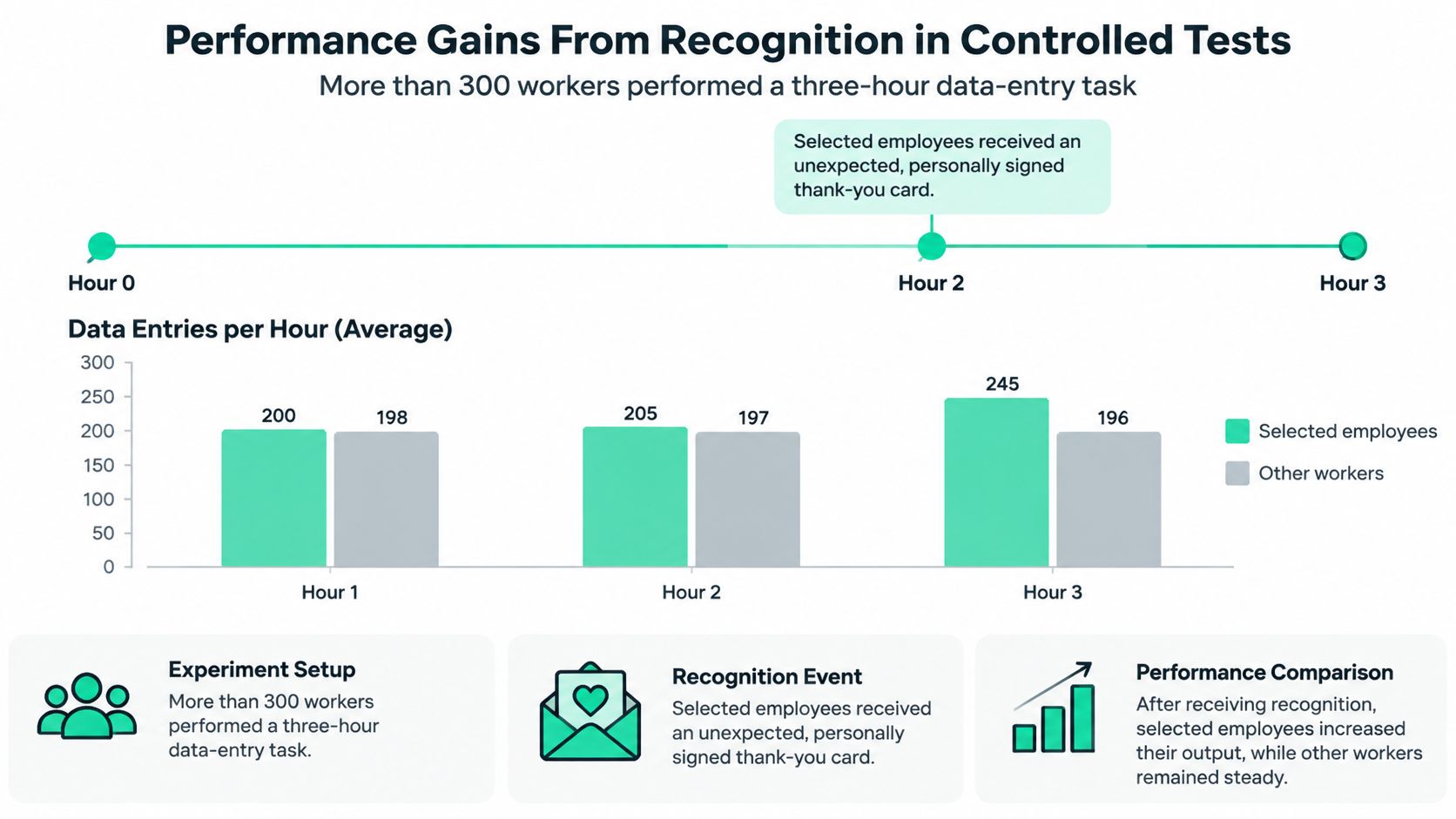
A randomized field experiment provides stronger causal evidence for a narrower outcome: immediate task performance. In the Management Science experiment, more than 300 workers performed a three-hour data-entry task, with unexpected public recognition introduced after two hours through personally signed thank-you cards; subsequent performance rose approximately 5.2%, or 0.27 standard deviations, when everyone was recognized, and approximately 7.3%, or 0.38 standard deviations, when the three strongest performers in an eight-person group were recognized.
Performance change by recognition design
| Recognition Design | Performance Change | Effect Size |
|---|---|---|
| Recognize every employee | About 5.2% higher after recognition | 0.27 standard deviations |
| Recognize the three strongest of eight | About 7.3% higher after recognition | 0.38 standard deviations |
| Control group, no recognition | Baseline | Baseline |
Random assignment strengthens the inference that recognition caused the measured performance difference in this setting. It doesn't establish the same effect for software engineering, clinical care, or a long-running enterprise program.
The illustration locates the thank-you-card intervention within the task.
The important result wasn't confined to recipients
The researchers found that much of the improvement came from workers who weren't recognized. That qualification matters when interpreting the illustration: other workers were not an unchanged background group.
The finding is consistent with social comparison, conformity, and reciprocal effort. Employees may adjust their behavior after observing what their employer values, even when they don't receive the acknowledgment themselves. These are plausible explanatory mechanisms, not a license to assume everyone responds positively to public comparison.
A useful design implication is to make the recognized behavior understandable. If a manager acknowledges careful exception handling, colleagues should be able to identify what the employee did and how they could demonstrate the same standard.
Test useful output, not just faster output
For an enterprise pilot, define both throughput and quality before introducing recognition. A processing team might monitor completed cases alongside rework and error rates, so speed doesn't become the only rewarded behavior.
Use a short measurement checklist:
- Coverage: Record who receives recognition and who remains outside the program.
- Timing: Capture the interval between the contribution and its acknowledgment.
- Concentration: Check whether the same recipients dominate repeatedly.
- Operational outcomes: Compare quality-adjusted output, not reward counts.
The accompanying video offers another format for discussing recognition with managers.
A before-and-after comparison is a useful diagnostic, but it isn't a controlled experiment. Account for staffing changes, workload complexity, and seasonal demand before attributing an improvement to recognition.
What Makes Recognition Work Across Teams
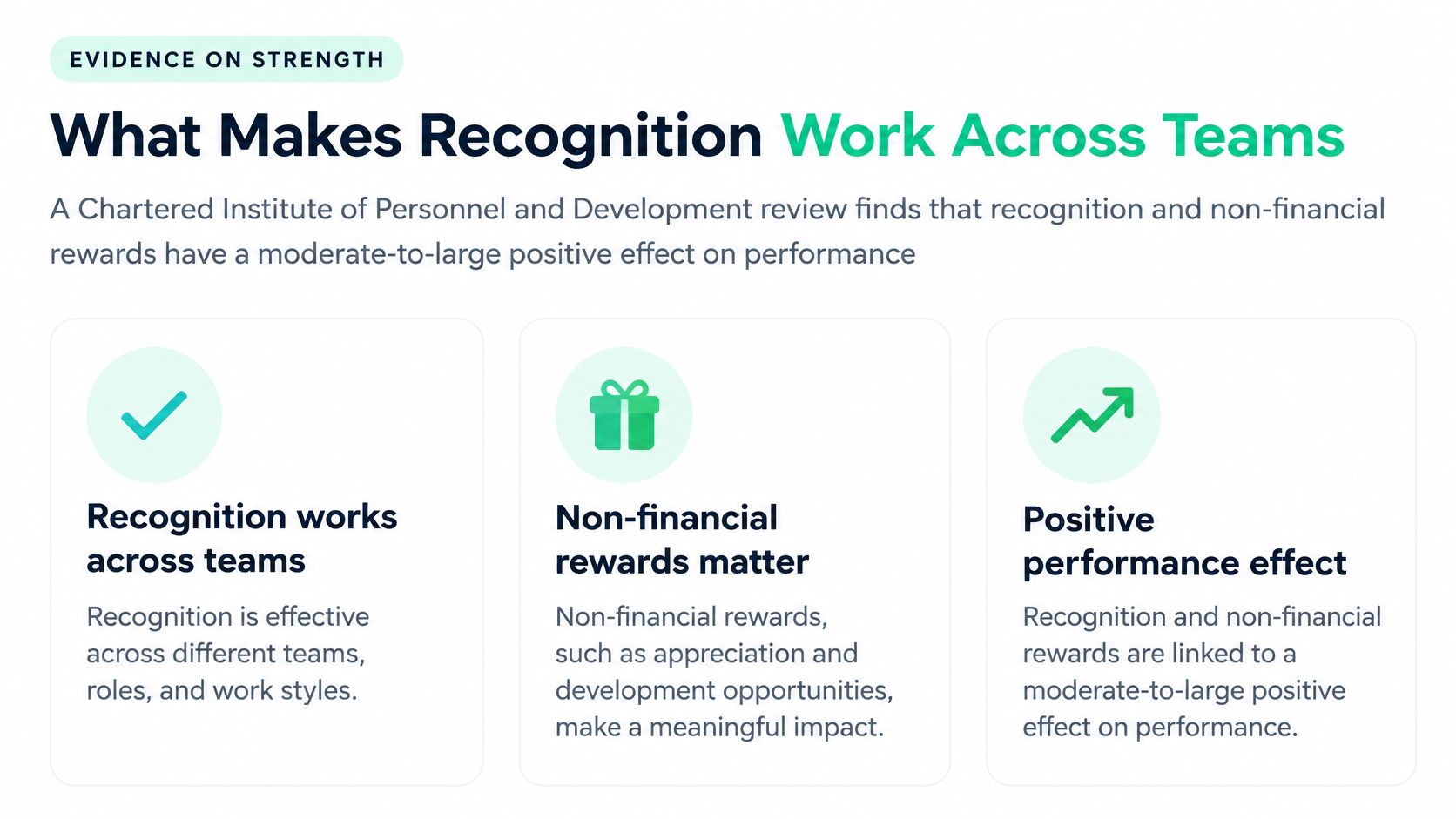
The evidence isn't equally strong for every promised outcome. A Chartered Institute of Personnel and Development evidence review concludes that recognition and non-financial rewards have a moderate-to-large positive effect on workplace performance, while findings for retention, commitment, and engagement are positive but smaller and more variable.
Separately, Gallup's workplace engagement analysis reports that employees who feel inadequately recognized are twice as likely to say they'll leave within the following year. That measures stated intention, not observed departures, and it shouldn't be presented as the same outcome.
The evidence summary below highlights the performance finding.
Turn quality into reviewable criteria
For program design, use practical quality checks rather than assuming that sending an acknowledgment makes it effective. These checks are operating standards, not a claim that each has an independently measured effect.
- Timely: Can the recipient readily connect the acknowledgment to the event? Review delays separately for scheduled milestones and unplanned contributions.
- Specific: Does the nomination identify an observable action and its consequence? Helping reconcile conflicting customer requirements is more informative than describing someone as excellent.
- Authentic: Could the manager explain the contribution without reading a template? Keep the employee's actual work at the center.
- Equitable: Can employees across roles and work arrangements qualify through comparable contributions? Don't require office visibility for work performed remotely.
Link the nomination form to a competency, customer outcome, safety practice, innovation, or collaborative behavior. Require the nominator to describe the evidence, not merely select a company value from a menu.
Audit access without turning praise into surveillance
Segment reporting by manager, geography, tenure, work arrangement, and demographic group where lawful and appropriate. Use aggregation and access controls to protect employees, particularly in small groups.
A gap is a reason to investigate, not a verdict. A low nomination rate might reflect overlooked work, an unsuitable eligibility rule, or a workflow that makes participation difficult for a particular team.
A nomination without evidence is a gift, not recognition.
Gifts can still be appropriate. The distinction matters because a program designed to acknowledge contribution needs a clearer rationale than a general employee benefit.
Scaling Recognition Across Distributed and Enterprise Teams
Under 200 employees, direct-send programs can scale adequately under our planning rule; more than 200 employees, or more than ten employee swag requests a month, signals that a store may be appropriate. These are FLYP's operational indicators, not research-derived thresholds or guarantees.
A branded internal store lets employees choose items using an allowance allocated by People Ops. The administrative question is whether your team should approve each transaction manually or establish rules that employees can use themselves.
Program models by team size and funding
| Program Model | Best Fit | Switch-Over Trigger | Funding Control |
|---|---|---|---|
| Direct-send gifts | Under 200 employees | Ten or fewer swag requests a month supports staying manual | People Ops buys each item |
| Swag store with employer-paid credits | Over 200 employees or more than ten requests a month | Introduce recurring or one-time employee credits | Employer funds each credit |
| Payroll-deduct store | Staff who want to top up beyond an allowance | Employees request purchases above their allowance | Employee funds the difference |
| Hybrid store with co-pay | Teams with mixed budgets | Employer covers an allowance and employees pay above it | Shared between employer and employee |
| One-time event grant | Conferences and launches | A discrete event needs a defined allocation | Event budget |
Separate employee choice from budget authority
Recurring balances can refresh monthly, quarterly, or annually. One-time balances can support onboarding, anniversaries, or bonuses, with employees redeeming credits against the catalog.
Choose the funding unit deliberately. Per-employee allocations support consistent access; team allocations put discretion with local managers; milestone allocations reserve spending for defined events. Distributed teams can use a common catalog while keeping budget ownership local.
A store isn't automatically a recognition program. An allowance becomes recognition only when someone explains what it acknowledges. For achievements that warrant a distinct physical acknowledgment, compare the purpose of custom employee recognition awards with the purpose of an employee-choice allowance.
Decide overages before employees encounter them
Document whether employees can exceed their allowance, who pays the difference, and what approval is necessary. For payroll deductions, involve payroll and legal teams before enabling the workflow across jurisdictions.
Keep a separate record of the contribution, recipient, approver, and funding source. Finance needs an allocation trail; People Ops needs to know whether the intended acknowledgment happened.
Start by counting monthly requests and employees by region. Then choose the model that removes a real administrative bottleneck without adding unnecessary infrastructure.
Recognition Moments Across the Employee Lifecycle
Consider a hypothetical employee's first year, then a later service milestone. The useful design choice isn't whether every occasion gets the same gift. It's which events need reliable scheduling, which need a manager's judgment, and which need both.
Onboarding begins with a known trigger. When the HR system records the start date, schedule the welcome acknowledgment and any associated credit. The manager supplies a personal note explaining why the employee's role matters, rather than leaving the entire welcome to an automated notification.
For teams incorporating recorded introductions, MEDIAL's a video workflow for welcoming employees can help structure that format. Keep the employee's own manager visible in the welcome rather than relying entirely on reusable corporate material.
Follow the contribution, not just the calendar
Later, the employee helps ship a project. This acknowledgment requires someone to notice and describe the work: perhaps the employee resolved a dependency that otherwise would have delayed a customer handover.
A promotion requires another distinction. The HR record can initiate the administrative steps, but the manager should explain the responsibilities and contribution behind the progression. A credit notification alone doesn't communicate that judgment.
At the work anniversary, the date can drive scheduling while the message reflects the employee's actual contribution. Employee choice can accommodate preferences without requiring People Ops to guess what item someone wants.
At a later major service anniversary, a more substantial acknowledgment might be appropriate under the organization's policy. The manager-written note should describe the person's contribution over time, not repeat their tenure.
Personalization needs evidence of its own
In Reward Gateway's 2024 survey findings, 84% of employees said personalized recognition made them feel more appreciated as a person, while 81% said it made them more likely to stay with their company longer. These are self-reported responses, not measured retention effects.
Use that distinction to set expectations. Personalization is a design priority to test, not a guaranteed way to prevent departures.
- Automate the predictable: Use reliable employee records for scheduled events.
- Keep judgment with managers: Ask them to describe contributions that a calendar can't identify.
- Support the message: Use employee recognition message guidance to improve specificity without making every note identical.
Map the moments already occurring in your organization before introducing new ones. A dependable acknowledgment of an existing milestone is more useful than an ambitious calendar nobody owns.
Confirm Your First Recognition Moment Before You Launch
Choose a single moment to pilot this week. A new-hire start date or service anniversary offers a clear eligibility event and a record you can reconcile against completed acknowledgments.
Write a short operating specification before arranging gifts or messages. It should define the milestone, eligible employees, responsible owner, expected delivery window, and exception process.
Make the pilot measurable
Use a checklist that connects the intended experience to an observable record:
- Eligibility record: Identify the HR-system field or approved list that determines inclusion.
- Delivery record: Capture when the acknowledgment was issued and whether delivery failed.
- Employee response: Ask whether the acknowledgment felt relevant and personally meaningful.
- Exception owner: Name the person who resolves missing records, transfers, and incorrect dates.
Set the budget before launch. Our merch credits are prepaid and can be funded per employee, team, or milestone. Decide who authorizes spending and how any employee-funded overage will work.
Pilot discipline: A completed transaction proves delivery. It doesn't prove appreciation.
Set the review before expanding
After a customer chooses a starting program, we map a 30-day rollout. Keep that rollout focused on the selected moment, using the team's existing tools wherever they can support accurate records and clear ownership.
Review coverage and delivery timing promptly. Retention needs a longer observation period and a credible comparison group, so don't promise an immediate turnover verdict from an initial rollout.
Before launch, put a review date on the calendar and invite the program owner, an HR analytics partner, and the budget holder. Use that meeting to inspect missed cases, employee feedback, and administrative effort, then decide whether to improve the pilot, expand it, or stop it.
FLYP LTD offers managed onboarding kits, recognition gifts, and employee-choice stores, with fulfillment, budgeting, and reporting support. Visit FLYP LTD to plan a starting program around a defined employee milestone and map a rollout with clear ownership and funding controls.