In 2024, 83% of 1,254 surveyed recipients in the United States, United Kingdom, and Ireland said receiving a corporate gift made them feel closer to the company, according to Sendoso's survey of gift recipients in the US, UK, and Ireland. That doesn't prove a gift buys loyalty. It does reframe corporate gift ideas for customers as a relationship touchpoint you should segment, document, and measure, not a catalogue you order from in December and forget.
The programs that justify their cost share three habits. They pick items customers keep using, they match value to the relationship, and they can show what happened after delivery.
Table of Contents
- Corporate Gift Ideas for Customers at a Glance
- Why Useful Gifts Stay Remembered Longer
- Matching Gift Budgets to Customer Tiers
- Letting Customers Choose Without Admin Overload
- Timing Gifts Around Customer Milestones
- Making Sustainable Gifts Hold Up Across Markets
- Three Customer Gift Programs and How They Measured Results
- Confirm Your Shortlist Before You Order
Corporate Gift Ideas for Customers at a Glance
A customer gift only earns its cost if the recipient keeps using it. That's why this shortlist favors everyday objects over one-off novelties. Costs below are typical unit costs before branding and shipping, so treat them as planning ranges, not quotes.
| Gift idea | Typical unit cost (USD) | Best recipient | Why it lasts |
|---|---|---|---|
| Recycled-cotton tee or hoodie | 25-60 | Broad customer base, teams that wear it at work | Worn repeatedly and visible to others |
| Insulated steel bottle or mug | 15-40 | Daily-use users across every tier | Used at the desk every day |
| Notebook and pen set | 12-30 | Operations, admin and mid-tier accounts | Used in meetings and planning |
| Laptop bag or tote | 35-90 | Strategic accounts and frequent travellers | Carried to every site visit |
| Desk accessory (organiser, lamp or desk mat) | 20-70 | Remote and hybrid teams | Stays in view for months |
| Curated coffee or snack box | 30-75 | Milestones and renewals | Consumed, so recall rests on the card |
| Premium travel kit (packing cubes, toiletry bag) | 40-100 | Senior buyers and frequent travellers | Used on every trip |
| Donation or experience voucher in the customer's name | 25-100 | Customers who decline merchandise | Memorable but carries no brand mark |
How to Read the Shortlist
The snack box is the exception that proves the rule. Once it's eaten, nothing physical remains, so its recall depends entirely on the card that arrives with it and the occasion you tie it to. If you use it for a renewal, write the card as if the box didn't exist.
The donation or experience voucher solves a different problem. Some customers can't accept merchandise, or don't want another object. Giving in their name respects that boundary while still marking the moment, but you lose every repeated impression a physical item would create. That's an acceptable trade-off when the alternative is a declined parcel.
Apparel carries the widest visibility and the widest risk. A well-fitting hoodie gets worn in public, but a wrong size goes straight into a drawer. If you can't collect sizes reliably, drop apparel from the broad tier and keep it for customers who choose it themselves.
Three Rules of Thumb
Pick items that sit on a desk or travel with the recipient, because objects that leave the room stop working for you. Check that the item works in the recipient's climate and dress norms, since a heavy hoodie in a hot market or a sleeveless tee in a conservative office won't be worn regardless of quality. Budget shipping and duties separately for international recipients, because a low unit price can be doubled by freight and customs before it becomes a landed cost.
A cheap item with expensive delivery isn't a budget gift. It's a mispriced one.
For a mixed customer base, test the insulated bottle or mug and the notebook and pen set first. Both cross climates, genders, and job types, neither needs sizing, and both sit where customers work. Add apparel or travel items once you know who's choosing and who's really keeping the gift.
Why Useful Gifts Stay Remembered Longer
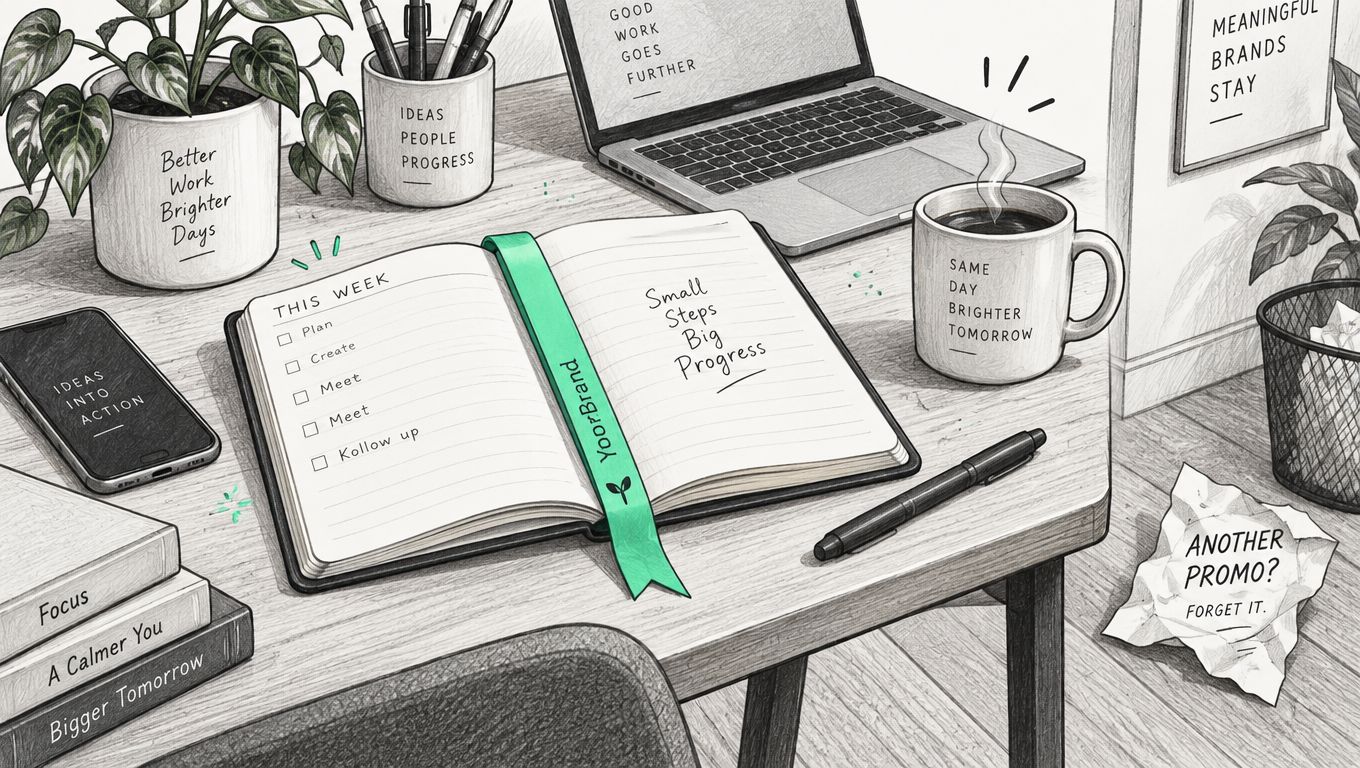
Think of a good customer gift as a small bookmark in someone's working life. It's placed where they'll see it again during an ordinary task, not waved past them once like a leaflet. The bookmark works because the page gets reopened.
The office items below show what that looks like in practice.
What Recipients Remember
A Promotional Products Association International consumer study reported that nearly 90% of recipients could remember the branding on at least one promotional item they'd received, while 80% could recall messaging from at least one item, according to the PPAI 2017 consumer study report. Roughly eight in 10 recipients had looked up the brand after receiving a promotional product, and 83% said they were more likely to do business with a brand whose product they'd received than with one they hadn't.
Recall alone isn't revenue. These are survey responses, not tracked purchases, so read them as evidence that kept items stay mentally available. A customer who can name you without prompting is easier to re-engage than one who can't, but you'll still need direct measurement to claim a commercial effect.
The Hand It On Effect
The same study found that eight in 10 consumers said they'd pass along an item if they didn't keep it themselves. A gift you miss with can still reach a colleague, a partner, or a family member, which extends exposure beyond your CRM record. That only works if the item is generically useful, though. Nobody passes on a mini trophy of your product launch.
This splits your options into two groups. Durables that survive daily use, such as apparel, drinkware, bags, and desk accessories, keep generating impressions for months. Consumables end the moment they're used, so their value sits in the moment and the message, not in repetition.
Relevance decides which group wins for a given customer. A packing cube set for someone who flies monthly will outlast a premium desk lamp they'll never plug in, even at the same price. Usefulness isn't a property of the object alone, it's a match between the object and the recipient's routine.
The operating principle is simple. For each gift, name the repeated task it joins, or don't send it.
Matching Gift Budgets to Customer Tiers
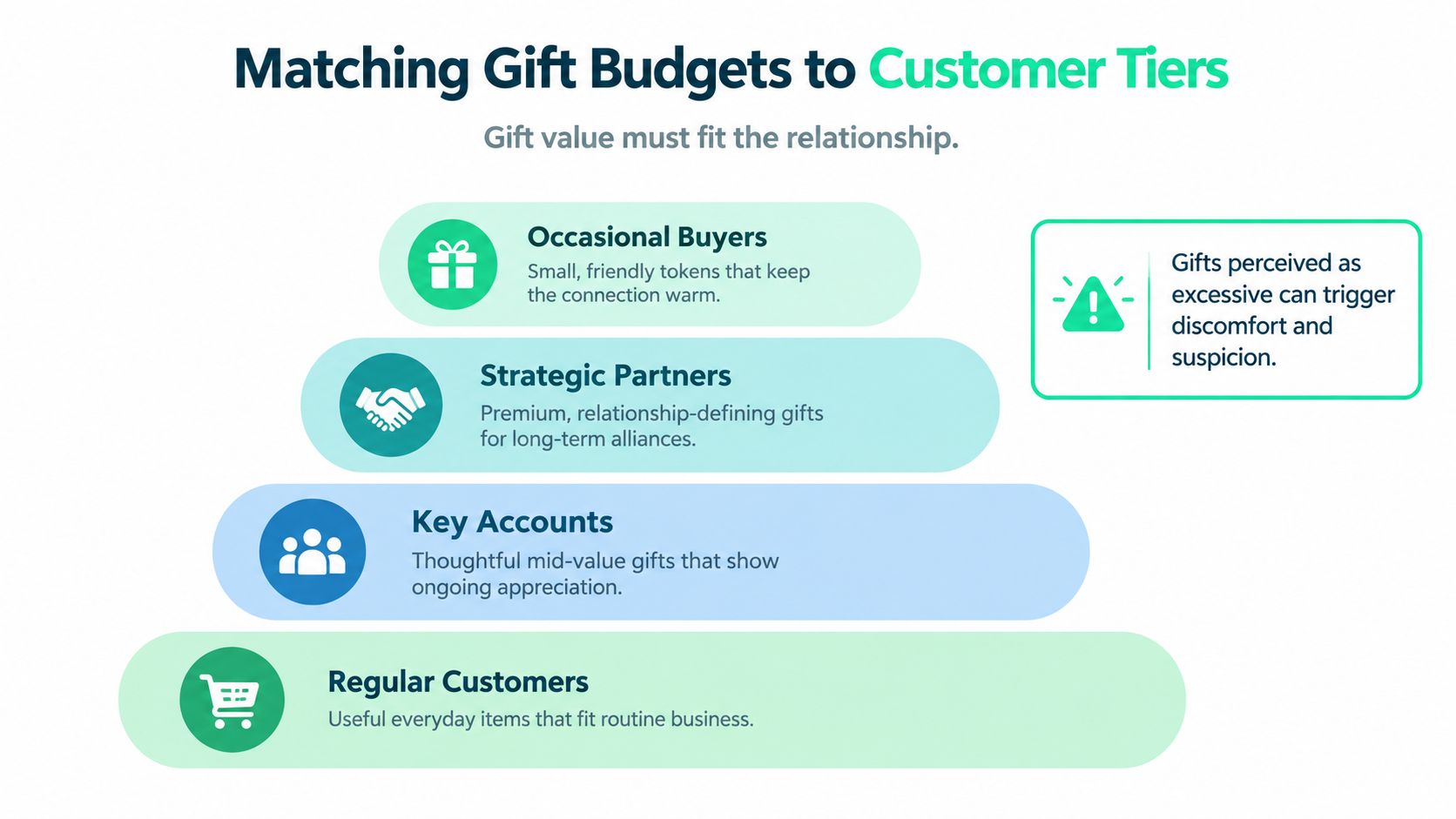
A customer gift needs a budget that fits both the relationship and the rules behind the decision. A 2024 randomized field experiment, supported by four laboratory studies, found that appropriately calibrated gifts can improve relationship performance. Gifts seen as excessive may raise suspicion, while gifts seen as inadequate may create disappointment or a sense of unfairness, according to the field experiment on calibrated business gifts. The researchers identified gratitude, suspicion, and unfairness as factors shaping reactions, and found that clear communication and customization can reduce negative responses.
Set tiers using recorded customer signals, then document why each account qualifies. That makes differences in gift value a consistent policy rather than an account lead's personal preference.
Four Tiers With Planning Ranges
| Tier | Qualifying signal | Budget per recipient (USD) | Gift approach |
|---|---|---|---|
| Broad base | All active customers with stable use | 15-40 | One useful item, such as an insulated bottle, mug, or notebook set |
| Growth | Expansion potential and rising product adoption | 20-45 | Curated choice of two or three useful items |
| Strategic | High contract value and multi-team usage | 60-150 | Premium bundle with a personal note from the account lead |
| Milestone | Renewal, anniversary, or five-year tenure | 40-120 | Item themed to the milestone with a handwritten note |
Use CRM fields to assign tiers. Contract value, tenure, product adoption, support burden, and expansion potential are workable signals because they can be checked and applied consistently. If an account needs a salesperson's judgment call to qualify, define the signal more precisely.
The shortlist should fit the recipient's work and the tier's full budget. A useful garment, travel item, notebook, or desk accessory is easier to justify than an expensive gift with no clear connection to the customer's routine. For strategic accounts with senior stakeholders, the guidance on choosing corporate gifts for executives can help shape appropriate options.
Documentation and Landed Cost
Keep the approved budget, qualifying reason, and item list together. An auditor, a new account lead, or a customer asking about a difference between gifts should get the same explanation. Include a brief note stating the occasion, and make clear that the gift does not depend on a purchase or favorable action.
Apply two overrides before approving a gift. Public-sector and regulated buyers may face gift limits, so check the applicable policy and retain the confirmation. If an account is in an active service escalation, route it to service recovery first. A premium bundle during a dispute can look like an attempt to distract from unresolved problems.
Budget by landed cost, not unit price. Include the item, branding, packing, shipping, and duties. For example, a $30 item with $8 branding and $12 shipping costs $50 landed, so it must fit a tier with room for that full amount. Teams that budget only for the item price risk exceeding the approved limit once fulfillment invoices arrive.
Letting Customers Choose Without Admin Overload
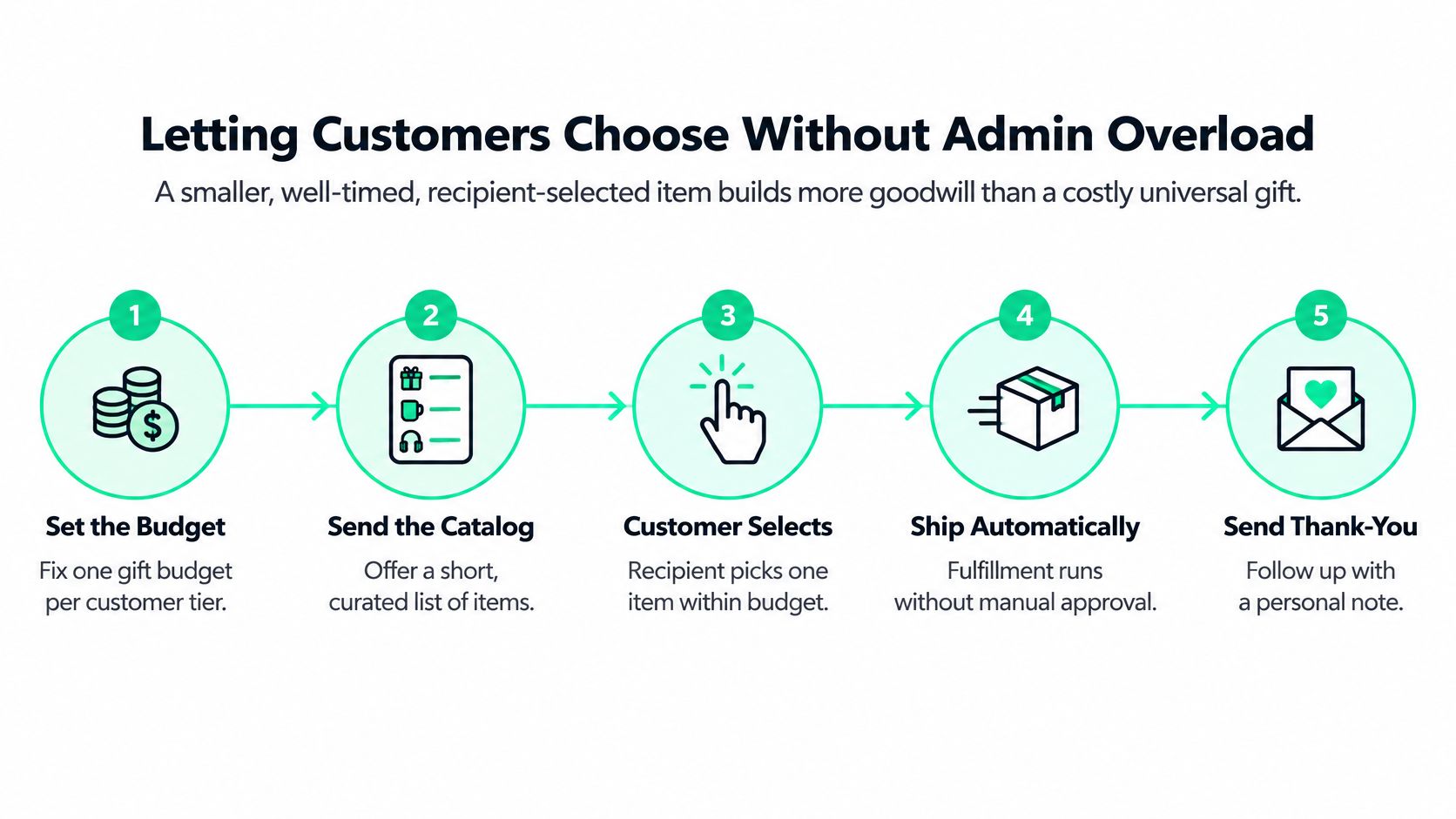
Holiday gifting already carries weight with customers. In a 2025 survey of 1,500 employed U.S. adults, 86% said receiving a holiday gift from a brand improved their perception of it, 74% said a thoughtful note made the gift more meaningful, and 58% of brand-loyalty-program customers said they wanted one, according to Snappy's 2025 survey on thoughtful holiday gifting. The hard part is relevance at scale, and letting recipients pick from a short list gets you there without interviewing each one.
The Six Step Routine
- Build a narrow choice set: Offer three to five items per tier, all inside the tier budget and all checked for sizing and local suitability. More than five slows decisions and multiplies stock problems.
- Collect only what fulfillment needs: Ask for size, colour, shipping country, and a flag for any dietary or accessibility need. Don't store free-text preferences you'll never use, because every extra field is data you now have to protect.
- Send one link with a deadline: Use a single-use link with a 14-day deadline and a short note naming the occasion. A deadline turns an open-ended chore into a two-minute decision.
- Include a way to decline: Offer a no-gift or donation option so nobody feels pressure to accept. Customers under gift policies need this exit, and offering it signals you understand.
- Ship in a fixed window: Dispatch within a set period after selection closes, and tell recipients that window in the invitation. In my experience, most "where is my gift" messages come from silence about timing, not from slow shipping.
- Default for non-responders: Assign a default item so everyone receives something, and log defaults separately in reporting. A default isn't a choice, and mixing the two inflates your redemption story.
Where Choice Programs Break
Apparel needs size guides by market, since a size that fits in one country can be labelled differently in another. Food and drink options need alcohol-free alternatives for customers whose culture, faith, or personal preference rules alcohol out, and you should check religious calendars before scheduling a send. Neither problem is hard, but both become expensive if you discover them after printing.
Delete choice records after delivery, keeping only the aggregate counts you need for reporting. A spreadsheet of customers' sizes and home addresses sitting in a shared drive is a liability that outlives the goodwill. Set the deletion date when you launch, not when someone remembers.
Timing Gifts Around Customer Milestones
Coverage fails more often than quality does. In 2025, 58% of employed U.S. adults said they wished brands would send them holiday gifts, while 68% said they'd never received one, according to Snappy's survey of 1,500 employed U.S. adults. Under-spending is rarely the cause. Programs send generously to a visible few and nothing to the customers who'd have noticed.
| Customer moment | Order lead time | Gift type | Timing risk |
|---|---|---|---|
| New-customer onboarding (weeks 1-2) | 3-4 weeks | Welcome kit with starter item | Arriving after kickoff |
| Contract renewal | 4-6 weeks, scheduled to arrive after signature | Milestone item or thank-you bundle | Landing before the contract is signed |
| Product launch or major release | 6-8 weeks | Early-access item | Sent before access is live |
| Year-end holidays | 8-10 weeks for international | Seasonal useful item | Missed customs and carrier cutoffs |
| Customer anniversary (1, 3 or 5 years) | About 4 weeks | Tenure-themed item | Wrong or outdated account records |
| Relationship recovery (once the fix is delivered) | 1-2 weeks from resolution | Simple note with a modest item | Sent while the complaint is still open |
Working Backwards From Arrival
Lead time is the gap between ordering and arrival, not between ordering and shipping. An onboarding kit ordered three weeks out that lands after kickoff has missed its only job, which is to make the first working session feel prepared. Build the calendar backwards from the date the customer should hold the item.
International sends dominate the risk. Year-end customs queues and carrier cutoffs don't move for your campaign, so eight to ten weeks is the minimum planning window. If you can't start that early, send to fewer countries well rather than everywhere late.
Moments to Skip
Don't send a gift during an active dispute, a price increase discussion, or a contract negotiation. The item doesn't change, but the timing makes it look like an incentive, and that interpretation is hard to undo.
A recovery gift is the exception that proves the rule. It works only after the incident is resolved and the customer has the fix in hand; send it earlier and it reads as an attempt to close the complaint cheaply. One to two weeks after resolution gives you distance without letting the moment go cold.
Renewals follow the same logic. Renewal gifts go out after the signature, when they're a thank-you instead of a nudge, but you can order during the negotiation so the 4-6 week lead time lands the parcel shortly after signing. The arrival date is what matters, not the order date.
Check the recipient's local holidays before fixing a send date. A parcel that arrives during a national break sits in a mailroom or gets returned, and a seasonal message that assumes the wrong holiday makes the customer feel like a list entry. Both are avoidable with one calendar check per market.
Making Sustainable Gifts Hold Up Across Markets
Picking a recycled or reusable item is the easy half. The harder question is whether the whole parcel, box, filler, labels, and delivery packaging, can be handled in each recipient's local waste system. A gift can be well sourced and still fail that test.
A premium box makes the risk concrete, as the sorting decision below shows.
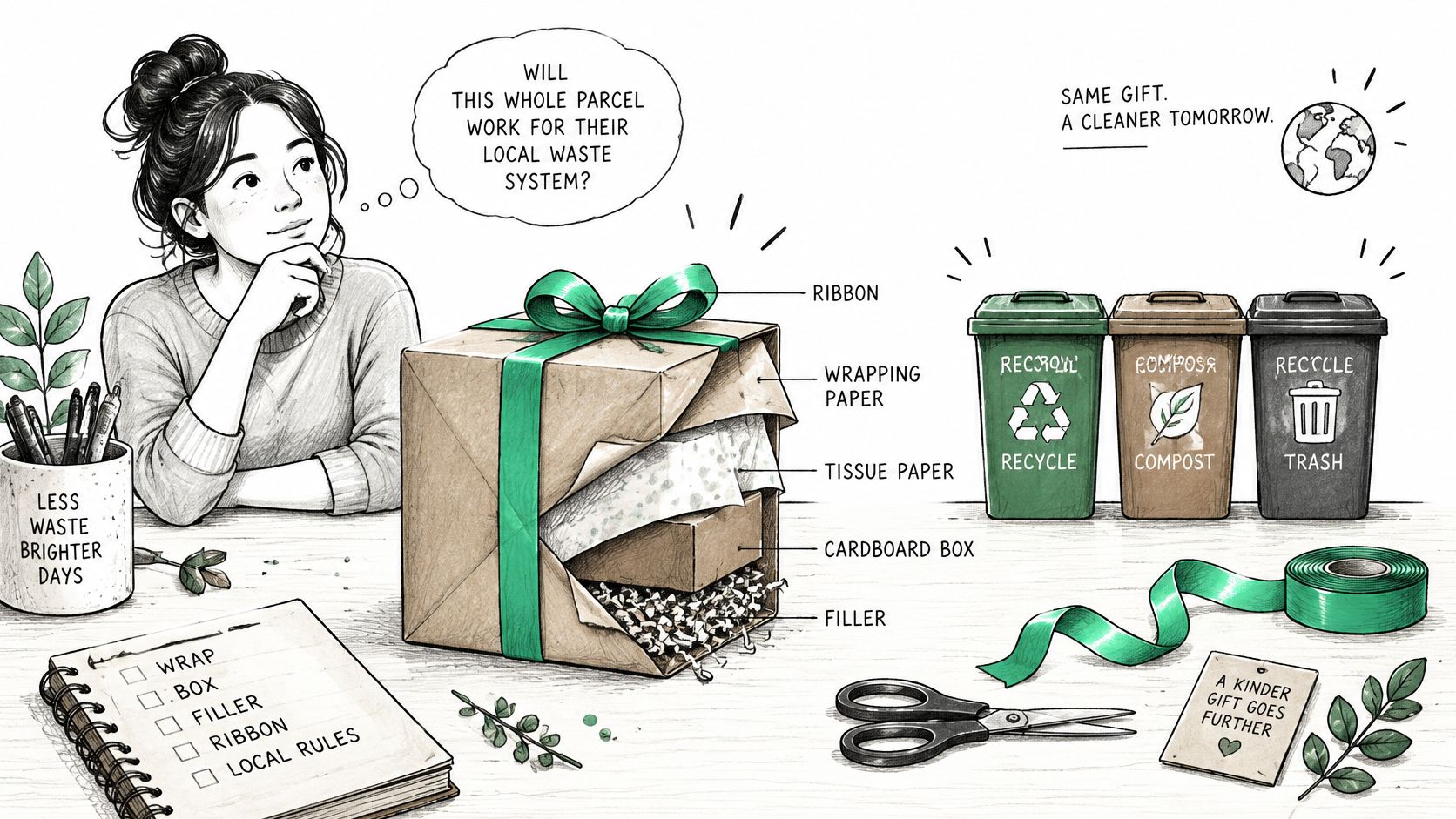
A 2025 McKinsey survey of more than 11,000 consumers across 11 countries found that 39% considered environmental impact extremely or very important when judging packaging, according to McKinsey's 2025 global survey on sustainability in packaging. The same research reported that priorities differ from country to country, so the packaging attribute that matters most in one market may rank lower in another. That variation is the practical takeaway: a single global packaging claim is hard to defend everywhere you ship.
My read of that gap is straightforward. The recipient's experience of your parcel starts with disposal, not with the item, because they handle the box first and decide where each piece goes. A premium box with plastic film, a foam insert, or non-recyclable labels can damage trust even when the gift inside is recycled, since the recipient is left holding waste they didn't ask for. Treat the packaging as part of the gift, because the customer will.
The video below is a useful prompt for checking how your own packaging reads to someone opening it.
Build a Proof and Disposal File
- Material composition: List what each component is made of, including filler, tape, and labels, not just the gift.
- Recyclability by market: Record whether each component can be recycled in every destination you ship to.
- Minimized packaging: Use the smallest mailer that still protects the item, since oversized boxes signal waste before the gift is seen.
- Claims matched to evidence: Word every claim only as far as your documentation supports, with no universal eco label.
- End-of-life instructions: Print disposal guidance on an insert in the recipient's language, so the right action doesn't depend on guesswork.
This file is also what your claims should be built from. The discipline behind credible sustainable company swag applies here too: documented specifications rather than a catalogue filter labelled green.
Be honest about the limit. A component that's recyclable in one country may not be in another, so set market-specific wording instead of one global badge. When a component can't be recycled locally, say so on the insert and tell the recipient what to do with it. Candor about one component protects the credibility of everything else you claim.
Three Customer Gift Programs and How They Measured Results
The three programs below are hypothetical composites, not reported results. Each shows how a team would structure a send and judge it, so read the figures as planning assumptions you would replace with your own. The survey evidence cited earlier in this article is real; these program numbers are not.
A Software Scaleup Onboarding New Customers
A 300-person software company sends onboarding kits to 120 new customers, each choosing a hoodie or a bottle at about $35 landed cost. The kit arrives before kickoff with a card naming the customer's implementation lead. Forty comparable customers receive nothing and form the holdout.
The team measures selection rate first, because low selection means the choice set missed. Then it compares 90-day product activation between the gifted group and the holdout. If activation doesn't move, the kit remains a nice gesture rather than an onboarding tool, and it shouldn't be budgeted as one.
An Accounting Firm With Strategic Clients
An accounting firm sends premium bundles at $100 to $150 each to 40 strategic clients after year-end work closes, each with a note from the partner who led the engagement. Matched clients of similar size and tenure receive a seasonal card only. Matching matters here, because strategic clients renew at different rates for reasons that have nothing to do with a gift.
Measurement runs on renewal and expansion over the following cycle, compared between the two groups. The firm also logs unsolicited replies. A bundle that generates thank-you calls but no difference in renewal is a relationship courtesy, which may still be worth funding from a different budget line.
A Consumer Brand Reaching Loyalty Members
A consumer brand sends a holiday drop to loyalty members with a unique QR code on the item linking to a customer community page. It measures scans by segment, repeat orders after the send, and complaint volume tagged to the drop. Complaints are the underused signal, since a gift that generates support tickets about sizing or delivery points to an operations failure in fulfilment, which calls for a different fix than changing the gift itself.
None of these measurements depend on recipients recalling the brand mark, though the recall research cited earlier in this article suggests they often do. That evidence is worth acting on in the design stage: place the mark where it stays visible in normal use, and don't ship anything flimsy. A cheap-feeling item gets discarded quickly, and it can revise what the customer thinks of you on the way out.
| Metric | What it signals | How to track it |
|---|---|---|
| Choice or redemption rate | The gift was wanted | Unique code or link per recipient |
| Delivery success | Address and logistics quality | Carrier status and returns to sender |
| QR or referral scans | The item is used beyond the box | Unique QR or UTM tag per segment |
| Account engagement at 90 days | Relationship impact | CRM activity against a holdout group |
| Renewal or expansion rate | Commercial outcome | Gifted cohort against matched control |
| Unsolicited feedback or complaints | Perceived fit and value | Support tickets tagged to gifts |
Measurement rule: Shipped isn't a result. Wanted, delivered, and used are three separate questions, and each needs its own number.
Survey-based recall evidence belongs in the upper funnel; it shows attention, and revenue needs its own test. Use holdouts or pre and post comparisons before crediting a gift with commercial outcomes. The program with the cleanest holdout design usually learns the most in a single cycle, even when its gifts are the cheapest.
Confirm Your Shortlist Before You Order
Run these five checks before you commit to a single item.
- State one objective per program, such as onboarding activation, renewal support, or holiday recognition.
- Assign customers to tiers using your recorded signals and budgets, and write down the reason for each tier.
- Confirm the choice set, the data fields you'll collect, and the deletion date for those fields.
- Verify packaging and disposal guidance for every destination market before any item is approved.
- Set the holdout group and tracking codes before the first send, not after results look promising.
Pilot Before You Scale
Start with 50 to 100 recipients across two tiers, a holdout of similar size, and a 90-day read. Change one thing based on what you learn, then scale. A pilot that size is large enough to expose sizing, address, and customs problems while they're still cheap to fix.
A managed provider can take on curation, quality checks, logistics, budgeting, and reporting. FLYP, for example, runs branded client and partner gifts as a managed service with design, production, direct shipping to recipients, personal notes, address collection, and program reporting. Whoever you use, the objective, the tiers, and the holdout stay yours, because a provider can't decide what success means for your accounts.
Ask any provider for three documents before signing, the packaging specification, the market-by-market disposal guidance, and the reporting fields they'll return to you. Then pressure-test the operational detail against practical guidance on corporate gift delivery, since most gift programs fail on addresses and timing rather than item selection.
The first gift to order is the one you can measure. If you can't name the metric, the holdout, and the decision you'll make from the result, you're buying inventory, not running a program.
If you want corporate gift ideas for customers run as a documented program rather than a seasonal order, FLYP LTD can handle design, curation, quality checks, global fulfillment, and reporting while you keep control of tiers, budgets, and measurement. Visit the site to see how a managed merch program would work for your customer base, and bring your packaging and reporting questions with you.