Many organizations don't fail at corporate gifting because they spent too little. They fail because they chose a polished item the recipient couldn't use, couldn't accept, or couldn't receive without customs, sizing, or policy problems.
Table of Contents
- Why Luxury Corporate Gifts Matter to Teams Now
- What Separates Luxury From Premium and Promotional Gifts
- Budget Bands for Each Gifting Occasion
- When Luxury Gifts Fit and When They Backfire
- Personalization and Etiquette Recipients Notice
- Compliance and Sustainability Checks Before Approval
- How to Run a Luxury Gift Procurement Process
- Pilot One Gift Program Before Scaling Globally
Why Luxury Corporate Gifts Matter to Teams Now
47% of U.S. employees said they did not receive a holiday gift from their employer in 2025, while 67% said they wished they had, according to Snappy's survey of 1,500 employed adults. That gap challenges a common assumption. The hard question usually isn't whether to give. It's what to give, to whom, and through which process.

That's a practical problem for three groups. People Ops and HR need gifts that support onboarding and recognition without creating exceptions for every manager. Global marketing and events teams need client and conference gifts that stay on brand across markets. Startups and scaleups need new-hire kits and company swag they can outsource without losing control of quality, addresses, or spend.
The Working Rule
For corporate gifts, luxury shouldn't start with a price tag. It should start with the recipient's experience. Would this person choose to keep and use the item if your logo weren't on it? Can they accept it under their employer's rules? Can you deliver it to their country, in the right size and form, without making them pay a fee or explain the package?
A luxury gift is one the recipient would choose to keep and use, presented so nobody has to guess who sent it or why.
You'll need a clear tier definition, budget bands by occasion, and a fit test before you shop. You'll also need personalization rules, compliance and sustainability checks, a procurement sequence, and a small pilot. Price matters, but it's only one part of the decision.
What Separates Luxury From Premium and Promotional Gifts
Think of gift tiers like hotel star ratings. The rating sets an expectation, but the room detail, service, and consistency decide how the stay really feels. A gift works the same way. Its tier comes from materials, craftsmanship, presentation, and use, not from price alone.
The pyramid below shows how the signal changes as you move up.
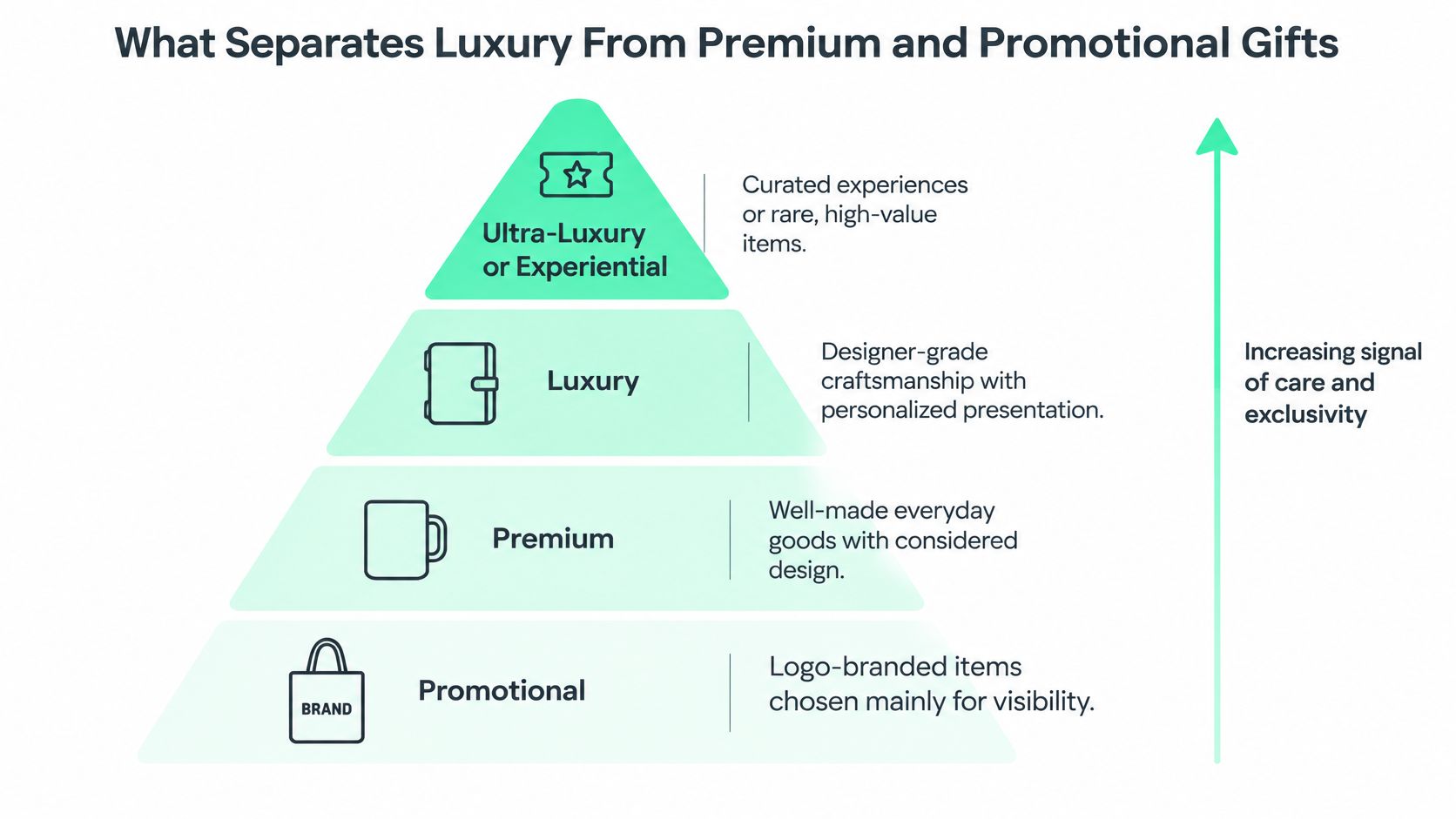
| Tier | Planning unit cost | What it looks like | Best used for |
|---|---|---|---|
| Promotional | Under $50 | Logoed everyday item in standard materials | Large event volumes and broad first-day kits |
| Premium | $50 to $150 | Better materials, clean branding, optional name | Onboarding and team recognition at scale |
| Luxury | $150 to $400 | Premium materials, visible craftsmanship, personalization and a presentation box | Recognition milestones, senior hires and key clients |
| Ultra-luxury or experiential | Above $400 | Bespoke pieces, hospitality or curated experiences | Executive partners and top-tier client relationships |
Treat those unit costs as planning benchmarks, not market prices. Check them against supplier quotes that include decoration, packaging, freight, duties, and replacements. A low product price can still become an expensive gift once you add rigid packaging and international delivery.
Three Tests That Move an Item Up a Tier
- Materials that age well: Full-grain leather, heavyweight fabric, solid metal, or dense ceramic should still look right after repeated use. Thin coatings, loose stitching, and brittle plastic pull an expensive item down.
- Craftsmanship you can feel: Clean seams, a zipper that doesn't snag, balanced weight, and engraving or embroidery that sits neatly in the material signal care in the first few seconds.
- Presentation with intent: A sturdy box, tissue that stops items rattling, and a short personal note make the gift feel chosen. A poly mailer makes the same item feel like a routine shipment.
Context matters within each tier. For example, curated barware can sit in the luxury range when it's well made and personally relevant, and collections such as personalized whiskey gift sets show how engraving and presentation change the signal. They won't suit recipients who don't drink, which is exactly why product categories can't replace recipient fit.
Consider the edge case. A $60 leather notebook that fits someone's daily meeting routine can feel more luxurious than a costly logoed bag they store in a cupboard. The notebook earns repeated contact. The bag earns storage space.
Practical rule: Price sets the ceiling. The recipient's actual use decides the tier.
Don't promote an item just because you added a larger logo or a heavier box. Move it up only when the material, finish, presentation, and likely use all improve together.
Budget Bands for Each Gifting Occasion
Start with the occasion, not the catalogue. Each trigger needs one spend band and one approval level. That prevents a tenure award, an event giveaway, and a board gift from drifting into the same product decision.
| Occasion | Spend band per recipient | Gift type that fits | Approval level |
|---|---|---|---|
| Recognition milestone (tenure or promotion) | $150 to $400 | Leather goods, quality writing set, travel piece | Manager plus People Ops |
| New-hire onboarding kit | $50 to $150 | Apparel, notebook, desk essentials | People Ops |
| Peak-project or performance recognition | $75 to $200 | Premium apparel or desk accessory | Manager plus People Ops |
| Client or partner appreciation | $100 to $300 | Curated goods or hospitality | Account lead plus Finance |
| Executive or board-level gift | Above $400 | Bespoke item or experience | Executive sponsor plus Compliance |
| Event or conference attendee | Under $75 | Premium apparel or keepsake | Events lead |
| Life event (new baby, bereavement) | $50 to $150, capped by HR | Thoughtful keepsake, always optional | HR discretion within a set cap |
The recognition band has a specific reference point. MarketIntelligence's luxury stationery corporate gifting report states that employee recognition accounts for approximately 21.2% of luxury stationery corporate-gifting revenue and reports higher satisfaction when organizations spend roughly $150 to $400 per employee per recognition event. Use that range as a starting hypothesis. It's directional market research, not proof that spending more causes better outcomes in your company.
Work the Cohort Cost Before You Approve It
Say you're recognizing 300 employees and set a planning point of $200 per recipient. The product budget is 300 × $200 = $60,000, before packaging, shipping, taxes, duties, and replacements. A pilot cohort of 50 recipients at the same point costs $10,000 on the same basis, which lets you test acceptance before committing the full amount.
That simple calculation changes the conversation. You can ask whether the occasion justifies the full cohort cost, whether everyone needs the same tier, and how much room remains for delivery. Senior hires, long tenure, and major client milestones may justify the top of a band. A large event usually protects the budget better by moving most recipients to premium and reserving luxury for speakers, hosts, or key accounts.
Set Your Own Bands From Evidence
Use last year's spend per occasion as your first baseline. Then compare it with acceptance, evidence of use, recipient satisfaction, returns, and replacement shipments by cohort. If a lower-cost item is used weekly and a higher-cost item is returned for size or taste reasons, the lower band is doing the better job.
Don't hide costs outside the band. State whether the band covers only the product or the full landed cost. For global programs, landed cost is the safer basis because freight, duties, address corrections, and reships can change the actual price per successful gift.
Also decide who can approve an exception and what reason they must record. Without that rule, one urgent executive request becomes next quarter's informal standard. Bands work because they make trade-offs visible before purchase orders are signed.
When Luxury Gifts Fit and When They Backfire
Say a 40-person engineering team receives leather travel kits at five-year tenure milestones. The kits work because the trigger is clear, the item supports regular travel, and the milestone makes the higher spend legible to everyone. Recipients don't need to wonder whether the gift is a reward, a sales tactic, or a leftover from an event.
Now change the context. A vendor sends a premium bottle to a client contact during a competitive bid. The client's employer bans gifts above a set threshold, and nobody checked the policy first. The recipient must decline or return it, and a gesture meant to build trust creates paperwork instead.
A third pattern appears in global programs. Headquarters sends one luxury food and apparel box to offices in five countries. Sizes differ, some items conflict with dietary or religious requirements, and one shipment attracts customs questions. A curated choice set, sourced or filtered by market, would've given recipients a usable option without lowering the perceived care.
Why Brand Familiarity Helps but Doesn't Decide
Seventy-seven percent of U.S. employees surveyed in 2025 said they would value an employer gift more if it came from a trusted or premium brand, according to Custom Ink's survey of 1,051 adults. A recognizable maker can reduce doubt about quality. It can't fix the wrong size, a prohibited product, or poor timing.
Use this three-question fit test before you approve a luxury item:
- Will they use it within a month? Name the routine it enters, such as commuting, note-taking, travel, or desk work.
- Does it match their role and location? Check climate, size, language, accessibility, dietary needs, and local customs rules.
- Are they allowed to accept it? Confirm both your gift policy and the recipient employer's policy, especially during bids, audits, renewals, or regulated work.
Backfire signals are easy to miss when a product looks impressive in a sample room. Watch for gifts that require an app or subscription the recipient didn't ask for, apparel with no size choice, alcohol sent without a profile that supports it, and personalization that can't be corrected if a name is wrong.
Timing can also turn a sound gift into a questionable one. Don't send high-value items while the recipient is scoring your proposal, approving your invoice, or investigating a complaint. If the occasion and the commercial decision overlap, delay the gift or choose a modest team-level gesture that policy clearly permits.
Personalization and Etiquette Recipients Notice
Personalization works best as a ladder. Each step adds emotional value, but it also adds data risk, production time, and the cost of getting one detail wrong.
- Level 1, brand only: Use a quiet tonal logo, small embroidery, debossing, or branding on the box and card rather than across the product.
- Level 2, name or milestone: Add the recipient's name, promotion, or tenure year after checking it directly against HR or CRM records.
- Level 3, role or location: Add a team, site, or project detail only when it will still make sense if the person changes roles.
- Level 4, recipient choice: Let the person select size, color, or one item from a curated set within the approved band.
Engraving needs particular care because errors are permanent. If you're considering metal pieces, guidance on personalising titanium gifts with logos can help you think through placement and legibility before production. Whatever the material, proof names character by character and don't use personal data beyond what's needed for the gift.
The recipient should never have to guess who sent the gift or why.
Send the gift with a note from a named sender. Two specific sentences work better than a generic thank-you card. Name the milestone, contribution, or partnership moment, then stop. Don't turn the note into a product pitch.
Time delivery to the occasion. A promotion gift that arrives three weeks late needs an explanation, while a plain message on the day can carry the moment until the item arrives. Remove price tags, discount labels, supplier invoices, and promotional inserts before the box is sealed.
Etiquette also means offering a graceful alternative. For food, provide a non-food option. For apparel, collect size and fit through a private choice link. For scented, alcohol-based, or physically demanding experience gifts, don't infer suitability from job title or location. Ask through optional profile fields or offer a set that includes neutral choices.
Senior recipients often need a more discreet approach. If you're planning gifts for executive recipients, keep branding subtle, avoid public ranking by gift value, and route the approval through the appropriate sponsor. Peers may enjoy a shared unboxing. A board member or client executive may prefer a quiet delivery and a short private note.
Do confirm spelling, address, size, and acceptance rules before production. Don't guess a home address, print a nickname you found on social media, or personalize an item so specifically that it can't be exchanged when your source data is wrong.
Compliance and Sustainability Checks Before Approval
Sustainability is now part of the specification, not a sentence you add to the gift card. Research in the MarketIntelligence luxury corporate gifting report reports that 64% of corporate purchasers prioritize eco-certified materials. Certification helps because Procurement and ESG teams can verify origin, labor practices, and supplier governance instead of relying on an unsupported claim.
| Check | What to verify | Owner |
|---|---|---|
| Gift policy limit | Recipient employer's rules and your own gift threshold | Compliance |
| Eco-certification | FSC, Fair Trade or B Corp records, requested as documents not claims | ESG or Procurement |
| Packaging weight | Rigid packaging weight against product weight and recyclability | Procurement |
| Cross-border shipping | Permitted items, declarations, duties and who pays them | Logistics |
| Recipient data | Consent to store addresses, sizes and dietary details | People Ops or Privacy |
| Utility and use | Likely repeat use compared with a disposable alternative | Marketing or People Ops |
| Market claims | Environmental wording approved for each country | Legal or Marketing |
Why Each Check Changes the Purchase
Gift policy limits come first because an unusable approval trail can force a return. Record the recipient category, value, occasion, business reason, and approver. Client and public-sector gifts need extra care.
Certification records should be documents with scope and expiry dates, not logos copied into a sales deck. Ask which product, factory, or material the certificate covers. A supplier-level credential doesn't automatically prove that every item in your order meets the same standard.
Packaging weight deserves its own line because presentation can undo a careful product choice. Customized luxury packaging can add cost, freight weight, and waste. Compare the packaging weight with the product weight, check whether the recipient can recycle it locally, and remove inserts that don't protect the item.
A durable gift only performs better than a disposable one when someone actually uses it. That's the lifecycle point many buyers miss. A premium jacket worn weekly can justify its footprint over time. The same jacket in the wrong size, shipped twice across an ocean and stored unused, cannot. This is why recipient choice and fit data belong in a discussion of more sustainable company swag, alongside materials.
For market claims, keep a simple claims matrix. List the exact environmental wording, the evidence behind it, and the countries where Legal has approved it. Don't use universal language across jurisdictions unless the documentation supports it everywhere.
Finally, name an owner and a completion date for every row. Approval shouldn't depend on one person remembering a side conversation. Request primary records, compare landed cost plus impact, and make the premium earn its place before you sign.
How to Run a Luxury Gift Procurement Process
A reliable process makes luxury feel effortless to the recipient. The work happens earlier, in sourcing, approvals, data checks, and delivery planning. One industry report linked through ABC17 News coverage of luxury gifting claims employee recognition led corporate gifting occasions at 66%, ahead of client and partner appreciation at 52%. As gifting becomes year-round, you need an operating system rather than a series of urgent orders.
The first two decisions shape everything that follows.
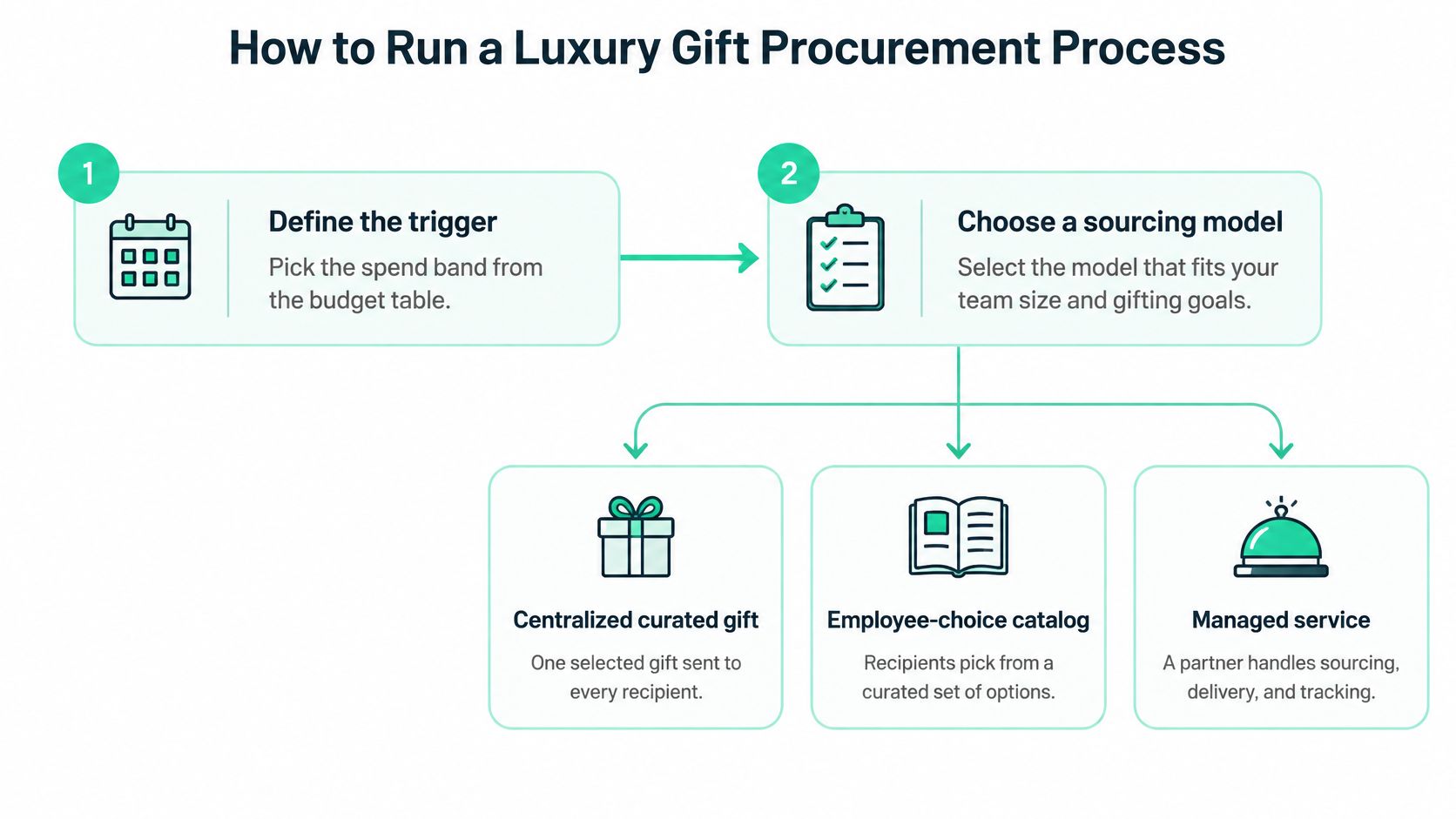
| Sourcing model | Best for | Main risk | Approval effort |
|---|---|---|---|
| Centralized curated gift | Single-market events and uniform kits | Size, dietary and customs mismatches across markets | Low |
| Employee-choice catalog | Multi-market recognition with varied needs | Budget overrun without catalog caps | Medium |
| Managed service (curation, QA, logistics, returns) | Global programs needing one accountable vendor | Vendor fee transparency and lock-in | Medium |
Seven Steps From Trigger to Delivery
- Define the trigger and band. Write down the occasion, eligible recipients, spend band, and required delivery window. This stops product browsing from setting the budget.
- Choose the sourcing model. Use one curated gift only when needs are genuinely uniform. Use a choice catalog when size, location, or preference varies. A managed service such as FLYP LTD can handle curation, quality checks, logistics, budgeting, and reporting as one option among direct suppliers and catalog providers.
- Request samples and a landed-cost quote. Handle the actual decorated item, not a blank substitute. Require product, personalization, packaging, freight, duties, taxes, address corrections, returns, and replacements in the quote.
- Run the pre-approval checks. Confirm gift limits, certifications, packaging, claims, data consent, and destination restrictions before artwork is finalized.
- Set one approval workflow. Name one accountable sign-off and record the business reason for each recipient group. Separate requester and approver for higher bands.
- Confirm recipient data and consent. Collect delivery address, size, and relevant preferences directly and privately. State how long you'll retain the data and who can access it.
- Order with a buffer. Build in production, personalization proofing, international freight, customs clearance, and replacement time. Don't promise a milestone date until Logistics confirms the route.
Step 3 is where cross-border problems should be solved. Remove restricted items from a destination's catalog instead of shipping them and hoping they clear. Name the importer of record in the quote, because that party usually bears duties and taxes unless the contract states another arrangement. If the recipient would have to pay to receive the gift, redesign the shipment.
Capture dietary, religious, cultural, and accessibility needs as optional fields the recipient controls. Never infer them from a name, country, or photograph. Record consent to store addresses and sizes before an order is placed, and give recipients a way to update details without emailing a broad internal list.
The video below is useful when you need to align stakeholders on the operational side of sourcing before samples are ordered.
If an item is blocked in one market, switch that market to local fulfillment or an approved local equivalent. If a sample feels flimsy, change the item, not the budget. If choice catalog prices drift, cap each selection at the band and remove products that need constant exceptions.
Good supplier questions reveal operating maturity. Ask who checks decorated samples, how address errors are handled, what evidence of delivery you'll receive, and which fees appear only after shipment. For client programs, it also helps to understand how teams strengthen client relationships through thoughtful gifts without making every touchpoint feel like a campaign. Then compare that intent with your workflow for sourcing corporate gifts through an online program, where consistency and tracking matter as much as the product shortlist.
Pilot One Gift Program Before Scaling Globally
Scale only when acceptance and use beat your baseline and the actual cost per recipient stays inside the band. That's the rule. A polished launch across every country makes it harder to learn which item, market, or delivery route caused a problem.
Choose one trigger, one region, and one full recognition cycle. Run the pilot with 50 to 100 recipients, then compare the results with a previous cycle or a similar cohort. Keep the band, note, and approval process stable so you can interpret the outcome.
What to Measure
- Acceptance and choice: How many recipients accepted the gift or completed a choice link?
- Evidence of use: Can you track repeat wear, repeat use, or a credible self-reported proxy without intrusive monitoring?
- Failure costs: What were the return, replacement, address-correction, and reship rates?
- Impact inputs: What were packaging weight, shipping distance, and the share of gifts left unused?
- Recipient response: What did a short satisfaction survey say about quality, fit, timing, and presentation?
- True unit cost: Did the landed cost per successful gift stay inside the approved band?
If use is low, don't automatically raise the budget. Move the item up or down a tier, change the product category, improve size choice, or narrow the audience. A returned or unused gift is the most expensive outcome because you paid for production and freight without creating the intended recognition.
Turn the result into action this quarter. Write a one-page brief with the trigger, band, approval owner, checks, data fields, and success measures. Get sign-off from People Ops and Finance, then request two comparable quotes, including one managed option if global delivery is part of the scope. You'll learn more from one disciplined pilot than from a larger order built on taste alone.
If you're planning a pilot and want curation, brand-safe design, global fulfillment, address collection, and reporting handled in one managed workflow, visit FLYP LTD to explore how your team could run the program. Bring your trigger, recipient count, markets, and spend band, and use them to request a concrete proposal you can compare against your current supplier.