A manager sends a cheerful message after a difficult project: great job on the project! The employee replies with thanks, the team moves on, and by Friday nobody remembers what the praise was for. The intention was good. The message just didn't name anything worth remembering.
That's the problem with generic recognition. It acknowledges effort without explaining what the employee did, who benefited, or which behavior the organization wants repeated. In Gallup's foundational workplace recognition research, only about one in three U.S. employees strongly agreed in 2016 that they'd received recognition or praise for good work during the previous seven days. A thoughtful annual award won't replace regular, specific appreciation.
A useful write-up connects an observable action to an outcome. It can also reinforce a company value, document a contribution for a performance review, or accompany a gift chosen by the recipient. It doesn't need inflated language, and it shouldn't turn every helpful act into an award submission.
- For everyday contributions, keep the message short and close to the work.
- For milestones and formal awards, add context, evidence, and shared credit.
- For any format, match the delivery to the employee's preferences.
These employee recognition write up examples cover peer-to-peer thanks, manager recognition, service milestones, and formal nominations. Each includes adaptable wording, the reason it works, the right occasion, and a tactical adjustment that makes it personal rather than copied.
Table of Contents
- 1. STAR-Format Recognition Write-Up
- 2. Company Values Recognition Write-Up
- 3. Peer-to-Peer Kudos Message
- 4. Service Milestone and Anniversary Write-Up
- 5. Customer Impact Recognition Write-Up
- 6. Team Project Award Nomination Write-Up
- 7. Handwritten Gratitude Note Paired with a Branded Gift
- 8. Public Company-Wide Recognition Post
- Recognition Write-Up Formats at a Glance
- Turning Write-Ups Into a Recognition System
1. STAR-Format Recognition Write-Up
Use Situation, Task, Action, and Result when the contribution needs more explanation than a quick thank-you. The structure helps a manager separate what happened from what the employee did.
Say a program manager rescued an onboarding-kit delivery after a supplier changed its production schedule. An adaptable write-up would read:
When a supplier delay threatened the onboarding-kit rollout, Elena was responsible for keeping deliveries aligned with new-hire start dates. She renegotiated the production sequence, confirmed regional shipping requirements with logistics, and gave People Ops a revised dispatch plan. The kits arrived before the incoming employees started, allowing their managers to focus on welcoming them rather than resolving missing deliveries. Elena demonstrated ownership by addressing the risk and keeping the affected teams informed.
Why it works and when to use it
The write-up distinguishes responsibility from action. Elena didn't just manage the project. She changed the production sequence and coordinated the response.
Use this format for complex work, award nominations, and contributions that may later support a performance review. It's less suitable for an everyday favor, where a formal narrative can sound disproportionate.
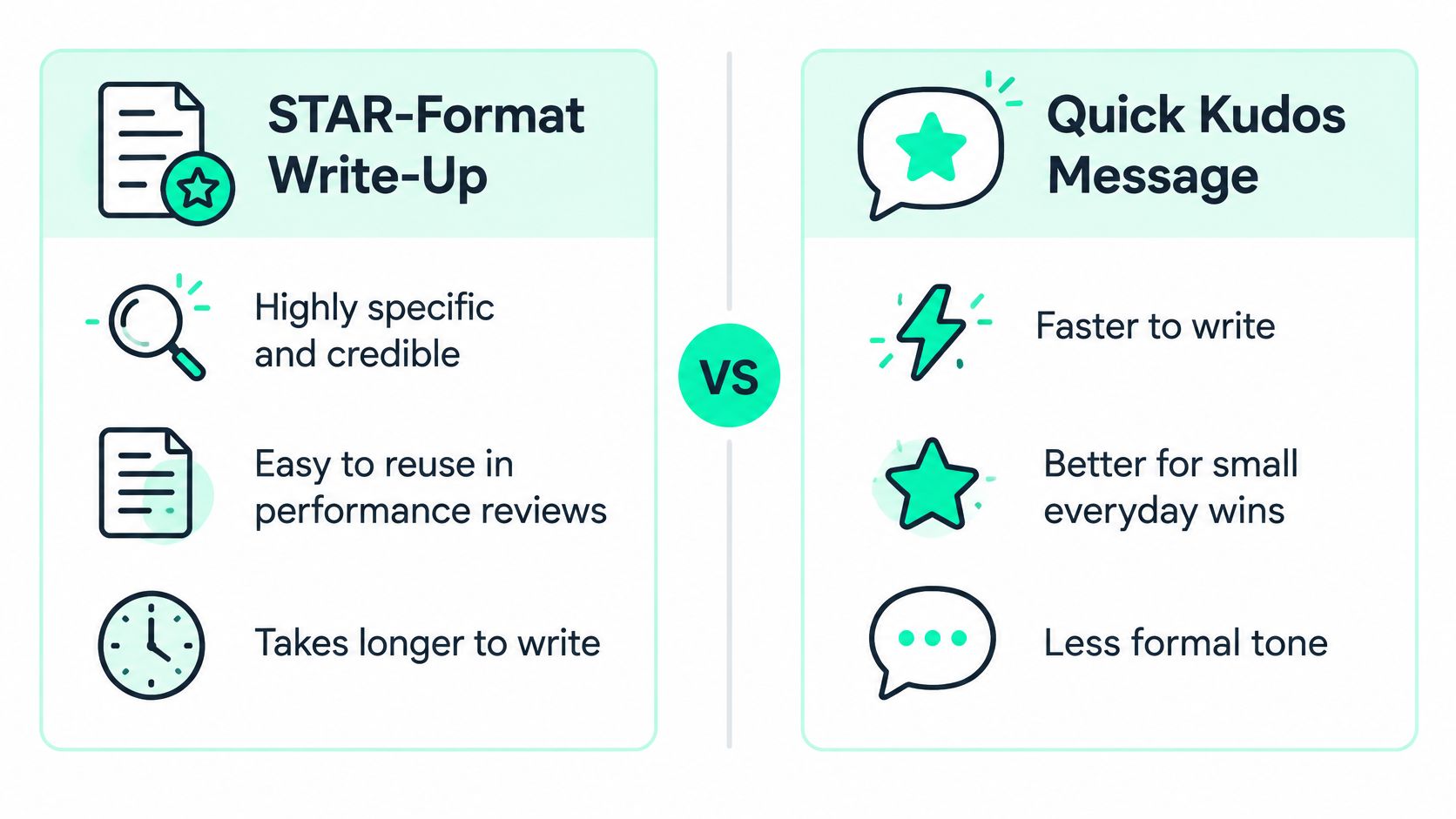
Tactical takeaway: Draft the Action sentence first. If it contains only words such as led, supported, or managed, ask what the person changed, decided, built, or resolved.
Save the approved version in an access-controlled recognition folder or the employee's review record. Don't put sensitive customer details or commercial terms in a broadly shared document.
Evidence rule: A clear stakeholder outcome is better than a performance number you can't verify.
2. Company Values Recognition Write-Up
A company value becomes useful when employees can connect it to a decision. Recognizing someone for collaboration without describing the collaboration adds little beyond the label.
Suppose your published value is Own the outcome, and a support lead follows a customer issue through several internal handoffs. The message could read:
Amara demonstrated our value of Own the outcome by staying accountable for a customer's unresolved shipment issue after it moved from support to logistics. She maintained a shared update, confirmed who owned each next step, and checked with the customer after delivery. Her follow-through meant the customer didn't have to restart the explanation with every team. Thank you, Amara, for making ownership visible through clear communication and a confirmed resolution.
Why it works
The message defines ownership through behavior rather than personality. Employees can repeat the useful actions: clarify responsibility, maintain updates, and confirm resolution.
That emphasis on quality matters. In a Gallup–Workhuman longitudinal study, employees whose recognition met at least four strategic quality criteria were 65% less likely to be actively seeking or monitoring for another job. The finding supports thoughtful recognition, not attaching a value badge to more messages.
When to use it: Choose this format when the behavior illustrates an actual published value, especially where employees faced a trade-off. Don't force every achievement into the same popular category.
Tactical takeaway: Use the exact wording of the value, then spend the rest of the message on evidence. Ask whether a colleague could identify the value from the action even if you removed its name.
Review which values receive attention across your recognition program. A culture that celebrates speed but never recognizes careful prevention sends an incomplete message about what matters.
3. Peer-to-Peer Kudos Message
Priya, thank you for rebuilding the event checklist and adding the supplier handoff notes before the conference. Marketing could confirm the final assets without chasing separate email threads, and the events team had a clear packing reference. Your documentation made the preparation easier for everyone involved.
That's enough for a useful peer message. It names the work, explains the benefit, and sounds like a colleague rather than an awards committee.

Keep it easy to send
Why it works: Peers can describe help that a manager may not observe, including troubleshooting, documentation, and thoughtful handoffs. They don't need to prove company-wide impact to make the appreciation worthwhile.
When to use it: Post in Slack, Microsoft Teams, or an internal recognition feed when the contribution is appropriate to share. Send it privately if the recipient dislikes public attention or the work involves confidential information.
For adaptable wording, use these employee recognition messages, then replace broad praise with the action you benefited from. Pure Write's workplace communication guide is a useful companion for reviewing how appreciation fits into everyday workplace communication.
Tactical takeaway: Give employees a simple prompt: describe what the colleague did and why it helped. Don't require them to select an award category or calculate financial value before saying thanks.
People Ops should also review who participates. A busy kudos channel can still overlook remote colleagues, quiet specialists, and employees whose work happens outside headquarters' working hours. Encourage cross-department appreciation, but don't turn sending praise into a quota.
4. Service Milestone and Anniversary Write-Up
An anniversary date tells you when to recognize someone. It doesn't tell you what to say.
A milestone message should acknowledge the employee's history without reading like an automatically generated tenure certificate. For a colleague who has developed the onboarding process, try:
Happy work anniversary, Daniel. Your contribution goes well beyond keeping the onboarding calendar moving. You've turned recurring new-hire questions into practical guidance, helped managers prepare for incoming colleagues, and made room for people to ask questions without feeling behind. Thank you for the care you bring to those early experiences and for sharing what you've learned with the team.
Personalize the contribution, not just the name
Why it works: The message recognizes the employee's accumulated contribution, including work that may never appear on a project dashboard. It says more than how long they've remained employed.
When to use it: Use this approach for service anniversaries, promotion milestones, or another planned career moment. Keep performance awards separate so employees don't have to demonstrate exceptional results to receive a consistent service acknowledgment.
These employee recognition ideas for years of service can help connect the message with an appropriate anniversary experience.
- Manager input: Ask for a specific contribution and something colleagues appreciate about working with the recipient.
- Recipient preference: Confirm whether they want a public announcement, private note, or team celebration.
- Gift choice: Offer meaningful options rather than assuming everyone wants the same item.
Tactical takeaway: Automate the reminder, but require the manager to personalize the message before it's sent. Keep an escalation owner for missing submissions so the anniversary doesn't pass unnoticed.
A milestone should recognize someone's contribution, not imply that their greatest achievement was staying.
5. Customer Impact Recognition Write-Up
Customer praise is useful evidence, but it shouldn't be the only route to recognition. The employee who fixes the underlying process may contribute as much as the colleague who receives the thank-you.
Consider a customer success manager who coordinates an urgent replacement shipment:
Leila, thank you for taking ownership of the replacement delivery when the customer's original order couldn't arrive in time for their event. You confirmed the requirement, worked with the warehouse on an available alternative, and kept the customer informed until delivery was confirmed. Your clear updates helped the customer make decisions without repeatedly chasing us. Thanks also to the warehouse and logistics colleagues who made the revised dispatch possible.

Recognize the resolution and the prevention
Why it works: The message connects the employee's actions to a customer need without claiming that they single-handedly saved the relationship. It also acknowledges the colleagues behind the visible interaction.
When to use it: Choose this format after a resolved complaint, a helpful implementation, or verified customer feedback. It also suits internal service teams when the beneficiary is a colleague rather than an external customer.
Tactical takeaway: Verify the outcome against the support ticket or delivery record before publishing. If you include customer feedback, use their actual words, remove unnecessary identifying details, and obtain permission before sharing externally.
Don't make emergency rescues the only customer work you celebrate. Recognize the person who improves order checks, clarifies confusing instructions, or prevents repeated escalations. Otherwise, managers risk praising the recovery while overlooking the work that makes recovery unnecessary.
6. Team Project Award Nomination Write-Up
Formal nominations need enough evidence for someone outside the project to understand the achievement. Enthusiasm alone won't help a panel compare submissions fairly.
For a cross-functional event project, a nomination might read:
The regional launch team deserves recognition for replacing fragmented event-kit ordering with a shared planning and approval process. Marketing defined the asset requirements, procurement aligned supplier commitments, logistics confirmed dispatch constraints, and regional coordinators validated local needs. The team delivered approved kits for the launch and left behind a reusable process for future events. Their achievement was both the completed rollout and a clearer operating model that other teams can adopt.
Make the nomination assessable
Why it works: The submission identifies the project, explains each function's contribution, and distinguishes the immediate result from the lasting improvement.
When to use it: Use this format for panel-reviewed awards, cross-functional achievements, and nominations where the decision-makers don't know the contributors personally. A standardized employee appreciation form helps collect comparable evidence rather than rewarding whoever writes the most polished nomination.
Recognition shouldn't default to the most senior participants. A Harvard Business School analysis of the Bravo! recognition program found that 71% of awards went to Grades 7–9, representing many individual contributors and early-career managers.
- Evidence to verify: Approved project outcomes, stakeholder feedback, and the process handed over.
- Credit to check: Coordinators, contractors, regional colleagues, and supporting specialists.
- Criteria to address: Explain explicitly how the project meets the published award requirements.
Tactical takeaway: Ask the project lead to validate the contributor list before submission. Include behind-the-scenes work by role, and name individuals where the award format permits it.
For an experiment that didn't succeed, recognize the disciplined testing and documented learning. Don't describe an unsuccessful outcome as a commercial win.
7. Handwritten Gratitude Note Paired with a Branded Gift
A handwritten note is useful when the manager wants the recognition to feel personal rather than broadcast. A gift can accompany it, but the message still needs to carry the meaning.
After a product launch, a leader might write:
Sam, thank you for turning the launch decisions into clear handover notes. Support colleagues could answer customer questions without retracing the team's discussions. Your care for the people taking over the work made the launch easier to support.

Let the gift support the message
Why it works: The note identifies a contribution the recipient can recognize as their own. It also gives the leader room to acknowledge quiet, useful work without making a public announcement.
When to use it: Choose this format after a meaningful contribution, a sustained period of support, or a milestone the employee prefers to mark privately. It can work for distributed teams, provided the delivery method respects the employee's location and preferences.
Tactical takeaway: Draft the note before selecting the item. If the message could accompany any employee's gift, it needs a more specific detail.
Let recipients choose sizes, colors, or an alternative where possible. Check delivery arrangements discreetly, and don't assume the home address in an old spreadsheet is appropriate to use.
Gift boundary: Merchandise is an acknowledgment, not a substitute for pay, workload support, or a promotion someone has earned.
For larger programs, assign clear owners for address handling, fulfillment, and delivery exceptions. The manager should remain responsible for the recognition itself, even when an operations team handles the package.
8. Public Company-Wide Recognition Post
Before drafting an all-hands announcement, ask the employee whether they want that visibility. Public recognition isn't automatically more meaningful than a private message.
For an operations manager who improves international fulfillment, a post could read:
Today we're recognizing Morgan for redesigning the warehouse picking handoff for international orders. Morgan mapped the recurring exceptions with warehouse colleagues, updated the picking guidance, and worked with regional teams to clarify destination requirements. Staff now have a clearer process for preparing these orders and escalating exceptions. Thank you, Morgan, and the warehouse and regional colleagues who tested the changes, for making the process easier to follow.
Give visibility without exaggeration
Why it works: The announcement explains a contribution to readers who don't know the operational details. It gives Morgan appropriate visibility while acknowledging the collaborators who helped implement the change.
When to use it: Publish through an all-hands meeting, company newsletter, or intranet when the contribution offers a useful example for the wider organization. Don't publish confidential customer details or unverified performance claims just to make the story sound bigger.
The O.C. Tanner State of Recognition overview emphasizes understanding employee recognition preferences rather than assuming a symbolic award or generic acknowledgment will suit everyone.
Tactical takeaway: Send the recipient a draft before publication. Confirm their name, role, photo permission, contribution, and preferred level of detail.
Review the distribution of company-wide recognition across functions, locations, and working patterns. Managers should also ask whether employees believe credit reaches the people who did the work, an issue included in SurveyMonkey's employee-engagement question guidance.
Pair the announcement with a personal message. The company post explains the achievement to everyone else; the private note lets the manager say why they appreciate the person's contribution.
Recognition Write-Up Formats at a Glance
| Item | Best For | Length | Formality | Effort to Write |
|---|---|---|---|---|
| STAR-Format Recognition Write-Up | Evidence-based recognition for reviews or nominations | Typically 100–200 words | Formal | High |
| Company Values Recognition Write-Up | Reinforcing a specific company value | Short, usually a few sentences | Semi-formal | Moderate |
| Peer-to-Peer Kudos Message | Quick recognition of a colleague's helpful action | Typically 1–3 sentences | Informal | Low |
| Service Milestone and Anniversary Write-Up | Recognizing tenure and long-term contributions | Brief to moderate | Semi-formal | Low to moderate |
| Customer Impact Recognition Write-Up | Celebrating work that improved a customer's experience | Brief to moderate | Semi-formal | Moderate |
| Team Project Award Nomination Write-Up | Nominating major project achievements for an award | Often 300–500 words | Formal | High |
| Handwritten Gratitude Note Paired with a Branded Gift | Personal, tangible appreciation for a contribution | Short, under 50 words | Warm and personal | High |
| Public Company-Wide Recognition Post | Giving company-wide visibility to an achievement | Brief to moderate | Semi-formal to formal | Moderate |
Turning Write-Ups Into a Recognition System
Match the format to the occasion, not the other way around. A helpful handoff deserves a timely thank-you, not a nomination form. A major cross-functional achievement needs more evidence than a celebratory line in Slack, while an anniversary needs personal context rather than a generic congratulations.
Across every format, keep the same foundation: specific action, credible impact, and appropriate delivery. Add a company value when it clarifies the contribution. Include a metric only when someone can verify it, and recognize a useful stakeholder outcome when a number would be artificial.
The stakes extend beyond wording. In a Gallup–Workhuman longitudinal study tracking nearly 3,500 employees from 2022 through 2024, well-recognized employees were 45% less likely to have left their organization after two years. That association doesn't mean a template causes retention, but it gives People teams a reason to treat recognition as an ongoing management practice.
Separate automation from appreciation
Automate predictable administrative work while keeping managers accountable for the message. An HRIS can identify an anniversary; it can't explain why a colleague's mentoring mattered to the team.
Build the workflow around clear ownership:
- People Ops owns the rules: Define eligibility, milestone treatment, approval requirements, and recipient preferences.
- Managers own the substance: Verify the action, explain its impact, and acknowledge collaborators.
- Program administrators own delivery: Monitor missed triggers, gift exceptions, and incomplete messages.
- Program leaders review fairness: Examine who sends and receives recognition, not just how many awards are issued.
For the gifting component, we at FLYP LTD can trigger employee recognition gifts from HRIS data, with credits dropping automatically into employee balances when new-hire, anniversary, or promotion milestones fire. Employees redeem those credits in a curated, brand-safe employee-choice store, so a personalized write-up can accompany a gift the person chooses.
Keep discretionary recognition separate from milestone automation. Employees shouldn't have to wait for an anniversary to hear that their work mattered, and managers shouldn't need a gift budget to express genuine appreciation.
Start this week: pick a pair of formats that fit your team's most common recognition moments, draft a reusable template, and have a manager personalize it around a verified contribution. Then configure the relevant gifting trigger and assign someone to review exceptions, so automation supports the moment without replacing the human message.
FLYP LTD offers HRIS-triggered recognition gifting and employee-choice stores where staff redeem allocated credits against a curated, brand-safe catalogue. Visit FLYP LTD to connect your milestone write-ups with a gifting workflow and give your team a clear process for onboarding, anniversary, and promotion recognition.